
Episode 170 · October 31, 2024 · 55 min
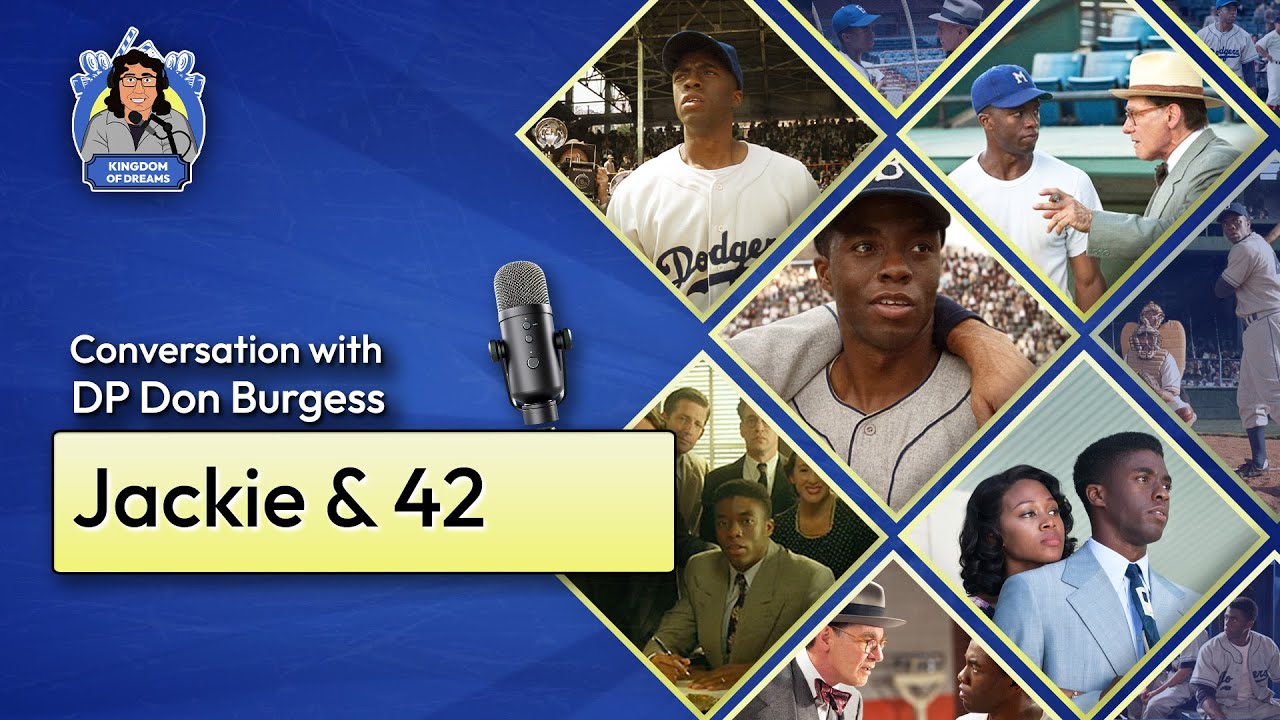
'42', Cinematographer, Don Burgess
Clips and Shorts from this episode
About this episode
Acclaimed cinematographer Don Burgess dives into the intricate process behind bringing the legendary story of Jackie Robinson to the screen. Reflecting on powerful scenes, like the Ben Chapman confrontation, and sharing unique insights into his collaboration with director Brian Helgeland, Burgess unveils the creative journey of capturing Robinson's resilience and triumph.
The podcast "Kingdom of Dreams" offers an exclusive behind-the-scenes look at cinema and the art of storytelling, featuring interviews with industry professionals such as screenwriters, directors, animators, and producers. Tune in to hear more about the making of '42,' with standout performances by Chadwick Boseman and Harrison Ford, and discover how Burgess's vision shaped this cinematic tribute.
#directorofphotography #cinematiclighting #visualstorytelling #brianhelgeland #visualstorytelling
Full transcript
Automatically generated from the episode audio, so expect the odd misheard word or name. Speakers were labelled automatically. About 8,900 words. Tap a timestamp to play from that moment.
0:00Don BurgessI'd say the scene that got all of us, it was tough for all of us to do the Ben Chapman scene, who was the manager on the other baseball team that's yelling at him when he's standing up at the plate. I mean, you know, none of us have heard language like that over and over, take after take after take. It's like, "Oh, man, this is horrible." that kinda got to all of us. And, you know, it's, it's... I think it's just, it's tough for us. I mean, listen, I grew up in Southern California, okay?
0:40Don BurgessIt's, Southern California was a whole different ballgame, even in that era, as they expressed with Jackie Robinson growing up basically in Southern California, than it is living in the South, you know? And it still is to this day, quite frankly, but it's not like it was then.
1:05Jawad MirYou know, just diving right into it, how did you come on board, working with Brian and, on this film, 42?
1:15Don BurgessYou know, it's a great question. You know, he contacted my agent. I had met Brian prior to this movie. And you know, wanted me to read the script, and I read it, and I absolutely loved the script. I played baseball as a kid, you know, Little League baseball. And, you know, of course, you know, The Natural was one of my favorite movies. You know, and he prob… you know, Caleb made me realize there was a thing called cinematographers, you know, 'cause I loved Caleb's work, Caleb Deschanel. And so, you know, here came this, comes this baseball script about Jackie Robinson, who I'd already shot a television movie about called The Court-Martial of Jackie Robinson. So, you know, I knew quite a bit about him already. And, I loved the script. I just think Brian is a wonderful writer, and, he's a, he's a lovely guy.
2:18Don BurgessI enjoyed the meeting. And he, you know, he basically offered me the job at the meeting, you know. He says, "Look, I want you to do the movie, so you know, that, this is it," you know. So I was like, I said, "Brian, I couldn't turn this down. Are you kidding? This is fantastic." It's a beautiful script. And you know, being an American kid growing up playing Little League baseball, it is, you know, it was one of those, one of those movies that I wanted I really wanted to make. So Brian and I, you know, we hit it off. We had a great time making the movie. He has this amazing way of kind of, using very few words to get a very strong point across. And he's, you know, he's very cinematic in his writing. And, so it just instantly grabbed me.
3:23Don BurgessAnd you know, you know, kind of getting through it and kind of designing the look of the movie was, you know, the, I think the production designer had given him, some stills from the era, which by the way is one of the most beautifully beautiful eras when it comes to, you know, design, I think. Whether it's clothes or cars or, you know, buildings or anything that's kind of designed and built in that era is fantastic. It is, it's just a, it's a wonderful, era to make movies about. And so from those stills, started our conversations about what 42 should look like. And, you know, it kind of went down, a path for a little while of, you know, does it need to be gritty?
4:25Don BurgessIs it a handheld movie? You know, are we making this, you know, kind of movie about this angst person who's angry about the way he's treated in the world? And ultimately, we, you know, veered away from that and got into more, I think, of a classic style of storytelling in an, in an elegant, eloquent way. And ultimately, I've shot a lot of the world's best athletes. You know, I started out in sports shooting all of that. And one thing you find about the best of the best, the cream of the crop is, you know, it's perfection. It's art, in the way that they do what they do at the level that they're doing it at. And so I always wanted to portray Jackie Robinson as this amazing athlete who was able to overcome it all. And, you know, they, he was born in the South, but he grew up in Southern California.
5:30Don BurgessYou know…
5:31Jawad MirRight
5:31Don Burgess... He went to Pasadena City College before he went to UCLA. But then the mom, you know, raised the boys. And of course, his oldest, his older brother, Mack Robinson, was a sprinter. He was also a great athlete, and he was also went to the Olympics as a sprinter and placed behind Jesse Owens in Germany. He got number two. He got the silver. So the family had a tremendous amount of athletic talent and obviously speed on the base paths, which, you know, Jackie was a terror. And so… That was ultimately our approach of the way that we shot the movie. And, you know, I'm very happy with the way it turned out and the way the movie looks. I wouldn't change a thing as I look back on it today of the way we shot it and the way we did it. And I think it holds up really well. So I'm a big fan of the movie still.
6:27Jawad MirYeah, no, it certainly does. And, you know, performances from Chadwick and even Harrison Ford, right? You know, when you see... W… watching Harrison Ford, you know, growing up watching Harrison Ford's film from Fugitive to Indiana Jones to Star Wars, Witness, this was probably one of his most important and iconic role, especially some of the lines that he delivers.
6:51Don BurgessYeah.
6:51Jawad MirAnd that's some… something I loved about the film is that, you know, obviously it's based on a true story. You're not gonna change it, but the message was so strong, that do not fall to that trap of being victim.
7:06Don BurgessRight.
7:06Jawad MirYou know, you gotta... I dug that so much. You gotta stand up, and you gotta keep at it no matter what.
7:14Don BurgessRight.
7:14Jawad MirAnd, you know, the world's against you. And I, it was just... And it was natural performances. That's... And I think a lot goes to the script because…
7:22Don BurgessYes
7:22Jawad Mir... You know, everything was just so spot on.
7:26Don BurgessYes. Interestingly, the, legendary people wanted to make this movie, and they offered it to Brian to, you know, to, you know, write the script and direct the film and he turned it down originally.
7:41Jawad MirReally?
7:42Don BurgessYes. He's like, "Well, no, you know, I'm not sure I'm the right guy to do that kind of material. You know, I don't know." And so, and so the, they wouldn't stop, you know. They kept hounding him. And then he went to see his father, who by the way, is the guy that sings the national anthem at the stadium for the…
8:02Jawad MirOh
8:02Don Burgess... For the Boston. It's actually Brian's father.
8:04Jawad MirOkay.
8:04Don BurgessSo he went back to the East Coast. I believe that the dad lived, the family lived in Massachusetts, I'm not sure, but anyway, East Coast. And so he had to get on a bus at some point to get to the town where he was going. And sure enough, the bus stops, and outside the window is a giant Jackie Robinson billboard because there, you know, still to this day, you know, his wife is running those foundations, and he's raising money…
8:31Jawad MirRight
8:32Don Burgess... You know, for education and all kinds of wonderful things. And so he's staring at this billboard, and it's just like it's haunting him, you know. It's like... So he starts reading books written about Jackie Robinson and about what it was all about. And he, it gr… it just gripped him and grabbed onto him, and he finally said, "Okay, let me write this script. Let me see how it goes." And then he wrote the script. And, you know, it just all... It's all there, you know. It's just a wonderful story.
9:07Jawad MirYeah.
9:07Don BurgessAnd this needs to be told. And so he takes on the job, and then Legendary says, I think it was actually, you know, coming from Thomas Tull himself, said, "Listen, you know, Harrison Ford wants to be in the movie." And Brian's thinking, "Really? What part does Harrison want?" And he says…... You know, "Branch Rickey." He's like, "Oh, no. I'm gonna go a different direction. I don't, I don't see that at all." And they're like, "Oh, okay. Yeah." Another week goes by, and, "Well, Harrison really wants to meet you." And Brian's like, you know, and Brian's a very nice guy. He's like, "I understand, and that's great, but no, I just, I don't, I don't think that really works." And so another week goes by, and they say to him, "Well, you know, you're gonna have to tell Harrison that you don't want him in his mo… in the movie." And he's like, "I didn't ask him. What do you mean I have to tell him he can't be in the movie?" He says, "Well, listen, he wants to, he wants to have a meeting with you know, and we're tr… I think you should take the meeting with Harrison."
10:14Don BurgessAnd then he's like, "Okay." He just finally had to throw in the towel. They weren't, they weren't gonna let up on him. So he goes to Harrison's office, which I believe was, you know, his hangar at one of the airports where, you know, he keeps his aircraft. And he goes, and he meets Harrison, and Harrison, you know, is just instantly, like, this enormous fan for this whole idea and the making of this movie, and he says, "Here, let me just do this scene for you." And Brian's like, "What?" He's, Harrison Ford's basically, you know, screen tested, you know, to play Branch Rickey. And so he actually performs this scene for Brian, and Brian is blown away by Harrison doing Branch Rickey. He can't believe it, right?
11:04Jawad MirYeah.
11:04Don BurgessHere's this superstar that you would never you'd think would ever do something like that, does it, and convinces Brian on the spot that, wow, Harrison can really do this. This is, this is great, you know, and won him over. And so the whole movie was kinda like that, you know. And then choosing Chadwick Boseman, you know, it's easy to see now, you know, after what, you know…
11:30Jawad MirYeah
11:30Don Burgess... Sadly what happened to him in the end, but his career took off and exploded and he's, you know, was super talented, could do anything. And but at the time he was, you know, to most of us, first time we'd met him and heard of him and seen him, and he was great. He was great. And I, and I think it was great that Harrison was there, that Harrison was not only a cheerleader for the director, he was also, like, a mentor to all those young actors playing all those different parts.
12:05Jawad MirYeah.
12:06Don BurgessAnd, you know, egos put aside because if Harrison Ford's going… Oh, sure. You want me to try it that way? Watch this. I can do that. You know, here, let's try it this way.
12:15Jawad MirYeah.
12:15Don BurgessAnd he was very... He just came into it, you know, with a very positive attitude, and any time he showed up on the set, you know, there was a tremendous amount of respect. And he was very professional in the way he did things, so all these young actors are like, "Oh, okay. Yeah, you know, if Harrison is acting this, we gotta, you know, we all gotta toe the line here."
12:35Jawad MirYeah.
12:35Don BurgessAnd so it was a big help to the actual filmmaker that the way Harrison was there and was such a positive influence on the film. So it's, the dynamics of filmmaking, it's, it's so interesting, you know, 'cause so much of it has to do with the lead actors, the director of this, and how that set is actually functioning.
12:56Jawad MirYeah.
12:56Don BurgessAnd what is the dynamic, what are the dynamics going on, you know? And so for that film, it really was like, you know, you know, this beautiful script that Brian wrote that everybody really wanted to do their best, to make, to make that movie, you know. It really inspired a lot of people.
13:22Jawad MirYeah. A… and you know, the thing with Harrison Ford is it's, it's the fact that he's done such iconic roles, you… anybody…
13:30Don BurgessRight
13:30Jawad Mir... It's hard to imagine him in a role like that and…
13:33Don BurgessRight, in a supporting role, you know?
13:35Jawad MirYeah. And what I w… th… this, th… when I was watching the film, it reminded me of films like Peter Weir's film, Dead Poets Society. Mr. Holland's Opus, a whole bunch of those. Good Will Hunting. ... You know, it... And Chadwick, I, well, I haven't seen, the Marvel movie of his. So this was my first film of him.
14:01Don BurgessOh, yeah?
14:02Jawad MirAnd yeah, and I was blown away, and I saw Sidney Poitier and Denzel Washington in the making. Like, he had that charisma. He had that grace, and he was a great performer. And it's so sad that, you know, he l… he left, so young. He was amazing in the film. I loved this. And even the actress that played his wife, she was incredible, too.
14:26Don BurgessYeah., oh, where did you go?
14:29Jawad MirI'm right here.
14:30Don BurgessI know, but I can hear you, but I can't see you. What did I do here?
14:41Jawad MirDo you want me to, log out and…
14:43Don BurgessOh, there you are. We're good. I got you back.
14:44Jawad MirOkay.
14:45Don BurgessOkay.
14:46Jawad MirAll right. Yeah.
14:47Don BurgessYeah, you know, Harrison was also very good about kind of working with Chad and saying, "Look, you know, this is not a documentary, okay? S… yes, you're playing Jackie Robinson, but you've also gotta play him, you gotta be Chadwick Boseman, right?"
15:06Jawad MirYeah.
15:06Don Burgess'Cause, you know, you are the star of this movie, and you've gotta let that, your personality come out in this character. And so, you know, people show up to s… see Harrison Ford to see Harrison Ford, right? Depending the p… you know, if he's President of the United States or Indiana Jones, right?
15:25Jawad MirYeah. Yeah.
15:26Don BurgessSo that, I think, was a big help to Chadwick to kinda loosen up and not try to be exactly Jackie Robinson. I mean, he d… he did a lot of things with the bat and the glove and tried to m… some mannerisms that Jackie had to kind of work into that mold, but, you know, y… you know, every one of those scenes with his wife and all, he has to become Chadwick.
15:50Jawad MirYeah.
15:50Don BurgessChadwick's version of Jackie Robinson, in essence. And so 'cause he is so charming, you know. He's such a handsome man…
15:57Jawad MirYeah
15:57Don Burgess... And so charming and lovable. And you know, 'cause at the end of the day, you wanna be rooting for the guy, you know? And so I think it was, just a very w… well-performed, you know, version of the character in the film that's, you know, that I think, you know, if y… if you don't have that, you don't have a movie, right?
16:22Jawad MirYeah.
16:22Don BurgessIf you don't have the central character that we all love and wanna follow.
16:27Jawad Mir100%. In making a decision for, you know, you talked about the style and everything, but when… ... When you are looking to, in terms of lens c… selection, right? Like, what kinda, what kinda frame you're gonna go for
16:46Don BurgessYeah
16:46Jawad Mir... What kinda setups and all that, was that something that you spoke to Brian about, often, or was that something completely with your team and yourself territory type of thing?
17:00Don BurgessWell, I think, what I usually, the way I usually approach it, and I believe I did on that film also, was that I discuss, with the director and sometimes the production designer, you know. We'll all talk about the look of the film, and we kinda get a sense and a feeling of what it is. And then once I get a kind of a grip on, you know, where we're going, then I'll apply, you know, all of my tools in my toolkit to bring that to the screen. So in this case, it was, the Red EPIC was the camera. The lenses w… w… were, you know, you know, 90% of the movie is shot on prime lenses. The focal lengths, are dictated a lot of times by the scene. Sometimes I'll progression through a movie depending upon how dramatic something gets at the very end. With this movie, being it's a movie about literally about color, and the color of, you know, the man's skin.
18:08Don BurgessAnd so, you know, where he starts in the Negro Leagues until he becomes a Dodger, there's a color palette that starts very warm and darker, and it works it, works its way ultimately to the end, when he's in a very white Dodger uniform. And the crispness of that white uniform I wanted to really stand out against, you know, against the Black man. And so, I used a variety of filters, that were, had a lot of warming quality to them in, early in the film.
18:49Don Burgess... And I, even the, even when I would bounce light, I'd, I'd bounce it off of, unbleached muslin. So everything had a warmer feel to it, to the point where at the end I'm bouncing it off of a, you know, a very white piece of canvas as opposed to a, something that's warm in color. So everything, the lights and even the bounces, went a certain direction to get to that point at the end when he became a Dodger. And, kind of the lighting was, stark, I would say, early on, especially when he comes into Branch Rickey's office.
19:34Don BurgessAnd Brian had this idea where he wanted the blinds kind of shut in the office, and you, and then Harrison opens up one of the blinds. And so it, you know, it's, it's illuminating this idea, in essence, of this very crazy idea of, you know, putting a, putting a Black man into Major League Baseball.
19:55Jawad MirRight.
19:55Don BurgessSo we, so we, you know, we exaggerated this idea with light. And so we had, you know, very hard, stark light, lots of contrast, really, you know, chiseling the images out in that office, for, you know, in the, in the bigger idea and the bigger scale of things of what this really meant. And so, you know, it was like, you know, softer backlights and harder keylights at that stage in the movie to kind of bring out this idea. And also I, you know, I was, I s… I wanted to give it a p… a period feel that we're, that we're telling this story from the past. And so there is a little r… romantic idea behind the lighting in that sense of, the way that we take the audience, you know, from the beginning to the reality of the b… of the, of the end when ultimately, you know, he becomes, you know, a huge hero in this, in the game of baseball and the game of life, you know, of what that really meant to, you know, Black people in America.
21:06Jawad MirYeah
21:06Don Burgess... And dealing with racism in America and how, you know, one man managed to step into that batter's box with, you know, 90 mile an hour fastballs coming at his head and runners stepping on his legs with spiked cleats, you know, these metal cleats on the bottom of their shoes. You know, the abuse that he had to, you know, put up with, to survive, and ultimately to get the re… earn the respect of the rest of the players on the team and the coaches and ultimately America.
21:41Jawad MirYeah. It's funny you mention the blind scene. I actually l… literally thought of the exact same thing, that it's like, you know, a ray of hope and this, you know, is coming through as he's about to just talk to, Jackie's, Chadwick's character, Jackie. And for me, I mean, there were so many amazing scenes and, but I think the most powerful scene for me, and I wonder if it was in the script, was that, when in the audience, when, I think in the halfway through the film, there's that child who looks around, the white kid who looks around everybody else booing, Jackie.
22:23Don BurgessYeah.
22:24Jawad MirAnd he starts imitating that.
22:27Don BurgessYeah.
22:27Jawad MirAnd I mean, that is such a big thing that how, you know, how we shape our future generation, regardless of how we behave in front of them.
22:34Don BurgessRight.
22:34Jawad MirWas that always in the script?
22:36Don BurgessYeah, it was in the script because, you know, there's an old saying, "Nobody's born a bigot," and it's a learned trait that you get…
22:45Jawad MirOf course
22:45Don Burgess... From the environment that you grow up in. And so I think that re… worked very well at just showing that idea. You know, the kid d… knows that something's not right. Like, it doesn't feel right to him, right? But he sees his dad do it, and, you know, and so he's trying to be, you know, part of the gang, part of the family, part of w… you know, w…
23:07Jawad MirBeing accepted. Yeah.
23:08Don BurgessYeah. Be accepted w… you know, from his father and, you know, what people believed at that time. So yeah, so, you know, ultimately a pretty simple little scene but so powerful…
23:22Jawad MirSo powerful
23:23Don Burgess... In this context.
23:24Jawad MirYeah. No, absolutely.
23:25Don BurgessThey, Brian worked very hard with the, costume designer, to fill those stands with amazing extras, and the way they're all dressed. You know, it's a lot of work to get all of that, you know, 'cause y… 'cause it's not everybody up in those bleachers 'cause that becomes a digital shot at a certain point. But for the most part, you still got 100 people around the closer part of the camera that you've gotta get right. Like, the look of those peoples is so important, and the way that they're dressed is so important, and their mannerisms is so important, of trying to express this idea of what it was really like to play baseball as a Black man, you know, in that, with that idea, the only Black man out on the field. So, you know, it really pays off in the movie. It really adds a lot of detail and a lot of caveats to this idea, and depth to the frame of, once again, the importance of everything from minimum focus to infinity telling a story.
24:27Jawad MirYeah. And was there ever a time on the set when it kinda felt awkward, especially when the audience, the crowd was, you know, booing, and they were using the N words and all that stuff? Was there ever a difficult moment, especially for Chadwick and other, Black actors, like that ever happened?
24:47Don BurgessWell, I'd tell you the scene that got all of us, it was tough for all of us to do the Ben Chapman scene, who was the manager on the other baseball team, that's yelling at him when he's standing up at the plate. I mean, you know, none of us have heard language like that over and over, take after take after take. It's like, "Oh, man, this is horrible." that kinda got to all of us. And, you know, it's, it's... I think it's just, it's tough for us. I mean, listen, I grew up in Southern California, okay?
25:27Don BurgessSo it's, Southern California was a whole different ballgame, even in that era, as they expressed with Jackie Robinson growing up basically in Southern California, than it is living in the South, you know? And it still is to this day, quite frankly. But it's not like it was then. And I mean, it was, you know, it was rough, man. It was very rough. And so all of us cringe really when, you know, when you're doing scenes like that, and you feel guilty, in essence, as, you know, a white person in America, and being a part of that, of what went on and how long, you know, how long it took to get, you know, in essence, Barack Obama elected President of the United States. And I think all of us since then have been crushed by what's happened since then because we all thought that, "Gee, American has r… America has really gotten over that point, and look how far we've come, and isn't this great?"
26:34Don BurgessAnd only to find, you know, in the Trump era that there's still a lot of hostility and hatred and racism, you know, that exists.
26:43Jawad MirRight. One point that you made, which was, which was really good, that, you know, not that things are better, but I mean, they're a lot better than they were probably in the '60s, right, with the civil rights movement and…
26:55Don BurgessRight
26:55Jawad Mir... Seeing a sign of white only or, you know, colored people entrance. I mean…
27:00Don BurgessRight
27:01Jawad Mir... If that, if that was to happen today, there would be, like, chaos everywhere.
27:05Don BurgessRight.
27:05Jawad MirI mean, so it's…
27:07Don BurgessYeah
27:07Jawad Mir... We've come far, but, you know, progress is there, but I guess it's one of those things where we constantly need to improve ourselves, and I, and I think we'll get there. I have strong faith that we will get there for sure.
27:18Don BurgessYeah, I mean, it's, it... Yeah, I mean, it's, it's certainly a lot better, but it's, we… I get reminded that it's, it's, it's still out there, and people just basically in fear of what they don't know ultimately.
27:36Jawad MirIs it, is it really... Okay, I'm, I'm being, like, I don't like to discuss politics, but is it really…
27:41Don BurgessYeah
27:41Jawad Mir... Bad even now in California?
27:45Don BurgessNo. No, it's not like that. No, I mean, I think that, it's, it's, you know, you wouldn't, you wouldn't,.. It would be rare that you would ever see behavior like that. I'm just saying that it, there is pockets of it that still exist.
28:03Jawad MirOf course, yeah.
28:05Don BurgessAnd, you know, I'll still witness it, more of it in the South than I will in…
28:10Jawad MirOh, really?
28:11Don Burgess... You know, the rest of America. But, you know, it's, it's, you know, the times are a-changin', you know? I mean, it's…
28:18Jawad MirYeah
28:19Don Burgess... There's no doubt about it. But you just get reminded every once in a while that there's still people that have a difficult time with it.
28:25Jawad MirFor sure. Absolutely. And I think what's also challenging nowadays is media's role. Media has lost so much credibility that even when you're s… when they're trying to tell the truth, you know, both sides, right and left, they kinda go in completely different direction, then there's all this mis... Trust is not there, and I, and I hope that gets right because, you know, journalism pretty much was something that we would be informed everything from there.
28:51Don BurgessRight. Right. And I, and I... Year, years ago, I asked my parents' generation. 'Cause I g… I remember growing up in the '60s, and I said, "Listen." There was, you know, there was channel 2, channel 4, and channel 7, ABC, CBS, NBC News, you know. I said, "Did anybody watch a particular news station because of leaning one way or another? If you were Republican…
29:16Jawad MirYeah
29:17Don Burgess... You watch this." And they're like, "No, that didn't exist." You know, that didn't really happen till cable news. And before that, news didn't have to make money. You know, it was, it was a requirement…
29:31Don Burgess... To have an FCC license to require to have a news division. And so the news division, you know, didn't h… they weren't driven so much by profit as ultimately they are today, and especially the cable, that they, you know, as you saw with Fox, they're, they wi… willingly lie to their audience so that they can, you know, keep their ratings up high, keep, you know, buying the service every month, and of course, they all get rich. So it's, it's harder for people to... You know, they don't have, they can't sit down and watch Walter Cronkite, you know, and get that half hour of, you know, update on what's going on in the world. So yeah, th… that is a problem.
30:24Jawad MirAnd I... It's also, I think, it's kinda like, you know, we, no matter which side you belong to, like, if you go on the other side, people will only wanna listen to what they agree with And that reinforces into them over and over again, and they become more on that side, regardless of which side.
30:43Jawad MirI at least find that. It's the same thing with algorithm. Like, if you go on, you know, social…
30:47Don BurgessAlgorithm's a big problem. That's, that's, that's…
30:49Jawad Mir... Social media. Like, I actually did this te…
30:51Don BurgessAlgorithm is the biggest part of the problem, I think. I think that they're gonna have to algorithm…
30:55Jawad Mir100%
30:55Don Burgess... The algorithm. It's gonna…
30:57Jawad MirI did this, I did this test for two weeks. One week, I started watching, all left media, and my whole thinking became left. And then next week, I started watching right, and I became right, and then I stopped. I'm like, "I can't take this. This is too much," right? It's, it just…
31:17Don BurgessRight
31:17Jawad Mir... It really plays with your mind. And that's…
31:20Don BurgessRight
31:20Jawad Mir... What's happening. It's not in America. I think it's happening all across the world now.
31:24Don BurgessRight. Right. I mean, listen, you know, it's like on your phone. If you, y… you book a flight to, it's a specific town, and look for a motel, next thing you know, you've got motels from Kansas City or wherever you're going showed up all the time on your phone. It's like…
31:40Jawad MirYeah
31:41Don Burgess... Great. This is, this is not what I need. But that's, that's what happens, you know? So as soon as you start looking at something, it'll just keep sending you things from that…
31:52Jawad MirSame thing
31:52Don Burgess... Direction. So…
31:54Jawad MirYeah
31:54Don Burgess... You know, and then, 'cause ultimately, you know, when JFK was assassinated, you know, I was very young. And my parents, my parents were, Republicans, and all I remember is how sad they were. And it wasn't, they weren't bashing the fact that the Democratic president had been assassinated. You know…
32:27Jawad MirYeah
32:27Don Burgess... They were very sad that our president, a… and how impossible that, they went, "Can't believe it. Our president has been assassinated." You know, it was our president still. You imagine today, I think some people would be dancing in the streets. It's…
32:40Jawad MirYeah
32:40Don Burgess... So that's about how it's changed, you know?
32:45Jawad MirYeah. It's, it's, it's crazy.
32:47Don BurgessYeah. But listen, I, you know, listen, one of the great things about filmmaking and is the fact that, you know, I get to work on projects like this and Contact and Forrest Gump and all the, all these different types of movies that we get to make that have something to say about the condition of the world. And, you know, I think we're very fortunate to be able to do it on such a grand scale. And in essence, speak truth. You know, whatever, you know, 'cause we always strive for, and I do in my cinematography, is I strive for truth in the story that I'm telling. And the characters and the actors, they do the same thing. I mean, they're always striving to make those lines believable and, you know, get it right, as do the writers and the directors. They're, you know, they're trying to get it right, you know?
33:49Don BurgessThey're trying to get that story told and make it believable. And so i… in some ways, we tell more truth than the news does about…
34:00Jawad MirNo. It's so true
34:02Don Burgess... About the human condition, about what's, what's going on or what happened.
34:06Jawad MirIt's so true. You know, I, two of the most recent films that I directed, feature documentaries, they were pretty much about the political nature of, certain human rights issue, and there's this side, and there's that side. And on one of my films, called Citizen Amoria, I went to Greece. We started filming, and I had only come to knowledge about what was going on from media, that how refugees are being treated really badly and this and that, and that's the mindset that I went in with. And then when I went to the town, and I started talking to the locals who are being shown by the media that they're, you know, really terrible people and this and that, I completely made a real… I had this realization. I'm like, "I need to have at least one or two people from that part of the world to share their angle, and then let the audience figure out whatever the truth is." And I, you know, just to vilify a group of people because, like you said, you know, you're not born a bigot, right?
35:10Jawad MirYou have to…
35:11Don BurgessRight
35:12Jawad Mir... Y… w… we just need to... And that you're right. Cinema does make you tell the truth if you choose to do so, and it's so important. You're, we do tell more truth than the media does, unfortunately. It should be the other way around, if anything.
35:24Don BurgessShould be the other way around, yeah. Yeah.
35:26Jawad MirYeah.
35:27Don BurgessYeah. It's a dramatic film, you know? I mean, a lot of times we're, you know, doing things for the drama, but ultimately, to get it right, you know, it, a lot of times there's a lot of truth in it.
35:42Jawad MirYeah. Going back to 42, do you recall any of the, any, not necessarily challenges, but anything that technically was not going the way you wanted on a certain scene light-wise or, you know, what you were aiming for wasn't coming out?
36:04Don BurgessYou know, y… you always have to, on the day, because of the weather, what other, or somebody…
36:16Jawad MirRight
36:16Don Burgess... Not showing up to work or whatever it may be, you're always adapting to the situation and making the best of the situation. And a lot of times it's a compromise, and then sometimes those compromises end up being better than the original plan.
36:35Jawad Mir200%.
36:37Don BurgessYeah.
36:38Jawad Mir200.
36:38Don BurgessSo I'll give you, I'll give you an example. We had to shoot the scene where Branch Rickey…... Tells Chadwick that he's gonna pick up his contract, and he's gonna travel north with the team.
36:55Jawad MirYeah.
36:56Don BurgessAnd Harrison's standing out on the, on an empty baseball field, and Chadwick enters from the dugout, you know, coming from the locker room or something. Comes out, and he meets him up on the field. Well, by the time we got to that scene, we didn't have maybe an hour of daylight left to shoot the whole scene. And so I thought about it and where the light was and where the sun was going down and the angles we kinda needed to tell that story, and doing it, you know, not just set up three cameras and shoot it but do it in a way that added a little bit more cinematic quality to it. I ended up, setting up, I believe it was two cranes on track.
37:40Don BurgessMaybe a dolly and a crane. If we had two cranes, I would've had two cranes on it, I think. But ultimately, what I did was I shot it at both sides of the coverage at the same time so that the cranes and the camera angles would travel, but they would travel from both sides, so it'd be, in essence, an over Harrison onto Chadwick, over Chadwick onto Harrison but in wide, and they slowly drifted in together. They slowly…
38:07Don Burgess... Drifted in so they could get, you know, both sides of the coverage and ultimately, you know, kind of a way to pay off the shot at the end of it, ultimately knowing that at the very end I'm gonna go inside the dugout and shoot the back angle to see them run out and see them together to set it up and maybe to finish it off, right? So you've got that kind of angle that you're gonna throw in your pocket once you get the dra… the drama, get the words, get the two of them, get the performance. So it ended up, I thought, playing really well in the scene. It's, it f… it's just kind of very organic. It doesn't really bring a lot of attention to itself, yet it has this kind of nice feel, this nice dramatic build of what's really happening, you know, and what really is gonna take place in the scene. So it was kind of something that I hadn't planned on doing until that moment when I only had an hour left to kind of shoot this scene. And it was the situation, if the blocking worked, then we could pull the shot off, basically.
39:12Don BurgessAnd I ended up, operating probably the B camera, and my A camera operator operated the A camera. And my B camera operator went off to shoot, who was my, who was my son, by the way, on that movie. Went off to shoot…
39:26Jawad MirOh, cool
39:26Don Burgess... Went off to shoot some second unit. So, you know, so a lot of fun, you know, jumping in there and doing that shot. And then, so I have two monitors in front of me. I'm watching what the other camera's doing, what I'm doing, and I'm, I'm, you know, we're feathering each other in, talking, we're talking, we're talking, knowing that we're all gonna get to two at the same time, kinda pay this whole thing off with this constant drift, for the drama…
39:53Don Burgess... Kinda working into it. So make it more cinematic, you know, making... 'cause the background shifts and where you are on the field shifts and his life is making a huge dramatic shift where he's, you know, ultimately gonna, you know, make the team. And it's kind of an, you know, a nice moment at the end where, you know, he wants to go call his wife and tell her that it's, it's all happened, you know. It's a beautiful scene. And you can, you know, if you can sh… you know, shoot something at the end of the day where the light's, you know, like that, it's, it's a, it's a bonus, you know. It adds cinematic quality to
40:28Don Burgess... To the shot, you know. What I call it's cinematic, you know.
40:33Jawad MirYeah. Yeah, no.
40:34Don BurgessThat's, that's one of those moments, you know. It's just one of those things where, you know, I think you get, fortunately, you get to a certain point, I think, in your career where you have the experience, you know, that's just in the bank. And you can tap atop… tap upon all that experience, to capture a moment like that. And so for me, you know, that's where I have the most fun kind of doing this, is just heightening what the drama is and making it maybe just a little bit better with, what we can do with the cameras and keep them part of it and keep the audience part of it and feeling more of, you know, what's happening.
41:16Jawad MirYeah. There were a couple of shots during when they were running between bases, you literally had them jump over the camera or the camera was underneath. I mean, that really immerses the audience for sure. Like, I'm not, I mean, I know the rules of baseball. I don't really watch it. I'm more of a cricket fan.
41:35Don BurgessYeah.
41:35Jawad MirBut just, you know, not even knowing the sport that much, the tension that's built because of those kinda shots makes a huge impact.
41:45Don BurgessYeah. The, when he steals home, and he, and he ends up ra… ramming into the catcher and the catcher drops the ball and he scores, and the, and he does literally fly over the camera. So somebody's, you know, my son went off and did that shot. That was one of his shots that he got.
42:02Jawad MirOh, cool.
42:02Don BurgessSo yeah. Yeah.
42:04Jawad MirSo he's a Don Burgess Jr. In the making?
42:08Don BurgessHe is. He's, he's, he's a f… he's a first unit DP now.
42:13Jawad MirGood for him
42:13Don Burgess... Just finished a Mark Wahlberg movie, and yeah, he's doing great. Very proud of him.
42:18Jawad MirFantastic. Is that the one, on Apple, the Mark Wahlberg one?
42:23Don BurgessNo, it's not, it's not finished yet. It's, they're editing the film right now.
42:26Jawad MirOkay.
42:27Don BurgessThey shot it, just finished shooting, like, a month ago.
42:32Jawad MirYeah, the reason I asked, I was in, where was I? The Hoover Dam area. And they were, they blocked the road. The police blocked the road, and there was this car scene with the, attached to a truck, and they were filming. And Mark Wahlberg was sitting in there, so I was wondering if that's the same one. It could be very much, very well be different.
42:55Don BurgessI think it is, 'cause they were in Vegas at the very end of the movie. So I think they did go out to Hoover Dam.
42:59Jawad MirYeah, this was two months ago, I think. Yeah.
43:02Don BurgessYeah.
43:02Jawad MirOkay. Yeah.
43:03Don BurgessYeah. So w… long time ago, I did the second unit on a movie called Cherry 2000. Which will be hard to find, but it's out there. It stars Melanie Griffith.
43:14Jawad MirNice.
43:15Don BurgessAnd I did a whole sequence at Hoover Dam, which is pretty wild.
43:19Jawad MirI'll take a look at it, see if I can find it.
43:22Don BurgessIt was a… Yeah, it was a movie that, I don't even know if it was released theatrically in the United States. It was one of those kind of films. And, but, pretty crazy. Steve DeJarnatt directed it. And, Jacques Haitkin was the first unit cameraman, who unfortunately he just passed away, like, a month ago, old Jacques.
43:47Don BurgessBut it was all of us doing, you know, non-union
43:52Jawad MirWork
43:53Don Burgess... Work back a long time ago in the deserts of Nevada. And on the first unit, the loader,.. Let's see. There were a bunch of people on that movie that all became directors of photography, very good ones.
44:10Jawad MirOh, really?
44:11Don BurgessYeah. Oh, gosh. What name may come to me, but anyway, it's a, it's a very obscure film, but might be…
44:23Jawad MirWell, the poster itself is interesting.
44:27Don BurgessYeah.
44:30Jawad MirNo, I'll definitely keep an eye out and see if I can find it. When 42 came out, the response, I mean, I was checking Rotten Tomatoes, and I was checking box office and all that. Like, was the response as much as pretty much expected from you guys, from the audience, sorry, that you guys were expecting?
44:54Don BurgessYou know, it actually did, it did very well. It was, commercially successful.
45:02Jawad MirYeah.
45:03Don BurgessAnd with sports films, you're never quite sure how they're gonna work out
45:07Jawad MirYeah
45:07Don Burgess... 'cause they're not international, it's not an international sport, you know? It's an American sport. So it's, it's, you know, you're never quite sure. But the movie was considered a hit at the time, and it was, most reviews were very positive and very good, as I recall. And, you know, and I think a lot of... And Chadwick was really, you know, discovered in that regard.
45:34Jawad MirYeah.
45:34Don BurgessHe got a lot of re… leading roles after that. So yeah, so it was, it, as I recall, yeah, a lot of positive feedback from it.
45:48Jawad MirWell, you know what you should see, since you like, sports, you probably are not familiar with the cricket sport that much in terms of rules, but there's a really good series on Amazon. It's called The Test.
46:02Jawad MirIt's basically about Australian cricket team's journey, as a whole crew is, like, following them playing different matches in different parts. So it's actually really good. You m… I mean, if you're into sports and stuff, it…
46:16Don BurgessOh, yeah
46:16Jawad Mir... Not even cricket, you might enjoy it.
46:19Don BurgessYeah, I've watched a little bit of cricket, but the five-day Test is, you know…
46:24Jawad MirWell, that's, that's what this is about, five-day Tests.
46:28Don BurgessYeah. Yeah.
46:29Jawad MirBut obviously they don't watch, show you the five a… five days Test, but nevertheless, great series.
46:36Don BurgessYeah.
46:36Jawad MirGreat. And listen, Don, I, you know, what I find interesting about your work is that you're... Not to say that, you know, by putting a number on it that, you know, time has passed a lot, but from where you came from Back to the Future films…
46:58Jawad Mir... You know, to be working with Robert Zemeckis over and over again, and a whole bunch of other films, and working on 42, and now working, just finished working on Here, how does it feel sometimes when you look back at your career when you were just starting out to where you are right now? Like, does that cross your mind, you know, how the journey has been?
47:25Don BurgessYes. I still go and see, the, one of the first second unit directors that hired me. He's retired. He's, he's, oh, he's about 88 years old, 89 years old. And he'll still, you know, walk the golf course. And so I'll, I'll, when I'm in town, I'll drive up north a little bit and go play a round of golf with him. And it's, it's nice to not ever forget where you started because, first of all, there's a lot of luck involved in getting to the position…
48:13Don Burgess... That I was able to get to. And when you, when you, when those opportunities show up, you know, you've, you've gotta have it in your nature to not be in fear of it, to take on the challenge, and believe in yourself. So I guess I would thank my parents for that ability to not shy away from the challenge. And I am grateful for the people that, saw a little something in me that were, that gave me opportunities, along the way, to give it a go. And so still to this day, even as much as I've done… I, you know, I still believe there's, you know, there's more Forrest Gumps out there, in essence. You know what I mean? You never, you never stop kind of thinking that, you know, y… you want...
49:18Don BurgessYou wanna keep making movies. And you wanna do it at, you know, to the best of your ability, and still be relevant to the industry and relevant to the conversation of what's going on today. I don't think, I mean, I don't think anybody ever wants to get out of the ring, really. I mean, I have met people that really don't like this, and they, and they get paid so much money they just keep doing it. And so they're they're not fun people to be around. But…
49:45Jawad MirYeah
49:45Don Burgess... But, for the most part, you know, like on the last movie we did, you know, on Here, I mean, people had a great time making that movie, you know, because we're doing something unique, doing something different, and doing it with a group of people that love making movies. And the next movie's with Chris Columbus, and Chris is still, he's fired up as he's ever been, you know? He lo…
50:09Jawad MirOh, he's back?
50:11Don BurgessYes. He loves making movies. And so he's got a wonderful project. It's, it's all kind of, you know, in a holding pattern now…
50:20Jawad MirYeah
50:20Don Burgess... Because of what's, what's happening with the writers. But, you know, his plans are, and the script and the idea and the cast that he's talking about, could be great. Could be great, you know? So, you know, you know, you dust off the light meters and pack the bags and off you go, you know? And so, you know, I feel very fortunate to have had the career that I've had, to have the family that I have, also. You know, 'cause it wouldn't be worth it if I didn't have such a wonderful family to come home to and experience it all with. And so, you know, you know, I'll keep doing this till, you know, as long as the phone's ringing, then I'll keep going.
51:06Jawad MirNo, a… and I think the key to your success, Don, and your continuation of the work is, you know, this whole idea about money, which is very important, don't get me wrong, but when you're driving, when you're being driven by money, you don't go far. You know, you have to have that element of that child crazy love about making films. And the money will automatically come if you do good work, and that's, I think that's the reason. I can sense that, and I can see that in your conversation. You just, you just love it. And I mean, people who love making movies, why would you wanna quit? I always tell my wife, I have no s… you know, retirement plan. I'm planning on doing this till my last breath.
51:48Don BurgessYeah.
51:48Jawad MirThat's it. I can't retire, because I don't know what else to do. What am I gonna do sitting around? Like, just work. This is what I love. So I absolutely under…
51:57Don BurgessYeah, that's so true. You know, and look, you know, you know, I pulled out the file for 42, and here's, you know, in essence, here's the bible for that, you know, every scene and my notes, right? So every movie I do this. So, but every movie when I start this thing, it's blank, you know? And I, and I have to stare at it a while. I, it takes me a while to, before I can get started putting all of that down because I've gotta get a handle on where I'm gonna go with it. And it, you know, it terrifies me every time. But somewhere along the line it'll start making sense to me. And it's, it's all about the collaboration with the other people that you're working with on the film to the point where it all starts making sense.
52:48Jawad MirYeah.
52:48Don BurgessAnd with some directors, we get into the pocket a lot sooner, you know? Obviously Bob and I have been doing this a long time together, so.
52:56Jawad MirYeah.
52:57Don BurgessAnd he's been thinking about it a lot before I ever get involved. So we get into the pocket, you know, a lot sooner. And then on some movies I'm kinda working by myself. You know, there isn't a lot, I'm not getting a lot of
53:12Jawad MirIn…
53:12Don Burgess... You know, help there. But that's, but that's okay, because that's part of the job. You know, you have to be, you have to adapt to that particular film, and what's needed of you and your services to help make that movie. Because, you know, directors are all different sizes, shapes, and colors, you know? It's, it's, some are just, pure storytellers s… and some are just wonderful with actors, and some of them couldn't place a camera to save their life. Which to me would be so terrifying, to be a director and have no idea where to, like, put the camera.
53:52Jawad MirYeah.
53:52Don BurgessLike, what's the shot, you know? But it works, you know? I listen to what they're saying.
53:59Jawad MirTo each their own.
53:59Don BurgessYeah, they work with the actors. It all kinda comes to... And then, you know, I say, "You know what, the camera would start right here, you know? Let's shoot it from here, and then we'll do this." And there's always a way to do it, you know? It's just a different way to make a movie, but the movie works. The movies will work, they'll, you know, the stories get told, and they're, and you know, so it's an interesting, very interesting process from the seat that I sit in, and see all the different ways that these things get made.
54:25Jawad MirYeah, no, I bet. And I, you know, to each their own. I, everybody works differently, and I can't imagine how people work as directors without knowing what the camera would do. But if it works for them…
54:39Don BurgessBut…
54:39Jawad Mir... In other ways…
54:40Don BurgessRight
54:40Jawad Mir... That's fantastic. For, it freaks me out not knowing if I was that, if that was that person.
54:45Don BurgessYeah
54:45Jawad Mir... But if it works, it works. That's all that matters.
54:47Don BurgessWell, yeah. They're not even worried about it. So.
54:50Jawad MirExactly. And I'm the one worrying about it.
54:53Don BurgessThey don't worry about it.
54:54Jawad MirGreat. Great, Don. Thank you so much. Appreciate your time.
54:58Don BurgessYou bet
54:58Jawad Mir... Love, lovely talking to you again, and, we'll, we'll chat next week.