
Episode 204 · February 14, 2025 · 45 min
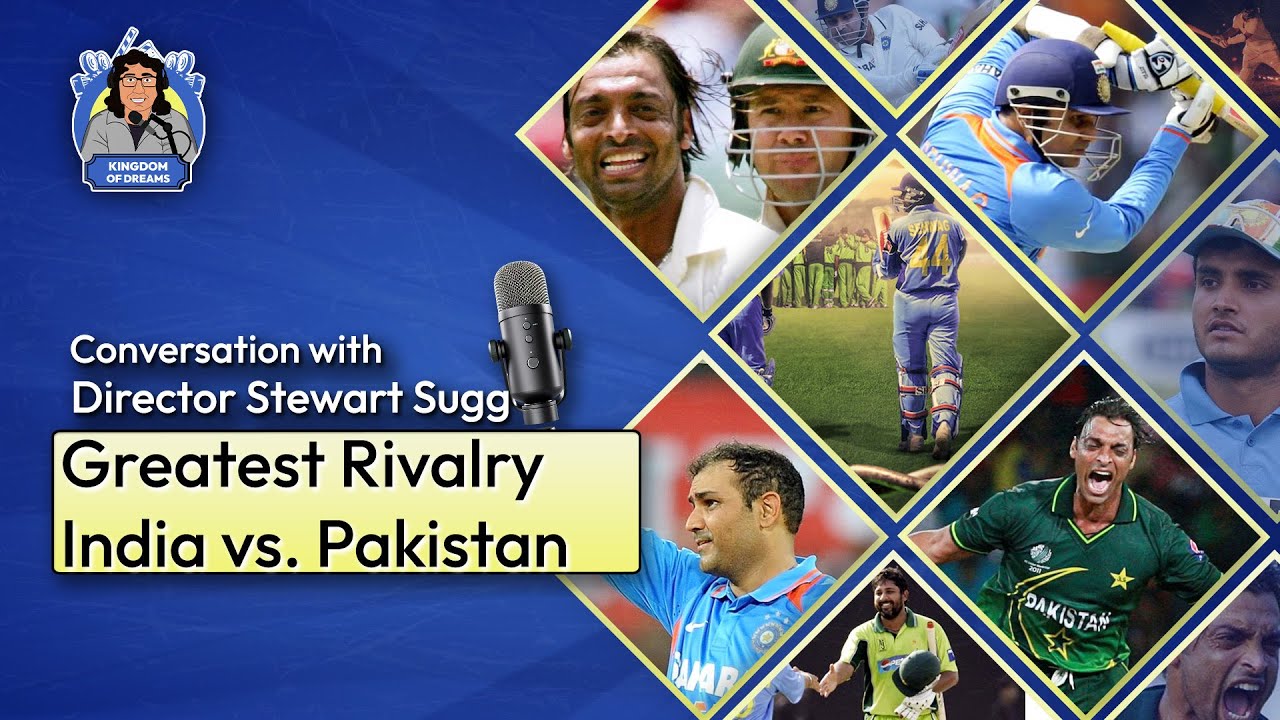
'India vs Pakistan, The Greatest Rivalry', Director, Stewart Sugg
Clips and Shorts from this episode
About this episode
Step into the world of cricket's most iconic clash with Stewart Sugg, Director of the gripping Netflix series "India vs Pakistan: The Greatest Rivalry." This three-part documentary dives deep into the history, politics, and passion that underscore the epic rivalry between the cricket teams of India and Pakistan.
Stewart is a Writer & Director whose films have won multiple awards, including a BAFTA for Best Production and the Grand Prix at Cannes. In his commercial work, Stewart Sugg often specialises in sports, working with legendary stars including Roger Federer, Carlos Tevez and Adam Scott.
#sportsnon-fiction #documentary #sporticacricket #cricketnews #netflix
Full transcript
Automatically generated from the episode audio, so expect the odd misheard word or name. Speakers were labelled automatically. About 8,500 words. Tap a timestamp to play from that moment.
0:09Jawad MirWelcome back everyone to another episode of Kingdom of Dreams Podcast, the making of stories. I'm your host Jawwad Mir. Today, my guest is Stuart Sugg. He is one of the directors of a new series that premiered last week on Netflix called India vs Pakistan: The Greatest Rivalry. It is a miniseries, three episodes, about 30 to 40 minutes each episode, that encapsulate the story between these two countries' cricket teams. Starting from, you know, early '90s or more so mid to late '90s all the way to now. But the main crux of the part is, like, mid-2000s. And it was a great conversation. We talked about cricket, we talk about, his experience in India and Pakistan while he was filming, the food, the culture, the stars, the celebrities, and everybody else. And without further ado, here is my conversation with Stuart Sugg. The series, India vs Pakistan, what's the exact title? I forgot the rivalry.
1:07Stewart SuggIt's The Greatest Rivalry
1:08Jawad Mir... Thank you. India vs Pakistan: The Greatest Rivalry, the series on Netflix, three-part episode. I just, 20 minutes ago I finished watching it, which is why when you emailed, when I saw you in, I'm like, "Oh, I haven't finished it yet." but yeah, no, it was, it was something that I've grown up with cricket, even being in Canada for most of my life. And, you know, that rivalry is always something that you're excited about. And, there were some things in there that, you know, I had seen before, I had heard all the stories, but just kind of watching it all together, it was very engaging and fun to watch. So thank you so much for working on it. I appreciate it.
1:50Stewart SuggWell, it's a pleasure. And I think that's always the balance, isn't it? You've got a lot of people who are passionate about the sport and know everything about it, and yet you have to also cater for, those who know nothing about it. So that's the, that's the line you always walk with these kind of projects.
2:06Jawad MirYeah. And where... So I, you know, I was watching it, and obviously one of the things that I picked up was because I know cricket and, you know, I was trying to figure out when did you guys start filming it? And I obviously with the Rameez Raja interview of him being part of PCB…
2:24Stewart SuggYes
2:24Jawad Mir... You know, which was, what? A year and a half ago, I think. I could be wrong.
2:28Stewart SuggSo we…
2:28Jawad MirSo obviously it was b… before that.
2:29Stewart SuggYeah. Initially there was a, we filmed something in 2021 around the World Cup initially.
2:35Jawad MirOkay.
2:35Stewart SuggAnd that was when obviously, Pakistan beat India, and there were those repercussions afterwards of what happened. So we shot in the UAE and, there was that, you know, rather extreme reaction in India, about it and those students who were jailed, for celebrating Pakistan's win, you know. And it, and it i… instantly introduced me to, you know, what this series would mean. And after that, we shot, in the, in the year after that sort of thing. So it's taken a while to get to screen, but it's always about, you know, getting the balance right. And I think this kind of subject is so tricky to actually get all the different elements right, you know, so that everyone feels happy. You know, it's, it's, it's so tied up with politics, the cricket really…
3:25Jawad MirYeah
3:25Stewart Sugg... Despite not, you know, it shouldn't be really. But that's the heady mix really is we're trying to get that process right. So there are different iterations as it went along. But, we got to a, you know, a line now which is more focused on sort of... Well, 2004 was always the focus. But it sort of, you know, it centers around that. I think previously we talked about having a, you know, timeline that went back to when the sport was introduced and why it appealed to India, which was India at, you know, at the time it was just India by itself. And the fact that really the British used it as a game to divide and rule to a certain extent. And one of the journalists, you know, you know, talks about that time in some of the rushes we had, but the idea that, you know, you would be put into a different team depending on your, religion, seems totally absurd, but that's what the British did, you know, in the, in these tournaments set in Mumbai. So that, we had some of that history in it, but I think maybe that stuff, you know, was probably too distant.
4:29Stewart SuggBut I was interested in that, in that stuff and how that kind of affected, the game and the history of maybe also the country. So yeah, that was, very interesting to kind of look at that.
4:43Jawad MirI'm, I'm actually surprised. I mean, I can see from the creative standpoint that to me that is way more interesting. Nothing to take away from the series, but just the root of all that, I mean, just to explore that, whether, you know, the audience kind of reached its own conclusion, but that was taken out. You guys had sort of for… figured out everything from the beginning to end, like storyboard and stru…
5:07Stewart SuggIt was... Yeah, it was all, I mean, the series, it was all structured, around... I mean, 2004 was always the heart. So actually what we did was, we had a, 2004 was all the way through it, right from the start, and we went back and forth in time, from 2004. And some of that stuff went by the way. I mean, I think, you know, that's, there's a commercial consideration about it, and some people think, you know, maybe that's not stuff people wanna hear, but I found it fascinating, you know, that one of our journalists talked about how, you know, why was it that cricket, why did it appeal to that part of the world? And it's a sport which you can be right at the top and you can be the best, and you can be taken right down to the bottom, and yet you can also fight your way from the bottom to the top. And those kind of sentiments I thought was really, was really interesting. It was very rule-based, but also within that it's about also, Facing someone face to face. It's an individual sport as well. And I think, you know, some of those things we looked at as a, you know, the root love of the game.
6:09Stewart SuggWhere did that, where did that come from? And that's what kind of interested me as well and how the empire and some of those things kind of wove into that storyline.
6:21Jawad MirAnd the reason for that sort of not to be there, was it a collective thing or was it more like a Netflix thing that we need to follow certain timelines and durations?
6:30Stewart SuggI think ultimately, yeah. I mean, I think ultimately there was a direction towards simplifying the narrative and making it, consumable by a larger audience. And I think maybe that was... You know, y… you and a lot of other people would fact… would have found that very interesting, but maybe it would have cut out some people. You know, the footage from that time from, you know, '30s, there is some, and there's some interesting footage of those, of those tournaments between different religions. But, you know, it's, it's not what people see these days and I think maybe there's a fear that, you know, if you start showing black and white footage and you talk about those times, it can put people off. But you know, that's, that's what happens in these kind of projects and the balance was always gonna be tricky.
7:18Jawad MirSo if I heard you right, and I didn't know this historically, so there... In the '30s there were teams based on religion?
7:26Stewart SuggYeah, there was, I f… I forget the actual name of the tournament now, but, there was a four different types. And there was the English, there was Hindus, there was Muslims, and there was one other group as well. I can't remember right now. But those…
7:43Jawad MirThe Sikhs?
7:45Stewart SuggNo, it wasn't Sikhs. No.
7:47Jawad MirParsis? Ismailis?
7:49Stewart SuggYes. What was the one you said? The, Pa…
7:52Jawad MirPars… Parsis
7:53Stewart Sugg... Parsis, yeah. I think the Parsis.
7:55Jawad MirYeah.
7:55Stewart SuggI think that's right. I mean, forgive me if I get this wrong.
7:57Jawad MirNo, it's okay.
7:58Stewart SuggIt was a while back when it was in. But it, but it was a tournament which was, you know, s… at the time incredibly popular. I mean, thousands of people flocked to it. And you can see why, 'cause people like having, you know,.. They like having their own thing to fight for. But also it's, it's incredibly, looking back on it now historically, how dangerous that kind of sentiment is, especially when what was going on at the time, you know, pre and post-war, the pull to pull the country apart, which is, you know, where the empire kind of started as well and what the empire did to sort of shake up India and kind of destroy the unity that was there. So cricket kind of carried on that storyline to a, to a certain extent, and I think looking into that from my point of view, it's sort of, you know, you do feel a bit of a historical shame about it really, about what happened. And actually India, despite having some issues, people got alr… got along kind of okay, you know? And certainly maybe better than now.
8:59Stewart SuggSo there was a, there was a, you know... The Indian family was bigger and included lots of different religions, and that seemed to be okay. But yeah, the British shook that up and I thought cricket was part of that, part of that way of shaking things up.
9:19Jawad MirWould you ever want to take all the stuff that you prepared for that part that didn't make the film and do something else with that down the road? Would you be…
9:27Stewart SuggI'd be fascinated.
9:28Jawad MirIs that…
9:28Stewart SuggBe fascinated to do that. I mean, to be…
9:30Jawad MirYeah
9:30Stewart Sugg... Typically kind of, you know, the root, the root of cricket, would be, would be interesting. I don't know whether Netflix, it would appeal to Netflix, but it would appeal to a lot of people like you and other people who, you know... I mean, it's something which just interests me. What is it about? I mean, I was looking i… into sort of the idea of cere… ceremony as well, that cricket is a game of ceremony. You know, the empires come out and they're dressed in a certain way and the cricketers are dressed in a certain way, and it's about rules. But ceremony, in India and Pakistan is, it's a huge thing and is,.. It's hugely important in all religions and I think cricket is a game of ceremony. And that's something which also kind of interested me. How does it connect to the, to the root culture of both countries?
10:19Jawad MirFascinating. I really would be interested to see that whenever and if that transpires. We're talking about, you know, partition, just to kind of segue for, like, 30 seconds. There have been so many films that have been made on partition, in India, in Pakistan, you know, in the west part of the world. There's one film, if... Because you're sort of talking about this and I think you'll, you'll like it. It was made in, I would like to guess, late '90s or early 2000s. It's called 1947 Earth. If you know Deepa Mehta, the director, she made a trilogy…
10:55Stewart SuggI haven't seen it.
10:56Jawad MirYeah, that's probably to me, I mean, I haven't seen all partition movies, but I've seen a lot, the best film because it's more about three characters…
11:04Stewart SuggYeah
11:04Jawad Mir... And how they are sort of wrapped around all this animosity and hate that initiates. So I highly recommend that you check that out. It's a great film.
11:14Stewart SuggYeah, that sounds really... I'll, I'll definitely look that out. That's, that's very interesting. We had a, we had a whole section, a larger section on partition and, you know, as again, the root cause of the rivalry and how that all kind of started and the idea that this British lawyer comes along and fairly randomly, puts a line through the country. And that was something which was kind of also... And we have a, in the, in the title sequence you can see there's a shot of, a cricket pitch from above.
11:42Jawad MirYeah.
11:42Stewart SuggAnd, the art department did this incredible job of creating the map of India on the pitch. I wanted this idea of, you know, the country on a pitch, and they did a beautiful job of... Actually, that was, you know, I didn't wanna do it in c… in post-production, 'cause you could have done it in post-production fairly easily.
11:57Jawad MirYeah.
11:57Stewart SuggBut actually the idea of doing a drone shot rising above and seeing this line of the country and then the red line which, demarcates the two different countries, on a cricket pitch, I thought was a labor of love, which was fun to kind of pull off.
12:12Jawad MirYeah, I really enjoyed watching that. Let's, let's go back to the genifi… genesis. I mean, the, in the recent years there have been f… few cricket series. I really enjoyed The Test, which was, season one and two on Amazon about the Australian cricket team. There was one on the IPL which I haven't seen. I think it was they were following the Mumbai Indians team, and obviously now yours. What was the genesis and when was that gen… when did that genesis take place?
12:42Stewart SuggWell, I think, I mean, Grey Matter, who are the company who produced it, the producers there, Payal and her husband, Chandradev Baghet, they've been working on, this idea for a, for a while. Chandradev, has worked in cricket all his life, basically. He's, he's passionate cricket enthusiast. And I think they just basically realized that there was a gap in the market that no one had actually made something which seemed in a way so obvious. You know, the idea of, rivalry, and cricket a… and actually talking about, for a change rather than just being like whenever they meet, you know, in a World Cup people start talking about it then, but actually a series and the fascinating history. You know, the idea, I mean, again, we didn't get into it, but you know, for a long time they played out draws. You know, the cricket was really boring because no one dared to win.
13:35Jawad MirYeah.
13:36Stewart Sugg'Cause winning was too much of a risk for unity to a certain extent. So that's also very kind of, kind of fascinating really. So I think they came, it came from them, and they came to me. I've done quite a bit of, sport documentary work. So, and for cinemas and that kind of stuff. So, Chandradev knew someone here who knew me, who I'd worked with, on a, on a series about Manchester City. Cricket is not something which I am, hugely knowledgeable about, but I, but I love sport as a, you know, games to actually tell, talk about people really. That's... To understand people I always find that the most compelling really, that sport tells us…
14:20Stewart Sugg... So much about ourselves. And actually, we play sport for all kinds of reasons but, you know, generally speaking, we can't fight each other anymore, and we can't u… we can't have these passionate feelings because they seem rude and impolite in normal society. But at a, at a game, you can scream and shout and cry and celebrate all in a short a… amount of time and that's, that's still a great thing.
14:45Jawad MirIt is. I can tell you, I mean, I used to watch a lot of cricket growing up, of course. But then I think mid…'90s, which was probably Pakistan's best cricket until like early 2000, I didn't. And then I remember watching the cricket series in 2004, and then the whole thing happened with the fixing and all that, and I kind of lost interest and I came back in. But India and Pakistan match, right? It's like even if you don't watch anything else you have to watch that, and there's just so much tension. Like, I remember specifically this one match which you kind of just showed at the very end in I think it was 2021 World Cup where they won by 10 wickets, Pakistan.
15:30Stewart SuggYeah.
15:30Jawad MirYeah.
15:31Stewart SuggThe first one we filmed. Yeah.
15:33Jawad MirOh, yeah. So I remember even when it was like 100 runs and no wicket, I'm like, "Anything can happen in a matter of minutes." And that was actually, that happened last, earlier this, last year when Pakistan was almost winning and then out of nowhere…
15:50Stewart SuggYeah
15:50Jawad Mir... You know, that happened because the pressure. It's all about the mental pressure that gets you.
15:53Stewart SuggSuch a mental game, isn't it? I mean, cricket is such a mental game.
15:56Jawad MirYeah.
15:56Stewart SuggAnd that's why, you know, you know, sort of when we had that section in the film about Sehwag and how he got into... You know, he worked with sports psychologists, and he couldn't find a way to control his mind and the only way was to sing.
16:10Jawad MirYeah.
16:11Stewart SuggThat he just emptied his mind and had a song in his head. And that was a fun thing to sort of to kind of play with.
16:18Jawad MirYeah. I remember this was something I watched a couple of years ago. There were the mi… the stump mics. They released some footage where he was actually singing different songs and just whacking the ball. And I mean, he was a great player. You know, it was like either do or die, and when you do and then it's more likely it's gonna go all the way to the 100, right? So.
16:41Stewart SuggYeah. His history, actually we had a little bit of, again, which, sadly lo… got lost, but there was a great sequence we did with him. You know, there's some reconstruction of him…
16:50Jawad MirYeah
16:50Stewart Sugg... I think watching the f… watching the cricket on the, on the TV and then sort of do some, doing some shadow batting. But we also had a little section which was where he used to play, and where he used to play was on a really rough field basically with his friends. So we had a bunch of kids playing and a beautiful sort of sequence with sun, the sun setting and everything. And he said because the pitch was bumpy, the on… you know, you had, you had to hit it, hit it, you hit it up over the boundary constantly because the pitch was bumpy. The ball didn't go very far and there was, you know, grass or whatever. So you had to hit it hard. So that's how he learned to hit the ball in the air. And also he also says, doesn't he, "There are no fielders in the air." But, yeah, his background and, you know, how he, how he learnt to play that way was featured.
17:35Jawad MirYeah. So you know, you have obviously the story revolves mainly around Sehwag and Shoaib Akhtar.
17:43Stewart SuggYeah.
17:43Jawad MirBut there are other people. You know, you have Ganguly, you have Miandad, you have, Inzamam, and, who else you had?
17:52Stewart SuggGavaskar.
17:53Jawad MirGavaskar. So all, you have all these people, so it... I know from, experience like when you're getting into a documentary like, you know, you're, you have to sort of sometimes you have to figure out the story before you start production, and sometimes you have started production, you have to find, you're trying to look for a thread as to which two characters or three characters. Were there d… were there ever other than Sehwag and Akhtar… sort of…
18:18Stewart SuggThey, you know, they were always the f… the lead two. We wanted, you know, because obviously they were both figured, heavily in 2004.
18:25Jawad MirYeah.
18:25Stewart SuggWe wanted two kind of, to a certain extent, heroes, to be, to be our kind of center points. And they seemed like the obvious, you know, you know, the 309 which Sehwag scored in that, in that match, the first 300 by an Indian. That seemed extraordinary, and Shoaib Akhtar, it's, it's hard to ignore, his pulling power really, and, you know, in the film he's, he's an absolute kind of hero. He's a star, isn't he? He's, he's great at telling stories. He was, very open. He said some extraordinary things. You know, he talked about his relationship with Inzamam and, you know, this line he has about, you know, "I'm a, I'm a, I'm a sports car. Leash me out on a, on a weekend car. Leash me out on a, on a Friday night. Don't, don't run me into the ground," was what he was saying.
19:16Jawad MirYeah.
19:16Stewart SuggSo, yeah, they, those two are... And, you know, both are, you know, both are real characters. Virender Sehwag is quietly got a twinkle in his eye, you know, and, quite a good foil for Shoaib who's more of a showman really. So those two…
19:31Jawad MirYeah
19:31Stewart Sugg... Were quite a good choice I thought.
19:33Jawad MirAnd they're really good friends in real life too. They're really good friends, and they tweet at each other during an India-Pakistan game just to…
19:39Stewart SuggYeah
19:39Jawad Mir... Tease each other, but they're really good friends off the field.
19:43Stewart SuggYeah.
19:43Jawad MirI… in terms of filming, you went to India, you went to Pakistan. Were there any challenges that you guys faced in terms of access, in terms of locations, permissions?
19:59Stewart SuggYeah. I mean, constant issues. I've never filmed in that part of the world before. I mean, it was, at the time we were filming, in basically May, April, May into June sort of thing, that kind of time in India, and Pakistan.
20:17Jawad MirNice weather. Nice weather.
20:19Stewart SuggIt was brutal. It was... Someone said it was the hottest ever on record in those two countries. So first of all, it was 40 degrees every day plus, and we had people, you know, sometimes fainting from the heat or having to sit out i… 'cause we, when we were outside it was very hot. And I think, you know, filmmaking of that, of that size on a, on a documentary is reasonably new, in that part of the world. They obviously, Bollywood and those huge productions happen. But the production team did really well just pulling together kind of some of these things. We had a issue at the border. We wanted to film at the border, and we had an issue one… once where we turned up and then we found out that the permissions hadn't come through. So we waited and waited and waited, and there was this amazing ceremony we wanted to film with Sehwag, and we, you know, annoyingly didn't come through in time, and we couldn't do it. You know, so frustrating. So we d… we had done other stuff, but we had to come back, you know, those kind of things.
21:23Stewart SuggSo, and going to Pakistan, I mean, you know, from the Western world you get a certain opinion of what Pakistan is, and will be, and I think honestly I was, I was nervous about going to Pakistan. But honestly, it was one of the most amazing experiences, travel experiences of my life and it felt like, you know, felt like 2004 over again. You know, they welcomed us. We turned up at the airport, we thought, "Oh, there's gonna be hassle at the airport," but s… they'd, they'd arranged us to sort of basically be met by one of the officials and swept all the way through, customs and straight out and from that point onwards, you know, Taha, who was the producer out there, and Shoaib showed us the most amazing time. They looked after us like brothers, and, incredibly generous with their, with their sort of, hospitality. You know, it's kind of what I, what you see in the, in the footage about the 2004, the Friendship Tour. I... You know, we certainly felt the genuine warmth, a… and kindness and hospitality, when we were out there and, yeah.
22:28Stewart SuggIt was a, it was a great experience, really was.
22:31Jawad MirI was gonna ask you, what were the similarities and differences between visiting India and Pakistan? Not from a f… you know, film standpoint, just the experience. So you already answered the Pakistan part. What was India like? Were there similarities? Were there differences?
22:47Stewart SuggWell, I mean, it's the... I mean, I remember turning up in Pakistan and we hadn't eaten any much meat in India, and then we turn up to this massive great kind of barbecue which they'd or… which they'd arranged, and ate all the meats we hadn't eaten in India. There's, there's definitely a slight character difference. I mean, your... Are you from, heralding from Pakistan originally? Your heritage is Pakistan, is it?
23:10Jawad MirYeah. I am, and I actually went to India in 2013 for three…
23:15Stewart SuggYeah
23:15Jawad Mir... Weeks.
23:16Stewart SuggYeah.
23:16Jawad MirAnd I had the same thing, like, you know, as a Pakistani going to India, what would the experience be like?
23:22Stewart SuggYeah.
23:22Jawad MirAnd it was one of the most amazing experiences of my life. Like, the…
23:26Stewart SuggYeah
23:26Jawad Mir... Hospitality there and the people, whenever they found out... Like, I mostly didn't disclose that I was originally from Pakistan…
23:34Stewart SuggYeah
23:34Jawad Mir... But if they did find out, their attitude towards me changed in such a way for a positive. Like, "Oh, you're our neighbor," you know? But sorry, go on. I kind of went on…
23:42Stewart SuggNo. I mean, I think that's very... I mean, that, you know, we're, you know, I was there with a, with a British cameraman and, we didn't know what to expect from either country, but, you know, everyone in India was so sort of kind as well, and welcoming and, you know, really hardworking. Everyone worked their socks off to kind of get the production right and, film in all these different locations and deal with the complications and locations falling through and, you know, the usual kind of, usual kind of things. And, y… you know, we were based in Mumbai, and just getting around Mumbai, is a real thing. You know, it's a… The streets are full of traffic constantly and
24:23Jawad MirYep
24:23Stewart Sugg... But, yeah, it was a great experience to kind of, you know, film in both those countries. We also obviously filmed in UAE. We filmed, Wa… Waqar Younis in Australia, 'cause that's where he lives.
24:36Jawad MirRight. Right.
24:37Stewart SuggSo and he was a great, contribution. And, you know, who else? We, yeah, we, you know, we had a great time and we had, you know, John Wright was… we filmed John Wright in Mumbai as well. He was a good contri… contributor. And I think, you know, there's a great line in the film where he talks about where he was feeling quite down, during the tour because India were losing. A… and one of the, one of the tests, one of the bowlers who was helping them out said…
25:05Jawad MirKumble. Kumble. Anil Kumble.
25:07Stewart SuggNo, I think it was one of the ones who, he was helping them out. It was like a, like one of the junior bowlers who the Pakistanis had given him.
25:13Jawad MirOh, right. Sorry. Yes. Yes.
25:15Stewart SuggHe said that the glory, the glory is in the struggle. And I think, you know, that's, that's what I take away, you know, from the whole thing. It was a, it was a very tough shoot, very tough experience. But I think when you look back, you know, you learn, you learn a lot. And you, yeah, you come away hopefully a stronger person and a person who has, who has experienced some pretty kind of extraordinary things.
25:41Jawad MirRight. I wanna go back to your early days of career, but before I do, just a random question. Do you remember any specific dishes from India and Pakistan that you really liked? Just one.
25:54Stewart SuggDish. I can't remember what they're called, but they're… in India, they had these, sort of little ball things and…
26:03Jawad MirOh, it's called thali. Like, you have different assortment of food.
26:05Stewart SuggYeah.
26:06Jawad MirIs that what…
26:06Stewart SuggUnbelievable.
26:07Jawad MirYeah.
26:07Stewart SuggI thought the taste of that was just incredible. They're sort of… it was sort of delightful, and I thought, "Well, why don't we see that in the UK?" 'Cause that was like a delicious snack. That was something I never had before. So that was, that was really nice. I think Pakistan, the, just the barbecues and the meats and, you know, all that stuff was my greatest memory of that and the hospitality from the Pakistanis out there to sort of generously take us around. Shoaib was amazing. You know, he kept on turning up in our rooms and got people to bring us cakes and, you know, he became a sort of friend out there. He, you know, he messaged me recently and, you know, he's delighted that the program's gone to… it's, it's number one in India and Pakistan. So
26:52Jawad MirOf course
26:52Stewart Sugg... Netflix. Yeah. Well, so that's a, that's, that's great for him and, you know, everyone's waited a long time for it to come out. So it's… we're all delighted that's, that's happened. So, yeah.
27:03Jawad MirAmazing. It… the thing with that thali is that in the Indian, assortment… ... It's actually supposed to be really healthy for you because you're just getting a bit of everything and you're not doing overdosage of one particular food, and I find that very, you know... I've had few times in India and here too, and I really enjoy that. And of course, in… I haven't been back to Pakistan in 35 years, but I remember the food, you know, when I was young there. But, yeah, I mean, food is just totally different and a wonderful experience. But going back to your early years, Stuart, what brought you into journalism or filmmaking? What was the catalyst in taking you on this journey to be where you are today?
27:45Stewart SuggYeah. I mean, I had no background, no family in film or anything like that. I think I was interested in photography and took photographs and won a com… couple of competitions. And I, and I did a degree in English and drama and I didn't really know what I was gonna do. But I ended up getting a job as a assistant photographer for a, for a bit. And then quite soon realizing that the technical side wasn't something, you know, that the cameras and st… the technical side was not interesting to me. I was more interested in the sort of the artistic side and the image making. But the technical side, I wasn't particularly good at it, I don't think, either. So, I l… left that, and then I decided… then I kind of, you know, went through a bit of traveling. I went to Italy with my girlfriend at the time, who's now my wife. And kind of, you know, when you don't really know about filmmaking, you kind of s… put together your talents. And I thought, "Okay, I like writing. I like photography." And then, so you… then it suddenly kind of struck me that actually, well, filmmaking should be something I should like, shouldn't it? But I had no, I had no in, I had no idea how to do it.
28:46Stewart SuggSo I just started making my own things, just independent films, just little things. I got grants from the Arts Council in the UK and started making a… I made a documentary. Then I traveled to Berlin, where they had a production company where if you made… it was a TV station where if you would make a film for them, then they would give you the equipment to make the film and the edit suite for free. So and I thought that was great. So I did that. Then I got a job with IMG, which is a sports production company, and directed there for a couple of years. Went back to film school. That kind of got my kind of passion about film even more kind of going. And I wrote a, wrote my first screenplay, which was called Fast Food, which was a low budget feature film, off the back of that really, which, you know, with no kind of… you know, I'd done, I'd done a road movie before that, which was like low, super low budget, like nothing. We borrowed…
29:37Stewart Sugg... The cameras from a production company, without telling them on the weekends, which was a bit naughty. But, and then, yeah, we raised about 15, £17,000, I think, to make, Fast Food, and we were lucky enough to get a great cast. You know, we… Gerard Butler was in it, which is, you know, quite something. He's now got a Hollywood career. So, he was at start of his career then. And we had… A good cast. And that film went to, went to Cannes and it went, and it got sold and went to various film festivals and that kind of stuff and…
30:09Jawad MirWow.
30:10Stewart SuggYeah, so that was a, that was an experience. But I mean, I… and then after that, I got a, another, a film with... A proper budgeted film with Sky, which was like a $5 million, dollar, feature film, called Kiss Bang, which I wrote as well, with Stellan Skarsgård and Chris Penn and some, you know, some great cast like that. Paul Bettany was in it as well, another big star now. So, but actually to carry on a drama career in this country isn't always the easiest thing to do. You know, we're, we're not so set up, especially at that time, to have, you know, a lot of people doing that. And sport was still something which I found interesting, and so I did more short form and then slowly got back into doing kind of feature length kind of documentaries. So yeah, I mean, it's a bit of an eclectic journey really. So, you know, I like, I like doing, I like doing both things. I'm writing a screenplay at the moment, which, has been picked up by, an American producer, and we're, we're developing that, putting that project together.
31:13Stewart SuggHopefully that'll come off, fairly soon. He helped produce, Monkey Man. I don't know if you know the Mon… Monkey Man, the film?
31:19Jawad MirYeah.
31:20Stewart SuggHe helped. So…
31:21Jawad MirAre you talking about, what's his name? The guy who's made Get Out, 'cause he produced, Monkey Man, right? What's his name?
31:32Stewart SuggYes. Not, no, not that one actually. I'm not sure that I can, I can say who it is…
31:37Jawad MirNo, that's fine. I'm sorry. I'm sorry. I didn't mean to ask you that. I was just…
31:39Stewart SuggHe's, well, there are a few producers on it, but he's…
31:42Jawad MirYeah
31:42Stewart Sugg... He's a fantastic guy and, he's, picked up this film, which actually is an international film which is set in Mumbai again. So, hopefully we'll end up going back there and filming in, filming in Mumbai. So but we… it's, it's with an international cast, you know? It's a bit of a crossover between something like Extraction and, District 9 sort of, sort of…
32:04Stewart Sugg... Feel. So that kind of milieu. But, in the meantime, I'm, I'm, you know, doing some, I'm doing… I had to do a BBC film just recently, about a footballer called Mark Hughes. And, yeah, I mean, you know, I do various things. I do, I develop, sort of short form content for people. I'm doing an extreme sports, thing as well. I'm signed with a, an agency in India called Taalsi, one of the bigger…
32:30Jawad MirYeah
32:30Stewart Sugg... Bigger agencies out there, who are a good bunch and, they're, they're coming up with a bunch of opportunities. So, you know, I think I'm lucky enough to be doing my hobby as a job. I mean, that's... W… whatever I do, I always feel grateful to be doing it. And the fact that, you know, when you have the opportunity to have, to have a, the playground of filmmaking, whether that's in drama or in documentary, it's a, it's a great playground and, you know, I'm still learning a… as I hoped I always will be. Because if you get stuck in a rut then you're in trouble, I think really. But, I still feel, find it incredibly exciting, to work with people and to take on a project.
33:12Jawad MirYeah. And I couldn't agree with you more on that last part where you can, you know, that pigeonhole thing and I find it with myself too, and that's not because somebody put me to it just kind of happened where, you know, I'm directing human rights documentaries revolving around protagonists. The posters are in the back. I'm just gonna give a little plug.
33:32Stewart SuggYeah
33:32Jawad Mir... But and now I'm working on another, like, a fiction that deals with, what's going on in the Middle East. But I'm really interested in now, like, you know, it's funny because I w… I used to wonder, like, all these series were coming out, like why isn't anybody making stuff on cricket, right? Like, and The Test came out and your series came out, and I'm, I've been for the last three years I've been trying to get something going because... And I may email you about it if that's something of your interest…
34:01Jawad Mir... That's relevant to cricket and that's something happening right now. But it's sports is the future. The way it is going right now, films, I don't know how much they're gonna be in terms of generating revenue and, profit, but live sports is where everybody's jumping in terms of investment. So, you know, doing something in sports area here and there, balancing it out with other stuff is definitely a good move.
34:28Stewart SuggYeah. I mean, I think you see it, you see the, how, you know, Saudi are now jumping on sport and… ... Using it as a, you know, also a place to draw people in, you know? People, you know, it's a, it's a, it's a, in a way you can't judge you around, you know, no one's judged around sport. I suppose funny enough in cricket, you know, there it is very political but of so often sport can just be sport and you can just enjoy it for kind of what it is. Yeah. And it's, it's always got great stories. You know, I always enjoy a good, you know, a good sports doc… kind of documentary and, you know, I think there are, there are a few good sports films as well, movies, as well out there. But, it's pro… probably trickier. There was one about the Indian team, wasn't there, I think? The, their World Cup win and it's called, I think it's called, was it called 1983?
35:17Jawad MirYeah. That was, that was really good. It was called '83. It was just called '83.
35:20Stewart Sugg'83. That's right. Yeah.
35:21Jawad MirYeah.
35:21Stewart SuggIt was, it was quite good.
35:21Jawad MirThat was really good.
35:22Stewart SuggYeah.
35:22Jawad MirIt was really good. There was actually a really good sports film that came out in the '70s starring Sylvester Stallone that I don't know why nobody talks about. It's called Victory Escape.
35:33Stewart SuggEscape to Victory.
35:35Jawad MirYeah. So it's basically during, I think it, if my memory serves me right, it's... There's an American team which is in prison. I think it's during World War II or some era, I don't remember.
35:48Stewart SuggThey're in that big prison…
35:49Jawad MirAnd the…
35:49Stewart SuggYeah, in the famous prison, aren't they? Yeah.
35:50Jawad MirYeah.
35:51Stewart SuggIt's great.
35:51Jawad MirAnd they have to p… they have to play a soccer tournament…
35:54Stewart SuggYeah
35:54Jawad Mir... To sort of, you know, initiate their, escape.
36:00Stewart SuggYeah.
36:00Jawad MirSo it's, it's an interest… I highly recommend that. I actually gotta see that again. It's been a while since I've seen it.
36:04Stewart SuggIt's quite, it's quite a well-known film in the UK, because it's got a lot of football, soccer players in it in… including Pelé, and various other really big names. So the inmates are various very famous footballers, which, y… you know, is always cool to…
36:18Jawad MirI didn't know that
36:19Stewart Sugg... It's quite an iconic, it's quite an iconic, movie that, yeah
36:24Jawad MirYeah. Have you seen Beckham?
36:27Stewart SuggThe documentary? Yes, I have. Yeah, I have.
36:30Jawad MirYeah.
36:30Stewart SuggI believe it was…
36:30Jawad MirI thought…
36:31Stewart SuggYeah
36:31Jawad Mir... I thought that was one of the best sports documentary series I've seen. I mean, I don't know anything about the… what kind of stuff that guy went through. It was just mind-boggling. But it's, it's crazy that how much pressure, you know, sports players have to go through with, despite all the limelight that we see, it's way more intense.
36:48Stewart SuggYeah, I mean, he obviously, he married a Spice Girl and he was already really famous and, has the looks and the playing ability to really shine. And he's still a big, you know, big star. I actually filmed with him, recently for the, film I made for the BBC and, you know, he was such a y… you know, a charming, lovely person. He was… he felt very genuine. He gave us time. You know, I think you often find that the really big stars are the ones who are particularly kind of decent people and, you know, you don't become an England captain and do what he did without, you know, being a, being a good guy and, yeah, he was, he was great. He was great in our series. And I think, you know, the Beckham thing is, really well made and I li… like that style of filming as well. I like the fact that, you know, people f… the questions are thrown in. I always like, you know, I actually like documentaries when you have, less archive and you… there's more w… the real person is in it. I did a film about Kenny Dalglish and, do you know about Kenny Dalglish?
37:53Stewart SuggHe…
37:54Jawad MirNo
37:54Stewart Sugg... He, have you heard of Hillsborough? The…
37:57Jawad MirYeah
37:57Stewart Sugg... So there was a disaster in Hillsborough and Kenny's a hugely popular, famous, footballer, in this country. He was, Scottish and he, played for Liverpool in their, in their pomp in the sort of '70s and '80s. And he ended up managing them. And in that time, he was the manager when, the Hillsborough disaster happened. He was, he was there when that happened. And, you know, I wanted to try and understand really what that disaster meant to him. And so with all of his experiences, I was trying to ta… take him back. So I took him back to his house where he grew up and I wanted to… I said, "Can we go back to the ground where that happened?" And he said, "I can't. I can't go back to that ground." And I said…
38:44Stewart Sugg... "But we're trying to try and tell it sort of in a way where we… it's not just like a, someone talking, but we see you connected to it in a way where, you know..." And we had, we had back and forth, back and forth, and then he came up with an idea. He said, "I'll, I'll, I'll go to the hill overlooking the stadium." So we have a sequence where we have him talking about that, those days and driving to the ground, driving to the ground, and then we have this amazing sequence where he parks his car and we're on a hill, middle of nowhere in the countryside and is, and he walks down the, down this, down this road and stops, and he's facing out over this view, and in the distance is this, is this stadium. And it's just a incredibly powerful and moving way of connecting…
39:28Jawad MirWow
39:29Stewart Sugg... In the present day because th… those things don't leave you when, you know, 90, I think it's 97, people died, in that, in that disaster. And, you know, it never leaves you. And stories came out as well when he was talking about it, which was his son was in that, in that end. You know, he didn't know, despite being the manager, he didn't know. So we found this footage of when his son is discovered and he, you know, you see Kenny, who's a very kind of, you know, he's… he holds his emotions in check all the time, you know. He… but just a couple of… there's one time where you see just a little break in that man of concrete and steel, you know. And that says everything when someone doesn't show their emotions and that comes through. So, you know, film… film's an emotional kind of medium and I like to bring, I like to try and bring that out really.
40:22Jawad MirI was reminded of with the one little thing and then I'll kind of come back to a series before I wrap up. I was sli… swiping through one of the social medias and there was an interview with Sylvester Stallone, I don't know, with Howard Stern or somebody, and he was talking about First Blood…
40:39Stewart SuggYeah
40:39Jawad Mir... The very first Ram… Rambo. And he said the original first, the first cut that we did, there was, it was almost three hours long because he had way more dialogue…
40:52Stewart SuggRight
40:52Jawad Mir... Than in the film. So he would just respond in a very, you know, sarcastic way to the police officer and everything, and they took that all out. And what that, the reason that film works, which he talked about, is because there's just something about not showing your emotion or saying what you feel that pulls the audience in…
41:14Stewart SuggYeah
41:14Jawad Mir... To your character, and it just doesn't let go. And I think that's just bang on. That is so true. Just keeps you wondering.
41:21Stewart SuggYeah. Do you write, do you write drama as well yourself?
41:25Jawad MirYes.
41:25Stewart SuggYeah. So I mean, I, when I've been writing this script and working with a producer in LA, you know, the more, the more I got into it, the more I was taking dialogue out really. I mean, you know, taking dialogue out, adding in imagery, you know. So because the audience, you know, we're, we're, we're primal beings, aren't we? And we are, imagery is what, before we could speak, you know, images and noises and sounds is really what we react to. So if you can tell it as much as possible. I love dialogue in films. I loved, you know, great dialogue is also amazing. But sometimes, you know, when you get to the points where it's the most emotional is just sort of vis… beautiful visuals, an amazing soundtrack, you know, those kind of thing but really break you I think, you know, as the audience.
42:13Jawad MirI agree. I agree, and I'm having this challenge right now where I'm, there's a film that I'm working on called Whispers in Time, and it's a short, it's like a proof of concept to make a feature. And… It's like I keep telling my DP, he's a friend of mine, like, "I need to cut the dialogue. I need to cut that." But the thing is, if I cut the dialogue too much, then there's a fine line, right? Like, you have to convey the emotion. Cer… certain…
42:36Stewart SuggYeah
42:36Jawad Mir... Things do require dialogue, but how much do you have to go? How much is too much? And that's where the challenge and the fun comes into play.
42:45Stewart SuggTotally
42:46Jawad Mir... Because I mean, I think the curiosity thing, if you look at Jaws, the shark not working or, you know, you don't say what you feel. It, think that just pulls, it's a psychological thing. We become way more curious about what somebody's feeling or thinking…
43:01Stewart SuggYeah
43:01Jawad Mir... Than being told what they're feeling or thinking.
43:03Stewart SuggNo, totally. I think, I think, you know, the hard thing is when you're, when you're selling a project, you're trying to get a project off the ground, is that the script is a sales document and people have to understand it. So, you know, my thing is always when I, when I write, action, I would never have more than three lines of action. And usually it's just one line of action because y… you wanna really kind of get it quickly and then, and then kind of not have people stuck in loads and loads and loads. And I think, but you, but you also don't wanna get them lost. So with dialogue, sometimes you might add a line more because you want them to... You know that the actor will go do an expression or will do something which will totally nail that. And you go, "Why would I leave that line? They don't need that line," because that expression t… says it all. But you can't write that in a script in the same way.
43:50Jawad MirYeah, no, I agree. I agree. The, sometimes the actors like, yeah, they, even in a documentary, if it's not an actor, it's just like a protagonist, like sometimes the emotions just are able to pull off so much more and that's what's incredible about it. I, are you looking for, are you gonna watch the next game that's coming up in the next two weeks, I think it's playing on the 21st?
44:09Stewart SuggYeah. I think s… yeah, it's, it's exciting. I mean, there was a big negotiation, wasn't it, around where they should play and all the rest of it. But, I think, yeah, I'll definitely be up for watching that. It's, it's an exciting time.
44:21Jawad MirWonderful. Well, it's been pleasure having you, Stuart. I'm really thrilled about what you're working on and what you have obviously, you know, told me about what you have worked on. Incredible series, India vs. Pakistan: The Rivalry on Netflix. I urge everyone to check it out, and thank you so much for your time. It's been a pleasure talking to you.
44:39Stewart SuggBeen great to talk to you, Jawed, and hopefully we'll catch up again in the future.
44:43Jawad MirI'm sure we will.
44:44Stewart SuggRight. Okay.
44:45Jawad MirTake care. Bye-bye.