
Episode 213 · March 12, 2025 · 31 min
'Jurassic Park', VFX Artist, Stephen Rosenbaum
About this episode
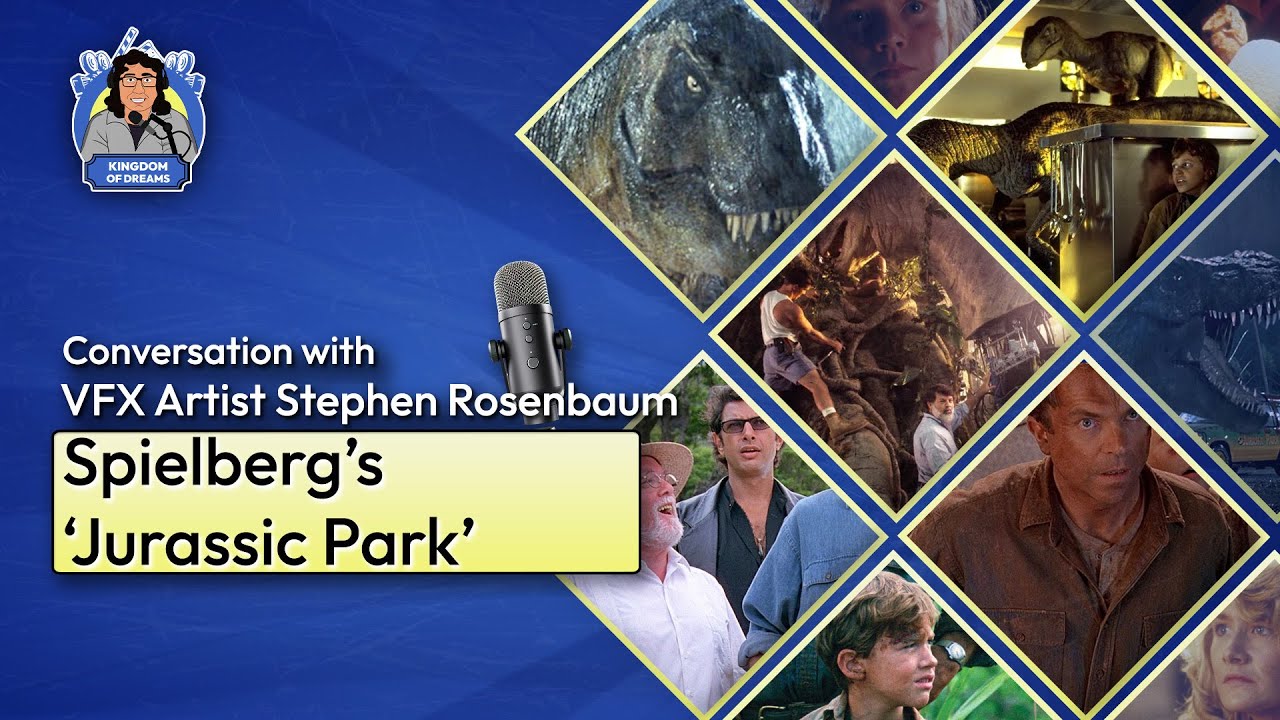
In this episode, return guest Stephen Rosenbaum explores the groundbreaking visual effects, collaboration, and technical innovations that brought Spielberg’s dinosaurs to life.
From the evolution of CGI in film to the stories of industry legends like Phil Tippett, Stan Winston, and the ILM team, this conversation dives deep into how Jurassic Park transformed the world of filmmaking.
Stephen Rosenbaum is an American visual effects artist and supervisor, and has worked on numerous movie, tv and music productions, including six that have won Academy Awards. He has been nominated three times for an Academy Award and two times for a BAFTA Award.
#motiongraphics #scriptwriting #lauradern #film #michaelcrichton #jurassicpark #jurassicworld #stevenspielberg
Full transcript
Automatically generated from the episode audio, so expect the odd misheard word or name. Speakers were labelled automatically. About 5,300 words. Tap a timestamp to play from that moment.
0:10Jawad MirWelcome back everyone to another episode of Kingdom of Dreams podcast, The Making of Stories. I'm your host, Joe Admir. First of all, my sincere apologies, it's been a while since I've had regular episodes, which are supposed to be every other day. It hasn't happened the last two weeks, just a lot of stuff has come up, just some personal stuff. Plus, I've been working on a film, that I'll tell you about down the road and just prepping up for that, location scouting and casting, and, yeah, and there's a whole bunch of stuff, in the works. The podcast is growing, slowly. The audience is growing, and I'm trying to try different things, anything that's relevant to stories. So even if it's a film, whether it's a book, an author of any sort, or any s… fascinating story that I hear about, it may not have anything to do with the film, but potentially can lead to a film or a TV show or series down the road. I'll be trying to cover that and see how that plays out. Got a whole bunch of episodes that we've already shot. I ha… I spoke to Simon Wells again, who I've spoken to like seven, eight times on this podcast.
1:13Jawad MirWe just talked about storyboarding and a whole bunch of different stuff. J.V. Hart, who has written Bram Stoker's Dracula, he came on again to talk about Steven Spielberg's Hook, and a few other people, and there are some other coming up. Today, I'll be speaking to Steven Rosenbaum again, who I have on this podcast. For this episode, he'll be talking about Jurassic Park, but I have him on, for Avatar, James Cameron's Avatar, the first one, followed by a few other things. So yeah, so my conversation with Steven Rosenbaum has spanned into like four different episodes, The Abyss, Terminator Two, Forrest Gump, and now Jurassic Park. You've seen those episodes, and thank you for watching them and listening to them. This was great conversation as well. A lot of the information that Jurassic Park has is already out there, but there's still some fun and anecdotal stories and tech stuff that you can, you know, listen to and watch and enjoy. So without further ado, here's my conversation with Steven Rosenbaum for Jurassic Park. To have you again, to talk about, Spielberg's Jurassic Park.
2:16Jawad MirWhat your role and your team's role exactly, what… I'll let you know, take a start from Jurassic Park. We left off with, T-two.
2:28Stephen RosenbaumTerminator two. Yeah.
2:30Jawad MirYeah.
2:30Stephen RosenbaumThat… It sort of really sets the stage for Jurassic. I mean, it, you know, we had on T-two, we had the opportunity to do a individual character, and now, and it was a human, humanoid-like character, very human-like, I guess. But, it was metallic. Now, all of a sudden, we had to do, you know, quadrupeds and various forms of bipeds, that had real skin and moved and interacted with humans. So that was a whole different level for us. It was interesting, the beginning, the very early days, when Steven was first talking about the project with us, specifically in computer graphics, w-we were being propositioned to just do, add motion blur to go-motion footage. So, Phil Tippett, who, you know, everybody should know, if they don't, look him up.
3:31Stephen RosenbaumHe's a, he's a god in our industry. But he had his own studio at this point. He had moved away from ILM, and, he was doing a lot of what we called go-motion work, which was sort of the, an evolution of stop motion. So go-motion is you could, you know, similar to stop motion, where you move a puppet, you know, to a pose, you take a picture, you move the puppet to slightly to the next pose, you take a picture, and so forth. With go-motion, you're, you're actually doing the same, but you're, you're, slightly moving the puppet during the exposure, so it gives a sort of pseudo motion blur effect to it. So, we had done some tests where Phil had animated a raptor running, using a go-motion technique, and they actually developed a new device called a, I think it was called a digital input device or something like that. And, it allowed him to animate much faster and more efficiently.
4:33Stephen RosenbaumBut it was a, if you imagine, it was like a profile shot of a raptor running, right? Raptors run bipedally. And then, we would take that film element, scan it, and then add motion blur to the legs to make it even more smooth, you know, s-see if that looked better than, you know, what Phil could output. And it did. We looked, it looked pretty good. And so Steven, you know, the initial thought was, "Okay, Phil's gonna do all the foreground dinosaurs, and ILM Computer Graphics will do all the background dinosaurs." And, we, specifically, Steve Williams was actually, one of our main animators, at the time. He had, he had animated, you know, Robert Patrick in the T… in the T-1000 in Terminator, and he actually even going back to The Abyss, the pseudopod. And he took it upon himself to build a T-Rex. Initially, it was just a skeleton. And he did a walk cycle of the T-Rex.
5:36Stephen RosenbaumJust we got a, we got a plate from Dennis Muren, who was the supervisor on the show. And, he, we comped it in. It just this, he rendered it out, and we comped it into the shot and sent it to Steven just saying, "Hey, you know, we can, we can do animation, you know, full, you know, principal hero animation." And that kind of blew the doors off, honestly. He didn't expect that. And there was a, essentially a title shift to, okay, let's do more… Of the principal creature work in computer graphics. But, you know, the big question mark there was Phil. You know, we had this, you know, incredible resource with Phil. And so the genius of the plan was that we actually brought Phil back into computer graphics, and, you know, this was a new medium for him. But animation is, you know, he is the master of that craft and, so he basically took, our animators and sent them to animation school.
6:40Stephen RosenbaumHe trained them how to… how he animates and, you know, and he essentially directed all the animation that we did in computer graphics, firsthand. So, you know, I spent many... I wasn't an animator, I was a TD, a technical director, but I shared an office with an animator and he, you know, Phil was in there all the time dancing around with our, you know, my office mate, you know, pretending to be, you know, a raptor or a rex or whoever a Gallimimus. Just, you know, becoming the characters and then, and then teaching them how to animate basically to his standards. And, you know, we all know how to animate, but there, you know, there's, as we all know, there's a craft to it or technique. So that was, that worked out really well. And so, and then just sort of the extreme foreground work was done by Stan Winston, s… s… who is now sadly deceased. And he had a, animatronic shop down in Los Angeles and, they built these full-scale, like they had a...
7:41Stephen RosenbaumThey actually, he built a full-scale T-Rex, which was used in just a few shots, mostly where it didn't need to move, like it was static or, you know, your extreme close-up of a foot coming down into the frame. You know, the classic, I think it's a trailer shot, you know, hitting the puddle of water.
8:00Jawad MirYep.
8:00Stephen RosenbaumThat's all animatronic Phil, sorry, Stan Winston, work. Who, you know, by the way you mentioned John Rosengrant last time, but that John was there with that doing, you know…
8:11Jawad MirYep
8:11Stephen Rosenbaum... Front and center on set. And, so, yeah, so we had Stan doing that on set. And then we were, you know, waiting in post basically to add the dinosaurs running and moving around and interacting with people. So, you know, for us, technically it was, you know, a huge, de… you know, demand for us. We didn't, we didn't know how to do skin at that point. You know, we had a, we had the benefit of, you know, the, Pixar guys leaving behind their version of RenderMan, and we had a deal with them where we could get their latest version and we could, you know, they were literally in the building next door, so we could walk over and ask them questions. And so we built skin shaders and, we beefed up our computer systems, more disk space. But it was a, it was, you know, it was n… a new frontier for us.
9:12Stephen RosenbaumWe, you know, we weren't sure we were gonna do it, but we felt confident coming out of T2, that we could give it a serious go. So that's, that's where it launched. And, you know, I mean, to think about moving from a single character to multiple characters was also, you know, just a workflow thing that we had to figure out. We s… we used, you know, initially we got into, thanks to Phil's, you know, style of animation, got into, you know, very specific blocking passes and just working out choreographies, in a very rudimentary form before we actually s… you know, started to really animate, key frame animate. And that helped a lot. You know, just characters moving through along a path at a specific timing, entering and exiting and so forth. That was invaluable to us to kind of work that out and have that interface with Steven, get his response, adjust, and then, and then we could get into animation, actually, you know, localized animation of the characters.
10:18Stephen RosenbaumSo, that was, that was great. There were a lot of, a lot of innovations, technical innovations along the way. You know, our tracking tools were, you know, pretty rudimentary up that point. We had some great in-house developers who built, improved upon our tracking tools. And then same with our compositing tools. We needed a sort of a more robust interface to compositing. As I think I had mentioned w… you know, a lot of it up to that point was l… largely command line driven. Make it brighter, you know, you'd literally type it out in a, in the command that you needed to do. And, we needed a way of basically including sliders and dials, so they developed us, you know, some UI to that, which helped a lot in terms of speeding up the process and so forth. And then, you know, we were also at the point where we could actually composite and film out our own shots. So the tide had shifted in that, at that point, where there wasn't a question of like, should we, should we film out just dinosaur elements and have them optically composited?
11:29Stephen RosenbaumBut now we were, you know, there was a wholesale shift into compositing our own shots, which gave us a lot of quick feedback response and be able to iterate more efficiently, rather than going out to film, waiting for that to be filmed, you know, to be optically printed, and then waiting for the negative to come back, strike a print from that, and then view it. You know, the turnaround on that was days as opposed to, you know, an hour or two for us when we were just compositing it digitally. So it was, it was quite a, quite a, uptick in our efficiencies.
12:04Jawad MirYeah. It's interesting you talked about command line, which I think is happening now again with the AI…
12:11Stephen RosenbaumYeah
12:11Jawad Mir... Where you're doing prompting, right? And like…
12:13Stephen RosenbaumYeah
12:13Jawad Mir... Eventually we'll probably go into that same place where… You know, the sliding tools and everything. And I'll tell you, man, like, and I say, I said this to John, I've said this to almost everybody who's worked on Jurassic Park I've spoken to. Jurassic Park changed a lot of people's lives. Obviously, the industry and everything. That movie is the sole reason I am a film director today. And, you know, I would always say Spielberg because Spielberg, but, you know, talking to people now on the podcast, it makes me realize that... And I've read that Making of Jurassic Park book. I've seen, like, behind-the-scenes stuff, like, so many times. It is such a collaborative effort that those dinosaurs, if they had not looked real, who knows where the industry would have gone.
13:02Stephen RosenbaumYeah. Yeah.
13:02Jawad MirWho knows if I, if me and people like me didn't wanna pursue in that industry.
13:07Stephen RosenbaumYeah.
13:07Jawad MirSo it's a very amazing thing that you guys all did, and obviously, you know, time and effort, and rendering back then was, like, you know, even rendering, like, 15, 20 years ago was a nightmare. I can't even imagine, like, you know, 30, 40 years ago. So…
13:21Stephen RosenbaumOh, yeah
13:21Jawad Mir... Kudos to you guys. It's, it's just been, yeah, it's... And it's probably the most, in my view, the best visual effects in any Jurassic Park film, by far.
13:34Stephen RosenbaumThanks. Yeah, I appreciate you saying that. I mean, maybe because it was so fresh and unexpected at the time.
13:41Jawad MirYeah.
13:42Stephen RosenbaumI go back and I look at it and go, "Oh, you know, it's not quite holding up."
13:46Jawad MirNo, but even…
13:47Stephen RosenbaumBut
13:47Jawad Mir... If you look at, like, scenes, like, where the T-Rex chases the Jeep. You know, I get it.
13:52Stephen RosenbaumYeah.
13:52Jawad MirLike, there's trees and it's nighttime. You know, a lot of T-Rex shots were in the dark except the one where he, when the... What are those dinosaur called? Gala…
14:02Stephen RosenbaumGalamimus
14:03Jawad Mir... Gala… Galamimus, like, you know, the…
14:05Stephen RosenbaumYeah
14:05Jawad Mir... Over the tree. Like, that…
14:07Stephen RosenbaumYeah
14:07Jawad Mir... Even to, like, it just looks amazingly real. I mean, I just... And the whole sequence in the end when the T-Rex grabs the jeep…
14:14Stephen RosenbaumIn the rotunda, yeah
14:15Jawad Mir... After. Yeah, it's just, yeah. I, like I say, I mean, I think one film that comes close to it is probably Joe Johnston Jurassic Park III. In terms of visual effects, like, and the seamlessly blending in. But yeah.
14:27Stephen RosenbaumYeah.
14:27Jawad MirAmazing stuff.
14:29Stephen RosenbaumI think, I think a large, you're, you're touching on something that I think is intangible in our industry and it's certainly not recognized, and that is, Steven's innate ability to stage action. He just has a instinct to it. I've, I've witnessed it many times, just watch, standing behind him, watching him set up a shot, and you just go, "Wow, that's, that's gonna be cool." Like, and you can already see what he's thinking, you know? And just... And that is, it's so underappreciated in filmmaking. You know, typically it's, you know, some gratuitous wide, you know, visual for the sake of visual, and y… you know, essentially the visuals start driving the narrative as opposed to the story. And that, Steven's really good at sticking to story, you know. Does that visual serve the story? He's always asking the question, and then how do I stage that so that it's, you know, there's a high level of interest in understanding and watching it.
15:30Stephen RosenbaumSo he's, he's very good at that. But, I, you know, you touched one moment on the technical limitations. We also, I, just a quick story. There was…
15:42Jawad MirSure.
15:42Stephen RosenbaumWe had, the render times were obscene. You know, s… I recall sometimes three, four hours a frame. So, and back in those days, you know, the pro… the, we had very limited processors and we had very limited, disk space. So, you know, saving stuff, we'd render a take. But before we rendered a take we'd have to move the previous take offline to some other place, so that we can make room. We just didn't have enough space to store it. And, you know, the sad thing is, like, a typical render in a shot was, you know, from recollection it was maybe, like, 300 megabytes. It wasn't, it wasn't that big, right? Right, in r… in grand scheme of things.
16:25Jawad MirYeah.
16:25Stephen RosenbaumAnd, but we didn't have enough space to accommodate it. So, I remember there was one artist who he, literally he spent two days rendering a shot, and it didn't work, so, something happened where he ended up basically deleting the render, the wrong render.
16:49Jawad MirOh, okay.
16:49Stephen RosenbaumAnd…
16:49Jawad MirRight
16:50Stephen Rosenbaum... So it was like, oh, you know, we're s… we were back to, okay, another two and a half days of rendering this shot. But it was, you know, y… it taught you know, to think all the way through the problem and there, like I keep saying over, there's, over and over, there's a lot of collaboration on this at that time when we were, you know, everybody was, you know, we were young and green and, you know, highly receptive to input. So it was, it was great.
17:23Jawad MirAwesome. I do have two questions, and you can answer in whichever order you like. One is, you know, you're talking about how Steven, you witnessed him working, without the actual physical dinosaurs being there and he's just trying to frame the shot. If you can think of a example, I know it's been a long time ago. If you can, great. If not, no worries. And the second question is when you're working on a film like Jurassic Park, right, this is, like, pre-internet. But still there could be leakage and all that stuff, like, to media and all that. Ta… do you talk about it to anybody when you go home to your friends that, "Hey, I'm working on this dinosaur film with Steven Spielberg," or do you not talk…
18:04Stephen RosenbaumNo
18:04Jawad Mir... Do you want to talk about it? But you obviously you have an NDA, right?
18:07Stephen RosenbaumYeah. Yeah, we're not really allowed to, and we, y… it's, the, I think at large the industry's pretty respectful of that. Even when we're working on a project, it's, it always is under some code name So
18:20Jawad MirYeah
18:21Stephen Rosenbaum... You don't, you know, so there's no indication in out there in the ether. But I…
18:27Jawad MirBut you have the desire to do that?
18:30Stephen RosenbaumOh, of course. I mean, you know, there are shows where you think, "Oh, I just can't wait for people to see this," and I, you know…
18:36Jawad MirYeah
18:36Stephen Rosenbaum... It's so exciting and you wanna talk about it, but you can't. You have to…
18:39Jawad MirYeah
18:39Stephen Rosenbaum... You really have to bite your tongue and, But yeah, and I would say that it's the same with, you know, in terms of Steven's abilities, I have m… m… many I, you know, experiences there, and I... There, actually the m… the last time I worked with him directly was, like, on AI, so I can't, I can't really talk about that. But
19:07Jawad MirYeah, I know nobody wants to talk about that. I've had so many people tell me they can't talk about AI
19:11Stephen RosenbaumYeah.
19:11Jawad MirIt's like
19:12Stephen RosenbaumYeah, that's, it's sort of a, you know, you're not, you're just not supposed to. So…
19:16Jawad MirYeah
19:16Stephen Rosenbaum... But you just have to take my word for it. I mean, he just, it's just his ability to stage action smartly and, you know, he's, he is thinking three steps ahead of you. And…
19:29Jawad MirYeah
19:29Stephen Rosenbaum... You know, it's, it's great. It… that's, that's what a, you want from a director, and he's obviously the master at that.
19:38Jawad MirYeah, no, I, look, I completely agree. I mean, for me, the way he blocks is just amazing, and one particular shot, for some reason it just stays in my memory. It's nothing significant, but there is a scene in Minority Report…
19:54Jawad Mir... Where Tom Cruise, is about to escape and Colin Firth kinda confronts him, and it's, like, when they get into the elevator.
20:02Stephen RosenbaumYeah.
20:03Jawad MirAn elevator is a small space…
20:04Stephen RosenbaumYeah
20:05Jawad Mir... Right? And the way the action is taking place, they're moving around, and the camera is in so much synchronized, it's synchronized with them.
20:15Stephen RosenbaumYeah.
20:15Jawad MirThat you don't feel that there's a camera, and that's, to me, is Spielberg at its best. And he does that…
20:21Stephen RosenbaumYeah
20:21Jawad Mir... Over and over again in every fricking film.
20:24Stephen RosenbaumYeah. I'm glad you actually touched on that 'cause it's, it's an important wor… important, style of filmmaking that I think is worth, reiterating. And I learned this also from Bob Zemeckis, and actually Jim Cameron. Those, the three are very good at that, at grounding the cameras. They really…
20:42Jawad MirYeah
20:42Stephen Rosenbaum... They put, if you watch their work, it's always, you know, in some physically plausible space. Especially in the world of computer graphics now where you can have these magic cameras flying through the air and at ridiculous speeds and so forth. They'll never do that. They'll, you know, they might drop wi… you know, pop wide for a geography shot just to remind the audience where things are. But for the most part, y… you're there as a, you know, first-person, you know, observer. You're, you're present in the experience with them, and that's, you know, because, again, 'cause they're situating the camera in some physically plausible space. You know, I think that's part of why, you know, as computer graphics as of late has gotten a bad, a bad rap, and deservedly so and because a lot of directors don't understand this and they figure, "Well, I can do anything with the camera," and they do. So they, you know, they pop into worlds that, you know, you just couldn't shoot realistically, and we sort of subconsciously understand that's not, how, you know, how do I...
21:51Stephen RosenbaumThey can't, you can't, compute those kind of, that kind of action or that kind of camera motion. And so the shot falls apart as a result. So I think that's, that's something that he in particular is very good at, but certainly I've seen that work, that sort of style with Bob Zemeckis and Jim Cameron.
22:11Jawad MirYeah.
22:12Stephen RosenbaumYeah.
22:12Jawad MirYeah. I would add one more name to that, Quentin Tarantino.
22:16Stephen RosenbaumYeah. Yeah
22:16Jawad Mir... I was, I used to avoid watching his films because I'm not, like, a, into violence and everything. But then I got into his film in 2010, very late, right? But, it was just, my apologies. It was, the way he does it too is just, again, you're just completely pulled in.
22:38Stephen RosenbaumYeah.
22:38Jawad MirAnd you don't know that there's a camera, and I completely agree, like, this whole thing about, you know, Steadicams and, gimbals and drones and it's, it becomes an overkill. It…
22:49Stephen RosenbaumYeah
22:49Jawad Mir... Totally become... And a prime example of that, have you seen Ambulance, Michael Bay film?
22:54Stephen RosenbaumNo.
22:55Jawad MirGreat film. Loved it. But the opening five minutes was, like, they d… at that time, the new drone had come out, like, you know, the…
23:03Stephen RosenbaumYeah
23:04Jawad Mir... One with the g… it was just, like, ridiculous amount of drone shots for no re…
23:08Stephen RosenbaumYeah
23:08Jawad Mir... I'm like, "What is he doing? This is not you."
23:11Stephen RosenbaumYeah.
23:11Jawad MirAnd it pulled me out of the film completely.
23:13Stephen RosenbaumYeah. It's the technology driving the story again, and that's…
23:17Jawad MirYeah
23:17Stephen Rosenbaum... It's unfortunate, yeah. Michael, but Michael, you know, in fairness to him, he has that style. I mean…
23:23Jawad MirHe does
23:24Stephen Rosenbaum... You know, he's the master of the 18 frame shot, you know? Which is like... But he kind of overwhelms you with, s… I would call it a collage of imagery, and that's, people respond to that. They l… some people like that, or a lot of people.
23:40Jawad MirNo, I…
23:40Stephen RosenbaumYeah
23:40Jawad Mir... I love Michael Bay films.
23:42Stephen RosenbaumYeah. Yeah.
23:42Jawad MirI love The Rock. I love, I even enjoyed Ambulance, but it's just that first few minutes of that film…
23:49Stephen RosenbaumYeah
23:49Jawad Mir... There were just some ne… unnecessary... I was talking to, John Schwartzman, who's worked with him… ... On, Armageddon. He's a DP. And he said the exact same thing to me. He's like, "What happened with the Ambulance opening?" Because it was just insane amount of dr… drone shots, but that's fine. I mean, it, but at the end of the day, it's just story, right? It's like the heart of everything is fricking story. If you provide a good story, nobody remembers what tools you used, what technology you used. The end.
24:16Stephen RosenbaumRight. I would say, just to, just to adjust a little bit on what you said, it… The story has to have heart.
24:25Jawad MirYeah.
24:25Stephen RosenbaumAnd that is key, as opposed to the…
24:27Jawad Mir100%.
24:28Stephen RosenbaumYeah, I mean, it, y… you know, it has to have heart, and with… in, and in order to do that, you have to have likable characters, and you know, a resonating message, I think.
24:37Jawad MirAnd not nec… and, also not likable characters, because sometimes people…
24:41Stephen RosenbaumYeah
24:42Jawad Mir... Connect to those too, because we have those vulnerabilities ourselves, right? So.
24:45Stephen RosenbaumYeah, true. Very true. Yeah.
24:47Jawad MirYeah. So when Jurassic Park is done and finished and, you know, June 11th, 1993, right? That's the date. I know this…
24:58Stephen RosenbaumI'm getting old.
24:58Jawad MirVery vividly. No, I know this very vividly because I was in grade 10 or 11, I think 11, and I used to take subway home, which is like a good 40-minute ride. And you know how those ads on the opposite…
25:11Stephen RosenbaumYeah
25:11Jawad Mir... Side of the track, and it had the Jurassic Park logo, and it said June 11, 1993. And I had no fricking idea what it was. I thought it was some museum or something. So that's why that sta… you know, that date sticks in my head, because I used to see it every fricking day for, like, months and months. So yeah, film comes out and it's received, you know, it breaks all the records. I remember it made 48 million or 49 million on the opening weekend, which at that time was, like, ridiculously high.
25:39Stephen RosenbaumYeah.
25:40Jawad MirAnd were you expecting that, you know, audience receiving it, the industry receiving it to that level? Because…
25:49Stephen RosenbaumYeah
25:49Jawad Mir... Because, like…
25:49Stephen RosenbaumTo be honest with you, yeah.
25:51Jawad MirRight? Yeah.
25:51Stephen RosenbaumYeah. We, it was another one where we, I mean, again, because it was so new and fresh, and I think we had done a respectable job with, you know, w… we had done an exceptional job with the animation, and I think the lighting and the rendering, compositing was, it was pretty good. You know, I look back at it now and go, "Ugh." But it's, you know, it was, at that time it was, it was very good. And, so I felt like there were no scenes that took us out, of the movie when you watched it. And so I f… we were, we were felt really confident. We, w… we were very happy with how it played, and of course, not ex… not s… not really surprised that it was well received. It's a fun movie.
26:41Jawad MirYeah. And it came out, I think, it was probably the longest running movie in the movie theater for a while, 'cause it came out October 4th or 5th, and the next year, 16 months later. I mean, that's unheard of. I remember because I got the VHS on the day it came out, right? So, but yeah, it's like, and now, I mean, it's like two, three-week period, sometimes a month. But 16 months is a long time because it kept running. It kept running in the movie theaters, even during the Oscar time the following year.
27:14Stephen RosenbaumYeah. I remember actually having a similar experience, with Indiana Jones, you know, when that, when it first came out. It was sort of the same thing.
27:22Jawad MirYeah.
27:22Stephen RosenbaumYou couldn't, you couldn't see it enough times, and that was, that had that same…
27:27Jawad MirYeah
27:27Stephen Rosenbaum... Another Spielberg classic. But, you know, it was…
27:30Jawad MirYou're talking about the Raiders, right? The first one.
27:32Stephen RosenbaumRaiders of the Lost Ark, yeah.
27:33Jawad MirYeah.
27:33Stephen RosenbaumSo, the original, yeah, which is just you... I remember a similar age. I was a teenager. I remember talking to my brother like, "Let's go watch it again." So we lived in Los Angeles. We'd drive over to Westwood, get a burger, and then watch Indiana Jones for the eighth time or something.
27:51Jawad MirYeah. Yeah, no, I honestly, man, like, those movies and even '60, '70, I mean, I'm not that old, but I love '60s, '70s, '80s, '90s, maybe early 2000s. And I don't know, I think the superhero world, personally, for me, I don't watch superhero films besides the Christopher Nolan ones. I pr… I just, I think it has really taken the industry in a completely different direction. Those same films…
28:15Stephen RosenbaumYeah
28:15Jawad Mir... That used to be, like, heartwarming stories of the '90s and the '80s, you don't see them anymore. Or they make 'em, but nobody hears about them.
28:23Stephen RosenbaumYeah. It's very true. I've, I've managed to stay away from superhero movies for that reason.
28:30Jawad MirYeah.
28:30Stephen RosenbaumI like to do, you know, the old classics and, you know, occasionally, you know, I'll, I'll, I'll certainly enjoy watching one. I enjoyed watching, the latest, what's it called? The Wolverine and, oh, I'm blanking on it.
28:48Jawad MirOh, the Deadpool one?
28:49Stephen RosenbaumDeadpool and Wolverine, yeah.
28:51Jawad MirYeah.
28:52Stephen RosenbaumI thought that was fun. You know, it's not... As far as, you know, these superhero movies go, I think it's w… the less serious they take themselves, I think, the better.
29:05Jawad MirYeah. No, I haven't seen it. The only superhero movies I have seen is obviously the Batman trilogy, the first and second Spider-Man by Sam Raimi.
29:12Stephen RosenbaumYeah.
29:12Jawad MirAnd the first X-Men movie because it was shot in Toronto at Casa Loma and I remember going, trying to sneak in on the set, which I never was able to do. But yeah. Those are the only ones. Awesome. Well, you know, Jurassic Park, there's another one coming out now in the summer, and I think…
29:29Stephen RosenbaumYeah
29:29Jawad Mir... The trailer's supposed to launch at Super Bowl, Jurassic World: Rebirth. I am... I love Gareth Edwards' work. I really enjoy him as a... I think he has a heart…
29:39Stephen RosenbaumGood filmmaker
29:39Jawad Mir... For stories.
29:40Stephen RosenbaumYeah.
29:40Jawad MirYeah. So I'm looking forward to it. Are you excited about it?
29:46Stephen RosenbaumIt's hard for me to say. I feel the same thing. I think Gareth does really good work.
29:50Jawad MirYeah
29:50Stephen Rosenbaum... And he always puts a, you know, a nice spin on things that I think are, you know, clever and, unexpected. But I kinda feel like they've beaten that franchise to death now.
30:05Jawad MirI do too. Yeah.
30:05Stephen RosenbaumAnd I, you know, so I'm having trouble with, you know, just... I understand pe… there's still appeal, an appeal. People wanna see dinosaurs, that you can never get enough of dinosaurs. And so, you know, especially younger kids just love it. Or reached…
30:22Jawad MirYeah
30:22Stephen Rosenbaum... That age, the teens.
30:24Jawad MirYeah, no, I agree with you. If Gareth wasn't doing it, I probably would have no interest because I like Jurassic World. I didn't fini… well, I did finish it, but I didn't really finish it the second one. Third one I thought was eh. But I'm just hoping that Gareth does something different, that it kinda brings you back. I mean, they're trying to market it that way. They're trying to say that it's gonna feel like the 1993 version, but we'll see.
30:49Jawad MirAwesome. Awesome. Well, awesome. That's great, man. Thank you.