
Episode 225 · April 13, 2025 · 39 min
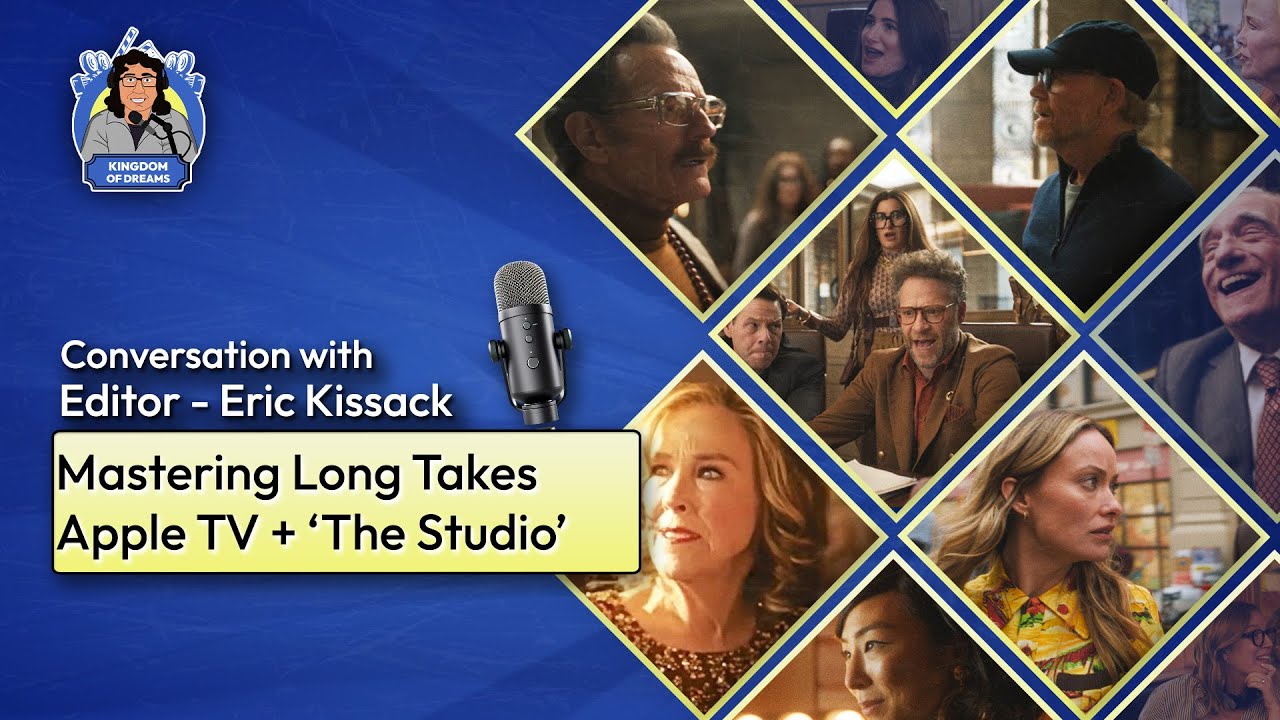
'The Studio', Editor, Eric Kissack
Clips and Shorts from this episode
About this episode
Step into the world of storytelling and cinema in this episode of Kingdom of Dreams, featuring acclaimed editor Eric Kissack. Go behind the scenes of Apple’s hit series The Studio, starring Seth Rogen, Martin Scorsese, Charlize Theron, and more. Eric reveals how live editing on set reshaped the production process, merging real-time creativity with post-production precision. From comedic timing to complex oners, he breaks down the challenges and artistry behind the cut.
Eric Kissack is an award-winning film and television editor known for his sharp comedic timing and innovative editing techniques. He has worked on acclaimed projects including The Dictator, Key & Peele, The Good Place, and Apple TV+’s The Studio. With a background in both directing and editing, Kissack brings a unique storytelling sensibility to his work, seamlessly blending humor, emotion, and visual rhythm. His diverse portfolio spans feature films, hit TV series, and viral comedy shorts, earning him recognition as one of the most versatile editors in the industry.
#sethrogan #tvseries #hollywood #visualstorytelling #appletv #audienceengagement
Full transcript
Automatically generated from the episode audio, so expect the odd misheard word or name. Speakers were labelled automatically. About 7,900 words. Tap a timestamp to play from that moment.
0:09Jawad MirGood afternoon, everyone. Welcome back to another episode of Kingdom of Dreams Podcast, The Making of Stories. Today, my guest is Eric Kissack, who is the editor on Apple's new series, The Studio, starring Seth Rogen, and a whole bunch of other cast, including Martin Scorsese, Ron Howard, Charlize Theron, and bunch of other individuals. A very fabulous series that is currently playing on Apple TV+ with four episodes in. And Eric shared some insights about being on the set and almost doing live editing, obviously before the actual post-production work. Here's my conversation with Eric Kissack on editing the Apple series, The Studio. I just finished watching the first three episodes of,.. Well, I shouldn't say I just finished. I did see the first two earlier, and I finished watching the third one, and totally loved the series. Being in the industry, I mean…... Even if, even if you're not, the pacing of the episodes, the s… the writing, the characters is just so spot on. It's just 100% spot on.
1:06Eric KissackOh, wonderful.
1:07Jawad MirYeah.
1:07Eric KissackI'm so glad that you liked it.
1:09Jawad MirYeah, no, it's something, that reminded me very much of that, but, and it's a totally different story. What was that, the one that came a couple of years ago? It was about Godfather, how Godfather was made.
1:21Eric KissackOh, yeah. Yeah.
1:22Jawad MirYeah.
1:22Eric KissackYeah. Yeah, what was that called?
1:25Jawad MirThe Offer. The Offer.
1:26Eric KissackThe Offer.
1:27Jawad MirYeah. Yeah. And, but this is a completely different, you know, obviously sets in a different time period, the insanity behind it and everything. So yeah, let's, let's start from scratch. How did you come on board? Was it as simple as someone you had worked with previously or, you know, any other process? I would love to get, the ball rolling on that first.
1:50Eric KissackYeah, I mean, I've been a comedy editor for, a pretty long time now, and, actually first met Seth Rogen when he was doing some writing on a movie I edited with S… for Sacha Baron Cohen called Bruno.
2:04Jawad MirYes.
2:04Eric KissackSo we met a long time ago. And then I'd sort of been doing a bunch of comedy editing for movies, and I'd been doing a little bit kind of like a comedy punch-up work, you know, where I'd come on and sort of help out on a movie. And, so Seth Rogen brought me on to do a comedy punch-up on Sausage Party, an animated film that he worked on. And that was the first time I actually worked for him, and it was, it was a great relationship, and he brought me back to cut the pilot for Black Monday, and then he brought me back to work on Pam & Tommy, and, Ninja Turtles. And so yeah, when this came up, he, you know, called me and he said, he said, "Would you like to do this?" And I said, "Yes, of course."
2:49Jawad MirAmazing. So what's interesting about this series is, long takes, not to mention episode two being a complete oner, right? As an editor, how do you sort o… Obviously there's, you know, a lot of, retakes, especially in episode one and three. There's... Each scene must have a lot of retakes because it's just, you know, let's say three, four minute long scene. Like, the very opening scene in the first episode I think was five and a half minutes long.
3:20Jawad MirBut then episode two is like, you know, from beginning to end, like a theater production.
3:25Eric KissackYeah.
3:26Jawad MirSo how, h… how is this, you know, a little different fr… if at all, from anything else you've done where you're working with, for the lack of better word, less material, if I wanna call it?
3:36Eric KissackYeah, I mean, it couldn't be more different. So when Seth called me to work on this, you know, he told me how he wanted to make it. And he said, "You know, I'm pretty sure the only way this is gonna work is if you're on set." And I was like, "Yeah, I think you're right." and so I was on set for all 60 days of the shoot, which is not something an editor usually does. Editors usually sort of feel strange and out of place on sets. But it was a, it was a fascinating experience. I mean, I sort of, I sort of started by kind of like having like a, like a soul-searching moment and thinking like, "Well, what is it that an editor does?" You know? Like especially a comedy editor, like what do they do, and like what are the parts that I couldn't do given the way that they were gonna shoot it? And so I kind of like broke everything down into like three different categories. Like essentially, comedy's all about pacing, right?
4:36Eric KissackAnd normally when we're in an edit, we just crank every scene. You know, we take out every extraneous word, we take out extraneous breaths. You know, we speed things up. We cut to a reaction shot so we can get a character across the room faster, so we're not waiting for them to open the door, that kind of thing, you know? It's all about pacing and rhythm, and I knew I wouldn't be able to do that with the way they were shooting, so that was like bucket one. Bucket two was improv. Like, you know, not all comedy is improv, but you know, I knew there were gonna be a lot of funny people on set, and they'd be doing different things from take to take. So there could be like a really hilarious thing that Catherine O'Hara does in take 12, you know, and a really hilarious thing that Ike Barinholtz does in take 15, and choosing between those two things would be painful. So, you know, would there be any way to kinda like combine those things? So that was sort of bucket two. And then bucket three was just transitions from scene to scene.
5:36Eric KissackI mean, a lot of times what an editor is doing is figuring out, like, how do you keep the momentum going for a whole episode? You know, like, do you need a breath at one point? So, okay, let's put in a establishing shot. You know, let's put in a shot of the sun rising over the city in the morning. You know, let's like control the pacing using, you know, like a little, a mini montage or something like that. None of which we could do in our show. I mean, our internal rule was that we could only do a cut…... When there was a big time jump, you know? So that meant no establishing shots. It meant no like, you know, like cutting from one office to another. Like, if we went from one office to another, we had to follow the characters as they went. Okay, so then w… I sort of entered problem-solving mode. Okay, how do I, how do I deal with pace and timing? Well, one thing I need to do is just sit by Seth and Evan, who are directing, Evan Goldberg, and just tell them like, "Hey," you know, af… after take four or five like, "Hey, this is, this is feeling good, but this part is feeling a little slow. Let's… let's like, let's tighten it up, you know?
6:38Eric KissackLet's, let's maybe cut this line because it's like funny, but not that funny." You know, stuff that I would have the freedom to do in the edit, but I had to do it on set, and it's very stressful to sort of say to Seth Rogen like, "Hey, I don't think this line is funny enough, you know? Let's cut it." But eventually I did, and he would almost always agree. And, you know, usually by like take like 12 or 13 or 14, we would have a version of the scene that was maybe like 80% as long as the original version, but that was flying. It had energy. Like, there was no… there were no duds, you know, that kind of thing. So that was… that was really exciting. And then part of it all was like blocking. Like, I would say like, "Okay, this moment is losing a little bit of energy because, you know, we're waiting for Ike to go to that door, you know? So let's have like say the line as he's on the move, so he's at the door, you know, at this point," that kind of thing. So it was sort of like crafting the pace of the scene live. I called it, like, live editing.
7:30Jawad MirYeah.
7:31Eric KissackSo that wa…
7:32Jawad MirYeah, no, that makes... Awesome. That's awesome. Go on.
7:34Eric KissackYeah. So that was sort of bucket one. Bucket two, improv. So, you know, it was a thorny problem because, you know, like we had these long takes, and again, Kathryn Hahn would do something wild and crazy in take 16. So what I'd started doing is I started working with the camera operator, who was amazing. Mark... God, I forgot Mark's last name. But he's… but he's like… he's like, you know, he's like a genius, and what was so genius about him was that he was incredibly consistent. Like, you would tell him, "Okay, after this line, I need you to pan from this character to this character, okay?" And he would remember to do that every single time, and he would remember like eight different moves, you know? And the reason why we did that is because… because he was so consistent and because the actors were so consistent with their blocking, we could move from take 12 to take 16 in that pan. And so I would sort of like design these moments with Mark and I would say like, "Okay, there's a big improv moment here where Kathryn Hahn is just saying something different every time. Let's put a little pan in before she does that so that I can use that as a cut point."
8:36Eric KissackBecause, you know, we can sort of like digitally manipulate the…
8:39Jawad MirYeah
8:40Eric Kissack... The moves to sort of create cuts, quick cuts. Every time you do that move at that exact time, and then I can swap takes at that moment, you know? So a lot of those takes, a lot of those scenes, it's like a three-minute scene, it's gonna be four or five different takes because I'm like, "I take the best moment from this and the best moment from this and the best moment from this," and I stitch them together on the pans, usually. And sometimes we were like a little fancy where we would have like a character cross frame and we'd use that as our cross... You know…
9:09Jawad MirYeah
9:09Eric Kissack... That as our stitch point, call them stitch points.
9:11Jawad MirThose I noticed.
9:12Eric KissackYeah. And… and we got better at those as we went along. Like, there's… there's ones that happened in the last like three or four episodes that, like, you just can't tell. Like, I'm even like b… blown away. I'm like, "Wait, we did, we did something there, right?" we just got better at like the trick…
9:26Jawad MirSure
9:26Eric Kissack... Digital trickery of it all. And then… and then… and then transitions, you know, that was just me sort of like having to keep in mind like, "Okay, wow, the previous scene, we ended close on Seth's face. We probably wanna start this next one on a wide," you know? So I'd say to the camera guys like, "Okay, we can start wide." Or like, "Hey, this is a new day. Like, can we start the camera on a shot where you can see the sun kinda coming up?" You know, like, we can't do an establishing shot, but we can include that information in the… in the pan. And, you know, I wasn't the only one who was thinking about these things, but that was sort of part of my job, just to… is to worry about that. So yeah. Those are sort of like the three things that I was like obsessed with while I was on set and, you know, I… I… I think… I think it all worked out decently.
10:12Jawad MirYeah, no, it... So it's interesting you talked about live editing, right? So not to take away anything from Mark, the cinematographer, or Evan, the director…
10:21Eric KissackMark, the camera operator. Adam…
10:22Jawad MirThe camera operator
10:23Eric KissackYeah
10:23Jawad MirSorry. Camera m… camera operator, Adam, cinematographer. But it's just you're essentially serving not... To me, not as obviously officially… ... Kinda like as a co-director, as a co-camera operator, like, you know, just to make sure everything sort of syner… synergizes together, and I think that's a really cool thing that you... Seth did to have you come on because comedy's all about timing. Everything…
10:46Eric KissackYeah
10:46Jawad Mir... About comedy is timing. And there were some things that in episode one and two that I picked up, and they... This could be just me being, biased. I… I've grown up with Se… Seinfeld, right? Like… ... Even to... I… I felt there was a lot of timing and certain s… moments of the choice of words and the way they were delivered that had that little bit of a Mash and slash Seinfeld kind of a feel to it.
11:10Jawad MirWhether it was intentional or not doesn't matter, but it just… it just connected to me at a very deep level because of those great quirky, fast, you know, to the point moments, sarcastic, serious, et cetera, et cetera. So, and that also…
11:23Eric KissackYeah
11:24Jawad Mir... Speaks a lot of volume about the characters. The characters are developed… ... Really well, even in that fast pace, which I thought was fantastic.
11:31Eric KissackThat's great. Yeah, I mean, so much of that is also, you know, a testament to the actors. Like, you know, there'd be like, you know, every time we'd do a scene with our core group, Seth and Ike Barinholtz and Kathryn Hahn and Cha… Chase Wonders, like, it was like, you know, you're watching virtuoso maestros of… of comic acting. They were just… they were just so on fire. And then every now and then you'd have someone come in who, you know, not like... Just it's not a skill that everyone has, you know? But there would be like a new person in and the rhythms would just be like a little bit off, you know? And… and so it's like not everyone could do this kind of like zany, madcap, live theater ex… performance. But the ones that could w… Luckily we had most of them…
12:12Jawad MirYeah
12:12Eric Kissack... As our core cast.
12:14Jawad Mir100%. That, and personally for me, one of the most amazing scenes was, I think it was the end of episode one when, Seth Rogen's character and Catherine O'Hara's character are sitting on this kind of a balcony of their…
12:29Eric KissackYeah
12:29Jawad Mir... Of her house, and you see the, LA downtown rainbow…
12:32Eric KissackYeah
12:33Jawad Mir... And the, that the crane comes in. And the timing of that was s… it was not the fact that it was a crane, a long take, but the way he was, his character was going on about being frustrated and everything, and as soon as the camera came close to them, the en… the moment, everything became calm. Like, you know, they…
12:51Eric KissackYeah
12:51Jawad Mir... Started talking about calm. And I thought that was brilliantly executed. Like, it's probably one of the most amazingly choreographed scene in the entire series. Beside, you know, yes, there's oners and all that, but that was something else for me.
13:04Eric KissackYeah. No, I mean, it's also the first time in the whole series that we kind of, like…
13:08Jawad MirCalm down
13:09Eric Kissack... Have an emotional moment, you know?
13:10Jawad MirYeah.
13:10Eric KissackAnd it's also, like, the first time... Like, our score is, like, kinetic, crazy drums, Antonio Sanchez, like, blasting the drums like crazy, and then we just stop and we have this jazz piece that just sort of, like, has a piano and it just feels so different, and they create such a wonderful, a… a… effect. The, that was the first piece of music that I put in to the whole show that was not, like, just pure drums, and, like, everyone who heard it was like, "Oh my God, it feels so... It's such a nice moment to just, like, take a breath for a second."
13:42Jawad MirYeah
13:42Eric Kissack... That scene was funny because we shot that scene, you know, rehearsed it a lot and we shot it. We shot it, like, 15 or 16 times, and it was raining. It was, like, gross and cloudy and raining, and we shot the scene and we, you know, we basically... You couldn't really tell that it was raining. It was, like, drizzling, you know. And we got it and we felt, like, pretty good about it, you know, and then we start, like, packing up to, like, move on to the next thing, and all of a sudden the clouds part and the sun comes out and there's a rainbow, you know. I'm like, "Oh my God, go back." And they like, everyone, like, jumps on the camera gear and, like, Seth and Catherine ran out there, and so, like, that take was, like, the moment the clouds parted and we shot the whole thing again.
14:21Jawad MirOh, awesome. I actually thought the rainbow was a post, so it was real…
14:25Eric KissackWe figured everyone would assume that, but no, it was real.
14:28Jawad MirYeah. That's really awesome. That is so cool. That, those are the best times in production, like, when you, when you just randomly get stuff very quickly and if it, you know, i… in a very quick manner. So that's super awesome, man.
14:40Eric KissackYeah
14:41Jawad Mir... So moving on to the second p… part, episode, I'm just kind of going in not any particular order, but…
14:48Eric KissackDo your thing
14:49Jawad Mir... The fact, the fact that it's called The Oner, it, to me, it looked like a oner. Were there any cuts in it?
14:59Eric KissackYeah. Yes. Yes, there were.
15:01Jawad MirYeah. I thought so.
15:03Eric KissackYes.
15:04Jawad MirI gotta watch it again now.
15:06Eric KissackYeah. So we shot it in, we shot it in 10 different pieces. ... So it was designed to be 10 different pieces sort of stitched together. And then because of, like, the kind of the improv and, you know, the nature of that and kind of combining takes, we ended up adding a few more cuts. We didn't have to, but it was just like, oh, you know, we love this part of take 16 and we love this part of take 17, and so let's, let's, you know, combine. So I think all told, there's about, like, 18 cuts in there. And you know, I mean, like we kind of nod to that. Like, at one point, you know, Seth ruins a take, and Sarah Paul gets really upset and Seth says to her, you know, "Well, why don't we just pick it up and we can stitch it together," you know? And she's like, "No, we're not doing stitches." And he's like, you know, "What? Even 1917 would, like, you know, do stitches…
16:04Jawad MirYeah
16:04Eric Kissack... For this part, that part," you know. And the camera's panning back and forth, and each time the camera pans back and forth we did a stitch. We didn't even have to at that moment, but we just thought it'd be funny to do that. So each time we're moving back and forth, we're actually cutting to a different take, just in that one scene. But yeah. So that was, you know, it was designed to be different parts, but then, but then we, you know, we used the stitching to sort of combine our favorite performances and pace up certain moments and that kind of thing. And we'd also designed it, you know, we, each time we go into the TV to watch, like, them actually shoot a real take, you know, that's all done in post. And so we were able to sort of control the timing.
16:43Eric KissackIn the case of that, we were like, you know... Yeah, like, it's, it's funny, yeah, like I'm always amazed when visual effects work out really nicely, and so, like, you know, we, the camera pans to the TV and then we would cut, and then, like, someone would be like, "Oh, wait. Should we, like, hold on the TV for a while 'cause we're gonna, like, you know, have to, like..." You know, and then, and then Sandro, our VFX supervisor, would be like, "No, it's fine." And so, like, you're just, like... I, every time I watch that scene, I always, like, watch the edges and, like, the, like, all the movement of the camera, it's all just, like, created in post. It's, like, not real, you know? They're just making it look like we were holding on that TV for a long time.
17:20Jawad MirBut you know, the cool thing is that you can, you, Ken, or I, or anybody else can say a lot about VFX or 18 stitches shots or whatever that is, but nevertheless, to have an entire episode in couple of different rooms and to have the dialogue and the script pretty much... Like, it literally, it's a, it's a, it's a, it's a appeasement between Seth Rogen's character and what was the director's name? She's Canadian…
17:47Eric KissackSarah Paulson
17:47Jawad Mir... I forget. Sarah Paulson, right? It, that's all it is, but to be able to carry that out with so many conflicts, with so many, you know… ... It's, it's a pure ma… It's not that simple. It seems very simple, but it literally felt like, again, I'm, I'm not trying to draw a compare, like a Seinfeld episode. It was, like, literally…
18:04Eric KissackYeah
18:04Jawad Mir... About n… nothing.
18:06Eric KissackYeah.
18:06Jawad MirIt was just him trying to connect, but that's all it was about.
18:09Eric KissackYeah.
18:09Jawad MirBut it was carried out for what? 30, 40 minutes? I don't even, I don't even check the time how long the episode was.
18:13Eric KissackIt's not, it's not, it's, it's literally about 30 minutes, yeah.
18:16Jawad Mir30 minutes. Okay
18:17Eric KissackYeah. I mean, I mean, Pete Huyck, who wrote that episode, you know, he comes from Veep, which is another show that kinda does those dynamics so well. That, you know, I think that script is also... It's j… it's just genius. Like, every… everything that happens is planted perfectly, like, every m… moment. You know, like the fact that, like, Seth feels protective of Doug, the PA, because he used to be a PA. And like, you know, like every… everything is planted perfectly. It's a... I love that script.
18:48Jawad MirAwesome. And, obviously you were on the set. I mean, seeing Martin Scorsese, and this is the second time or... I think he was in Shark Tale, which was a long time ago… ... The animated film. But, just to see him in that kind of a perfo… obviously, he was playing who he is. You know…
19:03Jawad Mir... He's gone through all that stuff about studio art versus money.
19:07Eric KissackYeah.
19:07Jawad MirWhat was that experience like being there with him and being in front of the camera at least for him?
19:13Eric KissackI mean, it was crazy. I mean, he walked on set and everyone was so nervous and, you know, even Seth was like, you know, I think Seth tells the story where, you know, and he would talk about it on the day, but, like, the morning of the shoot, Seth's mom called him and was like, you know, "You're gonna, you're gonna direct Martin Scorsese today?" Like, you know, "What if, what if he doesn't like you?" You know, like, "What if he, what if he thinks you're doing a bad job? Like, how are you gonna deal with that?" And Seth was like, "Mom, come on." so everyone was super nervous and he just walked on set and he just... You know, the funny thing about all these episodes, we have a number of directors in the episodes, everyone from Ron Howard to Martin Scorsese to, Olivia Wilde, to Sara Polley. Every single director was so happy to be there because they didn't have to direct. Like, directing…... You know, it is... Can be incredibly stressful. And…
20:09Jawad MirIt is
20:09Eric Kissack... Like, literally they were just giddy. You know? Like, Martin Scorsese walked on set and he was, like, skipping. He was so happy to be there. And he was doing, like, a bit. Like, he, like, walked in and he... His whole bit was that, like, he didn't understand filmmaking. Like, he didn't know what any of it was, you know? And so, like, the DP would walk up to him and be like, "Hi, I'm, I'm Adam. I'm the DP." And he'd be like, "Oh, what is that? What do you, what do you do? What's, what's your job?" You know? And, like, it was so weird and kinda like corny, but, like, everyone just loved it and ate it, ate it up, you know? And it was just everyone was laughing and, it was a great... It was great. He, and, you know, and he was, and he's amazing. Like, we were so nervous, you know? We had a, we had a teleprompter, in both of his scenes, with all his lines on it, that was actually in the scene, and we actually digitally painted it out.
21:02Eric KissackAnd, you know, 'cause we were like, "He's like an 80-year-old dude. Like, he's not gonna remember all these lines," you know? And he, like, didn't need it. He was, he was great. He was, he was perfect. Yeah, it was a joy. It was a real highlight.
21:14Jawad MirAmazing. I'll come back to, the studio, in a second. I just wanna revisit your beginning, beginnings of your career. How you were inspired or what was the catalyst to be on a journey that has brought you to where you are today?
21:33Eric KissackI mean, you know, I always loved films as a kid. I just, I just... It was like, I obs… was obsessed with movies. It was, you know, in the '80s and, you know, my family would go to the video store every weekend and pick out a couple movies to watch, and we would watch them. And, you know, it honestly never really occurred to me that I could, like, work in movies. Like, I just assumed that the people doing it were these incredible geniuses who, you know, were m… way smarter and more talented than I could ever be. And, you know, I had no contacts in the industry. I kinda, like, knew nobody. I was in New York and I just, I was like, "Maybe I should just, like, teach myself how to edit." Like, I was good with computers and at the time, like, Final Cut 1.0 had just come out and, like…
22:24Jawad MirYes
22:24Eric Kissack... I got a copy somehow and I started…
22:26Jawad MirOf course
22:26Eric Kissack... Messing around with it. Yeah. And I loved it and I... And it was like, you know, it was like, it was... I… again, like, I couldn't imagine being part of the industry, but I knew I was good at putting... Touching my keyboard and doing the stuff, you know? And like anyone in this business, I just got really lucky. I met a guy who was,.. Sort of became my mentor, and he was an editor, and he w… edited a pilot for Comedy Central called Stella…
22:56Eric Kissack... Which was this David Wain show. And he asked me if I wanted to assist him, and I said yes. And then, like, right after the pilot, he was like, "You know what? I'm gonna become a therapist," and just, like, quit. And David Wain…
23:09Jawad MirWow
23:09Eric Kissack... Was like, "Do you wanna edit the show?" And I was, "Yes."
23:13Jawad MirWow.
23:14Eric Kissack"Yes, I do." and so, like, that was my first, you know, editing job in television. And then, like, you know, right after the show wrapped, David says, "Oh, I'm, you know, I'm going to work on a, on a TV show... On a movie called The Ten, and it's actually great. It's, like, 10 short films that sort of, like, were put together to be a movie. And so, like, you know, you've never done a movie before, but maybe you could do, like, one of them, you know?" and I was, like, a 20-something kid, and I was like, "That sounds really cool, but, I wanna do all of them." And he was like, "Okay, come on, you know. Like, you do three of them." And I was like, "Great. All of them." And he was like, "Fine, I'm gonna get two editors. You each do half." And I'm like, "Nope, all of them." Until he was, like, worn down, and he finally just let me do all of them. And so that was my first movie. And then, and then he got a bigger movie. Then he got his movie, Role Models. It was, like, his first, like, Hollywood movie with... It was Paul Rudd and Sean William Scott. And, you know, again, he was like, "Well, you know, they're probably not gonna hire you 'cause you've never done a Hollywood movie," you know? And I was like, you know, "You make them hire me," and He eventually did.
24:20Eric KissackAnd, yeah. And then, like, you know, it was like… There's so much luck involved, but yeah, Role Models came out and Sacha Baron Cohen happened to watch it and was like, "This movie's really good." he literally called me up and he was like, "Do you wanna edit Bruno?" And I was like, "Yes, I do." and, yeah. And then, you know, you're sort of off to the races.
24:42Jawad MirYeah
24:43Eric Kissack... Yeah.
24:44Jawad MirYeah, that's cool. And you know, p… people talk about luck, and I've spoken about luck on this podcast, which I agree with to a certain extent, but luck only comes if you work hard.
24:53Eric KissackYeah.
24:53Jawad MirI mean, if you're not, if you're not pushing, if you didn't push the, him to give you 10 films, right?
24:59Eric KissackYeah.
25:01Jawad MirRight?
25:01Eric KissackYeah.
25:02Jawad MirSo I think the word luck sometimes is misinterpreted by a lot of people that, "Oh, you just got lucky." No…
25:06Eric KissackRight
25:06Jawad Mir... You gotta work your way towards it, right? So it... I know you're probably trying to be humble, but…... There's a lot of hard work and everything involved which brings you luck.
25:15Eric KissackThere is, but you know, I mean, like, I completely agree with everything you're saying. But I also know editors who are just as hard-working…
25:23Jawad MirI get it. Yeah
25:23Eric Kissack... As me and just haven't had the breaks, you know?
25:25Jawad MirYeah.
25:25Eric KissackSo it's like a combination.
25:27Jawad MirYeah, 100%. 100%.
25:28Eric KissackYeah.
25:29Jawad MirGoing back to the studio, so it's, it's an exact representation, maybe sometimes a little bit over the top because it's comedy, you know, of what Hollywood has become, you know, the whole art versus money thing, the IP. I mean, Kool-Aid movie, like, you know, I think that was, like, such a, such a fine parody of what really Hollywood has become.
25:53Jawad MirYou know? And to be able to be part of that industry and make the hell out of, fun out of it, on the actual sets, were there a lot of laughs? Like, were people, like, kinda like, "Oh, are we pushing to the boundaries too much?" Or, you know, w… what was that environment like?
26:11Eric KissackIt was wonderful. I mean, you know, yeah, I mean, I... It's a testament to Seth and Evan, like, they've just been in this business for so long, you know? They knew how... They, I mean, they've been collecting these stories for years, like, you know, it's why it feels so authentic. It's like every, you know, every one of these stories is something that either happened to them or happened to a friend of theirs or something like that, you know? But they also just, yeah, they created a great set. I mean, there was constant laughter. It's, you know, it's hard work. Like, sometimes you're…
26:43Jawad MirYeah
26:44Eric Kissack... You know, there at 3:00 in the morning doing a night shoot and everyone, you know, is just miserable. But, like, you know, there's also a ton of laughter. You know, it never felt... It... There was never, like, a moment where it felt like, you know, we're doing something, like, wrong. Or, yeah, you know, like, there was this... It's funny. The... So the first episode sort of climaxes with this scene where, Charlize Theron's having a party and Martin Scorsese, like, you know, is just, is crying and, you know. And this, the episode was written to end there.
27:30Eric Kissack... It was written to end at the end of that party, as they scurry off, and Martin Scorsese is crying. And it was, like, the one time we're making the show where we were like, "That doesn't feel right," you know? Like, this show is not about just, like, being a wrecking ball and making people cry, you know? It's about these guys that are, they're trying, you know?
27:55Jawad MirYeah.
27:55Eric KissackThey're trying their best. They're screwing up left and right, but what it comes back to ultimately is loving movies, you know? And so they're doing it because they love movies. They're, they're, they're not doing it to be, to ruin people's lives, I think, which is actually a character, something that Chase says in episode three. And so they added the scene where it's just, like, Seth and Ike are just watching Goodfellas together at the end, you know? I mean, it's, like, nothing really happens in that scene. It's sort of a funny way to end the episode because, like, there's not, like, a huge laugh, you know? It's sort of like, there's not, like, any big plot thing that happens. It's just two guys who love movies watching a movie they love, you know? But it just felt right. It felt like this is what the show is. This is the feeling of the show. And so yeah, it was, like, the only time where we were like, "Ah, gosh. Something feels wrong." And then, and then I was really happy with how they kind of fixed that or righted that ship.
28:52Jawad MirNice. That's nice, n… nice of you to s… tell me that. I just thought, I don't know if this was intentional in the script or not, but when you have that scene where Scorsese and Charlize Theron are in the background and he's just kinda crying…
29:05Jawad Mir... I ju… I just thought it was interesting 'cause she is tall.
29:09Eric KissackYeah.
29:09Jawad MirAnd he is not your average height. So I think that juxtaposition in the background, even though it was…
29:15Eric KissackYeah
29:15Jawad Mir... At the top of... I thought that was brilliant. I don't know, again, it was, I don't know if it was in the script like that, or... It just spoke so much.
29:22Eric KissackYeah. I think it was in the script like that, and, yeah. And Adam who, our DP, who, you know, responsible for sort of, like, a lot of where the camera e-w… almost all the where the camera ends up, you know, I love the way he kind of built that work with Cam, where we sort of, like, follow the guys in profile to the bar and the camera swings around and you see it in the background. Yeah, there's a ton of, there's a ton of... You know, because you can't, like, cut to a shot of them hugging, you know? And, you know, like, all those shots had to be so well-designed, where you're seeing…
29:53Jawad MirYeah
29:53Eric Kissack... The pieces that you need to see, and he just did an amazing job with that.
29:57Jawad MirYeah. That's, it's, it's all about a c… chor… choreography, right? The entire sh…
30:00Eric KissackYeah
30:00Jawad Mir... I mean, this, m… every show and movie is, but this is just another level because the way you guys executed everything. And…
30:09Eric KissackIt's w… just one thing about that, it was just like…
30:11Jawad MirPlease
30:11Eric Kissack... You know, we, Seth, you know, Evan, Seth was often on set in the scene. Evan Goldberg and I were often sitting behind the camera, behind the, behind the monitors, you know? And so we would just see what the camera was seeing. We wouldn't see what was going on set. And you know, there's a s… there's a shot in episode three, the Ron Howard…... Scene where it starts and Seth…
30:33Jawad MirYeah
30:33Eric Kissack... Pauses and there's just like a little, like, chess board in the foreground, and the camera kinda, like, moves up towards Seth. And we were like, "Oh, that's nice," you know? Adam found a nice little way to start the scene, you know? And then, like, at one point, like, we, like, poke our head just, like, into the set and we see there's, like, five guys, like, manipulating the camera around this chess board, like one guy kinda lifting it up, another guy clipping it onto a steady…... You know, with, like... And it's just, like, it was amazing. It was, like, just to see this simple little thing and all the work that goes into it. And every one of the scenes is like that. It's like, you know, there's... I think Apple's posted some, like, behind-the-scenes videos, but just, like, you know, like a camera that's on a steady cam that gets hooked to a crane to follow them up the stairs, and then gets hooked to another steady cam, and then gets passed to another... You know, it's like y… it… the choreography is just amazing.
31:21Jawad MirYou know, it's funny because, I forgot the name. I was just, before,.. Just give me one second. So this morning I was on social media. Yeah, it's called Soy Cuba.
31:36Eric KissackYeah. Yeah.
31:37Jawad MirSoy C… y… you know what I'm talking about, right?
31:39Eric KissackSoy Cuba. Yeah. Yeah, sure.
31:39Jawad MirYeah, it's made in 1964. And how it begins, the shot is basically a funeral, and it… ... Begins at, with a woman and the camera pulls back, and then it goes up, like, four or five levels, goes into a room where they're sort of finalizing a flag, and then it goes out another window and all the way over to a giant crowd. I mean, that's pretty much... It's so funny because I saw that this morning and I'm supposed to, I was supposed to talk to you. I just saw so much connection there between…
32:13Jawad Mir... That. It was a completely different m… tone, but the story and the energy was the same, right? So…
32:20Eric KissackWell, it's funny because, you know, I mean, like, we,.. Anyone who loves, who loves film loves one-ers. I think it's safe to say that, you know?
32:26Jawad MirYeah.
32:26Eric KissackIt's like just this... Because it's rare, because it's, like, all the technical wizardry, you know? A… and so, you know, like, the fact that... I think of it as one of the best compliments I've received, that some, a lot of people, even people who are in the, are in the film industry, in the film industry don't realize that we're doing these long takes sometimes. You know, like, eventually maybe they figure it out, but, like, people who watched the pilot were like, "Really? Those were all long takes?" You know? And I feel like that's such a compliment because, you know, it just, it meant that we were able to keep the focus on the dialogue and the camera and the story and the characters, you know, while also doing these things. And so it's like, you know, sometimes, like, there's this, there's this speech in episode two where, you know, Ike says, like, "One-ers are so stupid. They're just, like, the director jacking off in f… front," you know, "in front of the audience. Like, you know, no one cares." And so, like, what was nice about the studio was being able to sort of create these scenes that people could sort of, like, if they notice what was going on, they could marvel at and they could sort of say, like, "Wow, how'd they pull that off?"
33:33Eric KissackBut if, but if you didn't notice, you would just be completely engaged, you know? That's always the worry about the one-er, is that, like, are you, are you actually engaging people or are you just showing off? And I think we hit that balance. And it was really hard, but just, like, just, you know, always, something's always being said or done or, you know, or someone's falling or hurting themselves you know? Like, there's, there's always something happening, which was always, was always the goal.
34:00Jawad MirAnd it's, it's so true that you said that, because for me, I remember when I watched the first... So I had seen the trailer. I saw the featurette and then I finally saw the series. I started watching the series. So it wasn't until the sequence where Brian, Carson's, Garrison's character comes in…
34:16Jawad Mir... That's when it hit me, "Is this, like, a long take… ... Series?"
34:21Eric KissackYeah.
34:21Jawad MirAnd then when you mentioned earlier about the music track, I honestly don't remember any music track in the entire series.
34:26Eric KissackThat's great.
34:26Jawad MirLike, all the three. I… all the three, I have no clue if there was even music.
34:30Eric KissackYeah. Yeah.
34:31Jawad MirAnd that is a testament to everything that you guys are doing.
34:34Eric KissackI mean, that was, you know, one of the hardest things in post was finding the right music, you know? Because we needed something. You know, we would try the scenes dry, and they'd be s… good. They're still good scenes, but, like, they would always be this kind of, like... We wanted them to feel, you know, just more exciting, intense and, you know. And so we were like, "Well, what other movies have kind of tried that?" And the only, like, kind of movie that we could think of that had tried combining one-ers with some kind of comedy was Birdman. And so we were like, "What did Birdman do?" And Birdman had this very, like, kind of, like, percussive, like, jazz drumming score.
35:10Eric KissackYou know, we started taking some, like, Birdman tracks and, like, putting them on the scene, and we were like, "This works. This is great." Like, this just, you know, it doesn't draw too much attention to itself, it doesn't shade the emotion, but it just keeps, like, the energy and the tension up, you know? And so we were like, "Maybe we should hire the Birdman guy." And so we, like, called up Antonio Sanchez, who did the score for Birdman, and we, he was our, he's our composer, and he, like, I mean, he just surpassed himself on every level. You know, like, we knew he was an amazing jazz drummer. That's what he's known for. But, you know, there's an ep… episode four, is, which just is airing now, is a noir episode. They kind of are, sort of get sucked into this noir mystery. And he, like, wrote, like, a full-on noir score with, like, you know, beautiful melodies…
36:00Jawad MirThat's so cool
36:01Eric Kissack... And, you know, and, like, he just, he just delivered on every level. So yeah. So, I don't know, if you, I don't know if you've seen episode four yet, but if you do, hopefully you do notice the music, 'cause it's really great.
36:11Jawad MirYeah. No, I'm gonna, I'm gonna wait until the fifth one comes out, then I'll watch them back to back.
36:14Eric KissackYeah.
36:14Jawad MirI like to watch them in twos and…
36:17Eric KissackRight
36:17Jawad Mir... Threes, just b… especially when it's a good show, a good series, so you don't…
36:20Eric KissackNo, that makes sense
36:21Jawad Mir... Feel, like, left hanging. So now the show is coming out I think on a weekly basis. How many… ... Episodes are there? 10 or nine?
36:29Eric Kissack10. Yep. 10.
36:30Jawad Mir10. So you got another six weeks, so probably by the end of May it will be done, more or less, I think, right?
36:35Eric KissackYeah. Yeah.
36:36Jawad MirWhat is after that for you? Or what is after, like are you already done with that anyways? What is, what are you... Are you working on anything exciting that you can talk about or?
36:45Eric KissackYeah. I'm, I'm, I'm doing, it's funny we just mentioned noir, I'm working on a live action Spider-Man noir TV show, starring Nicolas Cage, who is, who, you know, I don't know if you've seen the Spider-Verse movies, but…
37:04Jawad MirYeah, I have
37:05Eric Kissack... But he plays this character in the Spider-Verse movie called Spider-Noir. It's just his voice. But it's like another alternate dimension version of Spider-Man who is from like the 19… he's like from a 1930s noir movie. And so yeah, we're doing this crazy eight episode show. It's black and white. It's 1933 New York, and Nicolas Cage plays a kind of like, sort of like o… you know, over the hill version of Spider-Man who's also a private detective, and it's weird and funny and pretty great.
37:38Jawad MirOh, wow, that sounds exci… I'm not a superhero Marvel type of, like I don't really follow that much, but I have seen the first two Spider-Man films… ... And the first two Spider-Verse. That sounds very interesting.
37:49Eric KissackYeah.
37:49Jawad MirAnd when is it supposed to come out? Is it in production?
37:52Eric KissackIt doesn't come out 'til next year, but it's like early next year.
37:55Jawad MirSo it's alread…
37:55Eric KissackEarly, yeah, '26
37:55Jawad Mir... It's already finished production or more or less almost, yeah.
37:58Eric KissackWe finished production, and we've got a ton of visual effects and editing to do, you know. But yeah, no, I've, I've, this is, I've never done any superhero stuff mostly because it didn't interest me that much, but this is, this was exciting and, it's different and, you know, it's a very, it's a very unusual superhero show. It's fun.
38:17Jawad MirAwesome, and this is gonna be for Disney…
38:19Eric KissackFor Amazon
38:20Jawad Mir... Or? Amazon. Amazon. Amazing, man. Listen, I, A, I would love to talk to you about that whenever that comes out in January…
38:27Eric KissackGreat
38:27Jawad Mir... February, March, but before the Sis series ends, I would love to have you on maybe just before the last episode.
38:34Eric KissackLet's do it.
38:34Jawad MirIs let's do it. And maybe if you're interested, I, we haven't done it, we're trying to do a live episode, so if that's something you're up for, that'd be super cool. I'll leave that up to you.
38:44Eric KissackSounds good.
38:45Jawad MirAwesome, man. Well, thank you so much for your work. It's phenomenal.
38:48Eric KissackOh, thank you so much. It's really, this has been great. It's really, enjoyed talking to you.
38:52Jawad MirLikewise, man. Take care.
38:54Eric KissackTake care.