
Episode 326 · September 28, 2026 · 16 min
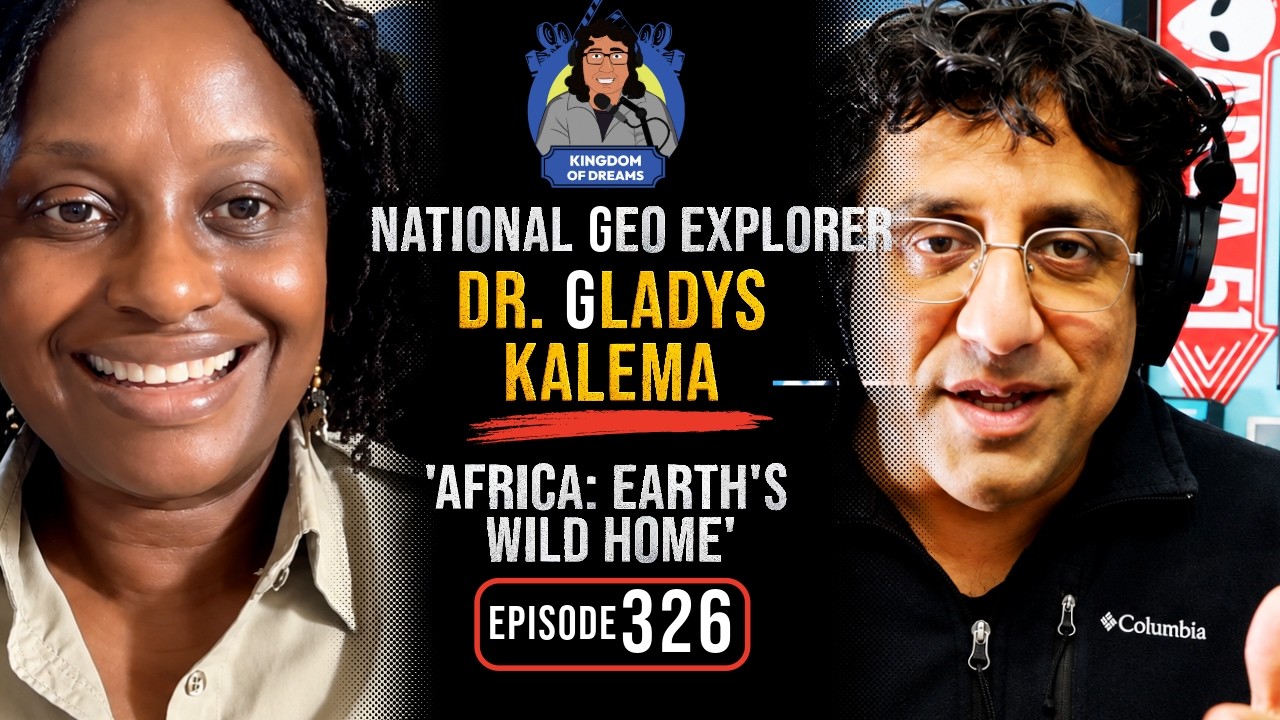
'Africa: Earth's Wild Home', Dr. Gladys Zikusoka, National Geographic Explorer
Clips and Shorts from this episode
About this episode
🎙️ On this episode of the Kingdom of Dreams Podcast, I sit down with National Geographic Explorer Dr. Gladys Kalema-Zikusoka to discuss her role in the new National Geographic series Africa: Earth’s Wild Home.
Dr. Gladys shares her journey into wildlife conservation, how she became a veterinarian, and the family expectations she faced around becoming a human doctor rather than an animal doctor. We also explore her work with mountain gorillas, her experiences featured in the series, and what decades of working closely with wildlife and communities have taught her.
It’s a fascinating conversation about conservation, following your passion, family expectations, Africa’s extraordinary wildlife, and the lessons we can learn from the natural world.
Dr. Gladys Kalema-Zikusoka is a Ugandan wildlife veterinarian, conservationist, and National Geographic Explorer known for her pioneering work protecting endangered mountain gorillas. She is the founder and CEO of Conservation Through Public Health, an organization connecting wildlife conservation with community health. Her work has helped strengthen the relationship between people, wildlife, and their shared environment across Uganda and beyond.
#nationalgeographic #africa #wildlife #natgeoseries
Full transcript
Automatically generated from the episode audio, so expect the odd misheard word or name. Speakers were labelled automatically. About 2,700 words. Tap a timestamp to play from that moment.
0:00Jawad MirYour experience working on this National Geographic series in partnership with Rolex, what have you learned s… in terms of the significance of that storytelling coming from the area of expertise that you come from, but sort of tying that into the, you know, world of entertainment and series or film?
0:18Dr. Gladys Kalema-ZikusokaThat's a great question. I would say that storytelling is really important if you want to win support from the general public and from people outside your field. Actually, quite early on in my career, working as Uganda's first wildlife vet, National Geographic filmed me in a film called Saving Uganda's Wildlife. I was only about 27 at the time, and the film producer who, Jane Murray-Franklin, really taught me how to start telling things really simply to the general public. And as I've gone along, when we founded our nonprofit conservation through public health in 2003, I realized the value of storytelling in raising support for our work, not only from the local communities and the government, but from people outside Uganda. And National Geographic, since I became an explorer in 2018, they've really taught us storytelling, the importance of storytelling, because it can really change the world.
1:18Jawad MirThank you so much, Dr. Gladys, for joining. I truly appreciate it.
1:23Dr. Gladys Kalema-ZikusokaThank you for inviting me.
1:26Jawad MirI, really enjoyed, going through the series that you have worked, that you participated in, you know, Earth's Wild… Africa: Earth's Wild Home. And I just wanted to start off with one of three question. What do you want the audience to take away from the series?
1:45Dr. Gladys Kalema-ZikusokaI'm really glad you enjoyed the series. I would say that one of the things I'd like the audience to take away is that you can't take care of the gorillas without taking care of the health needs of the community, the health and wellbeing of the communities who share their fragile habitat.
2:08Jawad MirAmazing. And before I go on to the next couple of questions, if you can just give me a little bit of a background as to how you got to be in this field. What inspired you? What was the catalyst that brought you into this world, and the journey that you took?
2:25Dr. Gladys Kalema-ZikusokaI would say that I've always grown up with lots of pets at home. As the last born of a family of six, so the pets, and my older sister was over five years older than me, so the pets became my companions, and I grew up with many cats and dogs. But it wasn't until a vervet monkey belonging to our next-door neighbor came, watched me playing the piano, and imitated me that I thought, "Wow, so this particular animal, not only do the fingers and fingernails look like mine, they can also play the piano." So my fascination with primates began. A few years later, I got an opportunity to set up the wildlife club in my high school in Uganda, and when I went to the national park, I was very disappointed that there was very little wildlife in the national park. There were no lions or leopards. We could even take a walking safari, and I thought, "Why don't I become a vet who brings back the wildlife?" The elephants had gone to neighboring Democratic Republic of Congo, and this was, like, in the '80s, the late '80s. So when I went to vet school in the UK, I felt like I wanted to be a vet who also works with wildlife, but when I came back to Uganda during my vet school, as part of my research, I did research in Bwindi, Impenetrable Forest, and I saw how threatened the gorillas were.
3:42Dr. Gladys Kalema-ZikusokaTheir habitat was disappearing, and there were only about 650 gorillas left in the world, and only about 300 in Bwindi, and I could see that we could get really close to them and make them sick. And I s… decided to become a full-time wildlife vet straight away, and convinced the director of Uganda National Parks to hire me as their first vet. And that's…
4:03Jawad MirThat's amazing
4:04Dr. Gladys Kalema-Zikusoka... Where the journey began.
4:06Jawad MirThat's awesome. You know, y… you gave me some of the best parts of the story, but I always am curious, because what you do, what a lot of people do, what I do, is something that is out of the norm, you know, in terms of your…
4:20Dr. Gladys Kalema-ZikusokaYes
4:20Jawad Mir... Profession and career. Was there a battle with your family about why are you dealing and working with animals as opposed to, you know, doing something else that's, quote, unquote, "better for the society"?
4:34Dr. Gladys Kalema-ZikusokaThat's a great question, coming from a African society where animals w… are not really considered... You know, being an animal doctor wasn't considered as prestigious as being as a human doctor. You know, one of my siblings said, "Why don't you just become a human doctor?" But I hated seeing animals suffering, and whenever I'd go to the hospital, I hated seeing... I hated being in hospitals. And because my mom saw how much I loved animals, she said, "Let her be an animal doctor. Even if it doesn't earn her a good living, at least she'll be happy." You know, she said, "When I pass on, when I leave this world, I want her to be happy," which is what happened last year, actually. She left this world, and she said she'd rather I'm passionate about what I'm doing than having to do something that I don't like. But then one thing, though, she was very concerned about was when I said to her that I want to work with mountain gorillas, she was very scared. She thought that they would maul me or something like King Kong, you know, like them Hollywood movies of King Kong.
5:35Dr. Gladys Kalema-ZikusokaAnd so that was a bit of a battle convincing her, 'cause she was a protective mother, but eventually I convinced her, and when she got to see them a few years later, she said, "Oh, they're just gentle vegetarian giants living in a big salad bowl." So
5:49Jawad MirThat's awesome. I'm sorry for your mom's loss. May she rest in peace. I… you talked about animal suffering.
5:57Dr. Gladys Kalema-ZikusokaYes
5:57Jawad MirI'm sure you've witnessed a lot of them, right? But if you can pinpoint, I know it's gonna be hard, to s… one particular incident where a…... An injured animal or a suffering animal really got to you, and if you can just share briefly a story of that and behind that.
6:16Dr. Gladys Kalema-ZikusokaYeah. I would say that very early on in my career as Uganda's first wildlife vet, essentially, there was a... Oops, sorry. There was a, gorilla that was sick. They told me that the gorilla has a losing hair and developing white scaly skin. So I contacted a human doctor friend of mine, and I asked her, "What is the most common skin disease in people?" And she said, "It's scabies," which I found surprising, 'cause in my vet school in UK, people never got scabies. They would occasionally pick up temporary infections from their pets, but it wasn't a permanent one. And she said, yes, low income groups of people in Uganda get preventable diseases like scabies because of inadequate hygiene. So that was very important for me, because I was able to get a bottle of ivermectin and drive the 10-hour journey to Bwindi. And when we got there, I was with a vet from Kenya Wildlife Service who was helping to set up the vet unit there, and he told me he had seen scabies in cheetahs in Maasai Mara that were visited by very many vehicles.
7:19Dr. Gladys Kalema-ZikusokaSo when we got to the gorilla family, they... It really looked like scabies. We treated the juvenile that was scratching a lot, even under the effects of the anesthetic. And la… sadly, the mom dropped the baby that was worst affected, and when we took samples and analyzed them, it was scabies. And then I looked around me, and I found out that there was a high incidence of this disease in the local communities, and this particular gorilla family like to go outside the national park to eat people's banana plants, which is something that they do once they lose their fear of people. They start to range in places they used to range before their forest home was cut, and that's how they probably picked it up, by touching dirty clothing on the scarecrows. And so that was a life-changing ex… incident for me because it made me realize that as a veterinarian, I can't only focus on the animals, I also need to think about the people who share their fragile habitat.
8:14Jawad MirWow, incredible. Thanks for sharing that. With this series, what do you hope that people walk away with, you know, the relation… the connection between... The audience walks away with the, with the connection between the humans and the wildlife. If you can sort of talk about that a little bit, that how important it is for us to be in touch, you know, obviously in space, but also i… mentally with the wildlife.
8:44Dr. Gladys Kalema-ZikusokaYes. I would say that the, this At Home series for Africa is really bringing this out, showing the importance of the coexistence. You'd rather call it coexistence rather than conflict between people and wildlife. How can we make people coexist with wildlife? The wild places are almost gone. You can't put wildlife separate from people. You just have to find a way that people can live in harmony with wildlife. And so this series really brings it out, and our particular s… story or journey is showing how, you know, as much as people mix with gorillas, as long as you're making sure that people are becoming healthier and their wellbeing needs are being met, they'll coexist with the wildlife. The Perpetual Planet, expedition of which I'm doing, the Perpetual Planet that's supporting our work, the Rolex Perpetual Planet, is actually helping us to build upon what is in the series.
9:44Dr. Gladys Kalema-ZikusokaWe're now trying to see, yes, gorillas go out, and I know in the series they show the gorilla guardians who had gorillas back and how we keep them going, but what else can we do? We are finding that within the forest, the nutritional quality of the plants that the gorilla's eating is reducing, and that could also be another driver for them going outside the park. How can we manage this, and how can we de… find out where the hotspots are so that the gorilla guardians and the rangers can be deployed in appropriate areas to reduce this human-wildlife conflict and the risk of them picking up human diseases? So it's, it's actually building upon
10:22Dr. Gladys Kalema-Zikusoka... The series, and it's something... I mean, it's ongoing work. I mean, it's showing that there's still a lot to be done to make sure that people and wildlife coexist, but when they do, it's gonna be a win-win situation for the wildlife and the people and our planet.
10:39Jawad MirThat's awesome. Just, two quick questions. One, are you planning to show, any parts of the series to your gorilla friends?
10:47Dr. Gladys Kalema-ZikusokaTo my, to my gorilla friends?
10:49Jawad MirYes.
10:51Dr. Gladys Kalema-ZikusokaTo the gorillas themselves?
10:52Jawad MirYes.
10:54Dr. Gladys Kalema-ZikusokaNot really. They're completely wild.
10:58Jawad MirI know. I know. I just, I just thought I should drop that there.
11:00Dr. Gladys Kalema-ZikusokaThey're completely wild, but I have to say that, I have visited zoos in America, and given talks, and I think it was the Smithsonian, the zoo in Washington, DC where, the National Zoo, where they actually enhance the captive gorillas with TV.
11:18Jawad MirOh.
11:19Dr. Gladys Kalema-ZikusokaSo it could be shown as TV to captive gorillas, and they may actually get excited. I think they would seeing their cousins in the wild, I think they'll relate to that.
11:28Jawad MirThat's awesome. And lastly, storytelling, whether it's in the form of a book, an art, a movie, a TV series, is one of the most powerful things in the world, right? And in the last 20 years, all these amazing shows and series about wildlife with so many different angles have, you know, come out. Your experience working on this National Geographic series in partnership with Rolex, what have you learned s… in terms of the significance of that storytelling coming from the area of expertise that you come from, but sort of tying that into the, you know, world of entertainment series or film?
12:11Dr. Gladys Kalema-ZikusokaThat's a great question. I would say that storytelling is really important, if you want to win support from the general public and from people outside your field. Actually, quite early on in my career, working as Uganda's first wildlife vet, National Geographic filmed me, in a film called Saving Uganda's Wildlife.
12:32Jawad MirOkay.
12:33Dr. Gladys Kalema-ZikusokaAnd I was only about 27 at the time, and the film producer who, Jane Murray Franklin, really taught me how to start telling things really simply to the general public. And as I've gone along, when we founded our nonprofit, Conservation through Public Health, in 2003, I realized the value of storytelling in raising support for our work, not only from the local communities and the government, but from people outside Uganda and the general public, even within Uganda, but, you know, donors and people outside the country. And National Geographic, since I became an explorer in 2018, they've really taught us storytelling, the importance of storytelling, because it can really change the world. And I've actually... It actually inspired me also to write a book about my conservation journey called Walking With Gorillas, and that was an experience in storytelling. I had to stop being just a scientist, but get my science easily understood by everybody, and that was a big lesson in that, and I really enjoyed it.
13:35Dr. Gladys Kalema-ZikusokaAnd I was really honored that the person who wrote the foreword is one of the greatest storytellers in the field of conservation… ... The late Dr. Jane Goodall. She inspired me because she wrote so many books, and she learned how to relate to the general public, and it's so important for us scientists to be able to tell stories that everybody can understand what we're doing, so that everybody can feel that they can make a difference to make the world a better place.
14:00Jawad MirHundred percent. Stories truly change the world, and one of the key things that you said, you know, even in your field or in the field of, tech world or business world, everybody speaks in their own lingo, and until you dumb it down for the general public and put it out in a story format, the emotion angle and the humanistic connection does wonders that nothing else do… does. But thank you so much, Dr. Gladys for… Gladys, for your time, for an amazing…
14:27Dr. Gladys Kalema-ZikusokaThank you
14:28Jawad Mir... Series. Really appreciate it, and if you wanna add anything at the end, great. Otherwise, thank you for your time.
14:36Dr. Gladys Kalema-ZikusokaThank you, too. I have to say, when you talk about that, the emotional connection, when I saw my first mountain gorilla, he was called Katupira. He had a broken hand. They called him Katupira, which means broken hand, 'cause when they were habituating them, he had a broken hand. I l… That very first day, he was on his own, and when I looked into his eyes, I felt a very deep connection, and I felt like I really... He was so accommodating. He allowed us to get close to him, and I felt like they may be big giants, but they're gentle and accommodating, and they w… they... And I really felt like I… he's vulnerable, and we need to protect the mountain gorillas. And I've never left Bwindi. For the past over 30 years now, I've been working there, and, would like to help other gorillas in other parts of Africa as well.
15:26Jawad MirWonderful. That's a great story for you to share and to close in on. Thank you so much for your time, and you have yourself a wonderful day.
15:33Dr. Gladys Kalema-ZikusokaThank you so much, and hope you visit us in Uganda and, see the work for yourself.
15:39Jawad MirWill do. Will do.
15:39Dr. Gladys Kalema-ZikusokaAnd we look forward to seeing it on your channel.
15:42Jawad MirPerfect. Thank you, Dr. Gladys. Take care. Bye-bye.
15:44Dr. Gladys Kalema-ZikusokaThank you so much.