
Episode 210 · February 26, 2025 · 24 min
'Superboys of Malegaon', Director & Producer, Reema Kagti & Zoya Akhtar
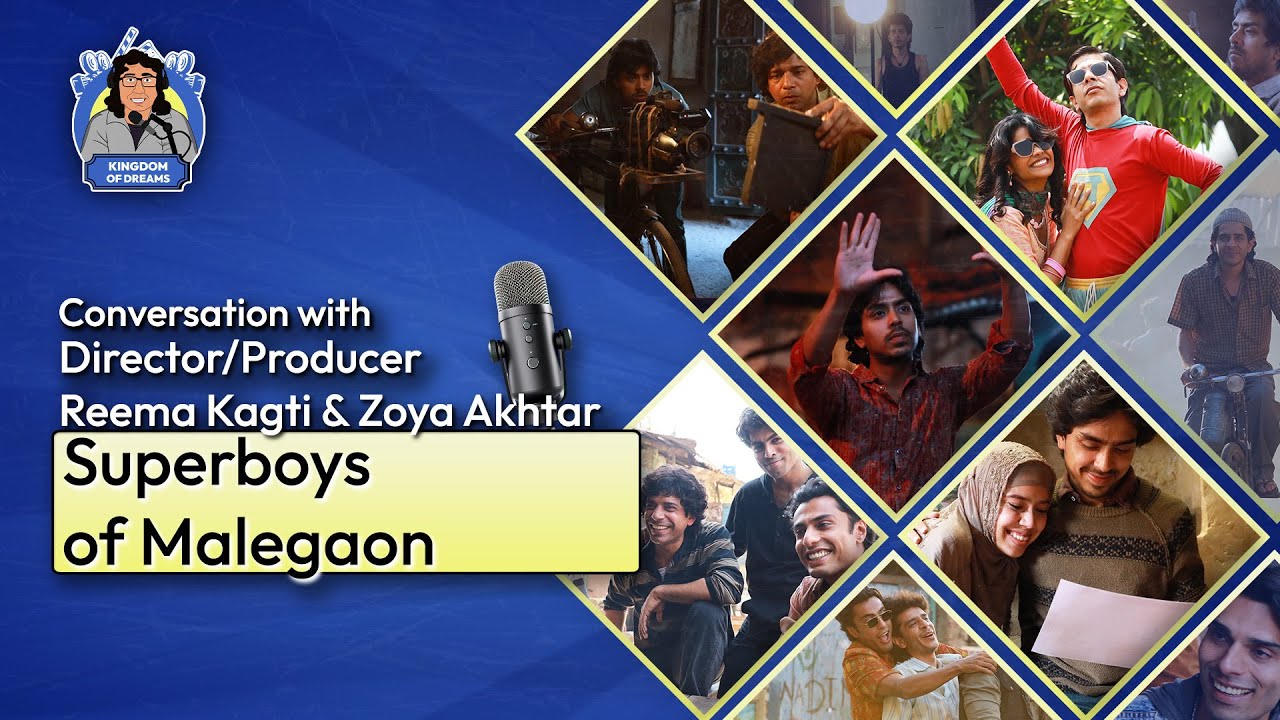
About this episode
Zoya Akhtar & Reema Kagti discuss the filmmaking challenges behind their latest feature, "Superboys of Malagaon," in this insightful episode of the Kingdom of Dreams podcast.
In this episode, Zoya and Reema share their creative process, the challenges they faced on set, and how "Superboys of Malagaon" resonates with audiences worldwide. Discover how their character-driven narratives and passion for cinema continue to inspire, and hear firsthand stories about their collaborative journey and creative synergy.
Don't miss the release of "Superboys of Malagaon," hitting theaters on February 28!
Zoya Akhtar is an acclaimed Indian filmmaker, screenwriter, and producer known for her work in Hindi cinema. Born on October 14, 1972, she is the daughter of renowned lyricist Javed Akhtar and screenwriter Honey Irani. She made her directorial debut with Luck by Chance (2009) and gained widespread recognition with films like Zindagi Na Milegi Dobara (2011), Dil Dhadakne Do (2015), and Gully Boy (2019), which was India’s official entry to the Oscars. Akhtar is also a co-founder of Tiger Baby Films and has contributed to anthology films such as Lust Stories (2018) and Ghost Stories (2020). Known for her nuanced storytelling and exploration of complex social themes, she remains one of Bollywood’s most influential filmmakers.
Reema Kagti is an Indian filmmaker and screenwriter known for directing Honeymoon Travels Pvt. Ltd. (2007), Talaash (2012), and Gold (2018). She co-wrote Zindagi Na Milegi Dobara, Dil Dhadakne Do, and Gully Boy with Zoya Akhtar. As a co-founder of Tiger Baby Films, she continues to shape contemporary Hindi cinema with compelling narratives.
#zoyaakhtarandreemakagti #superboysofmalegaontiff #reemakagtiinterview #anuragkashyap #luckbychancereview
Full transcript
Automatically generated from the episode audio, so expect the odd misheard word or name. Speakers were labelled automatically; this episode has several guests (Reema Kagti, Zoya Akhtar), shown as Guest 1, Guest 2 and so on. About 4,100 words. Tap a timestamp to play from that moment.
0:09Jawad MirWelcome back everyone to another episode of Kingdom of Dreams Podcast, The Making of Stories. I'm your host Jawwad Mir. Today my guests are Director Reema Kagti and Producer Zoya Akhtar. Today we're talking about their film Super Boys of Malegaon, which is based on a true story of Nasir Sheikh, and a documentary that was made in 2009 called Supermen of Malegaon. This film premiered at TIFF six months ago, and I had the pleasure of seeing it. It's an absolutely amazing film. It's a story about friendship. It's a story about hard work. It's a story about honesty, and it's a story about innocence. I also spoke to the three actors who played the protagonists in the film, which will be followed by this podcast, in two days time. For now, enjoy my conversation with Zoya Akhtar and Reema Kagti for their film Super Boys of Malegaon, which comes out in theaters on February 28th. I've read a lot of stuff about what, how you, came to know about the story and everything. What I wanna start off with was what part of the story besides of being it a very inspirational story and, you know, it's good for cinema that rel… related to both of you guys at a personal level that reminded you of your early struggles that pulled you in, for the, to direct and obviously to produce the film?
1:32Guest 1Early struggles, I think for me what was, relatable for me was, I think his compulsion and, just doing it his way. You know? I think I found that inspiring. Like, that talked, that spoke to me. But just the fact that he was movie crazy. He loves the films and he was just that... It was a compulsion to be in the arts and make it. I think that spoke to me a lot. And, also, working with friends because I do that. Yeah.
2:09Guest 1Reema had a lot more connection with him actually.
2:13Jawad MirGo ahead, Reema.
2:13Guest 2I mean, I g… because I, you know, my formative years were in a small town. Like Nasir, I was a film buff and, you know, being from the same generation, our influences are the same. And, there's like a, y… you know, with Nasir there's a kind of, innocence, you know, which is very, disarming. He didn't really have a huge agenda or anything like that, and he just went out and made this film, Malegaon Ke Shaole. That was his first film and that became a swile hit and it kind of inadvertently, created a parallel video film industry in a very small town with very little resources, you know?
3:04Jawad MirGot it.
3:05Guest 2Yeah. What was different, I guess, was that I had to come to Mumbai to realize my dreams and Nasir took Mumbai to Malegaon, you know, which is what I think is also so fascinating about his journey.
3:21Jawad MirHow did you guys, meet? I, from what I read on IMDb, and I know IMDb is not correct all the time, that Reema you worked on, Lagaan as second AD, I think, I think that's what it said. And Laksh. Just tell me both of you from both different perspective, how did you guys come across each other and the journey that started with the films that you worked on?
3:40Guest 2Us?
3:40Jawad MirYeah.
3:40Guest 2Oh, Zoya and I. Oh, okay.
3:42Guest 1Oh.
3:42Guest 2We, through friends. I mean, I knew who she was and, then we started working on a film called Bombay Boys.
3:51Jawad MirYeah.
3:51Guest 1Which was made by Kaizad Gustad and, it was really strange actually because that's how I got my first gig is with Mira as well. I was called to audition, for one of the parts and I'm not an actor and I'm actually a very bad actor, and I wanted to work, on films. I wanted to direct. So I took the audition so I could meet Mira Nair and, I did a very bad test and told her actually I just took the opportunity to meet her and I wanted to make movies. So she hired me and said, "You can be background when I need to and you can be an AD." So that's how I got my first job, and I did exactly the same for my second. I got called f… by Kaizad's team and at that time it was interesting because a very few films shot in Bombay that were shot in one schedule and they were shot sync sound. So I was very clear I wanted to work on those type of movies. And I went in for an audition and Reema was the assistant director who was reading the scene with me. So that's how we met for the first time. We read a scene together. Yeah.
4:51Jawad MirAnd what was it
4:53Guest 2I…
4:53Jawad MirSorry, Reema, go on.
4:55Guest 2Yeah, I mean, I kinda remember that and at the end of it Zoya was like, "You are the world's worst actor." And I was like, "I don't think you're gonna get the job either." So
5:07Guest 1And then we both, were ADs on that film and that's how it began.
5:11Guest 2But, then we came out as ADs and that's when we kind of really, started bonding and we both had a, I think a compulsion to write and we kind of really bonded on that. Yeah.
5:22Jawad MirSpeaking of, writing there's a line in that film, Super Boys of Malegaon, that writer baap hote, like, you know, the writer is the father of everything. And that in your, both of your films whether you produce them or direct them is very reflective because of your films are extremely driven by characters, not necessarily plot.
5:41Guest 1Yeah.
5:42Jawad MirObviously that's there.
5:43Guest 1Yeah.
5:43Jawad MirAnd that's what pulls people in and that's why a lot of people relate to your stuff. At least I've, I told you that last time, Zoya, that, you know, every film that you guys have worked on I've thoroughly enjoyed and I anticipate looking forward to it. So it clearly shows the writing part, which is good to see in, you know, considering that, you know, Javed Akhtar, Salim Javed, and then, Rajkumar Hirani.
6:01Guest 1Yeah.
6:01Jawad MirI think they are some of the best writers along with you guys. So
6:04Guest 1Thank you
6:05Jawad Mir... Clearly shows.
6:06Guest 1That's a really nice way you put it, actually, because my dad keeps telling us that he sometimes panics when he reads our scripts because he's like, "I don't know where it's going." And as an audience, he's like, "I wanna know, like, you know, where I'm being led." And, he's... The plot is not always very clear and he says, "I don't know how y'all do this and pull it off because sometimes I read your script and I'm panicking what's happening with this film." But now I know what to say. We don't do plot driven. We do character driven.
6:37Jawad MirI'm sure you knew that. You know, the film premiered at TIFF. W… any film, we all make films to, in a way, to tell our story, express ourselves, right? That's what filmmaking is, at least for me. And when an audience member, even if one out of gazillions, has a very personal and deep connection to that film and it changes them, that's like massive achievement more than box office or anything else. For you guys, whether it's this film or any other film, is there a story that has, you've sort of come across that has impacted people to the deepest core in their personal life?
7:22Guest 2I mean, I... For me, I think the crazy thing was after Zindagi Na Milegi Dobara, we got, quite a few emails and like, letters to the office about, young men who were feeling guilty about having broken their engagements, or then some people who felt like they just couldn't do it.
7:44Guest 1Yeah.
7:44Guest 2And…
7:44Guest 1There were a lot of people, actually. I've got, I've got this kind of re… reaction. I've got good reactions on most of my work, but I've got this kind of very, heartfelt reaction from Luck By Chance and from Zindagi. And Zindagi, I think what I remember really clearly was I'd gone to a PVR, which is a cinema hall, and I was in the restroom, I was watching another film, and a girl came up to me in the line and said, "Hi," and, "I loved your movie," and stuff. And I said, "Thank you." And she said, "My grandmother wants to meet you." So I met the grandmother, who was really, like, in her 80s, who told me she absolutely loved my film and she had always wanted to go to England, she said. England, she said, and she was like, "And I saw your movie and I went. I just went." And that to me was like, wow, because in my head, when I was making the film, it was for a much younger audience in a sense. So that was really, that stayed with me, you know?
8:45Jawad MirAmazing. Reema, what about you?
8:49Guest 2You know, every film kind of, I think you,.. Like, about two years ago, I was talking to, like, a young journalist and she said that, "You know, your first film, Honeymoon Travels." She was queer, and she said that in the home that she was growing up in and, you know, her parents' thinking, she was like, "Honeymoon Travels was the first time I realized it's okay to be gay," you know? And, yeah. So…
9:18Guest 1Made In Heaven even. Made In Heaven, I remember we were in…
9:21Guest 2Yeah
9:21Guest 1... Goa. I was with a group of other friends. I was with Jay, who was, the cameraman of Made In Heaven and, another friend, and I received a letter. I was on the beach outside a shack, and I received a letter and it said, "I'm so and so, and I'm a boy, and, I haven't come out, and I've just seen your show and I'm going to. And the next time I see you, this won't be an anonymous note. And thank you." And, you know, those kind of things are very powerful. They make,.. Yeah. They do something else.
9:54Jawad MirYeah.
9:55Guest 1Yeah.
9:55Jawad MirNo, it does. Absolutely. Coming back to Super Boys of, Malegaon, while working on the film, I mean, every film, it has its challenges, whether it's weather, whether it's... You know, there's, everything changes on the set no matter how much you plan. What kind of changes, if any, were there to certain script elements, if any? Or how did you improvise, like, a location? Because it's a very tight film location-wise, character-wise, story-wise.
10:27Jawad MirJust kind of struggles on the set, one from each of you, that affected you guys.
10:32Guest 2You know, in terms of the script, I had Varun's, Varun Grover, he's done a great job. But obviously before I went into shoot, I kind of sat on it and made it mine, you know, in that sense. But… ... Again, Varun seemed to, you know, most of the changes were okay with him. And on set, I do improvise a lot. I do allow actors, you know, when we do rehearsals, I do like actors to kind of go off script and see what we're getting on the day. So, in fact, this line, "Right above "" came from Vineet Singh because we were, improvising on set. So…
11:11Guest 2Yeah. A… and challenges, you know, all the normal challenges of making a film, I guess.
11:17Jawad MirYeah.
11:17Guest 2And it was... It's kind of period. It's set in the late '90s and so much has changed, so yeah.
11:26Jawad MirZoya?
11:29Guest 1I mean, challenges-wise, like, Reema had to do the bulk of the challenge lifting because she's, directing and that's what happens is the most challenging thing. But I think also just getting the spirit correct, the narrative correct, because you are, you are depicting somebody who… who's a living being, and himself a filmmaker, plus the two people closest to him that are in the film are no more. So it's a very sensitive space and it had to be done correctly and right and, Varun, and Reema both have just nailed it, you know, along with the actors. I think that was challenging.
12:12Jawad MirRight. What do you guys, one thing that you guys really enjoy about each other and one thing that really drive you guys nuts about each other? I'm sure there is.
12:23Guest 2Reema's…
12:25Jawad MirI'm not stir… I'm not stirring controversy
12:27Guest 2... I think for me…
12:28Guest 1No. Reema's funny and she's a great co-writer. I think if we weren't writing together, we'd probably not be speaking to each other sometimes. I, but the writing just brings us, keeps us in line. So, those things are great. She's, you know, she's like, she's got my back, I've got hers. I mean, it's, we're practically family now. But what's irritating about her is that she's in a constant hurry. Like it drives me mad. She's got no chill. Yeah.
13:02Jawad MirRe… Reema, what about, what do you think about Zoya's…
13:06Guest 2You know, I think the same thing that I really love about her is also very irritating when it turns on me, but she's got one of the finest minds, you know? In that sense, she's very analytical, whether it's a script or a personal problem, she has clarity and, you know. But, she also uses, you know, sometimes that can turn against you because, she has the clarity to tell you're being an idiot or whatever, you know? So I think it's the same thing. Her mind.
13:35Jawad MirI think it complements each other, right? Because I'm, Reema, I think that kind of mindset is more like a, for me at least, the rush is like more like a go-go documentary style, like you're always on the fly. Whereas like in a film that is, like you guys have one worked on, like you have to do setup shots and everything, but it collaborates to each other and complements each other, and you end up with something really positive, and that's what you guys bounce off of…
13:57Guest 1Oh, but this is in life. This is not just at work.
14:00Jawad MirOh, in life too. Okay.
14:02Guest 1Life, yeah.
14:03Guest 2I have no patience, I think.
14:05Guest 1Yeah. She'll enter a meeting and say, "I have to leave." Like, it stresses people out. It's not, like even, yeah, so that's annoying.
14:14Jawad MirWell, the fact that you guys are openly sharing this…
14:16Guest 1Whatever
14:16Jawad Mir... It's awesome. In terms of what's one thing that you guys learned from the film, whether it was during production, at the script stage, or post-production? We all learn when we make films about ourselves, about who we are. One thing that really had an impact and that made you think something that wasn't there before in your life for both of you.
14:41Guest 2I think for me, not something that wasn't there before, but, there's an idealism…
14:48Jawad MirWhat did…
14:48Guest 2... Nasir.
14:48Jawad MirYeah.
14:49Guest 2You know? And w… you know, why he made films kind of made me connect to why I wanted to make films in the first place.
14:58Jawad MirWhich is why? I know the answer, but I want the audience to hear it, please.
15:03Guest 2I mean, it, again, it's, it's just for a love of, cinema. It's a love of creating stuff, exploring stuff, expressing yourself without any agenda, you know? When I was a young person, before my first film, I don't think I was as, maybe calculated as I am today, and, somehow Nasir made me connect to that, and that was good.
15:32Jawad MirZoya?
15:34Guest 1Like, for me, I mean, this is something you know, you know? You just know it, and you know that, you know, films live beyond you and, you know, it's your legacy and you leave it behind and, but just what he did with Shafiq, and you realize that it does immortalize you know? And it is going to be forever, and it is just posterity, and there's something very special about that, and that stayed with me the most. You know?
16:06Jawad MirRight.
16:06Guest 1Because what he's done is gonna keep Shafiq and Farooq remembered, and eventually all of us, in a sense. Yeah.
16:15Jawad Mir100%. How, you know, the whole, the whole thing is the film is based on, recreating Sholay, right, which your dad co-wrote. Having that in there, which I thought was really, I didn't pick that up on the, in the trailer, in the very first trailer that came out.
16:35Jawad MirSomehow I missed it, and when I saw the film, I'm like, oh, how did that sort of, you know, was that helpful? Was that kind of weird, or did… didn't affect you guys at all? Was that part of the reason, Zoya, you may have been sort of attracted to at a subconscious level aside from…
16:50Guest 1No, I was attracted to Nasir for Nasir, whatever he would have picked. But, it, that was just what it was. It could have been any other film. It just happened to be Sholay, and it's like ironical and that's like I, the first time I met him, because I'd seen the documentary and, I saw him two or three years after the film had come out at a film festival in Delhi, and I recognized him and I walked across the room to introduce myself and he said, "I know who you are. I've ripped off all your father's work." And, he just said it w… I, he said it like a compliment, you know, without realizing the enormity of what he was saying, and we started talking and it's, it's, it's really uni… it's really special that he went out there, made this film. That's the film that caught people's attention. Then he was part of the documentary when he was making Super Boys, and he just did everything because he loved it, and eventually the mainstream, who he ripped off, their kid has come back and is making a feature on him.
17:53Guest 1Like, it's a full circle, you know? So, I think it's quite, special, but it would have been the same if it hadn't, I would have been as attracted if it hadn't been Sholay.
18:06Jawad MirGot it.
18:06Guest 2But I think on a level it had to be Sholay because, like I said, the Sholay was probably a defining film for all of us from that generation, you know?
18:17Jawad MirThat's, that's an interesting way of putting it. That's true. What are you guys, without revealing anything, I'm not trying to get any juicy information, but what are you guys trying to… what are you working on right now, if anything, and when it's coming out? Anything you can share?
18:33Guest 1Sorry.
18:34Guest 2Well, from Supervisor we've got, In Transit, which is a docuseries on the transgender community in India. We're currently developing a script for Zoya. We just finished writing a script for me, and we're developing a bunch of, feature films with, other writers and directors at the…
18:56Guest 1Tiger Baby.
18:58Jawad MirHave you guys ever…
18:59Guest 1And we are writing a show.
19:00Jawad MirSorry.
19:00Guest 1We're writing an Indo-American show with an American producer. Yeah. So we're…
19:05Jawad MirWhat's the theme?
19:07Guest 1We're hectic. We can't tell you. We are sworn to…
19:09Jawad MirWe can't tell you.
19:11Guest 1Yeah.
19:11Jawad MirI'm sure you can share the theme of those. Like... Oh, never mind, it's okay.
19:14Guest 1It's a drama. Okay?
19:16Jawad MirWow.
19:17Guest 1We share the genre. Yeah.
19:20Jawad MirHave you ever thought about directing documentaries?
19:24Guest 1Yes.
19:25Jawad MirAnd will you?
19:27Guest 1Yeah, I might. I… it's come up for me a couple of times, and I will. I think at some point I will.
19:37Jawad MirYeah, because a completely different beast, right…
19:39Guest 1Yeah
19:39Jawad Mir... Going from narrative to documentaries.
19:41Guest 1Yeah.
19:41Jawad Mir'Cause I was interviewing, I was speaking to Rakesh Roshan because of the most recent, the Roshan series.
19:48Guest 1Right.
19:49Jawad MirAnd he said the same thing, that he was working with Geeta, who had worked with you on
19:52Guest 1Yeah
19:52Jawad Mir... Savita Babi documentary, and how he was completely baffled about how documentaries are and like it's a completely different beast. What about you, Reema?
20:03Guest 2You know, I love watching documentaries, but I, haven't really thought about directing one. I think, if…
20:11Jawad MirBut that would suit you really well because you're always in a hurry.
20:15Guest 2Probably. Yeah. I should try it. I think if I find something that I really want to get into, if I find an idea, I might. You can never say never, but honestly, have I thought about it? Not.
20:28Jawad MirHm. And just to kind of wrap it up, we got about 10 minutes left, but I'll try to wrap it up early. W… when TIFF happened, you guys were there obviously, Toronto is a very big community of South Asians and, you know, TIFF, I remember wasn't as big as it is now up until 1999 when American Beauty came out and that changed TIFF every, in every direction. Seeing the film, the people's reaction outside of your home country, whether it's in Toronto or even in UK, and getting that vibe from, it's not that different people, it's just, you know, people who are outside of home and they're not attached to home as much as people in India are. What does that, how does that make you guys feel, if any different than reaction from people in India?
21:18Guest 1It's fun.
21:19Guest 2Yeah.
21:20Guest 1Really nice. You know, and it's, I mean, also it's such a specific story, on a level. It's, you know, it's a small town, it's Sholay. It… there's so many things that are so hyper-specific about it and, but the, but emotionally and the larger themes are so, universal. So it feels, it feels very good that when it crosses and it jumps culture in that way or, you know, people, identify with it and, it's just nice that quintessential Indian stories when they get that attention, it's just nice. It's fun.
21:58Jawad MirRe… Reema?
22:00Guest 2You know, for me it was, you know, we kind of screen, we, they screened the film at the Roy Thomson Hall, which is a concert hall.
22:07Jawad MirYep.
22:07Guest 2So when I went in to do the soundcheck, I was horrified, you know. And actually, Richie Mehta, our friend, had warned me. He said, "You know, it's a concert hall, it's not a movie theater."
22:17Jawad MirYep.
22:18Guest 2Sounds all over the place. And you know, like, people were gonna see the screen, like this is the view of the screen, you know, like straight from that.
22:26Jawad MirYeah.
22:26Guest 2So I was a bit, you know, through the film I just kept saying, "Oh God, you know, this is sounding wrong. That is looking wrong," whatever. But at the end of it, when 2,000 people get up and give you a standing ovation, that was…
22:40Jawad MirIt's a different feeling
22:41Guest 2... Not like a movie theater.
22:42Jawad MirYeah.
22:42Guest 2Which probably wouldn't have had more than 600 people. So yeah.
22:48Jawad MirYeah, that's, that's actually true about Roy Thomson Hall because it is, it does have a very weird s… seating chart for a film.
22:54Guest 2Yeah.
22:55Jawad MirAnd
22:55Guest 2Yeah. And also the acoustics, you know, it's not…
22:57Jawad MirYeah, the acoustics were the best
22:57Guest 2... Well-meant for that.
22:59Jawad MirYeah.
22:59Guest 2So I was a bit, freaked out with how it was sounding, but I was like, "No, it's fine." At the end of it was okay.
23:04Jawad MirMy Supervisor Mali Gao comes out on February 28th in theaters. And I just wanna say one last thing. It is one of the most amazing films I've seen, and I'm not just saying that, because of the fact that I could relate to it at so many levels. You know, personal, professionally, and how it's a constant struggle making a film. No matter at what part of the career you are at, wherever you guys are at or if somebody's beginning, it's a constant struggle and it's an always an uphill battle that you need to climb and, you know, basically rediscover yourself and I totally related to it and I'm going to show it to my family and everybody else. It's been an amazing film, so thank you so much for doing it. I really appreciate it.
23:49Guest 1Thank you.
23:49Guest 2Thank you.
23:50Guest 1Thank you. Thank you.
23:52Jawad MirI'm sure we'll talk again, guys.
23:54Guest 1Yes.
23:55Guest 2Yes. Thank you for taking the time to do this.
23:57Jawad MirNo, thank you for taking the time to talk about the film. Definitely one of my favorites now. Thank you, guys.
24:02Guest 1Thank you.
24:02Guest 2Thank you.
24:03Guest 1Bye.
24:04Jawad MirBye.