
Episode 209 · February 25, 2025 · 32 min
'Forrest Gump', VFX Artist, Stephen Rosenbaum
Clips and Shorts from this episode
About this episode
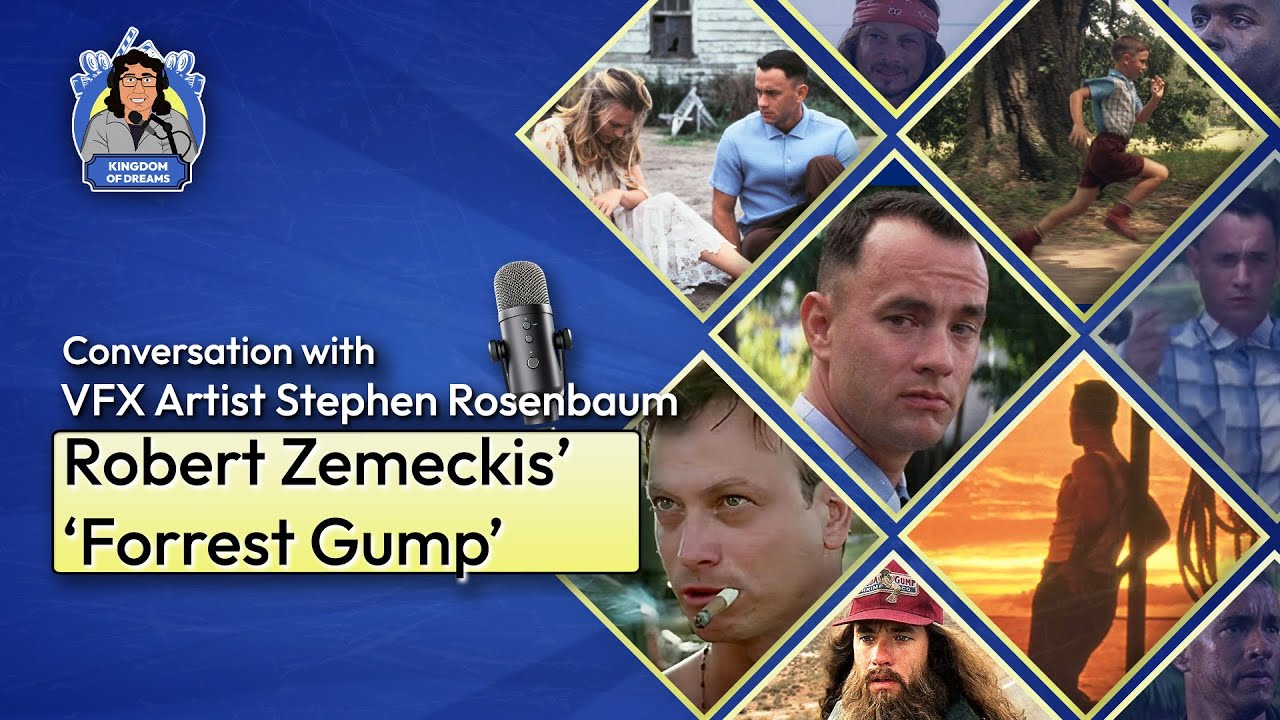
From the intricate feather sequence to seamlessly integrating Tom Hanks into historical footage, Rosenbaum explains the artistry of "invisible effects" and how they served the story without overshadowing it. This captivating discussion also explores the challenges of creating Lieutenant Dan's realistic prosthetic look and the evolving role of computer graphics in filmmaking.
Stephen Rosenbaum is an American visual effects artist and supervisor, and has worked on numerous movie, tv and music productions, including six that have won Academy Awards. He has been nominated three times for an Academy Award and two times for a BAFTA Award.
#forrestgump #robertzemeckis #oscars #vfxbreakdown #tomhanks
Full transcript
Automatically generated from the episode audio, so expect the odd misheard word or name. Speakers were labelled automatically. About 5,400 words. Tap a timestamp to play from that moment.
0:09Jawad MirGood afternoon, everyone. Welcome back to another episode of Kingdom of Dreams Podcast and Making of Stories. I'm your host Jawad Mir. Today, it's the third or fourth conversation with VFX artist Steven Rosenbaum. As you know, I had him previous two times. He talked about James Cameron's Abyss and James Cameron's Terminator Two. Today, I have him for Robert Zemeckis' Forrest Gump, followed by next week or the week after that, about Jurassic Park. But this was a really fun conversation about the VFX and behind-the-scene elements that went into, creating Forrest Gump, the historical archival footage blended in with Tom Hanks, and everything else that sort of went around it. I hope you enjoy my conversation with VFX artist Steven Rosenbaum for Forrest Gump, directed by Robert Zemeckis. Let's talk about Forrest Gump. I… my experience with Forrest Gump is I remember I watched it in my high school. They had a screening
1:01Stephen RosenbaumOh
1:02Jawad Mir... In the school auditorium. I…
1:03Stephen RosenbaumWow.
1:04Jawad MirIt was… Yeah, I don't know how and why now that I think about it.
1:07Stephen RosenbaumThat's an odd choice. Okay.
1:08Jawad MirYeah, and I specifically remember sitting in the corner somewhere, maybe in the seventh or eighth row, and watching that film. And what a great film. It's still one of those timeless films that you can watch over and over again. Again, same thing. Tell me how the process of that began.
1:25Stephen RosenbaumYeah, that was, it was, you know, again, coming off the heels of Jurassic, we, you know, we were now getting our stride with our workflow, and the pipeline was, you know, getting a little bit more stable. And, we… I think we had done, we might have done Death Becomes Her at that point.
1:49Jawad MirYes
1:49Stephen Rosenbaum... And then that…
1:49Jawad MirBecause that came out before Jurassic Park.
1:52Stephen RosenbaumYeah. Oh, did it?
1:53Jawad MirI'm pretty sure. '91 or '92.
1:55Stephen RosenbaumYeah.
1:56Jawad MirYeah.
1:56Stephen RosenbaumSo we, you know, we had a few, we now had a few films, you know, doing this, and so we were feeling more confident. The thing with Gump that really spun us was that, you know, up to this point, we had done, you know, a lot of these characters, computer char… generated characters, and now all of a sudden we're, we're needing to do, com… mostly compositing based work that was, didn't need to be seen. It was basically s… meant to be to complement whatever shot we were presented. So you weren't doing the in your face type of visual effects. You were doing much more subtle in what we call invisible effects.
2:39Stephen RosenbaumAnd at that time that, you know, again, we were, the department was still growing. I had mentioned, on the last session we had that the company had made a decision to start transitioning, talent from the practical effects side to the, into computer graphics. And so I had, I, at the time, I was a computer graphics supervisor. It's called, they call it a CG sup. And, I, easily three quarters of my team w… were newbies, guys from, you know, the practical effects, optical printing and effects camera and so forth. And they really knew very little about the box. I knew everything about the box. They knew everything about the craft. I knew very little about the craft and I, you know, I was supposed to be leading this. So it was really kind of a symbiotic r… relationship. It was great for me, and I think they benefited from learning the tech… basically a new tool. And one example was like this, there was this one guy, Peter Dalton, who, you know his work from Back to the Future.
3:45Stephen RosenbaumHe was the guy, if you ever saw a DeLorean flying through the air, lifting off and flying off… ... That's Peter Dalton's work.
3:52Jawad MirOf course.
3:52Stephen RosenbaumSo he was really good. And so it was a miniature, you know, in those days, it was a miniature, DeLorean. I think the model from recollection was about three, four feet long. And it was done using a similar go-motion technique where if you imagine, you know, you're at, you're have a camera on, in, on the end of a long track, and you have your DeLorean model here and your camera's here. If you want the DeLorean to lift off and fly away, obviously the model can't do that. We're not gonna swing the, we're not gonna actually fly the model away. We're just gonna do some localized rotation and translation to it. Basically, it's gonna do that, and then, and then maybe slide a little bit that way. But the k… in terms of like moving through space, the camera's gonna do all the work. So the camera's gonna go back. So y… if you have, if you put the two actions together, you have the DeLorean start to lift off and the camera starts to do this, it gives the effect of the DeLorean flying away when you see it on film.
4:59Stephen RosenbaumSo I think that makes sense, right? So he… ... He was really good at that. That's a sort of natural, we call object animation. It's, it's a, it's a whole art form in itself in terms of animation. And so we had a, we had a bunch of scenes, in Gump that sort of required this, sort of not obvious, but intuitively he understood how to do these types of work. And the one that a lot of people talk about is of course the feather shot at the beginning of the movie and at the end of the movie.
5:34Stephen Rosenbaum... But it also translated into other work, you know, playing ping pong and so forth. Just understanding, you know, natural object motion. And I can talk a little bit like how, yeah, he came in, you know…
5:50Jawad MirSure
5:50Stephen Rosenbaum... Completely clueless on how to operate a computer. You know, after a few days he's like, "Okay, I got it." And you know, we show, we trained him on how to use this tracking and animation tool and he's, you know, he worked on that. After another week of playing with that, he's like, "I got this," you know. It's just key framing and, And then just iterating. And he loved it. He ate it up. It was natural. So we did, like, the feather shot. You know, nowadays it would've been done as a, as a 3D element. It would... You know, somebody would've, you know, sculpted a feather in a computer, in a, in a modeling package, and then we would've, textured it and then rendered, lit it and then rendered it, or animated it and then rendered it. N… in those days we didn't have that ability. We didn't... You know, we had done dinosaur skin, but w… nobody had done, like, a feather. And, so Ken Ralston, who was the supe on the show, he had this idea, just take a real feather.
6:52Stephen RosenbaumAnd, what he did is he puppeteered the motion over a fan. So he set up on stage in front of a blue screen, a fan pointing upwards, and he had a piece of monofilament attached to the end of the feather, the thick end of the feather, and he would literally just puppeteer motions, you know.
7:13Jawad MirWow.
7:13Stephen RosenbaumTake after take after take of, like, you know, it went sort of this whimsical motion, just like going doing this, and then cut and then do another one, and you get some variation. And then, you know, and I think a testament to Peter's genius is we selected, you know, I don't know, a few dozen takes that we liked. You know, somewhere in this we like to do this, and now you have to take all of this motion, you know, discrete individual motion, string it together as one contiguous shot that lasts, I think the opening was, like, three-plus minutes or something like that.
7:48Jawad MirYeah.
7:49Stephen RosenbaumAnd he's like, "Cool, I can do that." So he sat down and pulled in this, you know, the feather elements, and he would start, you know, finding transition points. Like, okay, the feather in this take would, you know, once it turned over, I have another take that's really nice that where it's turning over similarly so I can do, like, a two, a two-frame dissolve, you know, to go from the A side of the take, this take to the B side of the other take. And just start doing these blends and work out the choreography. But it, he also needed it to play to the music 'cause the music is part of that opening.
8:26Jawad MirYeah.
8:26Stephen RosenbaumRight? And so…
8:27Jawad MirOf course
8:28Stephen Rosenbaum... He's just so skilled at that. You know, it's, it, you know, it's, it's such a simple shot, relatively if you think about it, just one element over a background plate. But it, but it, but the choreography is really what makes it. People, you know, appreciate the shot because, you know, it's got character to it even though it's just a feather. So, you know, it was a perfect example of, like, you know, the brilliance of taking, you know, again, the traditional, the, you know, the traditional people from the other, literally the building next door in ILM, doing f… you know, practical effects and bringing them into computer graphics and basically just teaching them how to use a new tool and s… and setting them loose. And, you know, Peter has done a lot since then. You know, he's f… he's flown CG Mi… Millennium Falcons, and he's done, he's, he, you know, basically any cool-looking object animated shot that you see for coming out of ILM, pr… odds are probably Peter did it.
9:30Stephen RosenbaumBut he's, I think he's since retired, but, really good example. And then we had other examples, like guys, you know, one guy, John Alexander, who came out of optical printing. You know, he was basically w… working the quad printer where you'd, you'd bipack four film elements together and compos… you know, film it out basically as a composite. So, if you imagine as you layer in shots, I don't know how savvy your audience is, but you might have a background and you might have something in the midground that you need to layer over, and then something in the foreground that you need to layer over, and then maybe you wanna put rain or s… fog or something over it as a fourth layer. And so you could, you would basically layer up those film el… in… individual film elements as, and pack them together and then film it out as one. So that's a traditional means of optical printing. And so he understood, you know, the art of compositing and how to, how to manipulate mattes and get things to work seamlessly together, multiple elements. And he came in, and again, I think his head spun for probably a good month, learning the tools, but once he got it, you know, it was, it was like, oh my gosh, you know.
10:43Stephen RosenbaumIt's, it's just such a, such a welcome thing. I learned a, I learned a lot from these guys. You know, to these days I th… I th… every bit of direction I give is coming from these guys that I lear… I learned from. So it was a, it was incredibly, serendipitous time…
11:01Stephen Rosenbaum... I think, for Gump.
11:02Jawad MirRight. Yeah, no, I honestly did not know about the behind-the-scene work for the feather scene because it is one of the most amazing scenes in the entire film, and obviously Alan Silvestri's music really put it to another level.
11:16Stephen RosenbaumYeah
11:16Jawad Mir... And I feel like Forrest Gump is one of those movies that had so many visual effects, right?
11:21Stephen RosenbaumIt does.
11:21Jawad MirWith the Nixon, Kennedy, and all that. But it's not something that people talk about a lot. Am I correct in saying that?
11:30Stephen RosenbaumNo. Y… yeah, that's right, and that was our goal, was to try and make, you know, the vast majority of it…
11:34Jawad MirYeah
11:34Stephen Rosenbaum... Invisible or, you know, not obvious in-your-face effects. They were really meant to complement the story. And, you know, I think probably the most obvious is where i… is the famous personalities that we re… reworded what they were saying, and that was quite controversial actually on the backside of that. But it was so crude. Again, just to, for context, n… nowadays we would just scan an actor or would, or, you know, have a digi human face that we would then facial, do the facial animation and then, render, you know, texture render, texture light render…
12:14Jawad MirRight
12:14Stephen Rosenbaum... And then composite that onto another person's face and blend it. You know, fa… we call face replacement. Sometimes it's head replacement if you have to accommodate the hair. Sometimes it's full body now. Those days we didn't have that ability, so, we were faced with the historical footage that we essentially had to take existing words and reanimate what they were saying. And that was, you know, was one of those, you know, how are we gonna do that? It was, it was interesting how we came across it. We... In… initially we did a test, with... Actually, Doug Chiang did, I believe, did the original test. And I don't know if you know Doug, but he's the production…
12:56Jawad MirNo
12:56Stephen Rosenbaum... Designer on a lot of the…
12:57Jawad MirOkay
12:57Stephen Rosenbaum... All the…
12:58Jawad MirOh, okay. Right
12:58Stephen Rosenbaum... Most recent Star Wars work. You know, he's, he's one of the most brilliant artists of our time in our industry. He's... Anybody who knows Doug, you should check him out. He's, he's incredibly…
13:09Jawad MirI will
13:10Stephen Rosenbaum... Talented. But in, on Gump, he was our art director, our assigned art director, and, you know, we didn't... So we took a, we took a, some historical footage. I forget w… who it was. It might've been JFK, but
13:27Jawad MirYou know where he says you, he said he forgot to pee.
13:30Stephen RosenbaumI believe I gotta go pee, right?
13:31Jawad MirYeah.
13:32Stephen RosenbaumAnd he was saying, he was saying something else. So if you, if you look at me, you know, like, you know, whatever I'm saying, you know, my lips are moving a certain way, but then you need to change that in order to say, "I believe I have to go pee," and so you're hitting, like, certain phonemes and so forth. So what we did is Doug took the, took the image and first, flattened out the dialogues w… using Morph. So we…
14:00Stephen Rosenbaum... Essentially warped it into neutral poses. So as, effectively all you got was that type of, that type of motion. No lip, articulation at all. It was just jaw motion. And, that sort of set us up to, okay, now we can, sculpt the f… the lips into those sp… specific phonemes. So if you needed to emphasize P, he could animate that, those lip positions. And that's essentially what it did. And it, you know, in those days it worked. If you look at it now, you kinda go, "Oh, that doesn't, that doesn't look so good anymore." But, you know, and it was, it was passable in those days. I mean, people bought it. They didn't question it. It, but, it was just an example of like, okay, how do we, how do we approach this issue? And then, you know, of course compositing into, you know, the historical footage also served as a, as a challenge.
15:04Stephen RosenbaumWe, you know, that JFK f… footage specifically was really grainy. I think it was, it was 16 mil, I think, but it looked like 8 millimeter. It was really, you know, poor quality. And so, you know, the first there was a discussion of like can we do anything about that? And then we decided just to, just to embrace the grain and the, and the quality of, you know, the low quality of the imagery, and stick Tom into the shot. So, effectively what we did is we would shoot, you know, the action around JFK. So, like, I don't know if anybody's seen the making of stuff, but it's, it would be like, Tom, you know, you need to stand on this mark, and you're shaking. And we had like a metronome in terms of the timing, so he could hit his mark and get the shakes at the right speed. And then essentially we would then extract him off the blue screen, composite him into the historical footage. There was inevitably, you know, a disconnect between the two hands, so we'd, we'd warp that together essentially using Morph again.
16:16Stephen RosenbaumAnd then pour grain all over his element to get it to blend into the historical footage. So that kinda stuff worked pretty well. It was interesting in that like there was a scene with Dick Cabot where he was still alive at the time and we thought, "Oh, can we de-age him?" And at that time we were like, we... There was like, everybody was like, "We can't do that. We can't, we can't make him look younger." So we just accepted. They did, they did as best they could with the makeup. Nowadays of course de-aging is…
16:49Jawad MirYeah
16:49Stephen Rosenbaum... Kinda almost automatic and overused honestly, but yeah.
16:54Jawad MirYeah. No, that's really great information. Thank you for sharing that. One scene that I remember, you know, there are certain moments that you remember the w… the very first time you watched them and they'd…
17:05Jawad Mir... Kind of stick with you, was the scene when Gary Sinise was sitting on the boat or the, you know…
17:12Stephen RosenbaumYeah
17:12Jawad Mir... And then it, with… without his legs and he jumps into the water. And I mean, I was so convinced that you guys hired an actor with no legs. That's how, that's how re… I mean, I'm just trying to use maybe the wrong terminology, but that's how real it looked. And then obviously you see the VFX of the, or the behind the scene green socks. Boom, right? So…
17:35Stephen RosenbaumYeah
17:35Jawad Mir... Yeah. What was, did you work on that sequence at all? I mean, that was amazing.
17:38Stephen RosenbaumI, it's funny you say that 'cause I did, I was a CG sup on the show with George Murphy, who was the other CG sup. We, and the, I did one shot on the entire movie, and that's the shot I did.
17:52Jawad MirOh, you did, eh?
17:53Stephen RosenbaumYeah.
17:53Jawad MirOkay. Talk about that.
17:54Stephen RosenbaumYeah.
17:54Jawad MirThat's awesome.
17:55Stephen RosenbaumIt, you know, going back before, we started shooting, Ken came to us and we spent a day trying to figure out how to, you know, h… h… how do we do Gary's legs, you know? D… we got a wheelchair and we, okay, well, he could sit on his legs or, you know, what are we gonna do? Should we, should we just, for certain shots should we have a d… Yeah, an amputee as a doub… body double and then blend between the two. We entertained all these ideas, and then, we just decided, you know, why don't we just put stockings on him? I think they were, I think they might've been blue screen stockings. You know, the spandex stockings, and they're, the, costume department made for us. And, you know, what that served was basically just a cut point for his legs, you know? It... We knew, you know, extracting, you know, for people who don't know, typically when you have something against blue screen, you're trying to extract, the foreground against whatever background you're gonna ultimately put in there.
19:02Jawad MirRight.
19:02Stephen RosenbaumIn this case, what we needed to do is his l… his, the blue part of his leg, the lower part of his leg was blocking background, and we needed to put that background back in. So if you imagine, like you see my hand over me, if I had to remove this, I'm gonna take my eyes and everything with it, right? So I have to then, if I, once this goes away, I then have to re… recreate what's missing here. And so it's not a trivial thing, especially when the camera's moving, changing perspective. So, you know, we just decided to go for it. We had our tracking tools had developed enough where we could shoot a clean plate, and, you know, so we'd, the actor would perform, and Gary would perform and do his thing, and then we'd have him step out, and we'd try to do the same camera move as best we could, you know, non-motion control, which we can talk about if you want. But just try to…
19:58Jawad MirRight
19:59Stephen Rosenbaum... Get the timing as best we could. And then in, when we got it scanned, both elements scanned, we would, you know, first thing we'd do is try to sync them. So inevitably, there would be a, you know, a misalignment, and you'd just keep refining it and getting closer and warping it a little bit if you needed to, until they, the two were perfectly married. So essentially, when you painted out the legs, you could bring the clean plate back through it. In the case of the shot you were talking about where Gary's on, he hops up, he's in the wheelchair. His legs are hang… hanging straight down with the blue screen stockings. He hops up onto the, onto the rail there, and he swings his, swings his legs through an opening in the railing. I don't know if you've seen, I don't know if we showed it…
20:47Jawad MirYeah
20:47Stephen Rosenbaum... In the making of, but, oh, okay. Yeah, ba… basically there was a hole there. And so he just, he just swings his legs right through there. That's an intentional, like, he's like, wait, to fool you. And then we shot the clean plate, with the, with the piece of the railing back in place. And so what I did is I essentially just, cropped out the part with the, with the railing that was back in place and put it into the plate with, that was, Gary was in. And then you have to do some cleanup around his knees 'cause he had a... It couldn't just be a clean slice. It needed the…
21:24Jawad MirYeah
21:25Stephen Rosenbaum... You had to essentially resculpt a little bit of the pant where that, you know, where that was bunched up at the knees.
21:33Jawad MirYeah.
21:34Stephen RosenbaumSo…
21:34Jawad MirNo, that, it, that, yeah, that, like the whole, especially that movement of getting off the wheelchair, sitting on the railing, and then turning, you know, before he jumps into the water. But that…
21:45Stephen RosenbaumYeah
21:45Jawad Mir... That little moment was, like, I, yeah, I, it's, it's convincing even in today's time, I would say. It's just so authentic…
21:52Stephen RosenbaumThanks
21:53Jawad Mir... And real, and it serves the story, which is the greater point.
21:57Stephen RosenbaumYeah. That's, yeah, it's true. There's a, there's another great shot, which I think is actually even better
22:03Jawad MirSure
22:03Stephen Rosenbaum... That Pat Myers did. It was a similar scene, where they're on the, on the shrimp boat, and, Gary Sinise is up in the, up in the, I forget what you call it. It's the thing that holds you…
22:18Jawad MirOh
22:18Stephen Rosenbaum... Up.
22:19Jawad MirYes
22:19Stephen RosenbaumYeah, the, anyway, it's this thing, and he lowers down, and so there's, there's this tremendous amount of perspective change, across what's going on in the background. And so he's, you know, the cam… he's, he's up here, camera's like this, and then he descends down, the camera does that. And so there's a lot of, you know, a lot of perspective change on the boat. And so it basically meant recreating large swaths of the boat wherever his legs blocked. That was really nicely done. That was, I think, I'm pretty sure that was Pat Myers who did that. But yeah, it's, there's, there's, and again, nobody ever sees that kind of stuff. But, you know, we were proud of it 'cause it, that's, that was our goal.
23:04Jawad MirAnd you should be because, again, like it served the story in every which way. Like we said earlier, you know, like Cameron, like Spielberg, Zemeckis is one of those directors that seamlessly blends in visual effects, for the greater good of the story. And
23:19Stephen RosenbaumYeah
23:19Jawad Mir... Yeah, and Forrest Gump is a very special film. I'm so glad they never made a sequence, sequel on it…... 'cause there was, there was a book that came out, Gump & Co., I think it was called. Yeah. Was Forrest Gump similarly with Jurassic Park and T2 that you felt this is gonna be like a home run with the audience?
23:41Stephen RosenbaumNo. No. In fact, w… just the opposite. It was such a quirky movie. Nobody was sure how it was gonna play. I mean, it, w… pretty much every scene as we're working on it, we're going, "This is, this is kinda odd." This is... But you know, just again, I think a testament to Bob Zemeckis's filmmaking style, and he had a great editor, Arnie Schmidt, at the time.
24:09Jawad MirYeah.
24:09Stephen RosenbaumYou know, it was certainly shot beautifully too. Don Burgess did a great job. I mean, it was, it was really well done. You know, a lot of, a lot of great…... Contributors to the show. But we were definitely not sure how it would be received. We were pleasantly surprised.
24:29Jawad MirYeah. Because, besides the arc of, you know, him trying to find his destiny as his mothers tells him to, and the Jenny part that comes in and out in the middle, in the beginning…
24:40Stephen RosenbaumYeah
24:40Jawad Mir... And the end, the, it's like, for the lack of better word, it's like little skits from Saturday Night Live.
24:47Stephen RosenbaumYeah.
24:47Jawad MirRight? Like the, just these…
24:47Stephen RosenbaumYeah
24:47Jawad Mir... Little just moments like in Vietnam playing ping pong with Kennedy.
24:53Stephen RosenbaumYeah
24:53Jawad Mir... You know, running the football, ground and all that.
24:57Stephen RosenbaumYeah. Yeah, the crowd replication and all that.
24:59Jawad MirYeah.
25:00Stephen RosenbaumYeah.
25:00Jawad MirYeah.
25:01Stephen RosenbaumYeah, I think, again, it comes back to it has heart and, you know, likable character, you know? And, you know, I think that's what people want. They want a good story that, you know, with somebody they can relate to or at least like, or dislike as you say, you know?
25:17Jawad MirYeah.
25:18Stephen RosenbaumBut there was, yeah, there was k… we enjoyed it because the, of the diversity of type of work, you know, other than the ones we mentioned. You know, there was the, yeah, the crowd replacement stuff. There was the ping pong work, the Vietnam work. And for us, it opened up these areas of like i… ideas and techniques that we had never considered and challenged us to try and step up to it, and we somehow figured it out. It was, it was qui… you know, I think again, like a lot of, a lot of brilliant minds put their head together and, you know, you just keep pushing and persisting.
25:59Jawad MirAbsolutely. Any… anything else that you wanna add, in terms of Forrest Gump?
26:05Stephen RosenbaumNo. I think, you know, again, largely I think the success is certainly our work is there, but not, you know, it's not meant to be part of that show. And I think it's, you know, that success was largely attributable to Bob and Tom's work. You know, they just, they w… they were just brilliant in that, in that project, and I think that, you know, I think we'd all like to see that again sometime. I think, you know, they just did a movie again together. I don't know if you, did you see it, Here?
26:44Jawad MirOh, yeah, I actually saw it three times.
26:46Stephen RosenbaumOh, you did?
26:46Jawad MirI absolutely loved it.
26:48Stephen RosenbaumYeah.
26:48Jawad MirI absolutely loved it.
26:50Stephen RosenbaumYeah. It's a good, it's a good piece of filmmaking. It, yeah, it doesn't have the story, you know, the sort of the heartwarming story that you want, I think, that Gump had, you know? And so I hope that they conspire again sometime.
27:08Jawad MirI think, I think the attempt was there. For me especially the... You, did you see the film?
27:14Stephen RosenbaumYeah.
27:15Jawad MirFor me, the ending made the film worthwhile. Like, there were all these moments that were sort of a little bit out of place, but I still enjoyed them. But the way it ended, that pretty much did it for me. And I enjoyed it and,... Yeah, no, I, listen, the thing is, I'll say one thing. You know, like I remember, and probably for you too, like, you know, '80s and '90s, the films that you will think about growing up from the past like Gone With the Wind, Casablanca, Wizard of Oz, Bambi, Dr. Strangelove, 2001: Space Odyssey, Ben-Hur, Spartacus, and all those things. In about another 30, 40 years, films that, a lot of films that you and other people have worked on, like the ones that we talked about, Abyss, T2, Jurassic Park, Forrest Gump, will be remembered in those ways because they're completely timeless. There is…
28:11Jawad MirThere's no timestamp on those films. You can watch them in any century, in any time period, and they would seem like they're just from today.
28:21Stephen RosenbaumYeah. No, I appreciate that. I think that's, yeah, we've been very lucky, to be able to work with these kind of directors, this level of filmmaking. It's, they're very fortunate in that respect. I think, and just again, the serendi… serendipitous timing of the technology coming online and at that, you know, at that particular period when these directors are in their prime doing, you know, asking us to, and pushing us to do things that, you know, I think the most moviegoing audiences had never considered or seen. And I think that's, that's largely what it is it just, I don't know if AI is gonna be sort of the next evolution of that. I somewhat doubt it, but, who knows? We'll see.
29:14Jawad MirYeah. No, I, if you had asked me five months ago, I would've said, "Yes, AI is probably gonna change a lot of things." I still think it will, but I think it's just gonna be a tool.
29:28Stephen RosenbaumYeah.
29:28Jawad MirI generally feel that. I think the most impressive tool that I've seen in AI in terms of video, I thought A… OpenAI Sora's was impressive. It's the new, it's the, by Google, it's called Veo, I think, Veo 2, V-E-O-2.
29:41Stephen RosenbaumYeah. Yeah.
29:42Jawad MirThat's very impressive. That's very impressive.
29:46Stephen RosenbaumYeah.
29:46Jawad MirNow, how do you utilize that? As a fill-in shots, as a B-roll shot? I don't know. Maybe that's it. But I just thi… think the heart at the end of the day, until, like the movie AI that Spielberg directed, there's that AI, the heart in an AI robot as he wants to become a real boy.
30:09Stephen RosenbaumYeah.
30:09Jawad MirUntil, un… if that ever happens, which I think it might, until then, I think the heart is only with human beings, and that's where it really is.
30:18Stephen RosenbaumYeah. I would agree with that. I would agree with that.
30:20Jawad MirYeah.
30:21Stephen RosenbaumYeah.
30:21Jawad MirAwesome. That's amazing, man. Thank you so much, buddy, for your time. I really appreciate it. I hope, your project kicks off sooner than later. And, if I'm in San Francisco and if you're around, let's grab lunch or something and talk.
30:36Stephen RosenbaumPlease, don't hesitate. I'm, I'm, you know…
30:39Jawad MirI won't.
30:39Stephen RosenbaumI'm, I, there's a chance I'll be whisked off in the near future, but, you know, I come back, so…
30:47Jawad MirYeah
30:47Stephen Rosenbaum... Just keep…
30:47Jawad MirAbsolutely
30:48Stephen Rosenbaum... Just keep in touch.
30:49Jawad MirAbsolutely, man. Thank you so much, buddy.
30:50Stephen RosenbaumWell…
30:51Jawad MirI appreciate it
30:51Stephen Rosenbaum... Next time you want, it, we could talk about Avatar if you're interested 'cause I think aside from, you know, that, the, I know Avatar has been talked about to death. But I don't, I don't think enough people have really talked about the whole virtual production process, which I think is, that was sort of a, I think a industry shift that I think is worth discussing and…
31:14Jawad MirAbsolutely
31:15Stephen Rosenbaum... Yeah.
31:15Jawad MirWhenever you are ready, whenever you want to, if the next two weeks you're still around, I'll reach out to you and then we'll do it then. If not, then we just do it when you come back.
31:27Stephen RosenbaumOkay.
31:28Jawad MirAwesome.
31:28Stephen RosenbaumThanks.
31:28Jawad MirThank you so much. Have a good weekend, buddy.
31:30Stephen RosenbaumTake care.
31:30Jawad MirThank you, bye-bye.
31:30Stephen RosenbaumThank you too.
31:31Jawad MirYeah, bye.