
Episode 250 · July 14, 2025 · 42 min
'Kingdom of Heaven, Director's Cut', Editor, Dody Dorn
Clips and Shorts from this episode
About this episode
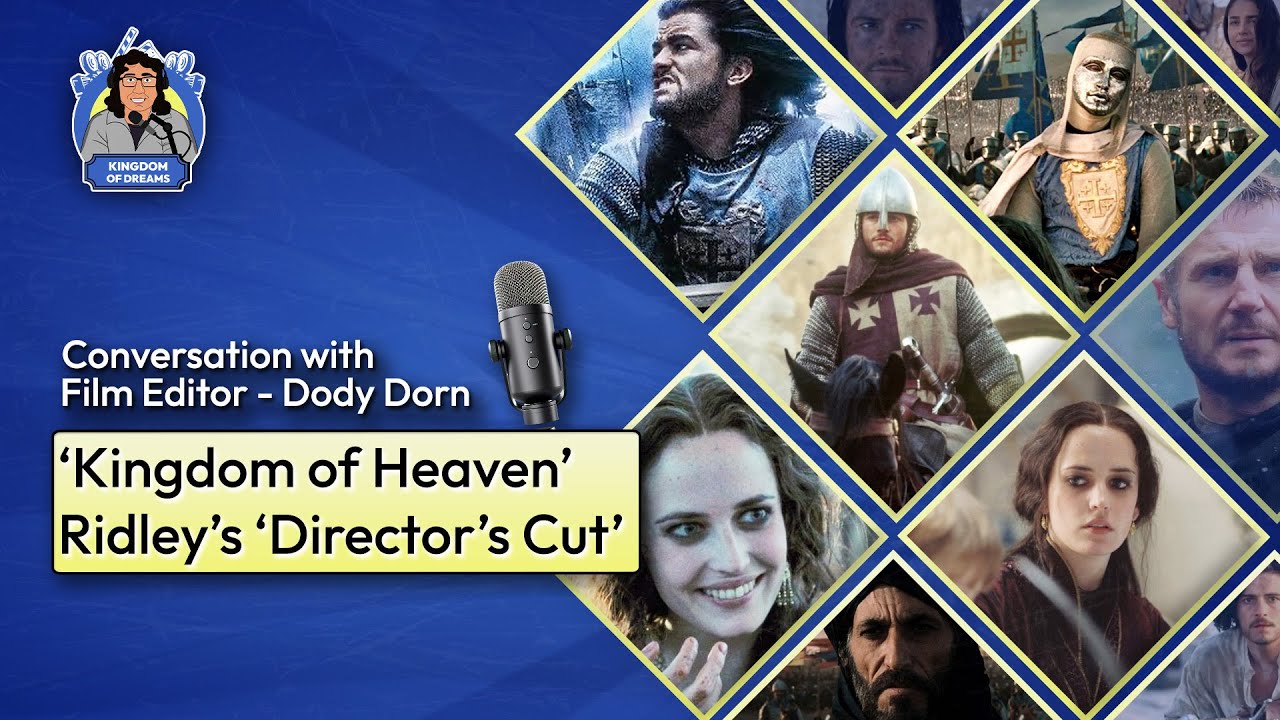
🎙️ On today’s episode of the Kingdom of Dreams podcast, acclaimed film editor Dody Dorn joins us to talk about the Director’s Cut of Ridley Scott’s Kingdom of Heaven. We dive into her creative journey, why she felt the theatrical cut didn’t do the film justice, and how she advocated for the version she believed in. A powerful conversation about artistic integrity, lessons learned, and the evolution of her remarkable career.
Discover the creative journey behind the epic historical film starring Orlando Bloom, Liam Neeson, and Eva Green.
Dody Dorn is an acclaimed American film editor known for her work on Memento, Insomnia, Kingdom of Heaven, and Fury. Beginning her career in sound editing, earning an Oscar nomination for The Abyss, she later transitioned to picture editing, gaining widespread recognition for her innovative, non-linear work on Christopher Nolan’s Memento, which earned her an Academy Award nomination. Dorn is celebrated for her precise storytelling, strong collaborations with directors like Nolan and Ridley Scott, and her ability to integrate sound and image seamlessly.
#ridleyscott #thecrusades #muslim #christian #liamneeson #history #orlandobloom #film #cinema
Full transcript
Automatically generated from the episode audio, so expect the odd misheard word or name. Speakers were labelled automatically. About 6,500 words. Tap a timestamp to play from that moment.
0:00Dody DornOne of the big things w… about Kingdom of Heaven was that it was actually a very well-measured portrait between the Christians and the Muslims. And because there were beheadings, and the beheadings were at a time when there had been some actual beheadings…
0:18Dody Dorn... That really had an impact on everything. I mean, I was not happy about cutting the film down, not at all. It was very painful to do it, and wished that I hadn't had to do it. I feel that the director's cut's the better film, and it will stand the test of time.
0:47Jawad MirWelcome back, everyone, to another episode of Kingdom of Dreams podcast, the making of stories. I'm your host Jawad Mir. Today my guest is film editor Dody Dorn. She has worked on some incredible films throughout her career, but today what we're here to talk about, is Kingdom of Heaven, Ridley Scott's film starring Orlando Bloom, Liam Neeson, and a whole wide of other cast. And, you know, Dody talks about how she felt about, not cutting the film, and a whole lot of other stuff, and also her career. So without further ado, here is my conversation with film editor Dody Dorn. If we can start off with your career, what got you into film or editing or the industry? Just would love to hear the journey that you've made all the way up to now.
1:30Dody DornOkay. Well, it's, you know, this is... It's interesting because, Los Angeles as a city, town, work… it's a working town for the film industry. And my father was a set builder and had a small shooting stage where they, a lot of movies were shot and commercials, and I worked there as a switchboard operator when I was in high school. And actually at that time thought I was gonna be a school teacher, and math was my subject. But once I was working as the switchboard operator, obviously I was introduced to a lot of people in the process of filmmaking. I started looking around for work in the film industry and I w… worked as an extra, I worked as a PA, I worked as an assistant to a producer, I worked as a, I worked in the art department, assistant props, ar… assistant art directing.
2:37Dody DornI supported myself actually as an extra for an entire year, which I thought was, looking back, was kind of interesting that I did, was able because the work is very few and far between. And this casting for extras also did casting for actual speaking parts, and she started sending me out on these auditions for speaking parts, and I had n… not only no training, no interest in being an actor at all. And it was... I'd get in these... I don't know why I, that I even said yes to going to the auditions, and it's practically, "What the heck?" You know, really bad readings. Completely unprepared. And then I met, through one of those I met a producer who said, "Well, why didn't you tell me? I could have hired you as a production assistant." He had a small screening room and I was a projectionist, actually.
3:36Dody DornAgain, how does that happen? So I'm handling 35 millimeter, loading up double system and doing all of that, and another friend of mine was working on a movie of the week, that I was working on as a, as a PA and assistant to the producer. And when they, finished that, it was a movie of the week for the, for Dick Clark Productions. When they finished that, they decided to do a theatrical release and they brought in a new editor. And the producer asked me if I would like to be the assistant editor, 'cause production was over, they didn't need me anymore. And I said, "Sure." Again, very cavalier. I'd never done this before. The only thing I had done was handle 35 millimeter. And I took that job. It was called... It was a movie of the week called Elvis starring Kurt Russell, directed by John Carpenter. And the editor was Christo… Chris Holmes, and he was sort of stunned when he learned after the fact that I had never been an assistant editor before and was doing all this kind of, you know, on the job training myself.
4:54Dody DornAnd then I got in the union and I never looked back. I was an assistant editor for about four or five years, then I went into sound. I did sound for 10 or 15 years, and then I decided I wanted to go back into film editing, and took me about 10 years of working from the bottom till I was making similar salary, as a sound, that I made as a sound editor as a picture editor. And that's really the tr… the full trajectory as to why I end… ended up becoming a film editor in my 40s, where, because I had a very active and busy career, but it was doing a lot of different things, so. And I feel like I bring all of that to what I do as a, as a film editor, obviously. And I think of sound editing, by the way, is where I really learned how to picture edit because I was recreating, I was a dia… both a foley editor and a dialogue editor and a supervising sound editor, and… Recreating the dialogue tracks of what the editor has done.
6:07Dody DornSo I'm really looking at how they're expanding and contracting the performances, creating pauses, kind of choosing alternate audio takes, and that kind of thing. And then it, with Foley, I'm really looking at rhythm and it... So I feel like that was my training ground.
6:28Jawad MirThat's incredible, and it's so fascinating, you know, m… to, for you to go through all those things because when you're going through all that stuff, you have no idea what you're being set up for. And then when you do get to that point and you look back at it as you just did, it makes perfect sense that where were you were going to... What you were being prepared for, right? And doing all those things definitely helps to an… immensely. So that's really cool. I really appreciate you sharing that.
6:57Dody DornYeah, I... Well, I think that any time you're storytelling, the more life experiences you're... Telling stories you're gonna be. So I think that... I think I had no idea. I came to working in film at, from a blue collar co… perspective.
7:16Jawad MirYeah.
7:16Dody DornI needed a job. I needed to make money. I needed to move out of the house. I had to pay rent. All of those sort of things. And a large part of the jobs in film are, I don't wanna say they're not creative, but they're more technical. They're crafts and you're, you know, have to get the work done, and you're following the vision of a director. And I feel like I'm just fortunate that I was able to end up here in a, in a creative role. But I still give myself completely as a collaborator, and I'm not that person who starts with a blank…
7:54Jawad MirYeah.
7:55Dody DornYeah.
7:55Jawad MirI mean, fort… fort… fortunate is a, is a right word, but it's fun. You know, a lot of people say they're lucky, which I completely agree, right? But at the same time, if you're not trying to make your luck by trying to seize up moments and seek opportunities, then that luck will... You're not, we will not be at the right place at the right time. So you have to at least take that first step, which is, which is not easy for a lot of people. A lot of people don't take that first step, right? Not just in our industry, in any industry. So I think you should just give yourself a little pat on the back because it's not just pure luck. It's also your timing and everything, and obviously you working hard.
8:33Dody DornThank you. Thanks. I do think of myself as a hard worker and so do the…
8:42Jawad MirYeah.
8:42Dody DornThey know I work hard.
8:45Jawad MirSo now that you have c… come into the film industry, you know, we'll get to Kingdom of Heaven just very seldom, very quick. You, right off the bat, you do Memento, which is probably... Or not right off the bat, but in the early days. You do Memento, which is Christopher Nolan's breakthrough film, and it's probably one of the most weirdest and difficult films to edit in terms of, you know, making sure the story flows backwards. How did you land onto that in terms of meeting Christopher Nolan, and did you know at the time that he was going to be someone that he's become today?
9:22Dody DornWell, my crystal ball was not working right. I didn't really know, but what I do know is that no, I didn't just land on Christopher Nolan and that is how I became a film editor. I had been working as a film editor for 10 plus years…
9:43Jawad MirYeah
9:44Dody Dorn... Before I worked with Chris and I was doing it exactly as I described, from the bottom up. So I had already worked with big Hollywood filmmakers and, or not just Hollywood, international filmmakers doing sound, and I had to find a way to support myself while I was going back to zero because I worked for free as a, as an, film editor, and then 50 cents and then a dollar and then $10 for 10 years. And I... Of that work was, below the radar because I was doing short films that went to festivals, feature, first feature films for people. And almost all of the films that I work… were, was working on were going to film festivals. And I think, one of the films I did was for the director Oliver Hirschbiegel, most known for, Downfall, the last days…
10:44Dody Dorn... Of Hit… in the, in the bunker.
10:46Jawad MirRight.
10:46Dody DornAnd I did a film for him called Murderous Decisions. It was shot in English, but we were working in Berlin, and it was a two-channel project, so two films that ran simultaneously on two different TV stations, ARD and ZDF. And that Wechseln erwünscht", which means switching is desired. Like, go ahead, switch channels. And it was an early interactive, film project where you can choose which character you're gonna follow.
11:20Dody DornAnd the stories ran in sync with each other. So you were, you were following... You wouldn't lose track if you jump between the two. And it's kind of, when I think of it now, I find it kind of funny because it's really saying, telling the audience, "Edit your own film."
11:37Jawad MirYeah.
11:37Dody DornLike, when you get bored with this one, go to that guy. Maybe that'll, you know. So, and then there were certain sections of the film that were identical. And I think that Oliver, hired me because, I was doing a lot of... The many things in tr… in sync was part of, you know, something I'd been doing for a long time. So, that we were keeping the story and the images in sync, which was different, but, I know Chris knew about that project, and he was intrigued by my... Excitement over doing something that was experimental. And, then I had also done several films that were POV.
12:22Dody DornAnd I'm als… and some documentaries that were kind of edgy. I did a documentary called Sick: The Life and Death of Bob Flanagan, Supermasochist, an early film by Kirby Dick who,... That is, you know, it's pretty out there. And my editing style, I did another film called I Woke Up Early the Day I Died, starring Billy Zane, that y… that was based on an Ed Wood screenplay. And I was just doing weird stuff. I don't know how else to describe…
12:57Jawad MirYeah, the mix isn't. It's called getting work and getting, building yourself up, right? So.
13:02Dody DornNo, but by weird I mean these were the things I was drawn to as well. There were plenty of things I said nope to. There... It's, it's, it's what I, what, it's what piqued my interest, and I always liked the idea of editing something where the editing is a character. So POV movie, the editing is a character, for sure. S… like I Woke Up Daily, Early the Day I Died, the editing is a character because it's very visible. It's a s… script that has no dialogue, but when I came in, I started going to stock footage and brought in all this weird stuff, and it was lots of jump cuts, and I really like, you know, kind of changed it in a, with a vi… visible editing. So I would say that Memento obviously is the ultimate in visible editing. And when I read this, the script, I... First of all, I like to read several times just so I get it embedded before a meeting.
14:09Dody DornBut when I read it, I had to really read it like four or five times to really get a grip. And it's, it was, it's, it's structured in the screenplay. It's not something I invented, it's something that Chris had clearly planned out and it had a purpose. It had a narrative purpose, which is another thing I really like. I don't like editing just for the heck of it.
14:34Jawad MirYeah.
14:34Dody DornI don't like story structures just 'cause you can. I like it when it has a purpose. And with, Memento, the purpose is so clear that you're, you're taking the person who's a protagonist and you're flipping it and he becomes the, you know, the e… evil character, you know? So it's, it's... And it's also, it's an anti-revenge tale, which I also love. That's a flip. Because usually like with the person the whole way through, but then you realize this guy's the serial killer and you go, "Whoa," you know? So when is revenge okay is really half the question. So it's not. Revenge is not okay. So from all those points of view, I mean, Chris and I just clicked when we start talking about it. And I think that's kind of the key in any kind of a creative collaboration, that you wanna click with the person that you're, whose vision you're manifesting, so.
15:38Jawad MirYeah, 100%, 100%. That's really cool that you're, you're attracted to different types of, for the lack of better word as you quoted, weird films, and then how that sort of aligned with Christopher Nolan's Memento. You know, moving on to Kingdom of Heaven, Ridley Scott, who obviously has been a big name for a long time, but he had just come off from films like Gladiator, Black Hawk Down, you know, two period pieces, and another period piece, Kingdom of Heaven. How did you get on board on that? Was it through a point of reference or you had met Ridley? Or just tell me that story and then we'll go on with talking about the film process.
16:20Dody DornWell, after Black Hawk Down, his editor Pietro Scalia wasn't available for the next film that he was doing, which was an, a very fun film called Matchstick Men starring Nick Cage.
16:32Jawad MirI love that film.
16:33Dody DornThank you. And then speaking about, you know, weird things, Nick has OCD and, I was very attracted to, the concept of like representing that in the editing style. So, first off, I'm not even sure how... I mean, Ridley must have asked for me or called my agent or something because I was, I was, finish…... I had just finished Insomnia and I didn't know what I was gonna do next, and there were some different options. And of course, when Ridley Scott calls, you go.
17:14Jawad MirYeah.
17:15Dody DornWith trepidation and excitement and everything else. And sitting in the, in the lobby waiting, so interesting, the script, there was a script supervisor who was meeting with him. She the wife of the guy who had the screening room that I was a projectionist at.
17:34Jawad MirOh, wow.
17:36Dody DornThat was pretty funny.
17:37Jawad MirOh.
17:37Dody DornSo I'm sitting there, and she goes in, and then she comes out and she leaves, and I'm still waiting, and I get called. And then it's a long walk across a very big sort of warehouse style, beautiful office by the way, with cubicles. And I'm thinking, "Oh my God, I'm going to meet Ridley Scott." I was like start... I was very relaxed, but then like as I'm walking I'm like, oh…
18:02Dody Dorn... My heart starts pounding and I'm like... I get there. Ridley is such a wonderful, lovely man. We start talking. He had a beautiful glass, like an ice bucket filled with ice and with the little Coke bottles, the glass Coke bottles that they're... It's a, it's an iconic design.
18:24Jawad MirYeah.
18:24Dody DornHe had a couple of those in this ice bucket, and he started talking about the design of the bottle and why it was a classic. And I had brought some, artwork with me, which wa… was some,.. It was a, just a little book of, Hockney paintings that I thought kind of were invoked in the, in the screenplay, by Ted Griffin. Ted and... Anyway, so, I brought that with me and we started, we just started working right away. I started talking about those images. We started talking about music. He mentioned some things, some different musical ideas, and it was what… i… it just was a collaboration immediately. That's really all I can say. It's very similar to how when I met with Chris because…
19:17Dody Dorn... We just started working, you know? And if you are there for the work, I think that's, that's what any director wants. They want someone who's there for the work.
19:31Jawad MirRight on. That's... Thank you for sharing that. And it... Was it a film that you…
19:37Dody DornWell, wait, there's one thing…
19:38Jawad MirOh, sorry, go on. I thought you were done. Sorry.
19:39Dody DornHold on, hold on.
19:40Jawad MirOkay. Okay. Shh.
19:42Dody DornNo, I was, but then that little booklet, which was some Hockney paintings, which I gave to Ridley, I didn't know, and I should have, that he went to sc… you know, this... He probably had, you know, like you have your stacks of books, the biggest prints of Hockney's pa… It was just, I just felt really... My little booklet of Hockney paintings. But he was very gracious about the ideas actually, you know? So anyway.
20:15Jawad MirRight. No, that's, that's amazing. And I w… I'm always curious. I mean, I know things... With certain directors, it's like on set, at least back in the day in the '90s, early 2000, maybe even now, but not so much, were you physically present on the set, and were you going through rushes on a regular basis? Or was it sort of like halfway afterwards?
20:42Dody DornYeah, no, I start work usually a week before shooting. I mean, as a pattern, I would say I start week, I work a week before the shooting starts. I go to the set the first day of shooting so that I can meet all the other HODs. If I can, I'll go to the production meeting that is right before, the shoot. If there's, a table read, if I'm invited, I'll go to that. If I'm not invited, I ask them to record it because I like to bring it into the Avid. On Memento, I went to the set every day just because I, Chris and I were watching dailies on DVD at lunch in his trailer. On Insomnia, I went to the set only a couple of times. Again, the first day and remember why. I went up to the, to the set one day after they had, there had been an avalanche. But anyway, I... And then on that one, I, we just saw each other at dailies at night.
21:46Dody DornWith Ridley, he likes to watch dailies, so I would watch dailies with him, but I would go to the set again only on the first day because that's, that's, that's my process. I don't really like to go to the set because, I'm, I'm the first audience as far as I'm concerned…
22:08Dody Dorn... And I don't wanna see outside the edges of the frame. And I think that for s… not for everyone, kind of the seeing all the work and effort that goes into something is a distraction from what, you know, what the audience gets to see. So I wanna be the first audience, without the foreknowledge of how hard it was to get something made. I'm cutting right away. I am continuously making any lists or whatever of things that I think might be missing. Some people want to know, some people don't, but I try to keep it on less, you know, a short list on less than a page. And then that's it. I don't go to the set otherwise.
23:00Jawad MirRight.
23:01Dody DornUnless there's a n… unless there's a reason for me... Talk to the director, then I'll go.
23:08Jawad MirSure. Makes sense. So, you know, as I was talking in the very beginning of the conversation, Kingdom of Heaven, the theatrical cut was two and a half, and the director's cut is three hours and 15 minutes. Obviously it's because of the film's, the audience attention span, but also exhibitors and, you know, how they have to sort of have certain amount of films in the day to make the money and everything. So tell me about that process of what was the first cut was, how long was it, and the process of it cutting it down, and then the director's cut, how much struggle there was with the studio between Ridley and then you making it back and forth. Or was it pretty much a smooth sailing?
23:50Dody DornWell, you know, it was a massive... I think we, it was about, you know, in retrospect, it's not that bad, but like 1.2 million feet of film or so. And, I did wanna mention one time that I had to go to the set there…
24:05Dody Dorn... Because I was with, I traveled with the production, so I traveled around from location to location in Spain, and then in Morocco I was Stationed at one of, at the hotel where we also had our screening room for dailies. And one girl had to go to the set to talk to Ridley. I can't remember what it was, but it was really, it was a very, it was burned into my memory in a kind of a special way because for one, the set was massive, and the driver was taking me, like, through the gates of, that we, that we had built for Jerusalem, and then around the back here and past this huge pile of dead horses, you know, dummies of course. Another pen with all these soldiers' gear and I mean, it was just section after section of huge, massive amounts of props and sets and wardrobe, plus the actual sets, and then we went all the way around to the back, and then we got to the video village.
25:17Dody DornAnd Ridley is in the tent. It was a pretty big video village, and he was in there, and I came in, and he sort of clocked that I was there. And then, again, so whenever they were shooting, he was, like, going, he's looking at me, and he'd go... Like, they had five ca… five, you know, monitors. He goes... Like, telling me, like, how he's visualizing it, how it's cutting. And it was so... I w… I just loved just seeing that in action because of course, when I'm looking at dailies, I'm not seeing the director go like this. Sometimes when we would sit together he might do that if he was, like, something that he really liked. But it was so amazing to see that happening in real time, and then I get back in the car, and I drive back through all this stuff, and I'm just... I was sort of floored by this huge, giant funnel into my editing room.
26:20Dody DornIt was, I was, I mean, of course I should be aware of this every day, but I'm just working. And just having that one experience driving out to the set and back, I was completely floored. And then when my editing room was, in this hotel, and there would be feets of sand, like, kind of sometimes shooting under the bottom of the door because of how windy it was out there. And all the crew members who, the DP and the production designer, whoever was coming to the dailies, which was across the corridor, an exterior corridor, where we would watch dailies, they would come in, and they were all wrapped. They'd have this much of their face exposed, and they take it off, and they're, like, all dirty and sandy. And again, it's sort of, it's so visceral, it's pretty, it's pretty thrilling, and I think it's really great for editors to be on location.
27:24Dody DornI know this wasn't the question you asked, but that was the beginning. Then we worked for a long time in London. Well, we worked in LA for a little while, and then we worked in London. London, we were kind of left alone, but, it was a massive, it was a massive story to tell. And the finished director's cut is very much where we wanted it to land. Business and political pressures to bring it down, and he did, like Ridley often says, he likes, he wants to work again. So…
28:05Jawad MirSo…
28:06Dody DornWe knew what sometimes you feel you have to do, but we always knew that we would have a director's cut.
28:16Jawad MirRight. That's a great way, that's a great quote. We, I wanna work again. Because at the end of the day, you know, well, I think most of us, learn over time that, "Oh, no, I shouldn't cut this. I'm gonna fight for this," which you should sometimes, but I think sometimes you gotta give in because of what just Ridley said, that, you know, you wanna work again, and you don't wanna be in one of those situations. Like, I was watch, watching a David Lynch film a couple of days ago, and I mean, I don't know how he got away with studios not cutting down his films and because they're so long and not, you know, sometimes they get a little bit mundane. But at the end of the day, that's David Lynch. So it's interesting to hear that. Thanks y… thank you for sharing that.
28:56Dody DornWell, I think that you bring up David Lynch is very important in this discussion because David Lynch was making his films in a much lower budget range.
29:05Jawad MirYeah.
29:07Dody DornUp to 100 million plus, then there are different, pressures that come to bear.
29:14Jawad MirYeah, 100%, 100%. And when you d… w… were you present at one of the early screenings, like, you know, test screenings just to get an audience reaction or studio executive screenings? And do you remember the response that you had received, at the time as an editor, just kind of making sure that things click?
29:36Dody DornWell, I think that one of the big things w… about Kingdom of Heaven was that it was actually a very well-measured portrait between the Christians and the Muslims. And because there were beheadings, and the beheadings were at a time when there had been some actual beheadings…
29:56Dody Dorn... That really had an impact on everything. So audiences were very kind of taken aback and, but I would call that in a good way. And historically, obviously, this film can be viewed through a different lens. So I don't really... 'Cause I was just, I mean, I was not happy about cutting the film down, not at all. It was very painful to do it. And wished that I hadn't had to do it. So because I feel that the director's cut's the better film, and it will stand the test of time better than the theatrical release. And it will also probably be used a lot for, discussion of the differences of these kind of politically motivated decisions, politically, financially motivated decisions by studios versus, you know, an artist's vision.
31:02Jawad MirYeah. And I'm glad you talked about, you know, the time that it came out, it was two years after the Iraq War, and I think that's when the insurgency was kicking off around that time. And then you talked about Christians and Muslims and when I was watching it a week and a half ago, again, the director's cut for the first time, you know, it was a very... So my background is Muslim, and it was a very... I don't really get in any way, like I know there are some films that portray one over the other in a way where there's no narrative, there's no arc of the character, but I really appreciated that in Kingdom of Heaven. And then when I saw that again, I remembered that time when I appreciated at that time too when it came out. Because when it came out around that time, it was, it was very diff… weird days at those times, right? Like, there weren't that many films coming out of that kind of nature. So it was... I really appreciated that, and I, and I wish part of me, even though...
32:04Jawad MirI wish that beheading stuff that you were talking about wasn't cut out, because I think it's okay to have stuff that pushes people to the edge because then you start questioning stuff. And as an audience, you need to be... You need to watch that. You need to understand that. But hey, that's just me.
32:23Dody DornWell, you know, ultimately what I... Still going back, saying it'll stand the test of time, this is... It's a much more measured, I think it's just a more measured, portrayal of versus coming together in a way that allows you to see them on both sides as human beings.
32:50Jawad MirI couldn't agree more. It's films like that and, you know, some other films, you know, films like Munich, I don't know if you've seen that with Spielberg directed and a bunch of others, including Schindler's List I would say, where the antagonist is always given a little bit of more, little bit of more human condition, and I think that's very important because not just for, from the standpoint of doing the right thing as a storyteller, but also a strong antagonist makes your protagonist stronger, you know, from a storytelling standpoint. So I really appreciate those kind of things because otherwise it's just like one-dimensional and, you know, one guy's beating everybody up and there's no arc to the other st… the other antagonist. And so I... Kingdom of Heaven, that's one of the reasons I appreciated it when it came out.
33:37Dody DornWell, thank you. Yeah. I feel very fortunate to have been a part of the film, and, yeah.
33:48Jawad MirDo you, do you remember the first time, it was... Like, were you at the premiere or when it was like a theatrical release when you saw it? What was that feeling like? I mean, yes, you've done all these films like with Christopher Nolan and a bunch of other directors before, but just watching something like that of that scale, despite the fact that you weren't really happy with the final cut.
34:10Dody DornI'm too much, I'm too emotional of a... By then, I mean, yes, the spec… of it and I'm, and I'm ex… excited and happy, but it was... Yeah. But I was still in that h… head of like, "Oh, no," you know? There's so much... You know, just to have that feeling, "There's a better version of this film." I mean, that's a very painful place to be, and it doesn't just dissolve. It…
34:44Jawad MirYeah, because…
34:45Dody DornI…
34:45Jawad Mir... Your name is attached to it too, right? Aside from that personal thing. Like, it gives us, it gives an indication that you green... You know, even though it's the studios that do that, but you were a part of it, but you weren't.
34:57Dody DornI have a friend who says, "It doesn't say a film by Dodie Dorn on the front of the movie." So.
35:04Jawad MirThat's true too.
35:05Dody DornSee? Is that supposed to make me feel better? Okay. Thank you.
35:11Jawad MirBut you know, that's an interesting point because, you know, the first thing you see is like, you know, Walt Disney presents or a Ridley Scott film, and after that the credits come in, but how many people outside of the industry actually pay attention to that? I don't know. I do…
35:26Jawad Mir... But I don't know.
35:28Dody DornYeah. No. Well, anyway, like I said, it was a lot of work, but it was a joy at every moment of the, of the way. It was an amazing experience.
35:40Jawad MirWhat was one thing that you learned from, by reading the Kingdom of Hea… Heaven script or even working on the film or afterwards that you didn't know from a hi… about the history and the story behind the history and all that…
35:56Dody DornWell, the whole history, the, of this story, of the struggle?
35:59Jawad MirYeah. Yes.
36:00Dody DornI mean…
36:00Jawad MirYes
36:01Dody Dorn... It's pretty... I didn't know any of that. So I was getting educated while making it. No, I did not know.
36:11Jawad MirAnd speaking of that, I always find it interesting because, you know, when you as a director, as a editor, as a DP, whatever y… whatever department you are, majority of the people, especially if it's a historical piece and it's based on a true story, we don't know about certain things. Or even if it's, even if it's fiction, like if it's about a certain culture and you get to know… Do you find that much rewarding aside from the work that you're doing, that you're learning about all these different cultures, these different, traditions, and different stories and history, and how it educates you and maybe even makes you a better human than you were before?
36:50Dody DornAbsolutely. I mean, I also had the pleasure of working on Baz Luhrmann's Australia, and we were... I was learning as... Beside that I had read a lot of books right before shooting, but was learning as we were going about the way that the half-caste indigenous children were being put into schools, you know, and taken from their families. And I was learning that as I'm working on it, and then watching a lot of documentaries. They had these kind of government documentaries that showed that ha… happening, trying to put it in a... Ing. They almost look like comedy if you look at them now, you know, those little videos or films that the government made. But it's terrible. They were tearing children from their mother's arms.
37:44Jawad MirYeah, similar stuff happened in Canada too that came into light, five, six years ago. I think it was just before COVID or after COVID, I can't remember. Like, it became a big news, and there was a lot of documentaries made on that too. But…
37:57Dody DornWell, in the United States too.
37:59Jawad MirYeah, of course. Of course.
38:00Dody DornBut that's very... So Australia has grappled with their past and, sooner than we did here. So it's now coming out in the Americas more, so.
38:16Jawad MirYeah. What's on the pl… If there's anything that you are ready to work on in the, just in the near future that you're able to talk about, or are you taking a break, or would you like to work on a documentary? What's your future plans?
38:32Dody DornI'm taking a break.
38:34Jawad MirTaking a break. That's nice.
38:36Dody DornI like that you asked that, though. Yeah, it's, it's always, when you g… when you finish something... I just finished a film for Amazon called Mercy, directed by Timur Bekmambetov, and I really love it. It's coming out in January 2026. And right now I'm just kind of, you know, recuperating.
39:04Jawad MirThat's awesome. That's good. Would you ever wanna do documentaries?
39:11Dody DornYeah, I do. I've done them before, and I would do them again.
39:14Jawad MirBut that was way different time, right? But now you would do them again. Yeah. Okay.
39:19Dody DornYeah. I, to me, like you were saying, if there's like the balancing of a protagonist and the antagonist, the character development, the emotion, all of that's what interests me.
39:33Jawad MirAmazing.
39:33Dody DornWell, and of course visible editing. And that's very funny because, the, there's been a lot made about how editing is supposed to be invisible, but I'm, intrigued by visible editing.
39:49Jawad MirWhat's in… what's visible editing? Making sure that you notice the editing ta… cuts?
39:54Dody DornYeah, I was saying, you know, like I was saying about Matchstick Men, we're, we were really playing with like jump cuts and things to sort of show his OCD character, and it would change over the course of the film. I'm sure that every editor does this too, but I've, I ar… I like to articulate it, that, you know, it's making the editing play a more, a role as a character. And, the same thing like we were talking about with Memento where the very fact of the restructure, not restructure, but the backward. It's actually backward and forward at the same time…
40:36Dody Dorn... That your, the editing is in a, as like a character in the film. That's what I mean.
40:47Jawad MirGot it. Fascinating. No, that's really cool. Thank you so much for sharing all that wealth and knowledge. I mean, we can talk about so many things for a long time, I'm sure, but, I really appreciate your time. I really enjoyed this conversation with you, and I would love to have you again down in the future if you ever have time. That'd be really cool.
41:04Dody DornWell, you have my number.
41:07Jawad MirI have your number. That's amazing. Are you in LA?
41:11Dody DornI am. Are you... Where are you?
41:13Jawad MirI'm in Toronto, but I do, come to LA a couple of ti… I would say three, four times a year. I'm due for another trip, so if I do come, and if you're free, we, maybe we can grab a coffee or something.
41:24Dody DornPlease do. Ple… please connect when you get down here.
41:28Jawad MirAmazing. Thank you so much again for your time. I really appreciate it.
41:32Dody DornMy pleasure.
41:33Jawad MirTake care, Dede. Bye.