
Episode 252 · July 18, 2025 · 52 min
Actress Marina Khan, Pakistan TV Plays
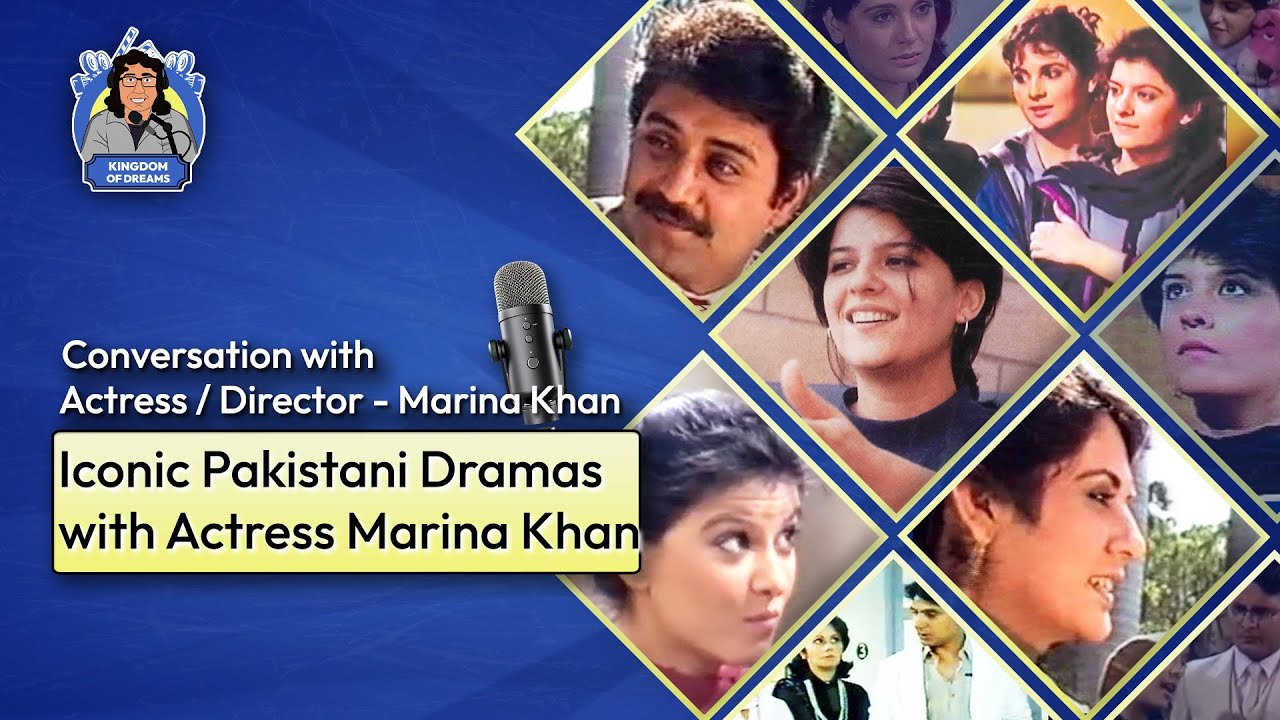
Clips and Shorts from this episode
About this episode
🎙️ On today’s episode of the Kingdom of Dreams Podcast, we’re joined by the legendary Marina Khan, a trailblazer of Pakistani television whose work has defined and inspired generations.
From iconic dramas like Tanhaiyaan, Dhoop Kinare, and Rashid Minhas, Marina reflects on the golden era of storytelling, the enduring power of strong scripts, and her evolution from celebrated actress to director.
Marina Khan is a renowned Pakistani actress, director, and producer best known for her iconic roles in classic dramas like Tanhaiyaan and Dhoop Kinare. Born in 1962 in Peshawar, she became a household name in the 1980s and has remained a beloved figure in Pakistani television. Over the years, she has also worked behind the camera, directing and producing several successful series, and made appearances in films such as Punjab Nahi Jaungi and Parwaaz Hai Junoon.
#pakistanidrama #bestpakistanidrama #toppakistanidrama #ptvolddramas #newpakistanidrama
#pakistanidrama #bestpakistanidrama #pakistanidramas #pakistaniserial #toppakistanidrama #marinakhan #ptv #80s
Full transcript
Automatically generated from the episode audio, so expect the odd misheard word or name. Speakers were labelled automatically. About 8,500 words. Tap a timestamp to play from that moment.
0:00Marina KhanPeople of my age, when we get a good script, it's, it's, you know, it's, it's lovely to read a script that is exciting, you know. Otherwise, it's the same lines, it's the same thing. You do it, you know, you do it for the money, you do it because a friend is directing, you do it for, you know. It's very rare that you get these, really good scripts. With Saira, I think I didn't get the same experience I got with Shehzad because when I was working for, in Dhoop Kinare, I was also dating my husband. And I was always in the rush to go there, do my work and, you know, get away so I can spend time with him. So I think I didn't enjoy that process, but she also was a person who had the ability to get the best out of me. The thing that I'll never forget is that when we did the scene... I always get emotional on this, because he was just such a hu… beautiful human being. He never used to say, you know, like, "Oh, brilliant," or, you know, he was a very, he always was a very reserved person that when...
1:08Marina KhanAnd I used to always say, "Shehzad Saab
1:10Jawad MirGood afternoon, everyone. Welcome back to yet another episode of Kingdom of Dreams podcast, The Making of Stories. I'm your host Jawad Mir. Today, a little bit different, a part of the world where I am from originally and something that I have grown up, back in Pakistan, the television dramas, that used to play or te… as known as teleplays here. And, one of the actresses from, several of those plays that were very popular in the '80s and the '90s, Marina Khan. She played a pivotal role in the '80s and the '90s, at least for me. I'm sure she's doing some great stuff right now in some of the most incredible, te… teleplays, dramas known as Tanhaaiyan, Dhoop Kinare, Tumse Hi Kainaata, and a whole lot more. We talked about her career, how she got into, acting, a very fascinating story, as well as all the stories behind the scene and the current state of teleplays in Pakistan.
2:19Jawad MirSo without further ado, here is my conversation with actress, director Marina Khan. So I would love to start off with your career. How it, what was the catalyst, that bug that got you into acting that led to Rashid Minhas and everything else throughout your career?
2:38Marina KhanYou know, it's just one of those things that I'd never, ever thought of acting. I didn't think... You know, we grew up with television, obviously, because, you know, we used to come home from school, especially I remember when cricket used to be on. We, you know, all afternoon we could watch TV. Otherwise, I think at that time we, I think 7:00 or sorry, that's my dog. 8, 7:00, 8:00 is, sorry, 7:00 or 6:00 is when TV used to start. But never thought of being on that side of the camera. So my friend Kaikashan, who was in Dhoop Kinare with me, and she played my friend, Anji, she, had, a love for singing and, didn't realize that acting was... So she went for an audition, for singing and, just, you know, there was an, a old actress, I can't remember her name now. S… oh gosh, it'll come to me.
3:40Marina KhanSo she knew her, and through her she went there, and then, you know, she did this amazing play called Jungle, and then Aasman Tak Diwari. This i… this is, Noorul Shah who wrote these, very, bold topics. And because Kaikashan used to go to the television station, now it was like a big thing for us, you know, because, you know, TV was... So I used to just go and visit her. And, I was spotted by, Shehzad Khalil, who directed Rashid Minhas and Tanhaaiyan. His assistant, who, at that time I think was doing something with Saira Kazmi, and she said that, "We're looking for a new face, and would you like to come?" And you know, I just looked at Kai… and then both Kaikashan and myself. He asked for both of us to come. And I was like, it's like, you know, basically it's for her. I'll, I'll just go along. And, he was the person who, he was just an amazing human being.
4:42Marina KhanHe was just this person who, he was, he was a small-framed human being. And I remember walking into his office and there was this massive desk, and there was Shehzad Saab sitting behind the desk. Spoke beautifully, Urdu and English. His family was from Afghanistan. And I think he had the ability to even convince a stone to act, because I was like, "Never done it. Don't know anything about it." My Urdu was really bad. I said, "I don't know anything." You know, it, the, just the way he convinced me, and I said, "Fine," you know. "Let me give it a shot." And he's saying, "Don't worry, there are not many dialogues, you know, and, you just keep doing what, I asked you to do." You know, like he just gave me that confidence. So I went and I asked my mom, and you know, my father is from, I won't say very conservative, but yeah, in one way we are a conservative family from Tando. And that was my biggest, issue because I wanted to get his permission because when we go to our hometown, we do purdah, you know, all of that.
5:51Marina KhanAnd I think Daddy wasn't there and Mummy spoke to him on the phone or something like that. No, sorry, he was there. And I said, "Because it's an Air Force play… you know, he said, "Okay," you know, sort of a one-off thing, you know? And that was it. It just started from there. And then next thing, Tanhaayi came along and Shehzad Khalil fought for me actually because Haseena at that point wanted to cast someone from Islamabad, I think. And, he just said no because while, I think, one was performing, you don't know, you know, you j… you just be… the moment the camera cuts, you just behave in a certain way or if you make a mistake, you behave in a certain way. So he was noticing all of that, and that is what he incorporated, in Tanhaayi and Sania's character. So that's how it all started. I mean, it was, you know, just a… I was just very lucky. Very lucky.
6:50Jawad MirIt's interesting you mentioned about Haseena, about making, you know, saying that it should be somebody else. Was she also a producer, but as a writer…
6:58Marina KhanNo, she was a writer, yeah.
6:59Jawad MirOkay.
6:59Marina KhanWriters had a very big say in those days.
7:01Jawad MirReally? Really?
7:02Marina KhanYeah. Writ… you see, the thing is the writer always comes with a wish list. Every writer, if you ask them, you know, when they're writing something, they always have a cast in mind or they always have someone in mind. And because she'd already done, Shehnaz Sheikh had already done, Ankahi.
7:18Jawad MirAnkahi, yeah.
7:20Marina KhanSo Shehnaz was the 100% there, and they needed the sister. And, because my audition in front of her was, I'm thinking, horrid. It must have been because I saw her face and she was like, "Ew, what the hell is Shehzad thinking?" and then later on I realized and I found out that, you know, she was very adamant that it should be someone else, but then I en… ended up doing four of her serials after that, you know? So,..
7:49Jawad MirInteresting. That's very…
7:50Marina KhanSo writers do have, writers do have, you know, they did have a say in it or they used to at least have a wish list usually.
7:56Jawad MirBut not anymore though, right?
7:58Marina KhanNot anymore. They, I'm sure they do. I'm sure they do, but, now it's just a question of who you can get. And if you have a wish list, and, usually the wish list is what the producer would also want, but, you just can't get actors. I mean, everyone is just so chock-a-block with work these days. There's so much work going on that just getting that wish list, so at that time whoever is available because it all depends on when it has to go on air and, you know…
8:28Jawad MirSure. Sure
8:28Marina Khan... All those things. Yeah.
8:30Jawad MirInteresting. So we'll come back to dramas and everything else in a second. Had you not gone for that audition, where do you think your li… wh… where were you visioning your life to be or you had no idea where you were gonna go?
8:43Marina KhanYou know, at that time I just didn't know. I knew I wanted to be independent. I knew I wanted to do a job. I was a terrible student. I was a hopeless student, but at one point I remember I alwa… I lo… I've loved animals, so that was something I really wanted to do. If I, if I was intelligent enough or if I had the brain, I would have loved to have become a vet and a, you know, a veterinarian. That was something that I really... And like if there was any, thing that I really wanted to do, that was something. But I did also audition, or audition, interview for, flight attendants for, British Airways. That is again something I was very interested in. Again, failed miserably because of maths. And, I think also not giving the right answers in the interview. So these are the only two things and, otherwise I did not know what my direction was going to be. I got, I was very lucky.
9:44Marina KhanI got a very lovely job with an orthodontist, Dr. Shireen Bajwa, and it wasn't a 9:00 to 5:00 kind of a thing. She used to come to Karachi once a week and I ha… I had basically two weeks of work. The week she was there I was with her 7:00 to 7:00 or 7:00 to 9:00, and otherwise it was just phone calls and, you know, making appointments and making sure people came on time and stuff like that. That was my actual first paying job. And it was decent money for, you know, just one week's work. And, tha… that just sort of gave me this feeling of wanting to be independent or wanting to make my own money and... Because otherwise, you know, parents are always there, but my father was, my father was an amazing guy. He wanted me to get married and wanted me to have a very conventional life, but he never forced me and he always also pushed me into things. You know, "You try because I think he also realized, "Okay, eventually, you know, but " So that independence, I was just like, you know, this is something I wanted to do.
10:55Marina KhanAgain, at that point there was no career, and even acting was never a career in the, in the '80s. It was, it was more of a hobby because for women probably in one way, yes, but for the men, I think most of the people who, most of the guys who were acting all had jobs. And, a lot of them used to come, you know, either after 1:00 or after 3:00, whenever, you know, banks, travel agency, whatever, you know, car showrooms, you know, they all had jobs. So I think just that determination that I just wanted to be independent at some point, even though I never wanted to leave my parents, I never wanted to move away from them, but I wanted to be independent in that way, to have my own car and to... But n… never, didn't think about it and never looked back after that. Never looked back.
11:49Jawad MirThat's incredible. Thank you for sharing that. You know, I'm, I'm, my conversations are normally all over the place, so please…
11:57Marina KhanThat's okay
11:58Jawad Mir... There's, there's no, there's no continuity to it. I always, so maybe it's me, So I watched, obviously growing up in Pakistan, lots of dramas because like you said, there was the morning session, which came I think in the late '80s with Musalsal Sanawer.
12:14Marina KhanYeah.
12:14Jawad MirBut it used to start around 4:30 PM. I used to watch my cartoon shows. I…
12:18Marina KhanYeah
12:18Jawad Mir... I remember that, all them dramas. But and when we moved to Canada, probably watched some dramas like Awaazin, Tum Se Na Kehna Tha, I think Aanch. But I just feel back then in the '70s, maybe even '60s, '80s and '90s, the dramas were more widely, about wide top… wide topics, like social, political, relationship. I don't watch dramas right now, but I know people who do, and any time I go in passing it's ab… always the same topics and same issues.
12:50Jawad MirDo you think... Is that, is that accurate assessment, that we have sort of drifted away from all that?
12:56Marina KhanWell, I think for the longest time we had. For the longest time, when we came into I think the private sector, Star Plus had just opened up. We were getting access to Indian, you know, these, dramas. People became…
13:12Jawad MirYes
13:12Marina Khan... And suddenly a viewership increased for that. So we started aping those, and we started, mimicking those, with obviously our own stories and all. But, Hum TV always I think kept its niche, and that's why it was also popular. So it would have the same themes, but Hum TV always kept a certain edge to their dramas. Now I think in the last, at least I would say in the last two years, and why I'm saying that is because I didn't watch dramas reg… regularly, but now I do a show, on, 24News, which is called Kya Drama Hai, and we review dramas.
13:54Marina KhanAnd because of that as we started, obviously we had to review. And this is now the 8:00 slot. I'm not talking about the 7:00 or 9:00 slot.
14:01Jawad MirSure.
14:01Marina KhanSo the 8:00 slot. And I noticed from, e… ever since the Green Channel came on and, view YouTube, subscribers came on or our channels went on to YouTube, the content has started changing now very slowly. Because now, I think there is a younger lot coming into it. Th… you know, th… there is a drama on right now called Parvarish. It is phenomenal.
14:29Jawad MirYeah.
14:29Marina KhanIt is so good, and it's, it's... And we have Namaa Najam, we have Savera, and we have, Ashir Mahmoud, and we have Shamim Hilali, but it's the kids who are the, highlight of the drama, and it's about them, and it's about families and how fa… And you know, y… I think five years ago, maybe even two years ago, something like this may not have been a possibility. Or if someone came with that idea they probably would say, "Nah, Yeah
16:48Jawad Mir... It's also, very, present in Hollywood, as well, right? Now there's this whole trend of remakes or
16:56Marina KhanYeah
16:56Jawad Mir... You know, sequels, like existing IPs and all that. And the chances element has kinda gone out the window taking risks.
17:04Marina KhanYes.
17:04Jawad MirBut going back to the dramas, what in my view made, and this is not to take away from direction or acting or anything else.
17:13Marina KhanNo.
17:13Jawad MirAny story begins obviously with a pen or a pencil, right? Writing. But the next one is characters. If you have strong characters, the story may not be that strong. Like, to me Tanhaiyan story wasn't that, you know, out of the box.
17:29Marina KhanYeah.
17:29Jawad MirIt was, it was very simple.
17:30Marina KhanYeah.
17:30Jawad MirBut the characters made, like Kabacha and, you know, all that stuff.
17:34Marina KhanYeah.
17:34Jawad MirSo is that still... Do you see that happening now, the characters?
17:39Marina KhanVery few. Very few. I mean, I can name, like, maybe on my fingertips, people writing. I mean, we do write characters, but with... But you know, like, when you followed Kabacha's story, you knew his entire, you know, like, w… what he is, where he is, and you wanted to see what hap… once. So here what we start is we start writing characters, but we just fade them out and we just stick to the main two or three or four people, and we don't give… Our, support characters' backgrounds or stories, whereas our dramas are up to… I mean, I recently, just directed a play called Dastak, which was technically 26 episodes, but we ended up with 43 episodes. Now, if you are writing for 43 episodes, you must have sub-stories and subplots and because otherwise to sustain just, I mean, either you have to be a genius to sustain the, just the, plot of, the main two
18:38Jawad MirCharacters
18:39Marina Khan... Leads. You know, when while one is shooting you can take a character somewhere because they are very developed characters. But very few, writers. We have about five or six amazing writers now, but five or six is too little for the amount of volume of work that we have. Mustafa Afridi is a genius writer. He did Tanmaan Neil O'Neil. He did Kabuli Pulao. I don't know whether you've heard of that.
19:03Jawad MirNo.
19:04Marina KhanBrilliant play. Sorry, that was Zafar Miraj. He did, Zar Patto Ka Band. Zafar Miraj, old time PTV, writer who again, thank God, has started writing again because you know, Zafar Miraj just disappeared, and we knew, you know, the kind of, you know, stuff he used to write. And now, thank God, because, a place that kind of writing is being appreciated by at least, you know, some, if not all the channels, but some of the channels. And now someone like Mustafa Afridi, I think he's probably booked for the next two years, three years. You can't get him to write a script for you because of his… he just writes amazing stuff. Amazing stuff. I mean, those plays are the ones to watch, you know, Zafar Miraj and then recently this, who wrote, Parvarish, Kiran. Again, very good stuff. So you know the, well
20:12Jawad MirYeah
20:34Marina Khan... You know, polished and everything. And even at that point it's not certainly perfect. You talked about the drama…
20:40Jawad MirYeah
20:40Marina Khan... You just d… directed. Can you tell me more about that? Like, what is it about and when is it coming out, if anything you're willing to share?
20:46Jawad MirSure.
20:46Marina KhanWell, Dastak was, it was basically about a, it's about a divorced woman, and what happens and the, not consequences so much, but a lot of the, you know, how society sees a divorced woman. But it wasn't too much on that part alone. That part of it was very much, incorporated in the, in the story. But it starts with her getting married to this man and, him being in love with someone else, doesn't treat her well, and then she has a kid and he says that, "I have to go." Once his father dies and, you know, that, the, he's freer to make his own decisions, he decides to leave her. And she's, and they've just had a baby and, the other woman is not willing to, obviously she's not going to get into a relationship with the child. So she, he signs off the child to her and then of course all the things that happen between, and then she finds a really nice guy and, but then this man comes back into her life and now because he can't have kids, he wants his child back.
21:56Marina KhanSo it's basically about that. But, I think the highlight for me in Dastak was my main lead, Sohai Ali Abro. She, I, you know, I'd never worked with her be… I have worked with her before, but in a very sh… in a, in a sort of a short film as an actor. But, she was just brilliant. She was brilliant. It was such a joy working with this girl. And she was the main, you know, it was, it was all about the girl's cha… the c… character's name was Kiran.
22:31Marina KhanSo it was an interesting thing and, you know, she was very invested in it and, you know, there was a lot of discussions that we used to have and in that way it was very nice. The only thing is the project went a little out of control because, we were put on air, suddenly and, then it was basically just micromanaging and firefighting. That was a little disappointing, but otherwise it went off well. I got, I got lucky. I got lucky again. I had amazing actors to work with.
23:02Jawad MirAmazing. You know, not to count the years, but let's talk about, you know, obviously you have a long career. Very fruitful career. And I'm sure, I mean, we all have these moments where, you know, where maybe we're sitting in solitude and we think about, how we got to where we are today. And do you sort of reflect back and enjoy those times of the '80s and the '90s, even early 2000s, you know, just to see your path of coming in all these, you know, very monumentally historically known well dramas and written, well-written dramas that kept audience, especially Haseena Moin dramas kept audiences on the edge of their seats until the last episode.
23:45Jawad MirLike, what's gonna happen with these two characters? You know how her dramas ended, right?
23:49Marina KhanYeah.
23:49Jawad MirSo yeah, so just do you sort of think about that and w… what do you feel about that? Because it's, it's, y… your career has been amazing, obviously. I have only followed it until the end of '90s, so I don't know much beyond that, but I'm just speaking in that realm.
24:04Marina KhanYeah. Yeah. Y… you know, the thing that I really miss, and loved about that time… Was, I think the times were innocent even though, you know, you, I don't know if Karachi has ever had innocent times but, somehow, th… there was something about Karachi in those days that I don't know, the, maybe it was just me because I had, I had my car, I used to drive to work, I would come back from work and, you know, I had that sense of freedom. And, just working with like-minded people, working with friends, working with, you know, that I really miss because now you don't really get a choice and not every time. I mean, I've been lucky with all my directorial projects that I've had, you know, a very happy green room, which I'm always happy about. I said, "Even if they don't like me, but the green room should be happy." And if the green room is happy, then you know, I know that my set is a, it's, it's a good set.
25:05Marina KhanBut I really miss that. I miss the camaraderie of that time. I miss, I miss the closeness. I think also it was all very new to me, so I was very into it. I'm sure a lot of, the actors must have felt, "Okay, achha haan, bas ho gaya na," meaning we've talked enough about it. But because I was new, you know, I was sort of much more hungrier to be part of it and... But yes, I miss the innocence, I miss the, you know, PTV had a lovely structure. It had the, we worked in studios. W… we could never underlie ka kabhi pata nahi chalta tha because, you know, we had air-conditioned studios. We had three cameras we used to work. I mean, I don't even remember how many scenes we used to do in a day because it was just so much fun. It was just going to work was fun. Now going to work can be a little tedious, because we work on sets, we work on, locations. Locations sometimes are not very comfortable. There's the heat, there, you know, there's, there's so many factors that come into it.
26:07Marina KhanAnd because we worked with multiple cameras, we used to do a scene like it was, it was, you know, like little theater pieces. The whole scene was shot in one go. So we had to know the entire scene, we had to know our lines from the beginning till the end. Now everyone comes, they don't know their scenes because, that's how they've learnt. A lot of the times, for some reason, I don't know why production, companies are not willing to give out, the script also. So actors are coming on set and they're, you know, learning their lines and, you know, mashallah, they're very good.
26:40Jawad MirReally?
26:41Marina KhanHa yeah. But they're very good. I mean, like, I know some people they'll come and they'll just look at the scene and that's okay, and they will give you a perfect performance. And I'm just thinking, "Oh my God, if it was all rehearsed and, you know, the whole thing was there, can you imagine what level we can get to?" But that's what they've learnt and that's how they have come, you know, to, be a part of this, fraternity. But I miss that. I miss the rehearsals, I miss the, I miss the seriousness of the craft. I feel that we're not serious about the craft.
27:17Jawad MirI was gonna say the same thing, that I feel that i… in those times it was more about the art…
27:23Marina KhanYeah
27:24Jawad Mir... Than necessarily about money, right?
27:27Marina KhanThat and your, and your face. So I remember when we used to be on screen, we should have, what we, what we called, quarters. So I think we had four quarters in the year. Every three, every three months. Yeah, every three months we had…
27:42Jawad MirYeah
27:43Marina Khan... A quarter. And so if we were on, say in the January quarter, we couldn't do the next one. We had to skip it. Nobody was, they were not allowed to cast the same actor for the next quarter. So but now it's like you see the same faces, you know? So…
28:00Jawad MirOh, yeah
28:00Marina Khan... So there's no thought process that goes into it. There's no, it's just ""I feel that's the, you know, "Okay, we're getting the views, we don't care." And, you know, sometimes, like in the, in our, in our, this, show that we do, there's so many dramas we have to watch which can be very difficult to watch, but they get their views. So, you know, we, and I say that at the end, I said, "Who are we to say anything?" I mean, look at, just look, just look at the numbers, you know? But I feel that if we had, developed, institutes and if we had developed a path, when we came into the private sector, then it, we could have really gone. I mean, we're very lucky because our dramas are loved all over the world. I know, that for a fact people watch it.
29:04Marina KhanBut I just feel that I'm just thinking where we could have been if we had taken it, step by step and the right, the right way.
29:17Jawad MirYeah. And I, look, again, I don't know much about the last 25 years, but I know that, you know, directors like, Saira Kazmi, you know, who…
29:28Marina KhanYeah
29:28Jawad Mir... Is probably one of the most talented directors. I don't even know if she still directs anymore. If she did, I would…
29:32Marina KhanOh
29:33Jawad Mir... You know, watch her drama in a heartbeat. And Shoaib Mansoor, who is obviously not in dramas, but Khuda Ke Liye and all that.
29:40Marina KhanYeah.
29:40Jawad MirSo there's, there's a lot of that and many more that I can't remember right now that's again, it goes back to the story, to the art. Like Nangay Pou, I mean, what a… ... Phenomenal drama that was, right? It was just so well structured, characters, and it was balanced in the way it ended and everything. So again, going back to the characters because those characters are missing and I genuinely be… even in Hollywood when there's no character, like movies like Jerry Maguire, which I'm sure…
30:08Marina KhanYeah
30:08Jawad Mir... You have seen, right?
30:09Marina KhanYeah.
30:10Jawad MirLike, all that stuff is… ... Not there anymore. You don't…
30:14Marina KhanYeah
30:14Jawad Mir... See that stuff.
30:15Marina KhanYeah. Yeah. And it's, it's also very, It's, I just find even the level of acting is sort of, you know, the... I mean, I love rom-coms, and we've had some amazing rom-coms in the past, but now you pick up one, you pick up another, in five minutes you can't watch it.
30:34Jawad MirAnd I think it goes to what you were saying earlier, too, that before it used to be like every quart… ev… you had to take…
30:39Marina KhanYeah
30:40Jawad Mir... A break for a quarter.
30:41Marina KhanYeah. Yeah.
30:41Jawad MirAnd now it's actors are coming on the set, they're getting scripts on spot. Yeah, a very veteran actor may pull that off but…
30:48Marina KhanYeah
30:49Jawad Mir... Others probably not because you're not really diving into the character, you're just reading lines.
30:53Marina KhanExactly. Exactly.
30:55Jawad MirYeah.
30:55Marina KhanSo these, the couple of plays that I've mentioned, if you see those, you can see that the actor, like, you can see the involvement of the team. You can see that there's, here's a well-oiled team that is interested in not just the, script, not just the thing, it's the characters, it's the actors, it's the directors. You know, like you can see that everyone was so involved in these.
31:20Jawad MirYeah.
31:20Marina KhanAnd I think also when especially, people of my age, when we get a good script, it's, it's, you know, it's, it's lovely to read a script that is exciting you know? Otherwise, it's the same lines, it's the same thing. You do it, you know, you do it for the money, you do it because a friend is directing, you do it for, you know. It's very rare that you get these, really good scripts. Nadia Afghan, recently said that. She's saying, "I've been very lucky." She's been part of some really good scripts. And she's saying that's, you know, she, just she's saying just reading it alone was such a joy.
32:00Marina KhanUs se pehle aap, you know, ya ek nand hai ya ek bahu hai ya ek, you know. And those are very flat characters and they're very flat, lines. And here is, you know, something that you can, you can show off your talent, you know? We don't get that chance to show off the talent that we have.
32:20Jawad MirActually, there was a drama that came out I think three, four years ago. I saw it during COVID. I forget the name, but it was about three brothers and their wives who lived together. Kavi was in it. He was playing the dad.
32:35Marina KhanOh.
32:35Jawad MirDo you know the one I'm talk…
32:37Marina KhanWas it…
32:38Jawad MirIt was like…
32:39Marina KhanWas it, like, Fun?
32:40Jawad MirYeah. It was very, it was very…
32:42Marina KhanLike Dream Gali or something?
32:43Jawad MirNo.
32:44Marina KhanOh.
32:44Jawad MirIt, one of the, one of the brothers marries a second time without letting the other f… the rest of the family knows. It, I forget the name, but it was one of the most, hilarious dramas I've seen since…
32:56Marina KhanAh
32:57Jawad Mir... I moved to Canada. I…
32:58Marina KhanYeah. Yeah
32:58Jawad Mir... I'll find out the name, but I thought that was the only one that…
33:01Marina KhanYeah
33:01Jawad Mir... Because it was character-driven, extremely character-driven.
33:04Marina KhanYeah. Oh. Was it, was it something like for Ramzan or something?
33:08Jawad MirNo, it was 13 episodes. Let me just see. I thought it was called A… Ang… Angan, but I could be wrong.
33:15Marina KhanOh.
33:15Jawad MirHold on. Let me just Google it. Yeah, it's, it's called Angan.
33:26Marina KhanAngan.
33:26Jawad MirIt's, it's actually…
33:28Marina KhanWho directed it? Kas… Qasim Mali?
33:31Jawad MirYes.
33:32Marina KhanYeah.
33:33Jawad MirI think so.
33:33Marina KhanOkay. I know which one.
33:34Jawad MirYeah.
33:35Marina KhanYeah.
33:35Jawad MirYeah.
33:35Marina KhanIt had a big cast. Big cast.
33:37Jawad MirYeah, it was based on a novel by Khadija Mastoor from 1962.
33:41Marina KhanYes. Yeah.
33:42Jawad MirYeah.
33:42Marina KhanThat went very well.
33:44Jawad MirYeah.
33:44Marina KhanThat was, yeah, it was a very popular one.
33:48Jawad MirSo I have a technical question. One of the things that I, yeah, I can't, I don't know why we don't change that in Pakistan. Maybe it has. Movie like Khuda Ke Liye, Bol, even Pakistani dramas, they're all dubbed, right, afterwards?
34:03Marina KhanYeah.
34:04Jawad MirWhy isn't there on location? I mean, it's not that difficult to do on location sound.
34:07Marina KhanWell, have you seen Lal Kabootar?
34:09Jawad MirNo. Is that on location sound?
34:11Marina KhanYeah, that's, that's... We don't have sound recorders. We have one, two, three.
34:17Jawad MirBut why not? It's not that…
34:19Marina KhanAnd there is, and it's…
34:19Jawad MirI mean, we live in 2025. Like, it's not... 'Cause it really adds…
34:24Marina KhanI think…
34:24Jawad Mir... To the ambience of the, of the story of the drama.
34:27Marina KhanYeah. You must watch Lal Kabootar. That is a…
34:31Jawad MirOkay, I'll check it out
34:31Marina Khan... A very good film. Yeah. That was, that was done by a gentleman by the name of Faiz, who is now my niece's husband, and they have recently... Well, my niece is Canadian, but they, he's, they just got married and, he's just done his landing.
34:51Marina KhanSo sound is the one of the weakest, aspect of our, even our, dramas because we over-process the sound. We've, we used to have no ambience, sound. We would have just loud music to cover up the faults of the, you know…
35:11Jawad MirYeah
35:12Marina Khan... So now thank again, thank God because of YouTube and, certain places where I think now they want to expand their viewership, these things are starting to come into play. Like, for the first time when I was doing Dastak we used to get foley done also at the same time.
35:31Marina KhanWhich never was, you know... A… and I used to always say, "Okay, why are you processing it so much that, you know, I'm losing the door opening and I'm lo… you know, I'm losing all of that?" And they said, "Ke woh his aati." You know, pehle it was a his aati, his aati. Maine kaha toh har kam pe kiye you know, they, it's a, it's a natural thing, is n… I know that sometimes we have a lo… we have a lot of noise pollution in Karachi, right? So there's certain areas where even Faiz says that, "I would just tell you don't shoot here," because it's, it's just not, feasible. Or if you have to, then you dub that, scene. But, Lal Kabootar was on location. That was done, and I think there was one other film, but yeah, I don't know. I do, I think it's money. I think, A, these kids are expensive, because, and they, you know, but… But, you know, at the end of the day we've started, thank God, paying our DPs. You know, there's certain areas where the money has, improved a lot, and I feel sound is the next thing that needs to come. The sound and production.
36:32Marina KhanThese are the two places. We really need to…
36:34Jawad MirI agree because to me personally sound is the most important part of production.
36:42Marina KhanIt's a huge part
36:42Jawad Mir... I will not take... Right? Because it really s… p… audience don't know it consciously, but it really pulls you in. And I think even in India, the only film that was not, dubbed, was on location, was Lagaan. Same problem there. Like, it's all majority of the stuff is dubbed. And you can sometimes see it because the…
37:00Marina KhanYeah
37:00Jawad Mir... Expressions of the facial muscles are moving differently than what, how you were recorded it, right?
37:05Marina KhanYeah.
37:05Jawad MirSo.
37:06Marina KhanYeah.
37:06Jawad MirYeah. But yeah.
37:07Marina KhanA lot of people go, "We can improve in the dubbing," and not necessarily.
37:11Jawad MirNo.
37:11Marina KhanNot necessarily. No.
37:12Jawad MirNo, you can't. Anything in post is not, you know, that's, the comment is, "We'll fix it in post." It's not something that works all the time.
37:18Marina KhanYeah. Yeah. It's true.
37:19Jawad MirI wanna go back very briefly to your, dramas, and I know it's been a long time. Do you remember any s… stories that you wanna share from any of the dramas from like Dhoop Kinare, Tanhaaiyan, or Tumse Hi Kainaata that still stays with you, that you sort of think about it puts a smile on your face?
37:38Marina KhanI think probably it was the first time that I ever cried in a drama, was in Tanhaaiyan. And, I remember Shehnaz telling me, she's saying that, "If you have to cry, and if you won't cry, then I can't." And I'm like, I'm s… I'm saying, I'm looking at her and I'm saying, "What are you talking about? You're the experienced one here. You should give me tear." I said, "How does one cry?" So I remember Shehzad Khalil coming down, because the control room used to be upstairs. And him coming down, he put all the lights off and we just had the lights for the set on, and otherwise he... And he sent everyone out, and just sat and talked to us, both of us, and sort of told us stories about how, you know, this person couldn't do it and how, you know, he just sort of telling us stories about how different people process, this feeling and all. And I'm just looking at him and I'm looking at him. Then he says, "Think of something that really has moved you in the last, you know, couple of months or t… " So I with my friends, we had raised, some money for Ethiopia, the famine in Ethiopia.
38:55Marina KhanEh, and, we got this massive poster, even though it was a fashion show, but we got this massive poster of this kid. And I always remember just looking at that child, it used to sort of, move me very, a lot. So Shehzad Saab said, "Okay, let's, let's focus on that. And, you just tell me, you just put your, you know, your thumbs up and I'll be rolling the camera, and we'll just get... " And that's how it came about. And, you know, he just got it the first time round because I just... And the thing is, I think because one was so involved, I mean, like, but also when I think about it, you know, we took time to do these scenes. We, even though it comes and goes like that, but, you know, we took that time, he took that time out. He made sure that it comes naturally. And he, and he told me also, he's saying, "Even if the tears don't come, I want to hear it in your voice.
39:55Marina KhanI want to, I want to hear the…
39:57Jawad MirYeah
39:57Marina Khan... " And then, and then Shehnaz came, and she looked at me and I looked at her and, you know, this is when she comes home late, and I'm very upset… ... And she's, I, she's missed my birthday. And I'll never forget that because sh… the thing that I'll never forget is that when we did the scene, I always get emotional on this because he was just such a hu… beautiful human being. He never used to say, you know, like, "Oh, brilliant," or, you know, he was very, he always was a very reserved person that way. And I used to always say, "Shehzad Saab "
40:57Jawad MirYeah
40:57Marina Khan... He should, he should have stayed on. So that I always remember, from one of my, yeah. And I remember also there was another scene in Tanhaaiyan where I get the news that something about Zara, and this was much later in the episode, and I automatically started crying. And he came down and he says, "No, Meera, I don't want you to cry here." And then I had to go fix my makeup and everything and come back and do the scene again. You know, he was so sure about... And I think that's what also got me into direction, was just the way I used to watch him work and how he used to work with us as actors. He was just amazing human being.
41:43Jawad MirWonderful. What was it like working with, Saira Kazmi?
41:46Marina KhanSaira was a totally different case. Saira was brilliant. S… with Saira, I think I didn't get the same experience I got with Shehzad because when I was working for, in Dhoop Kinare, I was also dating my husband.
42:07Marina KhanAnd I was always in the rush to go there, do my work and, you know, get away so I can spend time with him. So I think I didn't enjoy that process. But, she also was a person who… Had the ability to get the best out of you. I mean, like I said, I was extremely lucky, extremely lucky. I remember the one that the play that I, saw a little later on was a play called Najat…
42:39Marina Khan... Which she had done, Sajid Hassan, myself, Atiqa Odho and, Noman Ejaz were the main leads for that. And that to me was, for me it was a masterpiece that play was. It was brilliant. And even Dhoop Kinare I think I saw like five years later or something, and I just didn't realize how brilliant it was. And, you know, because when you're in the process…
43:05Jawad MirYeah
43:05Marina Khan... It's a totally different ball game, you know? It's, but, when I saw it put together as a whole, you know, it was brilliant. But Najat was just amazing. Again, oof, the characters, the characters in that. There were so many. I think, Syed Nadeem, what was his name? Asgar? S…
43:28Jawad MirSy… I know, I know exact…
43:30Marina KhanHa
43:30Jawad Mir... Asgar Nadeem Syed.
43:30Marina KhanAsgar Nadeem.
43:31Jawad MirYeah, I remember that name. Yeah.
43:33Marina KhanBrilliant.
43:35Jawad MirYeah. Yeah, amazing. I mean, it's been, yeah, I mean, if I could watch those dramas again and again, like, you know, it's just one of those things. I don't know if it's because you grew up with them or because it's a combination of that plus they were really good dramas. And even one thing, like, if you look at Tanhaaiyan, right, like you look at the wardrobe of yourself and Shanashi…
43:54Marina KhanYeah
43:54Jawad Mir... And you compare, again, I'm not criticizing anyone in particular, but you compare the wardrobe of people in their homes in the dramas today, and how they're all…
44:04Marina KhanYeah
44:05Jawad Mir... Well put together.
44:05Marina KhanDressed up. Yeah.
44:06Jawad MirI mean, I mean, who does that, right?
44:08Marina KhanYeah. Yeah.
44:08Jawad MirLike, it's, it's, that's not natural.
44:10Marina KhanYeah.
44:10Jawad MirI know they're trying to get, like, viewership and everything…
44:13Marina Khanhuh
44:13Jawad Mir... But it doesn't connect with an audience. And Tanhaaiyan, Ankahi and all those dramas, like, everybody just dressed simply. Like, you know, shalwar kameez and that's it.
44:22Marina KhanYeah, because... So there's another thing that I also r… realized, was, you know, when you read these scripts, I think a lot of the scripts are written for middle and lower middle class families. A lot of the scripts. And what we do is that we elevate it to an upper class or an elitist family and make the, lower middle class family a middle class family. And then what happens is the language doesn't change. So a lot of the times you disconnect with the characters because they're not speaking the language of their environment, and I wish they would keep it to what it is, and I'm sure the plays would do much better if you just…
45:06Jawad MirI agree with you
45:06Marina Khan... Because a lot of the things that are said also, or a lot of the restrictions that are said and all, you know, when you come to a middle class family also, it's not there. In a lower middle class and a maybe a lower middle class family, yes, those restrictions and those, taboos and all work, but in a middle class family now, not so much. Yes, there would be a sort of a 50/50 thing, and then in a upper class family, yes, it would be a 70, 40 kind of a ratio. But I think that is also where we went wrong slightly. We just wanted to show the glamour and the glitz and the, you know, and by that you are actually spoiling the story.
45:50Jawad MirYeah
45:50Marina Khan... You know, like a lot of people said "... " because a lot of the language that you speak is not the language of a "... " person who has grown up in a educated family. You know, you would not use certain words. You would not use, y… you know, there's certain things that you would say it in a little more refined manner. And when you read that character in the way it's written and you think of the charac… then it's fine. But the moment you bring it, you know, that character sort of becomes the strange that you can't…
46:30Jawad MirYeah. Yeah. You can't, you can't connect to it. You cannot connect to the character.
46:33Marina KhanSo that is also I feel a mistake that...
46:36Jawad MirAmazing.
46:37Marina KhanYeah.
46:37Jawad MirWell, just to sort of wrap it up, what's something that you wanna do in the next five years, that you may not have done or that you have been itching to do for a while?
46:50Marina KhanWell, before I die at least
46:53Jawad MirOh, that's not what I meant
46:54Marina Khan... I would love to, direct a film.
46:57Jawad MirYeah?
47:00Marina KhanNo, but it's…
47:01Jawad MirThat's awesome
47:01Marina Khan... It's a fact. It's a fact. That's, because of the way, you know, these two films that just came out, Love Guru and, to, you know, like to direct a film. That would be one thing. But otherwise, yeah, just enjoy life these days. You know, I'm, I'm going to be directing something next year, if a interesting project comes in between. I'm, I'm just hoping that our narrative gets better. You know, that's, that's something that... And in a film you can, you can, you know, you can dictate that. That's something that's…
47:44Jawad MirWell, that's good
47:45Marina Khan... Keeping fingers crossed.
47:48Jawad MirFor sure. Well, I hope you get to do that sooner than later and, because it's, it, we have a lot, I mean, you look at, for example, Coke Studio, right? The amount of immense talent that has sort of come out of that, there's a lot of raw talent, and what's, what's worked with Coke Studio is because they went to these remote places and pulled talent out of there.
48:09Jawad MirAnd that's what I think needs to be done in dramas, not in terms of talent, but also storytelling. Like, we need to go to these places…
48:16Marina KhanYeah
48:16Jawad Mir... And tell these, their stories because, you'd be surprised…
48:20Marina KhanThere are so many places
48:20Jawad Mir... How many people relate to it. Yeah.
48:23Marina KhanYeah.
48:24Jawad MirAmazing.
48:24Marina KhanYeah. So if you, if you just watch, Man Jogi and you wa… these three plays I would, Urge you to watch…
48:32Jawad MirSure
48:32Marina Khan... Manjogi, Tanmaan Neelo Neel and…
48:34Jawad MirAnd Parvaresh
48:35Marina Khan... And if you just watch those, I mean, the Parvaresh, yeah, that's very good.
48:40Jawad MirYeah
48:40Marina Khan... Those are just, you know, like they're simpler, simple stories, but there's so much depth in just that alone. I mean, Manjogi… And the beauty about Manjogi and the series that, Sultana Siddiqui did was that also sort of, hinting in a very intelligent way as to how we get driven by a mob element, which is usually en… enticed by a religious sentiment. And how intelligently it was written and, you know, because otherwise, you know, when one talks about religion, one has to be very careful, in a country like ours, where, you know, anyone can get up and, you know, put a case against you or say something against you. Like poor Sarmad Khoosat had to face with, what was his movie? It was this lovely film.
49:37Jawad MirI'm not familiar with that story.
49:38Marina KhanZindagi Tamasha. Zindagi Tama… So Zindagi Tamasha was, a lovely story about a guy who used to ha… He had lovely voice, and he used to recite naats. And it's Andaroon Lahore Sheher Ki Kahani. And one day he's gone to a friend's house, and, the, I think they're either, if I'm not mistaken, they're all drinking. If I'm not sure, I can't remember now, but then they ask him to... And he does this full dance. He does, he starts dancing because that's something that he likes doing. And another kid is taking a video, and the video goes viral, and everyone goes insane about this man, and the whole Mohallah goes. So the Maulvis got up. There was a sect in Lahore, and they did a fatwa against him, and the movie couldn't come out. And even though it had passed censor, it had passed everything. And when you see the movie, there's nothing. There's nothing in it where you can say that. But just because, again, one man will say it and five people will say it, and this mob element will come out and, you know.
50:44Marina KhanAnd he was fearing for his life for the longest time. This is, Sarmad Khoosat, was one of, was the producer or one of the producers on Joyland also.
50:55Jawad MirOkay. Okay.
50:55Marina KhanYeah. So Zindagi Tamasha I think is on YouTube, so if you get a chance you should see that.
51:01Jawad MirI will. I will.
51:02Marina KhanSo…
51:02Jawad MirAnd I think it's…
51:04Marina KhanYeah
51:04Jawad Mir... Sorry, go on. Please go on.
51:05Marina KhanNo, I'm saying s… so these three, shows, and they were not long, thank God. There was e… eight episodes, 10 episodes and, you know, that was the beauty of them. And again, shorter series will also help than these long drawn out stuff that, you know, we do. All had, a very, sort of an undertone of, hatred coming from using religion, f… in the wrong way and, it, they're very good. I don't want to say too much, but if you do get to see it, they're very…
51:38Jawad MirI will
51:38Marina Khan... Really…
51:39Jawad MirI will check it out and I will definitely check it out. And I think, this whole mob mentality thing has kind of happened in the West too with the can… cancel culture.
51:49Marina KhanYeah. Yeah. Yeah.
51:50Jawad MirIt's kind of toning down now. But yeah, I mean, it's similar to, probably not to that extreme than it is in that part of the world.
52:00Marina KhanYeah.
52:00Jawad MirBut yeah, no, this has been amazing. Thank you so much, Meera, for your time. I appreciated…
52:06Marina KhanThank you
52:07Jawad Mir... Lovely talking to you and, looking forward to your drama as well as the movie that you'll direct, inshallah, in the future.
52:13Marina KhanI hope. Thanks a lot.
52:17Jawad MirThank you so much.