
Episode 258 · August 11, 2025 · 52 min
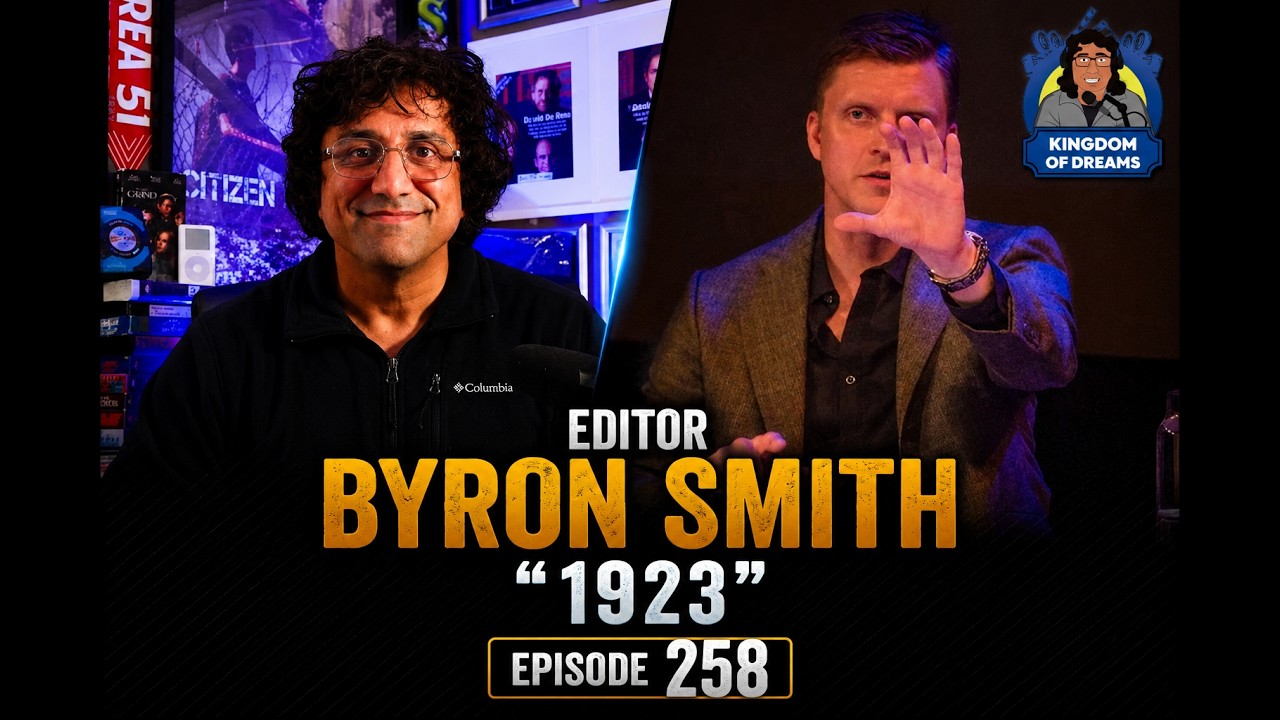
Editing '1923' Series, Editor Byron Smith, Starring Harrison Ford & Helen Mirren
Clips and Shorts from this episode
About this episode
🎙️ On this episode of the Kingdom of Dreams Podcast, I sit down with acclaimed editor Byron Smith, whose work on 1923 has captivated audiences with its sweeping scope and emotional depth. We explore his career journey, from editing acclaimed series like House of Cards and True Detective to shaping the epic storytelling of 1923. Byron shares insights into crafting long, immersive scenes, the art of pacing in high-stakes drama, and what the process has taught him about his own resilience, creativity, and love for the craft.
Byron Smith is an award-nominated American film and television editor with over three decades of experience. A member of American Cinema Editors, he has worked on acclaimed series such as House of Cards, True Detective, Altered Carbon, and Under the Banner of Heaven, collaborating with notable directors including David Fincher.
#1923tv #yellowstone #kevincostner #harrisonford #helenmirren #tvseries #1923Series #TaylorSheridan #YellowstoneUniverse #YellowstonePrequel #HelenMirren
#WesternDrama #TVEditing #ByronSmith #ParamountPlus #EpicWestern #CinematicStorytelling
#YellowstoneFans #BehindTheScenes #OnSet #Filmmaking
Full transcript
Automatically generated from the episode audio, so expect the odd misheard word or name. Speakers were labelled automatically. About 8,200 words. Tap a timestamp to play from that moment.
0:00Byron SmithIt was not only a Western, a movie in, on safari in Africa, you know, it was also a war movie. B… I was from this really tiny town, you know, 235 people. But a, this phenomenon happened all over the country where you could rent, laser discs and videotapes. You'd have… We had to take the machines home. No one could afford them. I mean, like, I've heard Tarantino speak about this, how when they would recut a movie for TV, and then when you would s… you know... We didn't say it specifically, but I knew what we were doing, you know, automatically. I mean, like, I knew what he was up to, and, you know, bringing that brilliance that, it's like bringing nature into your living room.
0:57Jawad MirWelcome back, everyone, to another episode of Kingdom of Dreams podcast, The Making of Stories. I'm your host Jawad Mir. Before I introduce my next guest, I just wanna take, a minute to apologize for not having any episodes in the last almost two weeks. A, summer holidays, a lot going on. B, planning on my next film, a lot of work there. Plus also trying to figure out some new ways of, entertaining you guys on this podcast, maybe some live episodes, maybe some news episodes. So that's around the corner, but just wanted to bring that up to you. Today my guest is editor Byron Smith, who has edited a ridiculous amount of amazing shows, including the House of Cards, Mindhunter, and my personal new favorite, which I never got around to, 1923 stars Harrison Ford and Helen Mirren. We talked about the show, we talked about films, and also the editing workflow that he has had over the years. But without further ado, here is my conversation with Byron Smith.
1:57Jawad MirI cannot tell you how much I'm loving 1923. You know, obviously there's performances, there's, production design, there's the cinematography, all of that, you know, the collaboration on the film set that happened. But one of the things that I really enjoy, and I think that makes the series what it is the editing. And what I mean by editing is, you know, obviously, as you know, it's not about just cutting. What I love about the most is long scenes, and it's not like, you know, you have to go back to another scene where there are three stories taking place. You have to give equal amount of time to each scene to get the audience interested. And that wasn't the case, and it just served the story, and that really absorbs you into the characters, and I absolutely love that. So thank you.
2:49Byron SmithThanks for having me. Yeah, absolutely. I'm glad you can appreciate how critical editing is, you know, h… how it, is a special place for the audience. It is... Editors generally, you know, are always just, they care about story. Everyone's really passionate about the story and, you know, rather than ego or themself or, you know. I mean, like, when I speak to all my fellow contemporaries, it comes out naturally, and you see it. You see it in their, in their posture when we meet, you know, when we have meetings. I'd like to say the American Cinema Editors, you know, the group, which is not just American Cinema Editors anymore, it's, it's very international, and the body's really large. And, but the, everyone is really passionate about the integrity.
3:51Byron SmithThe, you know, such an industry, this whole entertainment industry is built on professionalism. Y… and yet, sometimes, you know, other people that have their duties, the crew members, they kind of like, they are specifically, they're always, like, looking at, you know, how was the hair, how was the makeup, how was, a prop. And because they put their passion into that, you know. And, but, for the editors, then story is the most important paramount thing. And that is, so yeah, it's, nice that you can see it. And editing has become this really cool thing recently, so.
4:43Jawad MirIt is, and to be fair, I'm in the business and I've edited a lot, so I see that from my point of view, too. I've shot a, like, I've done pretty much every job there is o… on a, on a production, on a film. Maybe not costume and s… design, but other than that. So it's, it's, it's, it's just these little things that matter, right? And when I was watching it and I told my wife this story, so I had, what's his name? Jim, he has worked with, Francis Ford Coppola a few times. He's worked with Steven Spielberg, and, Robert Zemeckis
5:22Byron SmithJim. Yeah.
5:23Jawad MirI for… I had him on. I'm forgetting his last name.
5:25Byron SmithJim. That is like, there's a few of those.
5:27Jawad MirJames Reardon.
5:31Byron SmithYeah
5:31Jawad Mir... He's a, he's a, he's a writer, basically.
5:33Byron SmithYeah.
5:33Jawad MirAnd he was telling me this story when they were working on Dracula, him and Francis. ... And he said this story that when Francis had the screening of Godfather Part II… ... Which is where it goes back and forth into past and present, the Corleone family, like Robert De Niro and Al Pacino.
5:53Byron SmithYeah. Yeah
5:53Jawad MirThe very first response by the audience was very negative.
5:58Byron SmithYeah.
5:58Jawad MirAnd it was the exact same film in terms of the duration And Francis and his editor tr… you know, couldn't figure out what the hell was going on, and then it hit them that the film switched back and forth too much very quickly.
6:14Jawad MirSo the audience… ... And all they did was they stretched out… ... Each time period from 10 minutes to 20 minutes… ... And the, and the film worked. So… ... And that's what this reminded me of. That's what I was telling my wife
6:27Byron SmithGood
6:27Jawad Mir... Earlier this week, that it just... Yeah, I mean, I just absolutely, like, yeah, I can just keep on going. It's just, it's fabulous, man, and the characters are great.
6:36Byron SmithThat's a beautiful observation. That really is a really interesting bit of workshop that you realized, the how, when you are able to live with some characters and kinda get to know them a little bit, rather than getting tossed around like a rag doll, going from point of view to point of view, which happens a lo… you know, c… can be the temptation in television often. Because, studios are motivated, they wanna get the largest audience that they possibly can.
7:15Byron SmithThey don't have confidence that every demographic will want to watch a man or a female character, and so they kinda want everyone to feel included and they wanna try to please everyone all the time. And when, but when you can, y… you know, feel comfortable and kind of like settle in with a story and give patience for a moment, you know, and when you, when you're in service to the audience, they will stay with you. They will, they will hold on, you know, as long as, no matter what story that is. When you're, when you, when it's done and crafted correctly, carefully, the audience will stay with you, even if it is not someone that you may particularly strictly identify with or, be attracted to just for, you know, an image.
8:18Byron SmithSo, it, and it's funny because you mentioned The Godfather series because, I mean, like the first and the second, you can almost, you can pull up any clip and it would be hard to r… r… it may be f… hard to frankly know which movie you are in, because they're almost like it is one big piece. So that, I mean, like i… i… and it is funny that I didn't really know the little story that you just told me, but I've been there, and it, I've been kind of through, in that before. You know, in a situation where it was just like, the p… the flow overall is not, something's not quite right, you know?
9:02Byron SmithAnd yeah. The, there's, editing is a complex process. It is a complex, and the tools are very powerful, and all of the things that you utilize are incredibly powerful and a little bit can go a long way. You gotta be careful. And, getting to know through, with some time, some experience, and some patience, you can, you know, construct a m… a movie better. Yeah.
9:35Jawad MirCouldn't agree with you more. Couldn't agree with you more, man. We'll get back to 1923 in a second. What I'm really fascinated with now is that people in this business, you know, sometimes we kinda get, come to get involved in what we're doing…
9:50Jawad Mir... That we f… and that happens to me all the time, that we forget… ... Where we have come to from where. And sometimes we really have to think hard, like, "Oh my God, you know, even if I don't have an Oscar or even if I don't have a Golden Globe or whatever that Emmy, look how much path that I have walked on and what I've gone through."
10:13Jawad MirLooking back in life, what was that moment, if you can remember, that made you realize this is what you want to do? Or was it completely accidental?
10:23Byron SmithOh, it was, it was, there was a decision. Yeah, you're right. I came from a small town.
10:29Jawad MirWhich town, which town?
10:31Byron SmithI came from the Midwest, a small kind of a farm, agricultural town area called, Springfield, Missouri, in the Ozarks. In the real O… I was actually kind of like outside of Springfield in a very small town. My first town, there were 235 people. But I would go to Springfield and get a chance to see movies in cinema or, a drive-in movie theater where a story was told, you know, larger than life on the big screen, and it captivated me coming from such a small environment. And…
11:16Jawad MirWhich film was it particularly, if it was? Sorry to interrupt you.
11:21Byron SmithThere's, the, seeing movies in cinema, you know, it goes back to the days of when we're, when we were, you know, had prim… more primitive civ… civilization. We've always been telling stories around the campfire. It's something, and it's a way we keep our memories alive. It is a way that we educate each other, and we pass, history down from one to the next. And I loved, you know, just overall the presentation of cinema. I knew I could tell something was going on that really was about the storytelling. My, and my family, you know, coming from the Ozarks, storytelling is a part of daily life still. And the way your dad might tell a joke, the way your grandpa might, tell about, their childhood.
12:29Byron SmithThe s… you know, that was, that was really close when you grow up in the Ozarks. That was something… ... Close to me. And so, but, and so the movies, you know, y… you know, really g… grabbed my attention. And I knew I wanted to be an editor. And I'm trying to really remember, w… because it wasn't, it wasn't one movie, but I definitely do remember when I was five how ET was a…
13:03Byron Smith... Big influence. And I saw it in a drive-in movie theater, you know, in another small town. I think there was one in Aurora, Missouri. I think I probably saw it maybe there, or maybe it was outside of Springfield, you know, in literally, you know, a farm field, where one was set up. That is how I saw ET, and that really, you know, made an imprint on me at a young age, because I was about, you know, I was four or five or younger when it came out. And, that one seemed very vivid to me, and my memory of seeing ET is very vivid, as vivid as when we, when we imagine that movie or that character, the light on his finger or the glow that he, has behind him when he comes out of a spaceship or when he's returning on his spaceship to his li… community, his friends.
14:11Byron SmithAnd, you know, those things stick with you. Even the way ET begins, when it starts with a chase and… ... These men, and you never really see these men, these adult m… men that are gonna capture, this creature. And there's rushing through the woods and, tearing through branches, and the sounds of, you know, keys on this man's belt loop, you know, as he's running. I mean, that really, you know, hit me. And even, you know, at that, at that age. And it's funny because then a lifetime later, and, how the circle completes or continues, I sat my son down at a, when he was about six, you know, I, you know, 'cause all these Jurassic Parks were coming out. So I sat down. I sat my son in front of Jurassic Park, the original, and I realized, how Jurassic Park begins when they are offering, make this offering of a goat to a caged, you know, predator.
15:28Jawad MirVelociraptor. Yeah.
15:30Byron SmithYeah. You don't see any of it. It's just a similar, really it's like you can put the beginning of ET and the beginning of Jurassic Park and really capture the parallels of those two, beginnings f… you know, that come from the s… from Spielberg, the same f… filmmaker. You know f…
15:48Jawad MirI…
15:48Byron SmithAnd different…
15:49Jawad MirI would, I would argue…
15:50Byron Smith... Editors, but yeah
15:50Jawad Mir... I would, I would ar… sorry, I would argue Jaws as well, but go on.
15:55Byron SmithYeah, because, you know, I didn't see Jaws until I was, you know, that was probably too frightening. Back then, when movies left the th… the theater, they often didn't come ba… there was no other way to see them again.
16:07Jawad MirYeah.
16:09Byron SmithIt wasn't until now, you know, and I remember when I was telling a friend, the other day, because I have ano… a friend, another friend from the '80s, his name's Lance, who I was telling him, we just kind of like talking about our childhood and what we had in the '80s and we didn't know. And we were talking about videotapes and rental video, you know…
16:33Byron Smith... Rental houses that, and I was even telling him about laser discs. B… I was from this really tiny town, you know, 235 people, but a, this phenomenon happened all over the country where you could rent, laser discs and videotapes. You ha… we had to take the machines home. No one could afford them. They were s… $400 for a VCR. Like, that's ridiculous. And… Yeah. It was, I mean, like, I've heard Tarantino speak about this, how when they would recut a movie for TV, and then when you would s… you know, Jaws cut for TV was probably not nearly the same, you know, as it was in cinema. So it's funny that you mention Jaws because I didn't, I didn't see it until so much later. A… a… even though when I won, a student Eddie Award, funny enough, the evening that I won that award at the Beverly Hilton for the American Cinema Editors, this was, like, when I first came to LA.
17:45Byron SmithI'd only been in Los Angeles a few months, and then here I was at American Film Institute, and I won. I entered, as such an amateur, and I won the student Eddie Award, in the Beverly Hilton ballroom, there at the corner of Wilshire and Santa Monica. I'm in the ballroom, and I didn't know what to say when I accepted the award. But I couldn't, I couldn't believe it because actually Steven Spielberg was in the room. You know, they were honoring Robert Zemeckis that evening.
18:21Byron SmithAnd, or they weren't, I mean, no, s… Robert Zemeckis was also in the room. They were, they were honoring, no, they were honoring Zemeckis. Sorry, I was gonna say it was actually the Golden Eddie, I think. But, then, anyway, I couldn't believe... You know, here I was, and I actually accepted an award. Then the editor of Jaws came up to me afterwards and compl… and congratulated me.
18:48Jawad MirOh.
18:49Byron SmithYou know, I mean, like, and, she was definitely close to retirement, you know, at the time, and she was actually even, like, a supervisor for a studio. And l… and that was pretty powerful. That was pretty classy, you know? I mean, like, being, because when we lose these people, we lose something forever, and I spoke about that with Robin Wright, you know, when we were, like, editing one of her episodes of House of Cards. We were speaking about, you know, we were speaking about Andre the Giant, because he had been in Princ… Princess Bride with her, and he passed away, and when, we learned, and she was in the room with me, and, she, recounted a story about how he kept her warm when she was... Because she was this young girl, and, like, her body couldn't regulate her body temperature. They were shooting out in the freezing cold, and he would have these large hands and warm her.
19:49Byron SmithAnd, but then that, we went on to other stories, and she recounted things from things like Princess Bride, who, where, you know, you had to slow down and think more when we had just film, because the camera would spool out. A roll of film would only be, like, s… around nine and a half minutes. You know, and then you kind of have to s… load it, and you have to stop, and everybody has to kind of, like, let their guard down and reload the camera. R… rather than what, how it is today when I get, you know, eight or nine hours of footage because they can, they just don't even turn the cameras off.
20:33Jawad MirYeah.
20:35Byron SmithIt…
20:37Jawad MirYeah
20:37Byron Smith... But yeah, tr… trying to loop back the person.
20:41Jawad MirNo.
20:42Byron SmithYeah.
20:42Jawad MirThis is, this is fabulous…
20:43Byron SmithThat was…
20:43Jawad Mir... Because I'm, I am, I became a director because of Jurassic Park.
20:48Byron SmithYeah.
20:48Jawad MirLike, that's one of, one for, you know, I, yeah, that, my entire life has been, you know, I ca… movies are everything. Storytelling is everything for me, and I think I've been blessed to be able to figure that out, and I'm still figuring it out every single day. And this podcast, I, you have, I mean, this is, like, the 258th or 59th episode that I'm doing with you. And…
21:14Byron SmithWow
21:15Jawad Mir... The amount of knowledge that I have gained, and I'm still gaining every fricking day ... All these books are phenomenal. They're great. But when I talk to people that are in the industry who've been around for so long, and even if they're not, but they all have stories, you know, people who have made mistakes, what they did wrong, what they did right, et cetera, et cetera. It's just, it's, like, almost equivalent to, like, a PhD in my view, right? Because you're just…
21:42Byron SmithRight
21:42Jawad Mir... Gaining so much. Now, and that's what this is all about and just appreciating art…
21:46Byron SmithYou're…
21:46Jawad Mir... And storytelling.
21:48Byron SmithYou're practicing, aren't you? It is like you are a, you, we're all students, and we're constantly students of life, and we're, and we're students of storytelling, and that never ends. And when you create something on set, it won't ever happen again just like that. And, you know, all these filmmakers, and even the greats that I've been able to, you know, learn from and be, you know, in the cutter… cutting room, hours and hours at the cutting room with, you know. We all, they all have the vulnerabilities where they sh… you know, they share that at some moment. They really do. And I mean, I've, I mean, even sometimes, you know, when we're figuring things out with someone like David Fincher, you know, it's really fascinating that we kind of have to take a step back and ask ours… ourselves again and be a devil's advocate and say, "How does this all work?"
22:53Byron SmithAnd, that's how, why on Mindhunter we would gather in the room sometimes. We would put 10 hours of a movie on screen. We would watch it all. Even though it was 10 episodes for a season, we would watch them in succession as if it were just one, you know, running movie. You know, to... And all these filmmakers, they have more vulnerabilities than you, than you think, and they show that vulnerability, you know, the kind of thing that y… that you feel as a director yourself. And when you are exploring this, you know, powerful, storytelling tool, cinema, then you are, doing it for the first time. You're an explorer, even though we've been, you know, even though it's been happening for such a long time. Y… and you don't learn until you're really driving. You can read those books.
23:50Jawad MirYeah.
23:50Byron SmithAnd you can look at clips. But what we are, it, where you really learn is kind of like when you learn how to drive a car, and you learn by doing, and that is the only way. And even now, I mean, I'll say it, the kids have it so lucky and, you know, because everybody has a movie studio in their…
24:13Byron Smith... In their pocket. With your smartphone. Everybody, and I'm like because when I was in college, when I was in grad school at AFI, the American Film Institute, checking out a camera was like a big deal, and that was the only way. And once you even, you know, lend something and captured it on media, then it was like an engineering process to put it on a machine, on the Avid so you can manipulate it, edit it, and you can tell that story.
24:49Jawad MirYeah.
24:49Byron SmithIt's, it's, it, you know, it never changes. And I mean, like, it's funny even because I would have filmmakers, like really incredible filmmakers that I was, like, working with, people like, Carl Franklin, you know, magnificent director. I would see him, you know, we could hear Fincher coming down the hallway to the cutting room, and, like, Carl would shift in his seat…... And he'd get ready, you know. And you'd be like, "Oh, boy, here we go." You know, and kinda like, you know, there, the, and he's not the only one. Every other dir… you know, James Foley would be that way.
25:24Byron SmithAnd I mean, like, you know, Joel Schumacher would be that way. And, it was always astounding too. It's really, Fincher's just such a film school. He's such a huge resource, and I mean, like, I had this amazing learning curve with him because we would be in the, we would be in the room, and he would have his cat toy, you know, the laser pointer, and we'd be tal… we'd be looking at the screen. We'd be improving this, the film, the cinematography. We would be, you know, reshaping and forming it, and I learned his second nature, his style of how, to, treat the photograph. And he would say these amazing things about, like, people like Joel Schumacher. You know, there was a scene once that he said, "This is really well-directed." You know, and I mean, like, it was really funny. I'm like, it was, he said, "This is really well-staged." And then I looked deeper into that scene.
26:25Byron SmithYou know, it's in House of Cards, and I looked, I looked more closely, and I really can see that versus how a lot of dailies I get today, and I've had the luxury of working with 100 directors, I think, by now. And s… and I get a new director every week or every month, and sometimes I get two, sometimes I get three. A lot of times I'm juggling directors at the same time. I, you know, TV and projects like 1923 and so many others, you're doing more movie than once at the same time.
27:02Jawad MirYeah.
27:02Byron SmithEven on House of Cards, they would shoot, we would shoot in blocks, and I have to think about, I would get two episodes at the same time. I'd get dailies for 20 days. And so I would not only be getting dailies, I have to also think about two beginnings, two middles, and two endings, and I'm simultaneously editing two p… two movies at the same time, two parallels. It, and that funny cliche that always makes you laugh is like, "Oh, you know, they've, they've done a lot of work," or, "They've done TV, but have they ever done a movie?"
27:32Byron SmithBut actually it's the other way around now. It's like, oh, so they've done a lot of powerful movies. They've maybe won an Oscar, but have they ever done TV? Have they ever done…
27:41Jawad MirYeah
27:41Byron Smith... You know, you know, this kinda new form of original programming? Because I really am, you know, 'cause sometimes the studio is throwing multiple projects at me, you know, complet… you know, I'll be editing a story about a woman with breast cancer and it's on one machine, and at the same time then I'll, I have a courtroom drama with a police investigator. You know, just a mouse click away, and I switch from one Avid to another. And, you just, I just, switch gears in a blink. So…
28:15Jawad MirThat's, that's…
28:15Byron SmithYeah, it's, it's ongoing, yeah. And, like, and yeah, it's, it's a fascinating, it's a really, it's a really lucky thing, you know? I mean, like Tom Hanks once said, you know, he's like, you know, he kinda just st… sat back and he's like, "Can you believe what we're doing?" He's like, "Can you believe what we're doing?" I mean, even Fincher, like, told me a story, you know, 'cause it, c… and what Tom Hanks was like, "Can you believe we're getting paid to do this? You know, that we're storytelling and we're getting paid to do it?" That's what, that's what Hanks meant. And then at the same time, 'cause Fincher once, you know, kinda shared how they wanted, he wanted to do another take, and he's known for doing a lot of…
28:53Jawad MirYeah
28:53Byron Smith... Take and a lot of takes. And one time he said to Brad Pitt, like, and Pitt didn't wanna do it again or he did, but he was kinda like, "Why?" He was kind of like wondering how many more they were gonna do. And David just told me, he said to Brad, he just said, "Hey, well, this is better than digging ditches, isn't it?" he said it in a way that is just really in a, in his tone that just makes you know, smile, you know?
29:28Jawad MirThat it's, it…
29:28Byron SmithI mean, 'cause it happened again later, even on House of Cards. You know, I mean, like once I said, "How did you get this character to, this big movie star to do it 45 times?" And he said, "Oh, I went over to them and I said, 'I want you to do it again.'" You know, and, like, the, somebody said, "Oh, that's what they asked. They said, 'David, tell me what you want. I can do anything. I'll do any performance that you want. I can do it. Just tell me what you want.'" And Fincher just kinda like paused and said, "I want you to do it again." And he went back to the video, the video village. So, we're always learning. We're all students, and we're always, and we're always learning.
30:09Jawad MirAnd it's so true what you said about Tom Hanks, what he said. It's something, a conversation that my cinematographer and I, we… we're friends too for the last 20 years almost, we have this conversation too. How lucky are we…
30:22Byron SmithThat we're getting… Yeah... Paid to do what we love, and we're traveling the world to do what we love and getting our expenses taken care of. I mean, these are little things that you don't think about, right? Like, how many jobs, like, people get paid to travel, yes, but do they actually love their job? How many do? Maybe…, ... Maybe there is a good percentage, but in our medium, I think it's not somebody is just forced to do what they're doing. They've chosen, they made a choice to be in this profession, because it's not an easy profession to be in. You know, and i… it's, it's so true. And, you know, kind of touching upon, you touched upon 1923, which I'm glad you did, because I wanna go back to it, but we'll talk about, like, some of the challen… most challenging stuff that you had to deal with in terms of editing. But one thing I really appreciated, and I, listen, I love David Fincher's films. I really do. I think he's one of the most amazing storytellers. But one of the things that he did, which everybody else started adapting, is all these monotone colors in the films, like, you know, like desaturated… Yeah...
31:23Byron SmithColors. And I would watch that with D… from David Fincher any day, but anybody, because his films have that feeling to it, too, that tone that deserves that desaturation…, ... Of color. So many of other stuff that's out there that don't, they don't need that, but they do. But 1923 was refreshing to see not to have that. I mean, it was just, it felt like I was watching a series on shot on film. And the colors… Well, it's like a Technicolor. It's like the old days. It's like, it's like… Yeah... Yeah. Yeah, it's like… Right... The Searchers or the, or some of, one of these John Ford movies, you know, in Monument Valley, that, you know, Ben Richardson, that cinematographer, you know, on 19… and director, and he's my director on t… on 1923. We didn't say it specifically, but I knew what we were doing, you know, automatically. I mean, like, I knew what he was up to, and, you know, bringing that brilliance that, you know, it's like bringing nature into your living room, you know? Right. And you really capture the scope. Yeah. It's like, I mean, that's, that camp of filmmakers, who does Yellowstone, they do 1923, that is, they are making, they, the, it's, it's part, they, it's part of what they're presenting.
32:38Byron SmithIt, they know their audience. They know their audience, and they, and they are bringing, you know, that w… you know, life as a cowboy to your living room, you know? And so you feel that dust. You feel, like you're riding on a horse, you know? I mean, sometimes when I'm done watching one of these episodes of 1923, I'm like, "Ooh, I was on the road. I was on the trail for a while," because I felt like I was with them. And, yeah., Right. It's, it's, it's nice to, see color, l… you know, get… Yeah... Bathed in that lush saturation, like the old Technicolor days sometimes. Yeah., And I think audien… and I think audience wants that, right? If you look at films like Barbie, I mean, yeah, it was an entertaining film, but I truly believe one of the reasons it did really well was because of the amount of color that was in there. Even, ...
33:39Byron SmithEven the most recent Jurassic Park Rebirth, which was shot on film, I mean, it looks like I'm watching something from the '90s, right? And, Yeah... So that really tells a story. But, you know, on 1923, working on it, and we kind of touched upon these long scenes, and, you know, there's essentially three stories, that are…, ... At least from, I m… I know they're all connected, but at least right now there are two connected up to the cha… s… episodes that I've seen. What was the most challenging part in doing so, i… in putting together 1923, whether it was an episode or the entire series? As well as what was one thing that you learned about yourself the most as a human being after working on 1923? I really, boy, I was really excited that I was gonna work on a Western. You r… you know what I mean? Like, I really had not done a Western, and I mean, I was really completely enthused.
34:43Byron SmithI mean, like, and I really love Westerns. I kinda grew up on, farms, you know. I used to milk cows. I used to herd, I used to, I used to herd cows on both horseback and in a truck with, you know, and I would sit, I was the tallest one, so I was the one that drove the truck and had to learn how to shift a Ford pickup, you know, when I was like… Yeah... Eight. You know, when I was, like, too early, ei… eight years old, and I'm glad we were just in a field. And so I was so excited and so happy to be making a Western finally, and, to kinda, like, get in that dirt. And, the hardest part was almost something that there was a lot of, so many unknowns, and we were just really, and it happens a lot in my line of work.
35:44Byron SmithYou get thrown into something, and they don't tell you absolutely, they tell you nothing. They give you a script, and they don't tell you know, you don't re… may not really know the tone. You may not really know what kinda style do we want. Do you want this like Yellowstone or not? And then, you know, I, there was the, there were a lot of big unknowns, and automatically and, like, while I said that I was gonna edit a Western, we started in Africa, and it was almost also exciting. And here you are, you've got a hunter who's working for the Protectorate. He's, you know… Keeping people safe. And they've got this leopard, this panther, this, you know, this leopard that jumps out of the darkness, and that was a really... You know, and of course we had just a CGI cat, and we had, like, a puppet, and we had, like, a stuffed animal, essentially.
36:46Byron SmithI mean, like, just to be fundamental and rudimentary. You know, they were, the nicest, props you could ever ask for. But then, you know, you... To have the leopard, how is it gonna, how is it gonna attack this person? How is it gonna... You know, and I mean, this schedule, we were flying. I mean, like, we were behind from, you know, you know, the word go. I mean, so, and it was... We turned, I edited it in a matter of, you know, days, and, it was almost done bef… as soon as it, as soon as it began. But so it was, and here I am trying to, like, put, like, more of a House of Cards feeling into these moments, like, when they go back to the tent and, someone's been killed, you know, by this wild predator and, you know, a… and you have a standoff and y… and so it's trying to fit that in, you know, and give that, you know, its moment to really digest it, to really, you know, bring it up.
38:05Byron SmithAnd then, you know, and at the same time, you know, let's turn this over for visual effects department, you know? And then, it was not only a Western, a movie in, on safari in Africa, you know, it was also a war movie, World War I. And then, you know, I'm getting this footage in and seeing, all this stuff that looks like it's gonna be a, it's gonna take a big effort to pull this off.
38:39Byron SmithYou know, we're gonna need a lot of art done very, in very short time, and so I need to cut this, you know, in a moment and get it to visual effects so they can start doing their work. You know, I've gotta deliver it, have it locked, and, or in a some, in a place because it's gonna take some time to make some removals, you know, to remove some crew, to put in the, en… enhance, moments on the battlefield, enhance the leopard, you know, and get everyone, everything approved. So, you know, as an editor you have to be able to... You know, I know a lot of, you know, huge Oscar-winning editors that cannot do it. I know. I've just been told, you know, and they've just told me. They've admitted, like, "You know, I can't do that," you know? "I can't..." I mean, even one of my early mentors would tell me, you know, how long, it takes to edit a film, but the, you know, compared to what, the way I do it, I mean, like, I sit down.
39:39Byron SmithI've, I've honestly, I've gone and spoken to students at a school and I've broken a scene down with them with ever, without ever, reading the script before, you know? I'll just pull up, you know, just log in and say, "Hey, look, we're gonna cut a scene together. I'm gonna break down a scene together with you know, and I don't know what I'm doing and, you know, an assistant gave me these dailies. Let's look at it and we're gonna cut a page. We're gonna cut a page and a half in 50 minutes, in the amount of time of this class." And so I've done it, you know, and, like, I just demonstrate it. I'm like, "As an editor, and as, you know, an editor in this, in this world of streaming, I'm kinda, like, going to the treasure, and I, in how I do it, and I work differently, you know, and I'm kinda like a battlefield lieutenant." So, 1923 was like that every day, and actually, like, I'm working on something that is like that now as well, you know, which is really exciting. But 1923, there was another scene, another real big challenging scene in 1923 in episode four when, Harrison Ford's character rounded up the sheep herders that are, grazing on his land…
40:55Byron Smith... And they hang them. You know, they've, and they, the, getting, you know, when, th… sometimes the things you get, you're gonna get less than you realize, than you could imagine. And we didn't get much. And so here we got these characters. We've got this one character who's on his horse with a noose around his neck, and, if his horse moves out from under him, he, then he's gonna, break his neck and he's gonna die and be hanged. And so there's all kinds of safety in that kind of a stunt. There's cables, ropes, things that need to be, removed and, then the cable is dancing around back there in the branches of the tree that he's under. The continuity of the horse
41:55Jawad MirYeah
41:55Byron Smith... The, you know, and here we are trying to create some tension and stretch that rubber band, you know, tighter and tighter and, that scene was definitely, of all of my time on 1923, that actually, that sequence was the most challenging. But, I'm really proud with how, it ended up, you know? I mean, like, you know, that, I mean, that's my cut, you know? Completely.
42:28Jawad MirYeah.
42:28Byron SmithYeah.
42:28Jawad MirI mean, that's, you should be proud of yourself because… The story of the characters kind of revolve around that, too, about, around that whole attack and everything that leads up to that attack. What was the one thing that you learned about yourself as a human being, just to kinda as we wrap things up?
42:48Byron SmithOn 1923, what did I learn about myself? Just I m… I've been around, I've been doing this for a long time, and I've worked with so many different people. You know, even, like, Steven Soderbergh once took an episode. I was working on something with Bencher. Steven Soderbergh took my cut and then handed it back to me, and it was four minutes long. It went from 30 minutes to four minutes, and, I'm just mentioning that because that was really funny.
43:18Byron SmithBut also, like, I've been able to, like, gather a lot from a lot of different perspectives and a lot of different viewpoints. And so when I come to 1923, I'm ready, you know? And I'm like, I'm honestly, I'm kinda like, "I'm gonna be teaching the people I'm gonna be working with," but not to make them feel, intimidated, you know, which I don't. I'm, like, very welcoming. But, like, when we start on 1923, and it is gonna be this very grueling s… very speedy schedule, I'm, I'm kinda like, "I'm gonna stay ahead of the ball." And, what I really learned about myself is just I'm, I kinda just, like, fortified my confidence. You know, that like, eh, you know. Be, you know, and so I know to speak my heart for the goodness of the audience, for the goodness of cinema, for the goodness, for the, for the best benefit of, you know, ev… you know, everyone who's gonna enjoy this. I don't know that, you know, I really...
44:25Byron SmithThat show, it, I kinda really have to search, you know?
44:29Jawad MirThat's fine. No worries.
44:31Byron SmithIt's, it's…
44:31Jawad MirYeah
44:31Byron Smith... Like, I, it was a really great practice in patience. You know, the show… ... Was a great practice in patience.
44:38Jawad MirThat's a good one.
44:39Byron SmithAnd, yeah, you know, you can always, it is another thing we're constantly practicing. And know it doesn't matter who you are, what your job is, you know, you may be a school teacher, you may be a garbage collector, everyone has to have patience, don't they?
44:55Jawad MirAgreed.
44:55Byron SmithSo…
44:56Jawad MirAgreed.
44:56Byron SmithYeah. And
44:58Jawad MirThey go hand… the pa… patience and meeting deadlines kinda go hand-in-hand in a very bizarre way, 'cause…
45:04Byron SmithIsn't that funny? Isn't that funny? Yeah, it's kinda like…
45:07Jawad MirIf you can't meet deadlines…
45:07Byron SmithIt's saying…
45:07Jawad Mir... You have being patient.
45:08Byron SmithYeah. It's like saying, "Oh, that guy was short. He was kinda short, he was kinda short tall-ish guy, and he was kinda like a skinny, fat dude," you know?
45:16Jawad MirYeah.
45:16Byron SmithAnd it's, because I actually say that, I'm, I mean, even, I'm even working on a scene right now. Producer is in the UK, and, I said to him, you know, and, like, I get this kinda, like, action moment, and I said, "I'm gonna tighten it, but I'm gonna kinda live in the moment a little more." I said that to him. You know, I said, "I'm gonna, I'm gonna, I'm gonna, I'm gonna tighten it, but I'm gonna live in the mo… I'm gonna expand the moment a little bit more."
45:40Jawad MirThat's a nice quote.
45:40Byron SmithAnd he's like…
45:41Jawad MirThat's, I like that.
45:42Byron SmithYeah. Yep, we do it all the time.
45:44Jawad MirWhat are you, what are you working on, if that's, unless that's something top secret?
45:48Byron SmithI'm really excited about this project for Apple TV… ... Called Lucky. India Taylor-Joy is starring in it with an amazing cast that includes Annette Bening and Timothy Olyphant. It, has a new actor named Drew, and it is blowing my socks off. I cannot believe I'm working on this show. It's going to blow up. I have not been this excited about a project since I was working on Under the Banner of Heaven for FX, you know…
46:27Byron Smith... With Andrew Garfield, and that was, I don't know if everybody saw that finale. I was really proud of it, and it was an over hour long. And so this is back up there, and it's really gripping. It's really got ahold of me. I am working with, the director. Her name is Jett Wilkinson, and she, if you don't know who she is, you, have seen some of her work, and you are definitely gonna know her. She is a f… fierce storm and working with her, you know, she puts her whole soul into it, in a way that I don't see many directors do, and she brings such enthusiasm and pride to her work, and we are, we are, you know, gonna, you know, blow people away. It's really exciting. I'm, like, it's not gonna be out for a while, you know? We, but we're, we are cooking, and, it's, it's, it's, it's, it's, I'm just, like, every episode of it I'm like, "Well, I wanna see the next one.
47:35Byron SmithI wanna see the next one." And, we're having a really great time.
47:40Jawad MirFabulous.
47:40Byron SmithYeah.
47:40Jawad MirSo I'm assuming that'll probably come out later, if not early next year.
47:43Byron SmithI don't even know. It, you know what, I'm, like, it's hard to even say. Because, no, there's no, there's no idea. It's, it's, it's, it's w… you know, it's in the trades. It's, something to search for and find more about it, you know? And, like, there's a lot of, there's a lot being made right now, but I mean, like, here it is on the Apple website right here, Apple TV+ announces Lucky.
48:10Jawad MirYeah, I just saw it.
48:10Byron SmithNew limited series.
48:11Jawad MirYeah.
48:11Byron SmithYou know, and right there with India Taylor-Joy, you know, and, oh, and produced by Reese Witherspoon. Yep, it's, it…
48:19Jawad MirOh
48:19Byron Smith... It's Reese. You know, I've been working with, her company quite a bit lately. They've been really friendly, and, Lauren Neustadter there, Lauren Neustadter is, she runs a really tight ship, and she is kicking some butt, and she, you know, is so lovely that… They needed an extra hand on Lucky and she named Gat for me. I was kinda just finishing up on a Jen Gardner show with her, actually at the same time, you know, almost, like, right down the hallway. But Lucky is written and created by Jonathan Tropper. And Jonathan Tropper, if you, if you need to, like, y… if you search what he's up to, I... Right now I don't know where he is in the world. I mean, I d… 'cause he is on the move.
49:15Byron SmithI mean, he is c… because, you know, he's working with Jon Hamm on, Your Friends and Neighbors. He's working on a lot of other exciting things. So, and he and, you know, his staff, people like Cassie Poplar, they, she, they know what they're doing. We're in good hands. And, there is so much talent behind it. And I'm just telling you know, Jet, she's like, she's a big director now, and I mean, she is, y… to work with... It takes a special crew, it takes a special editor to work with someone, you know, like her because she demands your best, because she deserves…
50:02Byron Smith... Your best, because she's giving you her best to you…
50:05Jawad MirSure
50:06Byron Smith... In t… in return. And she, really is not in this for fame or her ego. She, it, cares only about, the story and people are recognizing it. She's doing a spin-off for Handmaid's Tale. At the same time while I was finishing up her edit, on Lucky, she was already off, shooting, you know, an… another exciting spin-off.
50:39Jawad MirNo, that's exciting, man. That's really, that's really good. There's a lot going on for you…
50:44Byron SmithYeah
50:44Jawad Mir... Which is awesome.
50:46Byron SmithYeah
50:46Jawad Mir... I look forward to, you know, maybe talking about another series, maybe Lucky, maybe another one from the past. I haven't, I have only seen, I mean, if my memory serves me right, I haven't seen True Detective, I haven't seen Mou… Mindhunter.
51:01Jawad MirI've seen House of Cards except the last season. Obviously 1923 now. So there's a lot to chat about, and I really commend you for what you're doing because I know the amount of work that goes into editing. And it's not that it's an impossible or daunting task, it's not an easy task, and to be able to do multiple shows or multiple episodes simultaneously, kudos to you.
51:27Byron SmithThank you. Thanks so much. It's really great to visit with you.
51:31Jawad MirYeah.
51:31Byron SmithI appreciate you know, bringing me on and getting to talk about the, what I love, so thanks.
51:36Jawad MirNo, man.
51:36Byron SmithThanks for making the time.
51:38Jawad MirThank you, and would love to talk to you again if,.. I... You're in LA, right?
51:44Byron SmithYes. Yep.
51:45Jawad MirI'd…
51:45Byron SmithYep, I'm based here
51:46Jawad Mir... I do come to LA every few months, every two, three months.
51:50Byron SmithYeah.
51:50Jawad MirAnd I'm due for a trip, this month or next month, so if I'm around and if you're around, maybe we can grab a coffee.
51:56Byron SmithI'd love that. Yeah, come on by. Come on by. There's a coffee shop, we can, we can walk right over.
52:03Jawad MirAmazing, man.
52:03Byron SmithYeah.
52:04Jawad MirThank you so much for your time. Take care.
52:05Byron SmithThank you. Thank you, Jawad. See you.
52:08Jawad MirThank you. Bye-bye.