
Episode 263 · September 24, 2025 · 1h 49m
Randy Dry's Decades Long Journey in Music
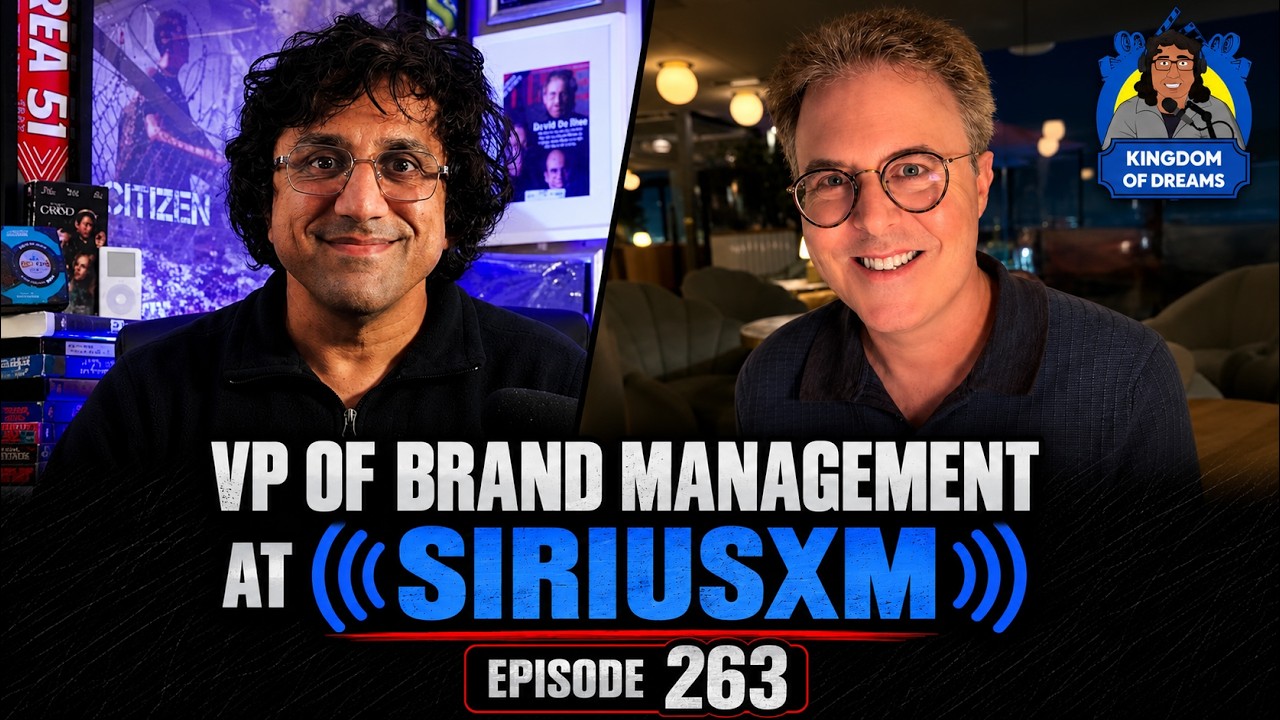
About this episode
🎙️ On this episode of the Kingdom of Dreams Podcast, we sit down with Randy Dry, the legendary Vice President of Brand Management at SiriusXM, to hear his remarkable journey through the world of music.
Randy reflects on more than three decades in the industry, sharing stories of the artists he’s collaborated with and his deep passion for music, soundtracks, and scores. It’s a fascinating conversation that steps away from film to celebrate the art, culture, and spirit of music itself.
Randy Dry is the Vice President of Brand Management and Partner Marketing for Music at SiriusXM. Since joining the company in 2007, he has overseen brand strategy and marketing initiatives for audio and video content across SiriusXM’s diverse listener base. Before his role at SiriusXM, he worked in the music industry with Decca Records, Universal Music Classics, and PolyGram, where he specialized in marketing, business development, and artist development. He earned his Bachelor of Science degree in Communication from Boston University.
#music #thebeatles #hanszimmer #siriusxm #music #band #story
Full transcript
Automatically generated from the episode audio, so expect the odd misheard word or name. Speakers were labelled automatically. About 14,800 words. Tap a timestamp to play from that moment.
0:00Jawad MirYou even organized an interview with Hans Zimmer over email. I still remember that. I launched a message board, and it blew up, and it was like 50-plus women pretty much. That's all it was, and I was, at the time, 24, 25, and I'm interacting with these…
0:14Randy DryIsn't that amazing?
0:14Jawad Mir... Much…
0:15Randy DryYeah
0:15Jawad Mir... Older fans and all that. And, yeah, it became a, that message board ran for six years just talking about Gladiator.
0:24Randy DryThis is very telling, and, because a lot of people... I mean, this really wasn't that long ago, right? I mean, we're talking…
0:30Jawad MirNo
0:30Randy Dry... About 25 years ago, 24 years ago. Again, there was almost no social media. There were people like you that were curating and cultivating these fan communities. We, meaning on the record company side and on the marketing side, we were like, "Ooh, this is good." What we used to call, in those days, it was a viral marketing. Like, l… how can it go viral?
1:01Jawad MirGood afternoon, everyone. Welcome back to another episode of Kingdom of Dreams Podcast, The Making of Stories. I'm your host, Jawad Mir. Today my guest is Randy Dry. Randy Dry is Vice President of Brand Management at SiriusXM. His connection with me, was very interestingly 25 years ago when I used to run a DreamWorks fan site, and he was the one who was heading Universal Group, music department and also soundtrack department, which kinda gets discussed in this episode. And he was able to provide my website probably about 50 or 60 Gladiator soundtrack CDs for promotional purposes, that we used as a contest to gain audience and which benefited my website ridiculously. And then after that, I started doing that regularly. So that was a connection. I messaged him, and he graciously said yes, and, great conversation with him, mostly in the music world. I loved his, skillset of storytelling, and, I thoroughly enjoyed the conversation.
2:02Jawad MirSomething a little bit different from traditional film talk, but please do enjoy my conversation with Randy Dry. I would love to just start off with your career, you know, how it began. Was it always into music? Was it always in, you know, marketing/PR, whatever that was? Just kind of guide me through that, your beginnings and
2:24Randy DrySure
2:25Jawad Mir... Yeah.
2:27Randy DryYeah, I'd be happy to. It... Yes, I have always wanted to pursue a career in the music business for as long as I can remember. ... It really comes down to my lifelong passion for The Beatles. So i… i… it's, it's their fault, those four lads from Liverpool, that I chose this career path. But I couldn't be happier and, you know, I was stricken with Beatlemania at a very early age and, there's no cure for that. And fast-forward to now, and now I'm very fortunate to actually work with, The Beatles team at Apple Corps in the UK, and also, our partners at Universal Music, here in Los Angeles, on, the Beatles channel on SiriusXM. So I'm part of the team that launched The Beatles channel back in 2017, which premiered, in conjunction with the 50th anniversary of Sgt.
3:42Randy DryPepper. And that was a monumental launch, and it is still, is, quite a thrill and a labor of love for me. And I must say that 13-year-old me would never imagine that now, not only do I get to, work with The Beatles team in London, but, you know, Paul and Ringo and, they love the channel, and, so do Sean and Yoko and Olivia and Dhani Harrison. And it's just tremendous, a tremendous honor and privilege to be part of that legacy and to continue to turn on millions and millions of fans, both reengaging old fans and helping to turn on new fans, of all ages.
4:51Randy DryI… i… it's just a remarkable honor and a privilege. And to me, it really hit home, w… we at The Beatles channel, once a year, you may know that Ringo, on his birthday, on July 7th, he will do an event to celebrate his birthday in honor of peace and love. So he uses his birthday, as a platform to promote peace and love throughout the world. And so wherever anyone is at noon, whether it's Toronto or Los Angeles or Italy, France, Japan, Australia, where… wherever you happen to be, at noon, Ringo encourages everyone on July 7th to say, "Peace and love. Peace and love," just like that. And so we at, SiriusXM's The Beatles channel, we, have been proud sponsors of that event for many years.
6:03Randy DryAnd… At one of the events, Ringo's wife, Barbara Bach, came up to me and one of my colleagues and said, "You know what I really love about The Beatles Channel is that I learn so much about Richie," Ringo's real name.
6:27Randy Dry"I learn so much about Richie by listening to The Beatles Channel because, I hear him tell all these stories that he's never told me, and you play all of these songs by Richie that I never heard before."
6:46Randy DryAnd that was something that, 13-year-old me never could have predicted, and that's pretty special. And then of course, you know, when, you know, when Sir Paul, you know, stops by and records something for the channel, and then it's like, "Beatles channel, all right, man." Can't beat that. So, you know, it's better than a real job, wh… what I do, and I'm very lucky, to still be allowed to do it. So let's, let's see. That was how it all started really, my love for The Beatles and which, you know, turned into a full-blown love of all kinds of music. And, I always wanted to be in the music business and, you know, starting, you know, way back when I was in high school, which was in the '80s, there, you know, there used to be these places, you may have read, you know, in the history books about this.
8:03Randy DryThere u… used to actually be brick-and-mortar stores where you could buy, pieces of vinyl and… ... Called records an… and, also pieces of plastic called, CDs. Here in Los Angeles, they still have a bunch of those stores, but sadly, many of those stores no longer exist as you know, the music business has long ago transitioned from, physical sales to, streaming. But when I was in high school, that's all I wanted to do was, as soon as I was employable, I went to work for what was at the time the largest, record store, in Chicago. And it was then, at age 15, that I first learned all about Ticketmaster and how that works. And tell you a quick story here.
9:10Jawad MirSure.
9:12Randy DryIn those days, and you may recall this, really the only way to get concert tickets was you, at the prescribed time when tickets would go on sale, you would have to, pick up your phone. You know, again, these were landlines.
9:30Jawad MirYep.
9:30Randy DryYou know, there were no cell phones, and you had to try your luck by dialing and redialing the Ticketmaster number as fast as you can and hope and pray, that you would get through, which almost never worked. Or you could go to either a large record store like the one I worked at or a department store, which would be designated as a Ticketmaster outlet. And so these stores, like the record store I worked at, they would have, a computer terminal, and these were old school computers. Like, th… this was not, you know, not Macintosh. We're not in…
10:18Randy Dry... In the Mac world yet. These were old computer terminals like that, you know, bankers would use. And, but people would camp out overnight, and in Chicago, that meant sometimes in the freezing cold, and they would camp out sometimes for several days and nights, so that they would be first in line when the tickets went on sale at that store. And, so I remember this was in the '80s, I think it was for U2.
10:56Randy DryAnd there were people camping out for several days outside of the store. In the morning, we would, bring them coffee. We became friendly with these people, and then tickets would usually go on sale, at, on Saturday morning at 10:00 AM, right? So at 9:30 AM, we would open the doors, and we would march everyone in single file. Everyone's really excited. They've been camping outside for days and very little sleep, but they were all pumped up and ready to be first in line and get the best concert tickets they could. So clock strikes 10, and I'm new to all this, right? So my store manager says, "Randy, you stand next to me and I'm gonna show you how Ticketmaster works." so literally it's this old computer terminal, and then next to it is a printer with blank ticket card stock.
11:57Randy DrySo you would type it in, type in the show you want, how many tickets you want, you'd process the payment, and then, it would spit out the appropriate number of tickets. It would just print them right there, and you'd hand them to the customer. Clock strikes 10:00, first person in line is all excited, and my store manager types it in as fast as he can. Two tickets come up, and they are all the way in the back of the main floor. The person standing in line can't believe it. He's like, "What? I've been waiting outside, sleeping outside for four days. Why am I not sitting front row center? I… it… it's 10:00 o'clock on the dot. I'm first in line." And I, too, had the same question. And, you know, my heart just sank.
13:00Randy DryYou know, I felt so bad for this poor guy. And my manager said to him very pointedly, "Look, there are a lot of people in line behind you. Time's a-ticking. You want these tickets or you don't?" He said, "Yes, I'll take the ticket," but he was very disappointed. And I whispered to my store manager, like, "What… what… what… what… what… what just happened?" And he said, "Listen, Randy, I gotta get through all these people in line, then I'll show you how it works." So that is when I learned that, when tickets go on sale, and this was long before there were pre-sales and, you know, but the basic premise is still pretty much the same in that when tickets go on sale, or certainly in those days, not all the tickets in the venue went on sale. And in many cases, some of the best tickets were held back, and they were held back for the artist or for the management team or for the record label or for the tour promoter.
14:12Jawad MirSponsors.
14:14Randy DrySponsors, radio stations, VIPs, et cetera, et cetera. 15-year-old me was like, "Wow, really?" And so then I'll, I'll never forget this. And the store manager said to me, "Randy, is there a show coming up that you would like to see that is sold out?" And I said, "Yes, I'd like to see R.E.M." Right? 'Cause R… R.E.M. Was just becoming very big in the late '80s. And, he said, "Okay. Make sure you schedule yourself to work, here at the record store on the day of the show. Every 30 minutes, just swing by the Ticketmaster computer here, you know, next to the cash register." Just, you know, 'cause I would be working the floor as a salesperson. He said, "Just every 30 minutes come by and enter in R.E.M., that you want two tickets for that night's show."
15:19Randy DryAnd he said, "I guarantee you at some point during that day, it might be just a few hours before the show, couple great tickets will pop up. Grab 'em, buy them, enjoy the show that night." And that's exactly what happened. And that trick, although it's not really a trick, but that methodology still works today. But you don't have to go to a record store or a Ticketmaster outlet. You can obviously do this all from your phone. And of course, there are many sophisticated bots out there that, mo… move a lot faster than your fingers and my fingers, in terms of dialing or even just ha… having it redial and redial. But, it's very rare that a show is truly sold out. So even a superstar artist like Taylor Swift, when she plays multiple dates at huge football stadiums, more often than not, if you wait until either the day of the show or maybe just keep checking in the days leading up to the show, you often will find tickets.
16:38Randy DryBecause what will happen is those tickets that are held back will very quietly and quickly be repopulated or r… you know, recirculated so that the general public can buy them. And it's just sort of are you in the right place at the right time, or did you dial in at the right place at the right time? But, you know, it can be anything from the people who, you know, maybe 10 tickets were held for a certain entity, and they only needed four.
17:15Jawad MirYeah.
17:15Randy DryOr maybe some credit card transactions got canceled, or maybe someone was planning to go but couldn't get a babysitter for the night. All sorts of scenarios. But sometimes shows are truly sold out. Like, if you have a big artist in a ver… very small venue…
17:36Jawad MirYeah
17:37Randy Dry... Then it can be truly sold out. But when you have a superstar act or even just a, you know, a not superstar act in a large enough venue, it's, you can always find seats. You may have to pay a little bit extra depending on what the situation is. But that's something that I learned, a long time ago. And so then, this is a very roundabout, long-winded way to answer your question.
18:09Jawad MirNo. This is fine. This is lovely. I'm loving it.
18:13Randy DryOkay. Well, good. I'm glad. I hope your listeners are loving this, too. But… I had an epiphany then when I was 15 years old, because as much as I love the Beatles and buying records and collecting records, which I still do, I also love going to concerts, and I still do. What I don't love is, what happened to that poor guy who waited outside for four days and then thought he was gonna get front row center and was all the way in the back of the house. So I remember thinking to myself when I was 15, "If I want the best concert tickets, I need to either become friends with someone in the music business or get a job in the music business myself, and not at a record store, but either for a radio station or for a record company."
19:15Randy DrySo, that's what I did. Now, I then was faced with, well, h… how does one get a job at a radio station or record company? And that's when I quickly learned there are really two ways, and this is still the case. There's two ways that I know of to get a job in not just the music business, but this goes for the entertainment business in general. One is to have a close friend or family relative who's already in the business who can help you get a job. Right. I did not have that luxury, so I went with option number two, which is get an internship and basically prove to the company that you're interning for that you will work your tail off for nothing or next to nothing. Or in my case, it was college credit and occasionally, you know, I would be sent out to, get lunch for everyone, and I could get myself lunch, too.
20:25Randy DryThat was a huge luxury. That was a big bonus. But once you got in… inside, then you had access to all sorts of things, free promo records, free concert tickets, and you got to learn by doing and by watching and learning. And those were wonderful days. This was late '80s, early '90s, and I was,.. I went to college at Boston University and lived at BU's radio station, WTVU, where I was, you know, the music director there and, basically emulated the radio stations that I loved in Chicago and in Boston. And, you know, I didn't... Basically, my theory was, if it, if it's good, we'll play it.
21:27Randy DryAnd late '80s, early '90s was a very ex… exciting time, in radio and in music in general because that was just at the dawn of what became known as alternative music. So I mean, I remember working at my college radio station and hearing Nirvana for the first time, or Mother Love Bone for the first time, which became Pearl Jam, and Red Hot Chili Peppers for the first time, and Jesus and Mary Chain, and you know, all sorts of, fabulous bands. And Boston also had a very, exciting and thriving local scene with, you know, bands like The Pixies and Breeders and we were big champions of the local Boston scene. But, while I was working and virtually living at my college radio station for those four years at, Boston University, which I loved, I was also interning at a legendary rock radio station that is sadly no longer with us, called WBCN, The Rock of Boston, a legendary FM, what they used to call free-form rock radio.
22:48Randy DryAnd then that was when I was in Boston during the school year, and I would come back home to Chicago for the summer, and that's when I started to intern at The Loop, which WLUP, which is still around. It's another legendary rock radio station, trailblazing. And it was very exciting to be at both of those stations because you never know who would show up. Like, one day, you know, The Stones would be there, and one day Aerosmith would be there, or i… i… Bon Jovi would be there, or, you know, whoever would be there. And, but, in Chicago, I began interning for the music director, a wonderful man named Dave Benson, who is still around. He's in the San Francisco Bay Area, and he's just a... I learned a lot from him.
23:50Randy DryBut Dave Benson shared an office, and it was a rather small office in… inside the giant, John Hancock Building in downtown Chicago. He shared an office with, Gary Meier, who was, one half of the legendary Steve Dahl and Gary Meier afternoon drive radio team. And thi…, ... This was the number one most listened to, most popular And in those days, most controversial and shocking, comedy talk radio show in, not just in, Chicago, but really for the entire United States. And, Howard Stern learned a lot and borrowed a lot from Steve Dahl and Gary Meyer, until obviously Howard, eclipsed them and everyone, and to this day is still, in my opinion, the most talented and amazing radio broadcaster of all time.
24:59Randy DryBut it was literally as simple as, Steve and Gary needed an intern themselves, and Gary was sharing an office with Dave. I was interning for Dave, so I was only, like, 10 feet away from Gary, and he looked at me and said, "Hey, do you have some extra time? We could use some help." And, so I said yes, 'cause I grew up listening to Steve and Gary, and they were legends in Chicago radio and in the Midwest. A real innovative, hilarious, rule-breaking, groundbreaking, what was then known as, shock jocks. And they would get fined all the time by the FCC, a… as would Howard famously later. But over the years while I was in college, and home for the summer, I graduated or was promoted from intern, actually my...
26:12Randy DryWhat they called me on the air wasn't intern, they called me Cabin Boy Randy. So I was promoted from cabin boy, which is sort of glorified gopher, to assistant producer, and ultimately to producer. And, you know, the Loop and Steve and Gary in those days, you know, they were on the air weekdays from 2:30 to 7:00 PM, and then on the weekends they would have a best of show, which I would produce and co-host. And it was an incredible experience, but I've never taken so much abuse on and off the air verbally…... Ever. But I knew exactly what I was signing up for. You know, Steve and Gary were famous and notorious for, their revolving door of producers.
27:12Randy DryBut I knew the drill, and I remember Dave and others at The Loop cautioned me and they said, "Randy, are you sure? Like, you know, y… y… you went to a good college. You're a smart guy. Are you sure you want to be Steve and Gary's producer? Because you know eventually you'll just be kicked to the curb like all the other ones." And I said, "Hell yes." Like, "Of course I do. Like, I'm about to graduate college. This is the number one rock radio station, not just in Chicago, but in really all of the Midwest." I mean, we were heard in Chicago, Milwaukee, parts of Indiana, parts of, you know, Iowa, Missouri. You know, we were all over. We had millions of listeners. So I was like, "Yes, I want it." And it was exciting, and there were many... Those years were a bit of a blur, but, I remember things like, when Steve and Gary were on vacation, they had special guest hosts, and one of the guest hosts was Joe Walsh of the Eagles.
28:23Randy DryAnd, Joe Walsh, as you may know, is now, among other things, I mean, obviously he's a Rock and Roll Hall of Famer, and a legendary musician, and member of the Eagles, he also happens to be Ringo's brother-in-law now.
28:38Jawad MirOh, okay.
28:39Randy DrySo at the aforementioned, birthday party, Ringo's Peace and Love birthday party, of course Joe is there, and his wife is there, and all of Ringo's family and friends are there. So I will reintroduce myself to Joe at these events and remind him, like, "All those years ago, remember when I produced your radio show in Chicago?" And, that experience, the producing Joe Walsh, was probably the single highlight of my entire career, as a radio producer. I learned so much from Joe Walsh in a couple of days. Just he and I. I mean, I was just the student and he was the master and I learned so much about comedic timing, and production, and tricks of the trade, and it was all second nature to Joe.
29:43Randy DryAnd that was quite a thrill. But anyway, just as I had been warned, my time, as producer of the Steve Dahl and Gary Meyer Show, soon came to an end. But because of the show's popularity, this was in the early '90s and I had just graduated college, and I'm like, "Okay, well now what do I do?" and I knew what I wanted to do, which was, segue from radio to work for a record company.
30:15Randy DryAnd fortunately for me, that radio show, Steve and Gary and The Loop, was so popular that… All of the people who worked for the record companies in Chicago listened to that show. And so I had become an involuntary celebrity, because of that show. I guess the best way to explain it to, i… i… in more contemporary terms is, you know, I was the Baba Booey equivalent…... To the Howard Stern equivalent, in Chicago radio in those days. And I've, I've actually, now that I've worked at SiriusXM for so many years, I've become friendly with Baba Booey, w… it's Gary Dell'Abate, who is a lovely man, a very talented producer. I mean, I don't think he gets enough credit for how talented he is, because let me tell you, producing a major radio show, in the morning or in the afternoon drive, it is much more difficult than you think.
31:28Randy DryAnd when you're working mornings, that means your day starts at about 3:30 in the morning… ... And then you do your radio show. The radio show itself probably ends at 10:00 in the morning, and then you have to start booking guests for the next show and the next show and the next show. So you would i… and you would start at 3:30 in the morning, and then you'd probably leave at 6:00 or 7:00 at night. And i… and, but, and you never stopped. You worked on weekends too, but you became this, involuntary celebrity, at least I did. So when I went looking for jobs, following The Loop experience, people would say, "Wait, you're Randy from the Steve and Gary show? Oh my God, what's it like working for Steve and Gary, and what's The Loop like?" So, they did me a tremendous service in terms of helping me get noticed and ultimately hired, by one of the big seven major record companies.
32:44Randy DrySo in those days, there were seven major record companies, in the world. Now there are only three due to mergers and consolidations. But in those days, I worked for what was PolyGram Records. PolyGram was a subsidiary of Philips Electronics based in the Netherlands. And…
33:07Jawad MirAnd I, and I think they also had PolyGram Entertainment, which did films, if I'm not mistaken.
33:11Randy DryThat's correct.
33:12Jawad MirRight.
33:13Randy DryYes. I… i… and, that's called foreshadowing, what you just did. Very good. Very good. Yes, so I, got hired by PolyGram in Chicago because again, in those days, not only were there seven major record companies, but in the United States, they had regional offices in, that were about, in about seven or eight major cities across the country, Chicago being one of them. And I remember when I first got hired, excuse me, by PolyGram, the first task I had, I was a promotions assistant originally for Island Records, and as luck would have it, that same band that we talked about earlier, that poor guy was…
34:13Randy Dry... Waiting in line for concert tickets for, U2, well, by that time, U2 was the biggest band in the world, and they had a little album called Achtung Baby. So when I joined Island, or what was then part of what was called PolyGram Label Group, I remember my first job was single number four from Achtung Baby, which was a, is a great song called, Even Better Than the Real Thing.
34:44Randy DryAnd I remember my boss at the time, he handed me this record and this CD and said, "Randy, if you can't get this played on the radio, you are in the wrong business." So not only did we have no problems getting that U2 record played on the radio, but we used it as leverage, along with concert tickets, to get other lesser-known, artists played, on the radio, and many of them never amounted to anything, but a few of them did. And the two that really stand out from those days that I was very honored to work with, and helped, I mean, I was a small part of the team across the country that really built up these artists and got them played on the radio. But, one was, a wonderful artist, a singer-songwriter, Melissa Etheridge…
35:51Randy Dry... Who's still doing it today. She's amazing. And another was a group from Ireland called The Cranberries, and, you know, sadly, the lead singer of The Cranberries, Dolores, died several years ago. But I mean, I remember taking The Cranberries around in my, in my Honda Civic, driving them around to radio stations in Chicago, getting them interviewed. Nobody knew who they were. They had never been to America before. And that was an exciting time… But I was in working for Polygram in first promotions and then sales and marketing. Because I kinda quickly did my best to segue to sales and marketing because, you know, promotions was fun, but it always seemed a little bit, a little bit greasy to me and because you would get records played on the radio, but which was important of course, but for me it was more important to say, "Look how many units we sold."
37:13Randy DryAnd by that time, SoundScan, which is, you know, was the industry standard… Yeah... Like that was still relatively new. So for me it was much more meaningful to say, "We drove X amount of sales and X amount of units," versus, "We got X amount of spins or ads on a radio station." Because half the time you'd later learn that those spins on the radio station happened at like 3:00 in the morning when no one was listening, so, you know, I... Like, how impactful was that? But the sales were actual sales and… Sure... The scans would be actual scans, and it was all very quantifiable and real data. And so I felt good about that, so I wanted to transition from the promotions department to the sales and marketing department, and I was working for the label for Polygram in Chicago for two years and then got the call from headquarters in New York and got the big promotion and was like, "Okay, my...
38:24Randy DryHere we go. My dream of getting a full-time career in the music business and moving from Chicago to New York is about to be realized." So I moved to New York City. I was about 24 years old. This was in the mid…'90s and, it's a very exciting time, and then, I was working primarily for the Verve label, the venerable jazz label. Yep. Not because I was such a jazz aficionado, although I quickly became one, but because that was the position that was open, right? Because what I quickly learned, you know, because obviously, remember, I'm coming from my love of the Beatles, right? So I wanted to, like almost everyone else, I wanted to be working for a major rock label or a major pop label, but those jobs were very hard to come by.
39:31Randy DryIt was extremely competitive, and also what I noticed from my friends who were in those jobs is about every 12 to 18 to 24 months they would... There'd be a lot of turnover., You know, that revolving door again. Right. But fewer people were coveting the jobs on the jazz and classical side of the business, and because first of all you had to be a little bit smarter and more clever not only to appreciate those genres of music, but also to figure out how to handle sales and marketing for those genres because in almost all of those cases there was no radio airplay, or maybe there was radio airplay on non-commercial public radio stations, but those didn't really amount to any sales. So as sexy and cool and attractive as it was to work for Island Records or Mercury Records or A&M Records or Interscope Records or all of those labels, and I had many friends and still have many friends at those labels, or the ones that are still around, I would notice that, again, every couple of years my friends would lose their jobs and they'd be shuffled around to other labels.
41:04Randy DryBut those who worked on the classical and jazz side tended to stick around., And part of the reason they tended to stick around is because, those labels, and certainly this was the case at Polygram which was the worldwide leader in classical and jazz music at the time with some of the most prestigious labels in the world, I mean, Decca and Deutsche Gramophone and Philips and certainly Verve, but, those labels made money and turned a nice profit without spending a lot of money because you didn't have radio promotion costs and the advertising costs were minimal because you were catering to a very devoted audience that was older. You know, these weren't kids buying these records… Yeah... And they were inclined to spend money. And unlike today, whether it's my kids or your kids or anyone, one of your listeners' kids, they feel like they shouldn't have to spend money for music, that everything should be free.
42:15Randy DryThat wasn't the case back in the '90s., And as a result, especially with people replacing their vinyl collections with CDs, which I know you remember, The record labels, all the record companies in the '90s were experiencing double-digit growth year over year, whether it was deserved or not, frankly. Just the money was rolling in. And, it was a good place to be, and it was fun. And especially being immersed at such a young age in New York City working for some of the biggest names on the planet in classical and jazz music, I mean, I, for work, would g… we told, "Go to Carnegie Hall, go to the Blue Note, go to the Village Vanguard, and work with Herbie Hancock and work with The Three Tenors. You know, Pavarotti and The Three Tenors."
43:17Randy DryAnd so I quickly got up to speed on those genres of music and learned from experts in the field on how to, how to package and repackage that music for new audiences. And I think you see where I'm going with this. So what happened in the late... At the very end of the '90s, was that Polygram was acquired by Seagram, by Edgar Bronfman Jr., and merged with Universal Music.
43:57Randy DryAnd at the time, Universal Music was strong in the United States, but not so strong outside of the United States, whereas Polygram was not so strong in the United States, but very strong internationally. So it was a good fit strategically. But in those days, and this is 1999 and 2000, all of Universal was under one umbrella. It was under the Seagram Company. And we were encouraged to maximize synergies between the business units, so the music group where I was working.
44:41Randy DryAnd by that time, you know, I had segued from Verve to Decca, which ironically, given the fact that I'm a lifelong Beatles fan, was the label that famously turned down The Beatles, but that's just a, just a…
44:53Jawad MirAh. Okay
44:55Randy Dry... But, Decca, and the Decca Label Group in those days was most famous for a few things. Certainly The Three Tenors, which I mentioned. And, you know, under the Decca Label Group umbrella, was, Deutsche Grammophon and Philips. And I was very fortunate enough to be part of the team, a very talented team, that launched the career of Andrea Bocelli in the United States. And, was very fortunate, I mean, it's all about timing, right?
45:32Jawad MirOf course.
45:33Randy DryIt was very fortunate that when the merger of Universal Music and Polygram happened, so many of my friends and colleagues were let go, and that's what happens when companies merge, right?
45:47Jawad MirYeah.
45:47Randy DryAnd I remember the good folks at Boston Consulting Group, you know, they went around to everyone, every floor in the building in Manhattan and would meet with every department trying to understand who was vitally important to the future of the business and who they should let go.
46:07Jawad MirRight.
46:07Randy DryAnd I remember they looked at our numbers, and they were very strong because, mainly because of Andrea Bocelli, who was just becoming a superstar at just the right time. I remember they basically said something to us like... Be… because another stroke of good luck was that the new, Universal Music Group, once it was, once Universal merged with Polygram, for every single genre of music, there was, o… on the Polygram side, there was a counterpart on the Universal side, except for classical. And we had this burgeoning superstar named Andrea Bocelli, who was becoming famous for his duets with Sarah Brightman and then later Celine Dion. And so I remember they basically said to our team, "We don't really understand your business, the classical music business, but your numbers are really good, so we're gonna leave you alone." We were like, "Thank you, sir.
47:22Randy DryThank you, ma'am." And that was more or less what happened. Roundabout that time, and this is where you and I, soon became, in touch with one another. Y… you know, there's only one Andrea Bocelli, right? There's only one Luciano Pavarotti. So we had to figure out, okay, how are we going to grow our business? And one way was when this merger happened, they didn't know the new company, Universal, wasn't really sure what to do with Broadway cast recordings. And believe me, there was a huge catalog of those, all the Andrew Lloyd Webber shows and, you know, Phantom of the Opera and countless others. Cats, you know, so many of those. And, you know, Decca, the Decca Label Group sort of became the place where it's music for adults, right?
48:27Randy DrySo it doesn't matter if it's a Broadway cast album or if it's, Andrea Bocelli… Or a sort of a jazz album or a new age album, we'll, we'll park it with the folks at Decca 'cause they're smart and they can figure out how to sell something that doesn't have a radio single. You know? Like how do they do it? And, the way we did it was that PBS, public broadcasting, was our MTV, right?
49:00Randy DryAnd that's how the Three Tenors became so successful, that's how Bocelli became so successful, and it was a very interesting business model. But soon we were saying, "Okay, well what more can we do?" And then what would happen is big rock stars like Sting or Elvis Costello would have, vanity projects, right? And so they would say, "Yeah, we're gonna put our rock records out through the rock labels." Like, so Elvis Costello would be with Island and, Sting would be through A&M, which was part of, then part of Interscope, and Interscope, Geffen, A&M in those days.
49:48Randy DryAnd, but then th… they would convince the powers that be to allow them to do some vanity projects. So for Sting, you know, he would have a jazz project or a classical project, and same with Elvis Costello. So they'd say, "Oh, give it to the guys at Decca." And so ultimately I would be tasked with coming up with marketing campaigns for these albums, and I was thrilled because, you know, now I was slowly creeping toward, the rock music that I love so much. But I also had grown to love all these other genres too.
50:26Randy DryThen someone came up with the bright idea, it wasn't anyone, in America, but it was a team of some very clever people in the UK that decided we're gonna do a Broadway musical, well, it started in the West End of London, based on the music of ABBA. But it's not gonna have ABBA in it's just gonna have their music set to a, basically a story that would be suitable for a rom-com, you know, a romantic comedy. And this was 1999 or 2000, so they said, "Randy, you gotta fly over to London and meet up with our Universal Music colleagues in London and go see this musical called Mamma Mia." "And we're gonna get the album to Mamma Mia, the Broadway cast album, 'cause at first it's gonna, you know, open in London and then it's gonna come to New York and open on Broadway," and then ultimately it went to Los Angeles.
51:30Randy DryAnd I remember being at the premieres of all three of those, London, Broadway, Los Angeles. But I was like, "Why would anybody want to buy an album of other people singing ABBA songs when they could buy ABBA's Greatest Hits?" And the ABBA Gold album, to this day, is one of the biggest sellers in the Polygram, now Universal Music catalog. It's like, why would anyone want to pay money to hear other people, actors, sing Dancing Queen when you could hear ABBA sing Dancing Queen? And he said, "Randy, don't ask so many questions. Just go over there…
52:10Jawad MirJust do it
52:11Randy Dry... Watch, just go see the show and come back to New York and tell us what happened." And I... Have you ever seen Mamma Mia? I mean, you've probably seen the movie, right?
52:22Jawad MirI've, I've seen the movie. I've seen clips from the show, 'cause I remember when I was going to university, I... It used to play at, Princess of Wales Theatre here in Toronto, and also another theater, I forget the name, where I live… Yeah, I forget the name. But I remember seeing this posters of the girl with the white outfit…
52:41Randy DryThat's right
52:41Jawad Mir... And just kinda like laughing and smiling, right? So I remember that.
52:43Randy DryThat's absolutely right.
52:44Jawad MirYeah.
52:45Randy DrySo anyway, I watch this, I, you know, I watch this musical in London. I immediately recognize that I'm one of the only men in the audience. It's almost all women. But then at the end, everybody, the cast and the audience, everyone's on their feet dancing and singing Waterloo, Dancing Queen, and I look around and I see the joy on everyone's faces. And then leaving the theater, everyone wants a souvenir of that moment, so they all flock to the merch table, and they buy CDs of what they just heard, the cast singing the music of ABBA. And they also bought lots of other things, T-shirts and all sorts of merch. And I saw this and I saw everyone and the joy on everyone's faces, female faces, and I thought, "Oh, okay, now I understand."
53:45Randy DryAnd so I came back and told the team in New York, like, "We are gonna have a lot of fun with this one, and we are all going to make a lot of money." And so we did, and then a few years later, there was another, this time an original Broadway musical that came to us called Wicked.
54:11Randy DryAnd I remember the day that, we knew who Kristin Chenoweth was, but none of us had ever heard of Idina Menzel. She was a new, a relatively new, Broadway up-and-coming star, and I remember she came to our offices and met with us, and we all saw Wicked, and we loved it straight away, the Broadway show. But from a marketing standpoint, Wicked and Mamma Mia had one very important thing in common, and they still do, because… As of course we all know, these went from being fabulously successful Broadway musicals to fabulously successful Hollywood motion pictures, and, you know, with sequels and everything. But from a marketing standpoint, what was most telling and also most unusual, was that each of these shows, Mamma Mia and Wicked, attracted three generations of women.
55:15Randy DrySo in the audiences you would, you would see grandmothers and their daughters and their, and their daughters. You know, the grandmothers, daughters, and granddaughters, three generations of women and their friends all going to see these Broadway musicals, and later these Hollywood motion pictures, and having the time of their lives and singing. And so for many years I handled marketing and a lot of, direct-to-consumer marketing for these two projects, as well as Andrea Bocelli. And then here's the part where you come into the picture. We, in those days, and this was around the year 2000…
56:06Randy Dry... Y… we could... I mean, remember, Tower Records was still around, and they were a huge driver of sales of all genres of music. They were huge stores. I miss Tower Records very much to this day. You know, living in LA, I drive by the location of the one on Sunset, the legendary Tower Records on Sunset, and I, it's still, I can't believe it's gone, which is very sad. But in the year 2000, Tower was still around, and it accounted for about nearly 50% of our, of our record company's business in those days.
56:43Randy DryWhich again, was all physical sales, right? This was the year before the iTunes store debuted, the year before iPods debuted, right? So in those days, if you had a hit movie, it almost wouldn't even matter what the soundtrack was. If you ha… if you were attached to a hit movie, and believe me, now that we were part of Universal Studios, Universal Pictures, there were a lot of hit movies to be part of. And literally in those days we, even if it wasn't a great soundtrack with a hit song on it, we could ship a minimum of 50,000 units in the United States just for anything. So what would e… end up happening is the number crunchers on our finance department would look at the, you know, at the end of each quarter, they'd look at our numbers and they'd say, "We're about a million dollars, short for the quarter."
57:54Randy DryAnd then they'd look at me and they'd say, "Randy, get on a plane, fly to Los Angeles, meet with the heads of film and TV music in, at Universal Pictures in Los Angeles. But not just Universal Pictures. I mean, go to Universal first because that's what we're supposed to do…
58:14Jawad MirRight
58:14Randy Dry... We're supposed to maximize synergies. But also meet with the fr… folks at DreamWorks and at Fox, and even at some of our competitors that had major music companies like Sony." But it was primarily Universal and DreamWorks and Fox in those days for our label group, which was Decca.
58:37Jawad MirRight.
58:38Randy DryAnd I instantly became very popular because, I would walk into these fabulous corner offices on these Hollywood movie studio lots and, with basically my checkbook open, like a blank check, and I'd say, "Hey, I'm Randy Dryve from Decca Universal Music in New York. We're in the soundtracks business. Do you have any major films coming up that have soundtracks attached to them?" And by soundtracks, primarily what I'm talking about were film scores, which up until that point mo… people weren't really paying much attention to film scores until composers like, well, certainly John Williams, but also James Horner, and we had success with, Braveheart many years earlier, and then a little project called Titanic came out, and all of a sudden…
59:42Randy Dry... It was typically a bidding war between, Universal or Decca and Sony usually on the other side for the big major film scores. So I remember, year 2000, just a few of us in New York City, we were put into a very small screening room and we were told, we're gonna watch a rough cut of this, new action-packed blockbuster film that's gonna harken back to the days of Rome, ancient Rome, and, Ben-Hur and these types of big widescreen CinemaScope movies from many decades ago. But the movie wasn't even finished and the music wasn't finished. Like, we were hearing temp cues, and we didn't know what to expect, and it wasn't exactly... It was a tiny screening room for such a huge production.
1:00:44Randy DryAnd so we saw a rough cut of Gladiator And we were blown away. I mean, we just couldn't believe it. And our president at the time, Chris Roberts, he was very attuned to Hans Zimmer, and he was, he was completely sold on Hans Zimmer. I had never heard of Hans Zimmer before.
1:01:07Jawad MirOh, really?
1:01:08Randy DryYes. You know, because this was a new world to me, film scores.
1:01:14Jawad MirYeah.
1:01:16Randy DryAnd I quickly learned all about Hans Zimmer and what a fabulous human being he is, and what an amazingly talented composer of music he is. So but we were blown away by this movie, and so we got the rights for the soundtrack. And then when we saw the finished product and heard this score, which was one of the first times, other than let's say Star Wars or Jaws or something like that, when you could actually listen to a film score on its own and enjoy it. Like, you weren't just buying it because it was a souvenir…
1:01:59Jawad MirYeah
1:01:59Randy Dry... Of a movie you loved.
1:02:00Jawad MirYeah.
1:02:00Randy DryIt was because you actually enjoyed the music, which was rare among film scores in those days, and still really. And so we did a number of projects with Hans Zimmer. None was bigger than Gladiator, but, we did Hannibal, you know, the sequel to Silence of the Lambs.
1:02:23Randy DryWhich was amazing and, a host of others. But oh my God, what a, what a thrill. I will never forget, I was fortunate enough to spend one evening with Hans Zimmer in his studio in Los Angeles and saw how he worked, and what a kind man. And, you know, and by then I had learned, like, oh, this is the guy who had the first ever music video played on MTV, you know, Video Killed the Radio Star with the Buggles. Like, I learned all about his history and how he made the transition from pop music to film scores, as did Danny Elfman, right? Like from Oingo Boingo to Batman or all the other movies that he scored.
1:03:17Jawad MirYep.
1:03:17Randy DryAnd then, but so for about six years, I, in addition to my marketing duties for Decca and Universal Music, I was also, head of marketing and A&R for soundtracks and Broadway shows. But by A&R it, you know, I wasn't... It wasn't a traditional A&R role, meaning I wasn't, like, working with the composer and saying, "I think you should put this song here and this song here." w… as you know in the world of film scores, what it really was, I was more or less a talent scout, and I would spend about one week, in Los Angeles every other month. I would fly in from New York, and it was a, it was loads of fun. I mean, I would, I would be...
1:04:17Randy DryI was introduced to this very small and wonderful world of music supervisors in Hollywood and, film studio executives who were huge music fans, extremely knowledgeable. And I would go to these, not just premieres, but more often than not there'd be these little screenings, and sometimes…
1:04:37Randy Dry... This would be, like, at 10:00 o'clock in the morning and I'd be the only person in this beautiful upholstered screening room, you know. And certainly DreamWorks had a beautiful one, and, still does, right? And, so we, yeah, we did a lot of projects with DreamWorks and other studios and, you know, I remember, a… and many of them with Universal, and certainly Randy Newman's score for Seabiscuit was one that comes to mind. James Horner's score for A Beautiful Mind, you know, with Russell Crowe, a…
1:05:15Randy Dry... Another Oscar winning picture from Oscar Crowe, from Russell Crowe. Beside Oscar Crowe. I could... He basically was Oscar Crowe…... After Gladiator and Beautiful Mind, you know? And it was wonderful and having conversations with directors like, you know, Ron Howard and, you know, Tom Hanks and, you know, these, th… these amazing films, but the common theme was always music for adults and how can we... You know, so literally it was a lot of, it was driven by the financial side of the business and they'd say, "You know, Randy, we're a million dollars short this quarter. Go and sign us five soundtracks, and we'll make up the shortfall. And then come back in a few months and sign us a few more." And some of them were fabulous, like the ones I mentioned. Some not so fabulous. But even the ones that were not so fabulous, in those days we would ship a minimum of 50,000 units and that would help us make our numbers for the quota, for that quarter.
1:06:23Randy DrySo anyway, a… a… a… and I realize I've been talking a long time. Do you have any questions or…
1:06:33Jawad MirNo, you're... No, you're fine
1:06:35Randy Dry... So, yeah.
1:06:35Jawad MirI... No, I'm loving it. I'm just loving, what you're talk… what you're saying and I was just thinking about, well, as you just paused, I wonder if I still have... I know I do. I don't know if I have it accessible, the Gladiator soundtrack. I know I still have the promotional copy that you sent just give me a second. It's somewhere…
1:06:55Randy DryYes, well, I know I have, I have it on the wall to my left here. And I remember when you and I met, it was because you were working for the DreamWorks Home Video division, yes?
1:07:10Jawad MirNo, I was not working for DreamWorks. That's the... Oops. That's the…
1:07:14Randy DryOh, am I wrong? Okay.
1:07:15Jawad MirYeah. So this is actually…
1:07:16Randy DrySorry
1:07:17Jawad Mir... Road to Predi… Road to Perdition, which you guys did.
1:07:18Randy DryRoad to Perdition with Tom Hanks.
1:07:20Jawad MirYeah.
1:07:20Randy DryAnd that was, Newman, right? David Newman?
1:07:24Jawad MirYes. No, Tom, Thomas
1:07:26Randy DryTom, Thomas Newman.
1:07:29Jawad MirNo, I didn't work for DreamWorks. So what I was doing was, so I wanted to get into film business, but I was studying IT, and I happened to take this course, and I flunked it, and I started this test website on Steven Spielberg, and it blew up to DreamWorks.
1:07:46Randy DryOkay.
1:07:46Jawad MirAnd then it just from there on, it just, like, I was, 10 years I was, like, ridiculously working hard on DreamWorks films. So it was nothing officially affiliated with DreamWorks in any way. It was just…
1:07:57Randy DryOh, see, I didn't even know that. I just knew you as someone I knew through my soundtrack work with DreamWorks.
1:08:04Jawad MirNo, it was just, like, I remember I emailed you. You even organized an interview with Hans Zimmer over email. I still remember that.
1:08:11Randy DryRight.
1:08:12Jawad MirAnd, I, w… I launched this message board on Gladiator, which I didn't, I ha… I had like a…
1:08:20Randy DryThat's right
1:08:21Jawad Mir... I had a message board on all the DreamWorks films and just one message board. For this season, somehow I launched a message board and it blew up, and it was, like, 50 plus women pretty much. That's all it was, and I was, at the time, 24, 25, and I'm interacting with these…
1:08:37Randy DryIsn't that amazing?
1:08:38Jawad Mir... Much…
1:08:39Randy DryYeah
1:08:39Jawad Mir... Older fans and all that. And it, yeah, it became a,.. That message board ran for six years just talking about Gladiator over and over again, Russell Crowe, and you know, there were always a couple of women…
1:08:51Randy DryYeah. Well, I think it's, this is very telling, because a lot of people... I mean, this really wasn't that long ago, right? I mean, we're talking about…
1:08:58Jawad MirNo
1:08:58Randy Dry... 25 years ago, 24 years ago. But it may as well have been 100 years ago because, again, there was almost no social media.
1:09:09Jawad MirNo, nothing.
1:09:10Randy DryVirtually none.
1:09:12Jawad MirYeah.
1:09:12Randy DryNo iPhones, no social media, and, but there were people like you that were curating and cultivating these fan communities online, whether it was a message board or a chat room. And we, meaning on the record company side and on the marketing side, we were like, "Ooh, this is good." This is what we used to call, in those days, it was a viral marketing. Like, well, how can it go viral?
1:09:44Jawad MirYeah.
1:09:45Randy DryIt was essentially grassroots marketing, but it was being done online instead of in the physical world.
1:09:52Jawad Mir100%, and I will, I'll give you, I'll tell you one more thing. So I gotta thank you for this. I just realized this. So at the time when Gladiator came out, it was 2000, and my website was three years old. It was still growing, but nothing rapidly, and I used to approach, like, studios and record companies, like, and toy manufacturers, "You know, we wanna do a contest," because I wanted to grow the audience.
1:10:15Randy DryYeah.
1:10:15Jawad MirAnd, nobody gave two craps about what I was doing, and you were the first one who actually did that, and, after that, I used that as a template, "Okay, Decca Records has done this, so you better do it, too," right? And it started working. Like, there was another label called Varèse Sarabande which used to do soundtracks.
1:10:34Randy DryYeah, Varèse Sarabande was always around and they would have…
1:10:37Jawad MirYeah
1:10:37Randy Dry... What we would call, like, the lower budget projects.
1:10:40Jawad MirYeah. And I remember, going by... I used to have my own PO box at the post office, and I remember going to the post office, putting each CD in the envelope, writing out the addresses. I think it was, like, 50 CDs that I mailed from Gladiator. Just…
1:10:56Randy DryOh, wow
1:10:56Jawad Mir... Yeah, just, like, just like that. So that started everything in terms of me doing, like, a lot of... And I learned, how to sort of promote, do promotions and marketing, if you wanna call it. I mean, I'm not,.. I learned a lot in terms of promotion sales and marketing from those 10 years.
1:11:12Randy DryDirect to consumer marketing. You were doing it at the post office…
1:11:15Jawad MirYeah
1:11:15Randy Dry... Even. I mean, it's…
1:11:16Jawad MirYeah, exactly
1:11:16Randy Dry... It's amazing.
1:11:17Jawad MirYeah.
1:11:18Randy DryNo, I mean, those were really fun, exciting days. One more quick soundtrack story because it's one of my fav…
1:11:25Jawad MirSure, would love to
1:11:26Randy Dry... One of my favorites, is, so in those days, hard to believe now, but in the year 2000, Hollywood wasn't yet sold on Marvel comics, it... Like, the blockbuster Marvel, universe of superhero movies hadn't really happened yet. There I think had been one…
1:11:53Jawad MirSpider-Man
1:11:54Randy Dry... Spider-Man movie through Sony.
1:11:56Jawad MirAnd Hellboy, which came I think couple of years before that, which wasn't, I don't know if it's Marvel, though.
1:12:01Randy DryYes, but Hellboy wasn't, you know, a known…
1:12:03Jawad MirYeah
1:12:03Randy Dry... Entity like Spider-Man was, right?
1:12:05Jawad MirYeah.
1:12:06Randy DryBut yes. And so on one of my trips to Los Angeles, I was meeting with Fox and a gentleman who is now, you know, head of, film music at Universal, and for many years, you know, Mike Noblock, a… and, wonderful, super talented, creative man, and I still bump into him every now and then, and, they had a little movie called X-Men.
1:12:38Randy DryNow, all of my colleagues, 'cause remember, like, at Decca, it was largely populated by people that were steeped in knowledge of classical and jazz and Broadway. They didn't know from X-Men. They didn't... Like, they knew Spider-Man, but they didn't know X-Men, and… You know, in addition to being a music lover when I was a little boy, I was also into comic books, and I loved Marvel comics, and I loved X-Men, and I knew what X-Men was all about. But unless you were one of those comic book kids, you didn't know what X-Men was all about in the year 2000. And so I remember coming back to New York, and I said, "I got us a film score, for Fox's big summer blockbuster film, X-Men. It's Marvel Comics." And they were like, "What the heck is X-Men?" "Why would we, why would we do this?" And I said, "You gotta trust me on this.
1:13:41Randy DryThis is going to be a big deal." Because, other than Patrick Stewart and, you know, Halle Berry, there weren't like... It wasn't like Brad Pitt was starring in this movie.
1:13:52Jawad MirYeah.
1:13:52Randy DryRight?
1:13:53Jawad MirYeah.
1:13:54Randy DryAnd it wasn't Spider-Man, or Superman, or Batman, so they didn't know. And I'd, I'd like to sit here and say they... That Decca decided to green-light the soundtrack because of my recommendation. I think it had more to do with the fact that the composer was Michael Kamen.
1:14:16Jawad MirYeah.
1:14:17Randy DryAnd our label president knew Michael Kamen from Mr. Holland's Opus, and the score he had done for that, and knew how talented Michael Kamen was, and also knew that Michael Kamen had a knack for, you know, not just classical film score, but he could inject a little rock and roll, which later really manifested itself when he, you know, would, be scoring orchestras with Metallica. You know, but that came later. But, so this little X-Men project did quite well. And then all of a sudden, Hollywood started warming up to the lesser-known Marvel franchises, and we all know what happened from there.
1:15:07Jawad MirYeah.
1:15:07Randy DrySo we did a few very successful superhero film score soundtracks. The other one that comes to mind was, The Hulk, which was…
1:15:18Jawad MirWith Eric Bana, right?
1:15:20Randy DryEric Bana. And the... There was actually a hit single, a rock track on that album that was played over the end credits by a group that was, formed for that project, called Velvet Revolver, which was essentially Guns N' Roses, but without Axl Rose, right? It was really Slash, who, as you and others know, has a long history of, performing guitar or playing guitar parts in major motion pictures and for several soundtracks and, you know, am… among his, you know, day job with Guns N' Roses. And a nicer, more talented man you'd be hard-pressed to find than Slash, just a, an amazingly talented human being. And, you know, and I grew up watching, you know, Lou Ferrigno as the Hulk on TV in the, in the late '70s, so I knew all about Hulk.
1:16:23Randy DryAnd quite frankly, the Hulk movie wasn't great, but people wanted a souvenir. Like, it just, like, if we could be a part of that massive franchise, and Universal did everything they could to maximize synergies with the Hulk, you know? Like, i… in the Universal theme park, there was a Hulk attraction, and there were, you know, obviously DVDs and tons of merch and, you know, the, obviously the film itself. So just to be a small part, of that major franchise with a compact disc meant that we were going to, turn a profit. So yeah, that was good.
1:17:05Jawad MirNo, that's, that's... X… so X-Men, I remember, so par… it was partially shot in Toronto.
1:17:12Randy DryYes
1:17:12Jawad Mir... You know, the Casa Loma, I'm not sure if you're familiar with Casa Loma. It's a s… it's kinda like a venue where they have, like, all these historical, like, nights and stuff, and there's events that take place.
1:17:23Randy DryOh, I see.
1:17:23Jawad MirSo…
1:17:23Randy DrySo that was the academy.
1:17:25Jawad MirSo the, yeah, the, that was all, Casa Loma. I remember going to the set, and it was a closed set, and I tried to sneak in, but that didn't work. And also, The Hulk, there was a certain sequence that was filmed in Toronto at University of Toronto when he, I think, fights with…
1:17:38Randy DryOh
1:17:38Jawad Mir... The military and stuff. Yeah, there was cer… certain sequences…
1:17:41Randy DryOkay
1:17:41Jawad Mir... That were done in Toronto. So it's interesting that you're talking about Marvel. So I, so I never grew up with comics, right? I remember I used to watch Batman, the Tim Burton Batman, and I used to watch Batman: The Animated Series. I had seen Superman III and IV, and I think the first one. I never saw the second one. So Spider…
1:17:59Randy DrySecond one's the best one.
1:18:00Jawad MirI know. I never saw it until b… recently. Until recently. And then, Spider-Man I loved, and I didn't, I didn't mind the Hulk. But when Iron Man came out, from that point on…
1:18:13Randy DryThat was the game changer, yes. That was the game changer
1:18:15Jawad Mir... It was a game changer. But funny enough, the only superhero movies that I've watched since Iron Man, if you wanna call them, the Bat… the Christopher Nolan Batman trilogy, and that's it. Like, I just can... I've not been able to get into the superhero world.
1:18:31Randy DryReally?
1:18:31Jawad MirMaybe because, yeah, maybe because I didn't grow up with comics or... I've tried myself a few times. It just hasn't worked.
1:18:37Randy DryOkay. Well…
1:18:39Jawad MirInteresting. Just a point.
1:18:41Randy DryThere's, there's something for everyone out there, obviously. But it's hard, like, 'cause I remember explaining to my kids that, you know, who are so used to the Marvel, you know, universe and the multiverse, and, I remember saying, "You know, there was a time not so long ago where it took a long time, and lots of money, and lots of people losing money… trying to develop Hollywood scripts for Marvel projects. Yeah. The Spider-Man movie that eventually got made by Sony in the late '90s, I mean, that went through so many rewrites and stop-starts and... Because no one, no one had any, confidence that it, that people were gonna pay money to see it. It s… sounds silly to say. And then when X-Men took off, that took a lot of people by surprise because nobody knew, unless you were a comic book, fanatic, nobody knew what X-Men was all about.
1:19:52Randy DryAnd, like I said, it was all... Like, if it was comic book, you knew Spider-Man, Superman, Batman. Yeah. That was, those three… That's true. That's true. No… Then all of a sudden they were like, "Well, let's do Ghost Rider, and let's do, " you know, the, obviously, you know, Black Widow, or all these, like, minor characters. Yeah. Silver Surfer, you know? So... But the, that's how it all went. I sort of teased this earlier when I was talking, and lamenting the loss of Tower Records. But in 2006, Tower, went bankrupt. And I'll never forget this, I, you know, I was head of marketing for Decca, and I went into our head of sales, office, and he was a dear f… still a dear friend, Gerry Kopecky, and he was a very seasoned and smart, record company executive who had been head of sales at Island Records for many years, including the heyday with U2 and all of that.
1:21:05Randy DryAnd the s… sad thing about Tower is we were all customers as well as suppliers., So not only... You know, we had a deep relationship, not just a business relationship, but a personal relationship, 'cause we knew all the buyers, we knew all the salespeople a… and, you know, Russ Solomon and his whole team. And there was an opportunity for Tower to be saved, but unfortunately, as often happens in the world of, you know, mergers and acquisitions, is that, it was purchased and then basically they stripped it clean, closed all the stores. And I remember sitting in Gerry Kopecky's office with a few other people, you know, senior executives at our label, and we looked at each other and we knew we were in big trouble, and, because you don't have to be a math genius to know that if roughly 50% of your business is with Tower Records, y… you can't replace that business.
1:22:23Randy DryYeah. Yeah. Maybe if you're lucky you'll replace 10% of it with, a then upstart company that was starting to sell CDs called Amazon. But in those days, 50% of our business roughly was with Tower, and then the rest of it was sort of divided between, two bookstore chains, one that doesn't exist anymore called Borders Books and Music, and then… I remember that. Yeah. And then one that does still exist, called Barnes & Noble, but there aren't that many Barnes & Nobles anymore., But, you know, unlike Tower, which... You know, Tower was always first and foremost about records, about music. They had books and they had other things, but it was all about music. Borders and Barnes & Noble were all about books, and they also had some music because they used that to get people in the doors, they would buy books.
1:23:29Randy DrySure. By that time, Best Buy was around, and Best Buy, same thing, they would undercut... That was the other reason why Tower went bankrupt, is because Best Buy strategically would open a store across the street from Tower in every major market ac… around the wor… around the United States and Canada, literally across the street. And whereas Tower would be selling CDs for 15.99…, ... Best Buy would sell them for 9.99. And they were undercutting their competition right across the street, luring the customers away, and then Tower, the stores would close, and all these people would be out of business. And so it took a few years, but that's ultimately why Tower went under. And the streaming business was still in its infancy. I mean, there was no streaming yet, it was downloads, you know? Yeah. It was people were purchasing downloads through the iTunes store, but that was a very small part of our business.
1:24:32Randy DryAnd people in the music business that had been used to years, I mean, record company executives, who had been used to years of double-digit growth, whether they deserved it or not, as I mentioned before, because people were replacing their vinyl collections with CDs… Yeah... And the margins were ridiculous, you know? I mean, it didn't cost much to make a CD, and then you could sell it, in some cases they'd sell for 20 bucks or 18 bucks or 15 bucks. Yeah. Now all of a sudden those CD sales were dwindling, and so we knew we were in big trouble. And, we knew it was a time of massive change in the music business that was coming. It was a seismic shift… And I was very happy at Universal Music. I loved my job. I loved my team. I just loved being a part of it, and I still have nothing but good memories of Universal Music. But I remember thinking to myself, and I had a good contract, and I had, like just renewed, and I remember thinking, "If Tower goes away, we are all going to be in big trouble and nothing's gonna save us, so I better start looking around."
1:25:46Randy Dry"otherwise, I'm just gonna get packaged out like every one of my friends and colleagues here." And it was around that time, 2006, that, another person that came up earlier in the story, Howard Stern, had, signed with this startup company called Sirius Satellite Radio, and, in New York, and stunned everyone, by leaving terrestrial radio, where he was constantly being fined by the FCC for what he was saying…, ... On the air, or what they thought he was saying. And everyone thought... You know, in those days there were two competing satellite radio companies, XM, which was the first and the bigger of the two, and they were based in Washington, DC, and Sirius, which was based in New York City. And, very conveniently, three blocks from my office at Universal.
1:26:49Randy DryAnd it's still, it's still there. You know, there are, the Sirius XM headquarters now, is at Rockefeller Center in Midtown, and my office in those days at Universal was just a few blocks away, and, same scenario exists today. And I loved the energy at Sirius and XM, and everyone thought Howard, the smart money was that Howard Stern was gonna sign with XM because they were the bigger one, and they were, they had m… they had many more listeners, and they were more well-established. But of course, Howard shocked everyone and decided to sign with Sirius, and I think it's safe to say that if that hadn't happened, then Sirius probably wouldn't exist today. It would just be XM. But because of Howard, primarily, Sirius ended up acquiring XM a few years later., But both companies nearly went bankrupt.
1:27:50Randy DryIt was a very exciting time, but it was a scary time. This was the late 2000s, you know? But I had a friend, a longtime friend who I'd originally met, at Island and at Polygram in the early '90s, named Steve Leeds, who is a wonderful human being, music industry veteran. He and his brother, Harvey Leeds, who, Harvey worked at Sony for many years. S… Steve was the original head of talent at MTV who hired the VJs and then segued to, the record company side. Actually, he started with the, at the record company side, then went to MTV, then went back to the record company side. Right. And we became fast friends. Long story short, he was now working for this new upstart company, Sirius Satellite Radio, and in those days, Sirius was, the people working there were mainly radio people, right?
1:28:56Randy DryThey were mainly, people from terrestrial radio who were interested in this new technology. There were almost, there was almost no one from the record company side, because, you know, frankly, no one really thought anyone would ever pay for radio. Why would you pay for something that was free? Yeah. And I remember when I, when I went to work, at Sirius and left Universal, everyone I knew said, "What are you, crazy?" Like, "Why would you leave Universal, the biggest music company on the planet, for this upstart satellite radio? Like, nobody's gonna pay for radio." No. And there were two reasons I did that. Number one, Howard Stern. Never bet against Howard. A true visionary, king of all media.
1:29:58Randy DryThe other is, just the energy from v… day one when I walked into Sirius, it was just contagious, the passion, and it was such a refreshing change from the lack of energy that sadly had, you know, become commonplace at the record labels because we were all scared about losing our jobs, especially when Tower declared, you know, when they filed for Chapter 11 and declared bankruptcy. We knew it was a matter of time, and it was all about the bottom line, and it was, a lot of people we know were getting let go, and there were more and more mergers and consolidations and layoffs. But then a few blocks away was this wonderful creative, throw it against the wall and see if it sticks satellite radio company.
1:30:59Randy DryAnd I was reminded of my love of music radio when the programmers were allowed to be creative…... And most importantly, no commercials, right? So for a music lover like you and like me, I mean, this is, like… No-brainer Not only would I pay for this, but I'd willingly pay…... For this. Like, I would tell all my friends. Like, you know, this was... Remember, this was before Spotify came over here.
1:31:27Randy DryAnd, this was a good five years before then. So, the president, and still president and chief content officer of SiriusXM, a brilliant, creative genius, media executive named Scott Greenstein, who came from the film world. And I had done... You know, he started with Miramax, and then had segued to October Films, and what then became known as USA Films, and ultimately Focus Features, and had some pretty successful films, in those very early 2000s. And that's when I was hustling, trying to get whatever soundtracks I could for Decca. So I did a couple of soundtrack deals with Scott, very forgettable, small projects. But I knew Scott a little bit.
1:32:29Randy DryBut I knew him enough so that when I would, in my job at, in my role at Universal, and I mentioned earlier, we would have artists like Sting and Elvis Costello who would have these vanity projects, and we couldn't get them played on the radio, but satellite radio would play them. And I knew Steve Leeds and I knew Scott Greenstein, and it was three blocks away. So I would bring Sting or Elvis Costello over to Sirius satellite radio, and I would make sure that they would pop their head in and say hello to Scott, which he very much appreciated. Because, again, Sirius, we were a very small startup company in those days.
1:33:23Jawad MirYeah.
1:33:23Randy DryAnd other than Howard Stern and the NFL and some music channels…
1:33:29Jawad MirNobody else there, yeah
1:33:30Randy Dry... Wasn't much going on. And so I remember one day I s… a… and oh, and plus, Mamma Mia. Scott i… was and is a huge ABBA fan. So to Scott I became known as, "Oh, here comes Randy, the Mamma Mia guy." Right? So that didn't hurt either, being associated with Mamma Mia, and of course Andrea Bocelli. So I had a few, successes under my belt. Certainly Gladiator 2 and Wicked. But I remember one day I popped my head into Scott's office and I said, "Scott, I have to tell you, I adore listening to Sirius satellite radio. I listen in my office at Universal. It's amazing. You know, I'm a, I'm a paying subscriber. I can't get enough of it. But there's one thing I don't understand. There's tons of advertising that you do for Howard Stern. That I totally understand. There's lots of advertising you do for the NFL football. Totally understand. But you have all these great music channels and you don't do anything to promote them.
1:34:32Randy DryWhy?" And he said, "Randy, you're right. We're still a startup company. We're not fully staffed yet, and we don't have anyone currently on our team focused on music marketing." And so I said, "Well, if and when you're ready to change that, please let me know because I would love to help you because I know I can help you. And you need someone like me with a music company, a record company background versus almost everyone else at Sirius who had a radio background." They didn't know sales and marketing of music from the record company side. And the record labels in those days were very suspicious of satellite radio. They were like, "Oh, we're not sure about these people," and, "Are they paying us enough?" And you know, it was, it was, no one was really betting on satellite radio.
1:35:30Jawad MirRight.
1:35:31Randy DryYou know. Anyway, so I started very persistently but not in an annoying, pushy way, but I would gently lob ideas, over the course of about a nine-month period when I would be sending ideas and marketing plans and PowerPoint decks to Scott and Steve Leeds and a few other executives there. Just like, you know…
1:36:05Jawad MirYeah
1:36:05Randy Dry... And I didn't even know if people were reading them, but I was just trying to show them, "Hey, if I were to work with you, this is, here are some ideas." And I didn't know if they liked them or not. I would never hear anything. But I knew from Steve, who was on the inside, that they were reading them. And, then one day Howard Stern announced with much fanfare on his radio show that Sirius satellite radio is going to launch the world's first ever Grateful Dead channel. This was in 2007.
1:36:42Randy DryAnd, within one hour I had sent Scott and Steve Leeds a marketing plan, "Here's how Sirius should market the Grateful Dead channel." And the very next day I got a call from the then head of marketing at Sirius who said, "Randy, Scott has been sharing your ideas with me and your marketing plans with me, and, they're very impressive, and are you still interested in working here?" And I said, "Yes." And they said, "Why don't you come in and talk to me and you can meet some other people on the team?" And I thought maybe they'll hire me as a consultant, you know? And again, everyone else thought I was crazy. Like, why would I leave Universal?
1:37:35Jawad MirRight.
1:37:36Randy DryBut I had the very rare opportunity to create my own gig, which was I was the one-man music marketing team at Sirius Satellite Radio. And, so they hired me, and then my very first task was, "Randy, remember that Grateful Dead marketing plan you wrote? Well, now you get to execute it." And, I think this will be a good place to end this story because here I am now, more than 18 years later…... I'm still at Sirius XM, except I have moved from New York to Los Angeles. And yes, of course, we have long since proven that people will pay for a subscription audio service, and of course people will pay even more for a subscription video service. But, or just as much. And there are a lot more of those, than there are subscription audio services.
1:38:39Randy DryBut in any case, I remember, this was my first week on the job, and I was in Scott's office and he said, "Okay, Randy, I know coming from Universal you're used to working with big marketing budgets, like for Andrea Bocelli and Mamma Mia. And, but, you know, so how much money do you think you're gonna need for the Grateful Dead channel launch campaign?" And remember, Scott came from the world of motion pictures, so he's thinking like we're gon… th… we're gonna launch this channel. And he did the same thing with Howard Stern, that the way we're gonna launch it from a marketing and advertising standpoint is just like you would open a major motion picture. So big, like a lot of out of home, and outdoor billboards, and…
1:39:32Jawad MirRight
1:39:32Randy Dry... And, full page ads in The New York Times and USA Today. So I remember he said to me, this is how you know it was 2007, he said, "What do you think you need? Like half a million dollars?" And now I had just started, I think this was maybe my third day on the job or something, and I had to watch, I had to choose my words very carefully here. Now I have worked with the Grateful Dead team ever since then, you know, so it's over 18 years or... And the Grateful Dead…
1:40:10Jawad MirSure
1:40:10Randy Dry... As you may know, were not only one of the most enduring and beloved rock bands of all time, but they're also one of the most enduring and beloved rock brands of all time. And they just sort of by accident invented and pioneered a lot of things that are very commonplace in the music business…
1:40:37Jawad MirSure
1:40:37Randy Dry... Including ticket pre-sales. I mean, that… ... You know, they used to... It was a bunch of hippies in the Haight Ashbury district in, San Francisco that would literally, open up envelopes, of fans sending them cash through the mail with a self-addressed stamped envelope, and then they'd send them back tickets because they were just early fans of the band that just wanted to see them and would see them anywhere. But, you know, th… they, there's a wonderful book, that the president of Grateful Dead, Productions, a wonderful man named Mark Pinkus, who works for to this day, at Warner Music and Rhino Entertainment. And when I started working with him and the Grateful Dead team, he ga… gifted me this book. It's a, it's, it's a really quick read, but it talks about how Grateful Dead, almost by accident, pioneered so much of what now is, has long been the standard in music marketing.
1:41:44Randy DryAnd it's all about super serving your fans, right? So…
1:41:48Jawad Mir100%
1:41:49Randy Dry... I knew by s… you know, when Scott asked me this question, like $500,000 budget, I knew that in order to effectively reach Grateful Dead fans, just like you were reaching those 50 plus women on your message board talking about Gladiator…
1:42:07Randy Dry... It doesn't take much to engage a Grateful Dead fan base. You just need to know where to find them and then empower them to be brand ambassadors, and they'll do the rest. So I remember I thought hard and I said, "Listen, Scott, we could spend a half a million dollars, but I think through a grassroots marketing campaign employing much of the things that you used to do, message boards, chat rooms." You know, by this time they're, they're, w… the beginnings of social media were just…
1:42:46Randy Dry... Starting.
1:42:47Jawad MirRight.
1:42:48Randy DryAnd, so I remember saying, "I think we could do the whole thing for about 75 grand." And he looked at me and he was like, "$75,000? Not $500,000, really?" I said, "Yeah, I think so." And Scott paused and he looked up at the ceiling, and then he looked at me, and then he looked at my new boss, who was standing to my left, and he goes, "I like this guy." And I think that's probably why I still have a job. And…
1:43:27Jawad MirNo
1:43:28Randy Dry... Employers tend to like when you save them money and…
1:43:32Jawad MirOf course
1:43:32Randy Dry... A… and so, but I'm very fortunate to be able to do what I do. And, I am very honored and privileged to, you know, work on music marketing and, at SiriusXM and, you know, manage a lot of our content partnerships with some of the most iconic artists ever, and some of them still among us, like Bruce Springsteen…
1:44:05Randy Dry... And some of them who are sadly no longer with us, like, you know, Tom Petty or Frank Sinatra or Elvis or, you know, obviously we talked about The Beatles, Grateful Dead, Phish, Dave Matthews Band. The list is, goes on and on and on. It… it's, you know, Bon Jovi.
1:44:28Jawad MirYeah.
1:44:29Randy DryA lot of rock and a lot of country, you know, W… Willie Nelson, Carrie Underwood, Eric Church, Kenny Chesney. I mean, it, you know... A… and also working with institutions like the Rock & Roll Hall of Fame and the Grand Ole Opry and the Metropolitan Opera and Jazz at Lincoln Center. I mean, what an amazing gig. What an amazing opportunity for an amazing creative group of people. And it was very exciting to see Sirius, which then merged with XM, became SiriusXM, and to see this business that no one, no one was... I mean, anyone who says that they thought SiriusXM was gonna become a profitable business is probably lying. But we believed that our content was second to none, and we still believe that.
1:45:24Jawad MirYeah, of course.
1:45:25Randy DryAnd that people would pay for it. And, you know, given our preferred position in the car, which now of course isn't…... Such a preferred position 'cause people can stream whatever the heck they want…
1:45:39Jawad MirYeah
1:45:39Randy Dry... In their cars through Bluetooth or, you know, Apple CarPlay. But in those days, that technology h… doesn't, didn't exist, so you had to have the satellite radio that came factory installed in your car. And it was a wonderful idea that, spent many years trying to become profitable, and then ultimately did. But it was just…
1:46:06Jawad MirAnd most…
1:46:07Randy DryYou know…
1:46:07Jawad MirSorry, go on
1:46:07Randy Dry... It was just a fun, it's just a, it st… was and still is an amazing, creative, opportunity. And, you know, I'm, I'm very fortunate to work with so many talented and passionate people who are like you and I, in that, you know, it all comes back to our love for the music. And, you know, I can't think of anything else that I would... You know, I'm too stupid to do anything else, you know? It's…... It, this is the, it's better than a real job. That's what I always say, what we do.
1:46:44Jawad MirNo, I get that. I totally get that, and I'm very thankful for what I do in terms of making films and telling stories, and you're in the music world, so that's amazing. And listen, this has been f… fantastic. Thank you so much for sharing so much detail and so many stories. I learned a lot, about the music industry that I didn't know, as much as you do, so I really appreciate that, and, would love to connect with you again, in person if I'm in LA, if you have time.
1:47:10Randy DryAbsolutely.
1:47:11Jawad MirAnd, it would be fabulous. So thank you so much for all the work that you've done. You were kind of part of my life 25 years ago for a year, and, it taught me a lot, so thank you so much, and thanks for joining today. I appreciate it.
1:47:24Randy DryYou're, you're so welcome. I thank you for, asking me to be on your podcast and to share my story. Definitely look me up when you are in Los Angeles. And, yeah, I think, you know, the best way to close this is just, you know, follow your passion, follow your dream, because, you know, most of our lives, are spent sleeping.
1:47:53Jawad MirYeah.
1:47:53Randy DrySo when you're, when you're awake, you better find something that you enjoy doing. And if you…
1:47:59Jawad MirAnd do it, do it great
1:48:00Randy Dry... Right? And if you, and exactly. And if you love what you... If you're fortunate enough to be able to do what you love and love what you do, then you're really never working a day in your life.
1:48:13Jawad Mir100%. That's been my feeling for the last probably 30 years, so I completely relate to that, and I appreciate that. And let's connect, for sure.
1:48:23Randy DryAbsolutely. Looking forward to it. Thanks so much, and, I hope you have a good rest of the evening.
1:48:29Jawad MirYou too, Randy. Take care. Bye-bye.
1:48:31Randy DryOkay. Bye.