
Episode 282 · December 20, 2025 · 42 min
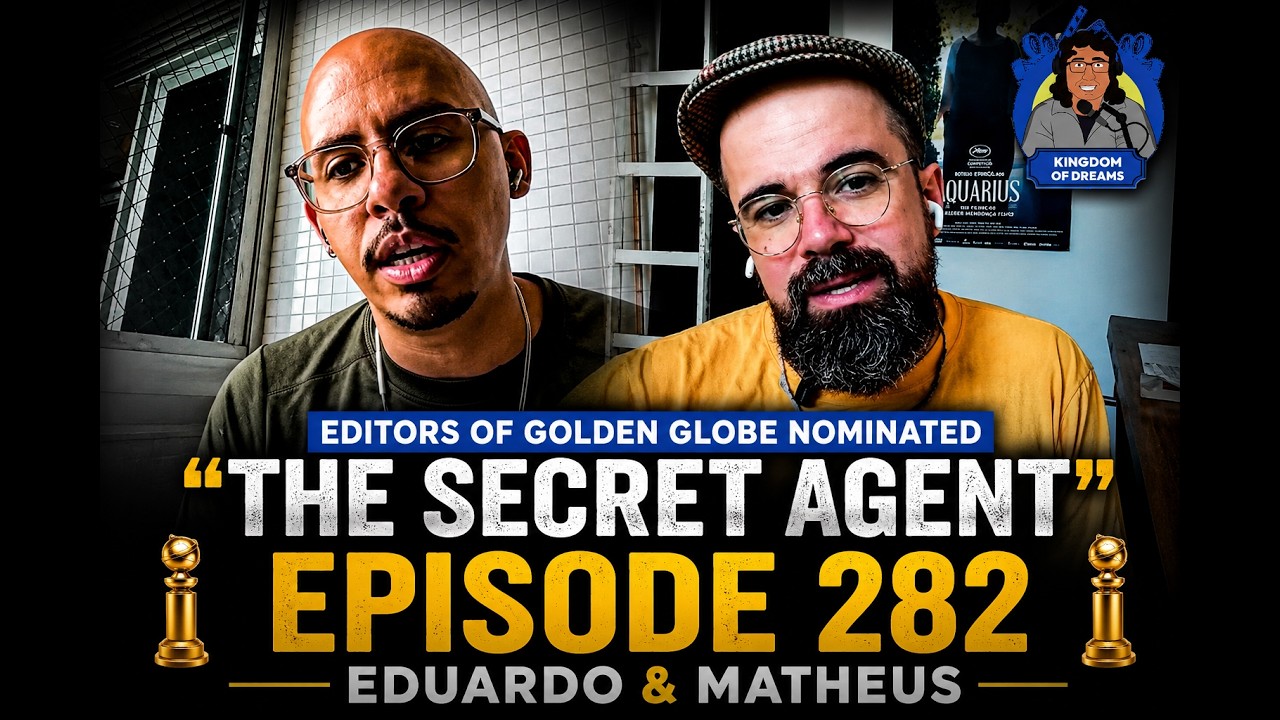
Editors of Golden Globe Nominated, "The Secret Agent", Eduardo & Matheus
Clips and Shorts from this episode
About this episode
🎙️ On this episode of the Kingdom of Dreams Podcast, I sit down with editors Eduardo Serrano and Matheus Farias to explore the craft behind a Golden Globe nominated Brazilian spy drama set during a political dictatorship.
They discuss how they shaped the film’s pacing, tension, and emotional rhythm, handled key scenes, and approached their editing workflow. It’s a focused conversation on discipline, restraint, and how editing can amplify both story and political impact.
Eduardo Serrano is a Brazilian film editor known for his work in bold, socially engaged cinema. Trained in editing in the UK, he has collaborated on acclaimed films such as Bacurau, Aquarius, Neon Bull, and Divine Love, with his work premiering at major festivals including Cannes and Venice. His editing is recognized for its precision, rhythm, and strong collaborative spirit with visionary directors.
Matheus Farias is a Brazilian film editor and director whose work spans narrative and documentary filmmaking. He edited Pictures of Ghosts by Kleber Mendonça Filho and has been involved in several internationally recognized projects. Alongside his editing career, he also writes and directs, bringing a strong authorial sensibility and emotional clarity to his work.
#filmediting #braziliancinema #politicalcinema #goldenglobes #postproduction #editingworkflow #filmpodcast
Full transcript
Automatically generated from the episode audio, so expect the odd misheard word or name. Speakers were labelled automatically; this episode has several guests (Eduardo Serrano, Matheus Farias), shown as Guest 1, Guest 2 and so on. About 6,400 words. Tap a timestamp to play from that moment.
0:00Guest 1I was invited at the last day of shooting of The Secret Agent. Kleber came up to me and said, "do you wanna join us?" And it was a big surprise because I wasn't expected that. I was shooting a film about the film. It's like a making of, but, focused on Kleber
0:18Guest 2There is kind of a tension that's, it's building up, and I guess that's, that's what you get from, this, link with Co… Conversation. But Conversation is a kind of a very good reference to talk about in this film, because you can feel something's going on, but you don't really know…
0:39Jawad MirExactly
0:40Guest 2... What's going on. So you can't pinpoint what's going on, but you can feel something's going on. And this is, like, something that's build up a whole film. The whole structure is,.. Yeah, it's everything, like, structured like that, yeah.
1:03Jawad MirWelcome back, everyone, to another episode of Kingdom of Dreams Podcast, The Making of Stories. I'm your host Jawad Mir. Today, my guests are Eduardo and Matheus, who are the editors of Golden Globe-nominated film in the Best Picture category for foreign film called The Secret Agent. I had never heard of this film, again, up until a few weeks ago. I'll be honest, which I talk about it in the podcast, this 2 hour and 41 minute film picks up very slowly, but after... Once it does pick up in about 45-minute mark or 50-minute mark, it does become very interesting. And it is shot in a very old-fashioned way. The story is set in the 1970s as well as present, and it kinda reminded me of Francis Ford Coppola's The Conversation with Gene Hackman. Kinda similar feel and tone to it. Both the editors talked to me about the process of the film, the difficult scenes that they had to deal with, and reading the script at the first time, as well as how the film has been received very well in Brazil.
2:03Jawad MirSo without further ado, here's my conversation with Eduardo and Matheus. I really appreciated the defined details and the extension of certain scenes. It wasn't really, you know, in terms of pacing that up to beat as you... As it would, but it still was very engaging, especially about 45 minutes in, and there was a lot of build-up and setup. And it reminded me quite a bit... I'm not sure if you've seen that, one of the early films of, Francis Ford Coppola, The Conversation with Gene Hackman.
2:33Guest 2Yeah.
2:34Jawad MirIt gave me…
2:34Guest 2Yeah
2:34Jawad Mir... That kind of feel and vibe. So I just wanted to sort of extend that first, in terms of, what I thought of the film and, very rewarding at the end.
2:45Guest 2Yeah. There is kind of a tension that's, it's building up, and I guess that's, that's what you get from, this, link with Co… Conversation. But Conversation is a kind of a very good reference to talk about in this film, because you can feel something's going on, but you don't really know…
3:06Jawad MirExactly
3:07Guest 2... What's going on. So you can't pinpoint what's going on, but you can feel something's going on. And this is, like, something that's build up a whole film. The whole structure is,.. Yeah, it's everything, like, structured like that, yeah.
3:22Jawad MirAmazing. Let's talk about, first of all, how both of you guys got involved on this project and at what stage. Was it during the production getting dailies, or was it after the production or halfway? And just talk to me about the process, whoever wants to take the floor first.
3:43Guest 1You can start, Eduardo, 'cause you did it first.
3:45Guest 2Yeah, maybe. Yeah. I,.. Actually it was a kind of a fun l… project and fun and interesting how it all started because, I edit both, two films of Kleber, both fiction ones. And Matheus has done a documentary he made last, two years ago, about cinemas and his, kind of, childhood and dreams and stuff. And, I was, I was editing the film on dailies, so yeah, you'd get the dailies and then watch them and try to edit them. And sometimes with the Kleber, because he had some, you know, like one day per week or something like that. But as soon as we s… we started, I realized that we were very... Th… there was a lot to do, you know? And then Kleber suggested that Matheus could come in. And, what's really interesting this process is that Matheus was... He was doing... Matheus was already doing a film about the film. So he was shooting the film while it was, like, you know, being made on set.
4:59Jawad MirOh, the making of him.
5:00Guest 2Yeah.
5:01Jawad MirYeah.
5:01Guest 2It was not really like a making of, because it's a project he can talk about it.
5:05Jawad MirSure.
5:06Guest 2But that's kind of a very interesting point of view. Two different points of view. I could see everything from my window… ... My, you know, my computer, and he was on set. He knew everything that was going on there. So we joined forces, and we started to, tackle this because it was a very longe… large project and the script was really long as well.
5:31Guest 1Yeah. I was invited at the last day of shooting of The Secret Agent. Kleber came up to me and said, "Do you wanna join us?" And it was a big surprise because I wasn't expected that. As Eduardo said, I was shooting a film about the film. It's like a making of, but, focused on Kleber, doing his film with his cast, with his team. We are editing this film right now but at the last day he invited me and I began to work, like, one month, before. Sorry, one month later. Eduardo, was already working on the film, and then I came up to starting doing scenes, start… starting editing scenes with the effects first, and then we start to edit the film in chronologically.
6:35Jawad MirRight. That is so cool. And I would like to ask, when you say you were making this film, not necessarily the making of or behind the scene, is it something similar to, Hearts of Darkness for the… for Apocalypse Now, or the most recent one, Megdoc, which is Megalopolis, behind the scene. Is it, is it something similar to that?
6:58Guest 1Yeah, it's similar. But doing in our own, our way, you know. I always loved, the cinema Kleber, was doing in the past few years. I was formed by,.. Kleber used to be a film programmer here in Recife. And my cinephilia was formed by his work. So I always loved what he proposed, exhibit, in showing films for people. So I know Kleber for a longer... A v… a very long time, and I always, dreamed to, work with him. And my first experience working with him was editing a trailer for his second feature, Aquarius. And then we start to have this partnership, and then he invited me to do... To edit Pictures of Ghosts. This film essay documentary about, old street cinemas. And for me, Pictures of Ghosts is like a big research, before The Secret Agent. So it's kinda, it's kinda wonderful to be part of these two projects because in a way they seemed, they seems like, one film divided in two for me.
8:25Jawad MirRight. Interesting. And when you guys read the script, I mean, I know Eduardo, you have worked with him before, but still I know I... You know and as much as I know that a film like this with not much intensity and m… suspense was there, but I meant, like, action and, you know, all that stuff, would never get made in Hollywood at this day and age. Right? It would never get made. Nobody would even entertain it because it's two hours and 40 minutes, and where's the f… action, where's the visual effects or all that fun stuff. So when you read that…
9:00Guest 1Oh, you…
9:00Jawad MirSorry?
9:01Guest 1Sorry. No, continue please.
9:03Jawad MirNo, I was just gonna finish my question that when you read the script, I know the part of the world that you're in things are a bit different, but was that ever your reaction in terms of where is this film going? Is it too long, nothing has happened yet? And it's meant for both of you actually, whether it's from the script standpoint or behind the scenes standpoint.
9:25Guest 1I think, I think the,.. It's, it's not only there in US or, I mean, in Hollywood that, it wouldn't be done because here as well, we, you know, our cinema, we come from the north of Brazil. And it's completely out of the production, you know, the commercial production of Brazil.
9:45Jawad MirRight.
9:45Guest 1The commercial production of Brazil is within, like, the borders of Rio and São Paulo. So we are kind of, kind of a gem. It's, well, it's, it's a bit of a miracle that Secret Agent and the whole cinema here. And we rely a lot on, foreign investments, so we have this co-production with Holland and French, co-production. A lot of money from the government as well.
10:09Guest 1So it's not, it's not like, it's, it's, it's, it's not pro… probable, I guess, to be, you know, to have this cinema. But, we've been doing it. It's been,.. The whole thing is really great. I mean, I went to a school that was, like, focused on, commercial filmmaking, you know, in UK.
10:32Guest 1So it's a k… kind of, I remember when I was in school and my professors really, like, struggled to understand me why I wanted to come back. But I knew there wa… there was this new scene of cinema going on and I was really happy to come back. And, but I guess I don't see... You know what I really want to see in cinema is people…
10:58Guest 1... And love for them. And more the narrative aspects of, or mechanics of the film. I would rather, you know, like, project m… because, you know, cinema is a bit of projection of yourself into, you know…
11:11Jawad MirOf course
11:11Guest 1... One character or another, so.
11:14Jawad MirRight.
11:14Guest 1I would rather have this kind of... And I was very... We were very happy yesterday we got shortlisted for the casting. It's the first time, an Oscar…
11:24Jawad MirYeah
11:24Guest 1... Prize is gonna be done
11:26Jawad MirRight
11:26Guest 1... Given for that. And one thing that…
11:28Jawad MirCongratulations, by the way.
11:30Guest 1Yeah. A… and one thing that, I think it's really important this film is, like, the love for people and for the city and everything that's around here. And of course the political, you know, background of it because it was made, during the '70s, during…
11:45Guest 1... The dictatorship. You know…
11:46Jawad MirSure
11:46Guest 1... It was the... Yeah.
11:50Jawad MirOkay. That's cool.
11:51Guest 1And this very large number of characters of the film, they are played by both professional and non-professional actors. But of course everything is guided by Wagner Moura, presence. But I think one challenge, was making sure all these characters, felt balanced
12:15Guest 2In the film…
12:16Jawad MirYeah
12:16Guest 2... In terms of performance quality, screen time, narrative importance. So, at the end of the session of the film, none of them felt forgettable, I think. So it's, it's, it's something that Kleber, loves to do, setting the film, setting the problem, presenting people, and then at some point something happens, and then you know what this film is all about. That's my feeling.
12:48Jawad MirRight. I'm glad you mentioned that because I kinda had that feeling where there were certain scenes, just the one, that particular one that comes to mind, it was somewhere in the middle of the film when they... A bunch of people were sitting in the living room. Some of them are on the couch, some of them are on the floor, and I had that... I don't know if that's a scene, but I did feel in that scene where some people were not necessarily professional actors, not because they were not doing a good job, but because they looked way more natural than an actor would look. Right? And it came across really nicely, so I'm glad you brought that up.
13:24Jawad MirFor me, I wanna sort of break down the scenes. There's so many interesting scenes in the film on their own. For me, the ones that stood out the most were the beginning when the car pulls into a gas station, and the scene that sort of, you know, develops through that. Then there was a scene when it cuts between the present time, and when the audio tapes are being listened to in a small room with the protagonist and his father-in-law, and the other individuals. I thought the cutting on that was really cool. And then the actual closer to the end, I wouldn't say closer to the end where the... I don't wanna reveal the film. I'm just trying to figure out how to put this… where the, if you wanna call it, like, a shootout that kind of happens towards the end. It's not really a shootout, but someone comes to get somebody.
14:20Jawad MirAnd… ... All that sort of plays out, the editing and the pacing of that. Those three parts really stood out for me. So if you guys wanna take a, take a bite at one of those scenes one after the other, what was the process in cutting those three scenes? 'Cause I really found them very interesting and fascinating.
14:40Guest 2Yeah. They were very challenging. I guess the first one, or the beginning of the film, it's setting the mood. It's something that, in, usually on, in Kleber's film, he's always, like, watching and recutting and very intensely working on the fi… the beginning of the film. It's, it's a very... Yeah, it's a, it's a standard thing for him, and the f… film kind of feels a bit different. It's almost like a prologue before the f… the film kind of comes.
15:09Guest 2But it sets the mood, the atmosphere that you need to understand for the film that's coming. So the narrative is not really there yet, but it's only setting the mood for the, what's coming later. And let's see. Oh, yeah, the song with all the interview scene was really long…
15:29Jawad MirYeah
15:29Guest 2... Scene. It was, like, 45 pages long…
15:32Jawad MirOh, wow
15:32Guest 2... In the credit, in script. Then I was... I got, like, two or three rough cu… like, drafts of the f… the script, and I was, like, really in panic with this film, with this scene. I was like, "Oh, my God, how is it gonna work?" And feel like these people only talking. And then the flashback came, and everything, like, started to come together, and I was really happy, with the script by one point, but still very nervous about doing it and cutting it. So I spent like six or s… or eight weeks, like, editing only this scene because it's quite a large one. We had, like, five hours and a half of, footage, you know. Like, really long takes, like, I don't know, 40 minute takes. And
16:18Jawad MirWow
16:18Guest 2... And they, y… you needed, you needed to feel, that this person is drifting. He's, you know, like, he's, he's, he's thinking about something and then remembering. It's about memory, so it's always, like, the way that the Wagner stands and remembers something, and then the way he feels about the memory he just had. And…
16:43Jawad MirRight
16:43Guest 2... And then there is this... I think th… this is, like, the one of the, let's say the adobe of the pillar stone of the, of the film that's, like, the cassette tape. You know? It's like, it's the symbol of the something that can really, like, endure time, and then it's there to kind of make the passage for future and past and…
17:10Guest 2And also it's something that I guess came from the film that Matheus did with him, the Picture of Ghosts, you know, while he was researching for the archives, and he had, the idea to write this film. But yeah.
17:26Jawad MirRight. Okay. Matheus, do you wanna take a bite at the last scene that I was talking about, which is in the newspaper, building, and then it goes outside into these streets? Do you know what scene I'm referring to?
17:43Guest 1The... What scene is that, Rodrigo?
17:45Jawad MirIt's, it's the... I'm just trying to remember.
17:50Guest 2It's the manhunt in the end.
17:51Jawad MirYeah. Yeah. That's the one. Yeah. That's a nice way to putting it. Yeah.
17:56Guest 1The moment she discovers the armors…
17:59Jawad MirNo
17:59Guest 1... Is that?
17:59Jawad MirNo, the, that... No, that whole scene of this guy comes in, and he calls out the protagonist's name, and that's... He kind of looks like her.
18:07Guest 1Oh, yeah. Yeah.
18:08Jawad MirAnd that everything else…
18:09Guest 1Oh, yeah
18:09Jawad Mir... Following that whole thing in the streets… ... And the policemen kind of following the tr… the trail. That I…
18:17Guest 1Okay
18:17Jawad Mir... I mean, that, yeah, that was really well executed
18:20Guest 1In fact, Eduardo, edited the scene…
18:23Guest 2Yeah
18:23Guest 1... This whole scene.
18:24Guest 2Oh, okay.
18:24Guest 1And, but there is, there is some curious about it, because the scene was edited, and Kleber came up with, a, some music, a beautiful music played by, a band from here. And I just put the music in, on the entire sequence, and it works perfectly. And, I have some experience about music and editing…
18:52Guest 1... Because I wanna point out some other scene that I think it's…
18:55Guest 2Sure
18:56Guest 1... Very different, but it's, it's, for me it's really great and fun. It's about the Harry, like, scene. It's quite a short horror film in the middle of the film.
19:09Guest 2Right.
19:09Guest 1Which is something very different, from approach, from rhythm, from acting. But it's somehow it works. I don't know. But i… in these two scenes the music is, for me is the main character. It evolves the scene, it evolve the characters, and it helps a lot the editing being, on almost on, almost other film, almost, it looks like other film going on, you know?
19:41Guest 2Right.
19:42Guest 1But Eduardo can talk more about this scene of course.
19:46Guest 2Yeah. The la… this, the manhunt is a little bit of, is like a rabbit hole of, sound and experience because we have the poet, this, like, vague poet that's claiming things on the streets. And when you have people running and talking and y… you know. Everything like sound... Actually sound's a very big thing in Kleber's films.
20:10Guest 2He's always very connected to sound, so we do a lot of work in sound while editing. And yeah, I mean, yeah, it's a classic kind of a manhunt, but it was, very fun to try to make, the foc… I mean, maintain the focus on him while he was, you know, going, round and through this, all this sounds and people and things in the very hectic, city center. Yeah.
20:41Guest 1Yeah. I really thought it was really cool seeing, the person who was doing the manhunt. Before that when he's met by, when he's being agreed to pay 4,000 in, I don't remember the currency. But that whole inter… interaction with, between them really portrayed his character in such a beautiful way that you knew what this guy was about. And even though he's in the film for, like, maybe, I don't know, five, 10 minutes, he really leaves a mark.
21:11Guest 2Yeah. I will, I will, I'll give a shout-out to the casting director because actually Kleber had a very strong, idea for the character. You know, the…
21:20Guest 1Yeah
21:21Guest 2... He actually, he was in… inspired to o… inspired on a real, like, killer that, lived here. And he sent him this, prote… yeah, information that he was, like, searching around…
21:41Guest 1Sure
21:41Guest 2... And he found this guy. And he has, like, very good, I don't know, eye-catching kind of, face.
21:48Guest 1Yeah, 100%. You know, fr… from what you guys are saying about Kleber, I have, I haven't seen any of his films, but it sounds, you know, five hours or 45 pages and all that stuff. It reminds me of, Terrence Malick who has done some incredible films including The Thin Red Line. I don't know if you've ever seen it.
22:07Guest 2Yeah.
22:07Guest 1And that was, I think its first or second cut was, like, six and a half or seven hours long, and had such a big star cast that they had to take out so many big names because the film got cut by six hours or seven hours to three hours. So it kinda reminds me of that kind of an approach, at least from what you're s… telling me. No, but it's, it's curious because, our first cut, the film has two hours and 46 minutes, I guess.
22:38Guest 2Really?
22:40Guest 1Yes, the first cut.
22:41Guest 2Yeah.
22:41Guest 1Because, Kleber likes to edit the film chronologically, but he goes to go f… further on each scene until it gets satisfied with…
22:52Guest 2Right
22:52Guest 1... The scenes. And all…
22:54Guest 2But he sh… but he shoots a lot, right? That's at least, that's the understanding that I got.
22:59Guest 1Yeah. Not really. Yeah, I don't think so. I mean, I…
23:02Guest 2Okay
23:02Guest 1... I've, I've, I've done project as a boy, like, very long. I mean… ... It's because the script was really long, and that's why…
23:09Guest 2Oh, I see
23:09Guest 1... The film is long.
23:10Guest 2I see. Got it.
23:10Guest 1But it's not, it's not like, it's not like he overshoots. Actually, he is very good directing, you know, blocking, and then he use two cameras to actually, get two, angles, you know, angles that he will need for the editing. And he's a very good editor as well. He could be do, you know, editing the film, but, because he's very good in blocking and remembering and trying to tackle the problem, the architecture of the scene, and putting the pieces together. He can really, like, envision what's going to be the scene. So it's very easy in a way to work with him because he knows what he wants and he knows where the film should be…
23:54Guest 2Yeah
23:54Guest 1... And should go, but it's also very intensive because we work a lot in the... Yeah, because we work with, known actors as well, I mean, you know, known professional ac… actors. We have to take care of them as well, sometimes to the demise of the main characters and the more professional ones to actually balance everything. And yeah, it takes a while to do this, but, it's not like, he overshoots a lot, you know?
24:21Guest 2Okay. Okay.
24:22Guest 1I've had, you know, I had directors that had, like, three hours of f…
24:26Guest 2... You know, footage per day, but not Kleber's I guess.
24:30Guest 1And of course, having Kleber sitting next to us all the time… ... Helped us a lot because he always knew, exactly what he wanted to get out of each scene. So it helps a lot.
24:45Jawad MirOkay. That's good to know. I misunderstood earlier. My apologies. Let's talk about, let's talk about, away from the film for a second. I would love to know how both of your careers started. What was the reason you, that you got into the film world, post-production world? Whoever wants to take a jab at it first. I would love to know your backstory.
25:08Guest 2Go first, Matheus.
25:10Guest 1Okay. I used to be a law student like 15 years ago. And I quit, but, my parents have, video stores here in my… ... In my, in Recife, in Olinda. A twin, city from Recife… ... In Recife. And I worked there, from 10 to 15 years old. And of course I watched a lot of films, and then I decided to work with that. I go to college, I study cinema, and I began to work with, editing because it looks, it looked great to me. But I'm also a director. I'm a screenwriter. I just, shot my first feature here in Recife.
26:03Jawad MirCongrats. Nice.
26:04Guest 1Thank you. So the cinema was always on my life in some way. This is res… well, this is... My parents are responsible for that. But now I'm focusing more on editing and directing. So it's, that's how it started for me.
26:25Jawad MirThat's cool. The fact that you worked in a video store reminds me of Quentin Tarantino, 'cause that's how he started…
26:29Guest 1Yeah
26:30Jawad Mir... Working in a video store.
26:32Guest 2Yeah. That's good.
26:34Jawad MirYou... When you left law school and went for this, what were your parents' reaction?
26:40Guest 1They are fine.
26:42Jawad MirOkay.
26:42Guest 1Because, I like to work. So in the f… in the beginning of the college, I was working on a, on a production company, a small one, doing publicity, doing short films. And then I quit…
27:01Jawad MirOkay
27:01Guest 1... And started to do my things, direct my shorts.
27:06Jawad MirNice.
27:06Guest 1And that's how I met Kleber.
27:09Jawad MirGot it.
27:10Guest 2Very cool.
27:10Jawad MirKleber, how about... I mean, Eduardo, how about you?
27:13Guest 2Well, I was a f… a graphic designer… ... A long time ago. And then I went to Europe when I was like e… early 20s, and then I was like, doing some animation, web design and animation. And then I started doing some motion design and then,.. And I went to study editing in a master's in England, in National Films and Television School. It's a very kind of a posh kind of place.
27:43Guest 2And, yeah. And then I came back to Recife because I really wanted to come back to my hometown, and started working here with films. Yeah. Been doing a lot of films since, you know, from everywhere, including other countries.
28:01Jawad MirNice. Back to the film, if you guys can talk about, each of you, what was the most difficult scene to edit and why?
28:22Guest 2Well, I've, I've, I've talked about…
28:24Guest 1Difficult scene.
28:24Guest 2I mean
28:25Guest 1Yeah
28:25Guest 2... My one would be the São Luís one. You know, the whole interview thing. I mean, it's very difficult to…
28:30Jawad MirOkay. Right. Yes
28:31Guest 2... Establish like a small... You know, like it's, it's like a dinner scene without dinner. So it's you have to, you have to edit everything in this small place. But I sh… I also, trying to expand the universe a little bit with the memories and, the whole, pacing and, the way that the whole film actually, you, the narrative of the film makes... It becomes clear in this scene. So it's a lot of weight in the film as well.
29:04Jawad MirYeah. Which is... I'm, I'm glad you mentioned that because that's almost halfway into the film.
29:08Guest 2Yeah.
29:09Jawad MirA… and then the narrative becomes clear at that point. Which
29:13Guest 2Yeah, that's why I was…
29:13Jawad MirWhich
29:14Guest 2... I was nervous, you know? Like, "Oh my God."
29:17Jawad MirWhich is, which is good, but at the same time it's, it's daunting because, you know, from an audience standpoint, like how long of an attention span they have that they're like, "Okay, this is not going anywhere. W… why am I gonna sit through it?" But I think that scene really builds up for all the earlier part that was necess… that was probably not there. So yeah. Matheus…
29:38Guest 2Yeah. You know, we had like, one million tickets sold in Brazil already, so we passed that mark. It's quite good and it's, it's been great, you know. People really enjoy... Like, they love Sebastiana, which is the old woman, you know, like…
29:54Jawad MirYeah
29:55Guest 2... That, holds the house. And, I think, I, it's kind of a paying back, I guess.
30:02Jawad MirNice. Nice. That's awesome.
30:04Guest 1Well…
30:04Jawad MirMatheus?
30:05Guest 1For me, I guess, I wanna point out two scenes. I think the hairy leg scene, it's, it was quite hard to edit because, at the first, the first cut was without music. We didn't use music, just, the plates, just the camera movements. And then we need to choose a rhythm for the f… for the, for the scene.
30:32Jawad MirRight.
30:32Guest 1And then Kleber came with this, with this one hour music from El Espejo de la Bruja, a Mexican horror film from 1962.
30:43Jawad MirOkay.
30:43Guest 1And then we cut and recomposing parts of the music to creating something absolutely new in the end of the process. And the second scene for me, it's the last, the very last scene of the film when the sons of Armando is, talking with the, that girl, and he's talking about the history of his family. We invest a lot of time in this scene because at some point, the story seems confused, and then, not so clear about we... About what he's talking about. And then we came back to the scene a lot of times to find the perfect balance about the history, about interest. And of course, at the end of the sc… at the end of the film, after two and a half hour, it's always challenging thinking about this big scene of dialogue.
31:44Guest 1So, it was quite challenging edit this scene.
31:51Jawad MirYeah. Got it. And was this shot... I'm assuming this was shot digital, right?
31:56Guest 1Yeah.
31:57Guest 2Yeah.
31:57Guest 1Yeah.
31:57Guest 2Yeah, but they had Panavision, lenses. You know, the…
32:03Jawad Mirhuh
32:03Guest 2... Real Panavision ones from the '80s and '70s.
32:06Jawad MirYeah.
32:06Guest 2You know, like cinema... Yeah, CinemaScope and stuff.
32:11Jawad MirYeah, it definitely had that feel. And in terms of the post-production workflow, software, Avid?
32:19Guest 2Yeah. It was…
32:20Jawad MirOkay
32:20Guest 2... It was done in Avid, yeah, from the beginning.
32:23Jawad MirIf you, both of you guys can talk about the workflow of how you guys worked on this film from a standpoint strictly from the editing and Avid working between you two guys, between the both of you, and, you know, technicalities behind, like, what is your workflow normally or even on this film, if an editor was listening and they wanted to know how you approached it?
32:51Guest 2Well, I can talk a bit…
32:52Guest 1Eduardo knows a lot about technology, so…... He would say a lot.
32:56Guest 2Yeah, I could, I could say because I was in... Since I was in the beginning, I kind of designed it. But, yeah, usually, I get two assistants. One is go… is going to the set. She's gonna be, like, a logger or data wrangler.
33:10Guest 2But she's an... My assistant, not photography kind of, set, you know?
33:15Jawad MirRight.
33:16Guest 2Real. It kind of, holds the film together, and she goes to the s… the first assistant that she organized the whole material and gets into Avid. We then use the Post Lab's, MimicQ to mimic, like a server-based kind of post-production, house. And then we could work all three of us, including the assistant, could work in the same project. And yeah, we used, Avid for that. That w… And the color pass later on, you know, the color grading was brilliant, so I had…
33:55Jawad MirI... Yeah, it was fantastic. It was fantastic.
33:59Guest 2Yeah.
33:59Jawad MirYeah. It gave me a little bit of vibes of, not exactly, but have you ever seen that film Traffic by Steven Soderbergh with Benicio Del Toro? The way he shoots, it's very kind of, like, yellow palettes, you know?
34:12Guest 2Yeah.
34:12Jawad MirAnd that... And, v… so it had that, but it wasn't as intense as Traffic was, but it had that '70s feel, the warm colors, and, it wasn't... You know, one thing I really appreciate in films is the environment that is shown around the characters. So you're always seeing, like, medium, waist-high, or wider shots more often than not, and very few close-ups, and that really brings the audience into the film, and be… b… makes them involved essentially in it.
34:47Guest 2Yeah. It's, kind of the city is a character as well in the film, so.
34:51Jawad Mir100% it is.
34:52Guest 2The city... Yeah, the movie theater is a character, and the whole, you know, old city, the way the city was as well. It was really important for us. And the heat, the warmth, you know, the whole buzz and craziness of, you know, being in Brazil as well…
35:08Jawad MirYeah
35:08Guest 2... I guess. And during the carnival, which is kind of crazy time here in Rio de Janeiro city. It's, like, crazy. It, all these carnival sh… things you see in the TV, oh, they come from Rio, from here. So yeah.
35:23Jawad MirRight.
35:23Guest 2Yeah.
35:24Jawad MirMatheus, I wanted to know from you when... And, eventually Eduardo as well, but to start off with you, when the film got nominated for Golden Globe, and now that it's shortlisted for Oscars, but specifically Golden Globe nomination, what was... Was that a pure surprise, or was that a, there was an expectation, and what was your reaction, not just as an editor, but as a human being to that?
35:52Guest 1For me, it's, so completely surprise because, n… not a completely surprise, but b… because, the film, received two award, two awards in Cannes, so, of course it seems something ... For the film. And Kleber loves to talk about the film. He loves to travel with the film. So he's completely, into the campaign. So, but for me, it was, completely surprised because I never been in this ex…... Kind of situation before. So it's, like, crazy talking to you, talking in English for the first time. It's, it's quite, incredible for me. And having these nominations and the film having all this, attention, not only in Brazil but a… all around the world, and now, in this race for the Oscars, for me it's something s… it's really something for me.
36:58Jawad MirGot it. Eduardo?
36:59Guest 2Yeah. Yeah, it's, well, it's always a surprise, isn't it? I mean, I was really, like, yeah, taken down because last year we had, you know, Fernanda Torres, a Brazilian actress, was, you know, n… nominated and w… won the Globe and Google. And we were like, "Wow, we need to be there if we want to go on," you know? And I was like, we were expecting because the neon, the distributor was really working on the campaign, and Kleber was working hard on it as well. But yeah, it was really... I was really happy about it, and everyone. Like, it's almost like a carnival, and I think you can see in your Twitter, maybe if you posted this in Twitter or YouTube, you will see how the engagement, Brazilian engagement on this is crazy. You will see. But, yeah, everyone kind of takes on it. It was like last year with the Oscar, last...
38:00Guest 2Not last year, this year. It was almost like a carnival party, you know, when…... When we got the Oscar here. It was crazy, you know? Like, people gather in the streets because of that, and it was really, amusing.
38:17Jawad MirYeah. No, that's, that's fantastic, and I think you guys have some, tough competition, definitely. I haven't seen all the films, but I've seen, The Voice of Hind Rajab, which is also nominated, and I had the... Who did I speak to from that film? It was a cinematographer, and he was f… I think he's from Colombia. So there's obviously tough competition, but nevertheless, you know, whatever sort of the outcome is, at the end of the day, I always say getting shortlisted, then on top of that, getting nominated, are huge achievements by themselves. The victory obviously becomes the icing on the cake, and I hope that, you know, the film does wonders. I mean, the fa… the way you're sort of telling me about the Brazilians really embracing this success, it's, it's wonderful to hear.
39:05Guest 2Yeah.
39:07Guest 1Yeah.
39:07Jawad MirAnything you guys wanna add at the end? Anything that I may have missed, something that you wanna talk about from the film, or just a thought?
39:21Guest 2Yeah, I guess, I guess I would say that, I hope, you know, the experiences of watching films in cinema, can endure n… next years, you know? Because it's, the whole experience is so great when you... It's the way we design them. We want people to watch them in the cinema, and, we're very happy about this. And people... You know, it's, it's also, I have this experience in Bacurau, was Kleber's last film, like last fiction.
39:51Guest 2And in this one, when everyone in a point of the film kind of almost stands up and starts clapping because they have very kind of, enthusiastic reception and, for a scene, you know, and, yeah, I'm, I just hope we can still do this for years.
40:11Guest 1Yeah.
40:11Jawad MirI hope so too. Amazing. Matheus?
40:15Guest 1No, I don't think I have some… nothing to add, but, the film is out today in France, and, in the US they, it received a lot of, in cinemas in more than 100 cinemas today… ... In US. So, for me, the best thing is when people watch the film in the better conditions and talk about the film. I love to read and to listen the reactions around the film. It's funny and it's very interesting, so people talking about something you did, something about your work for. So, for me, that's it.
41:01Jawad MirYeah. Don't, don't... I would recommend don't go on Reddit or read YouTube comments because sometimes they get a little too harsh.
41:07Guest 1I love it. I love it.
41:11Jawad MirWell, I'm glad you have that attitude because some people really take it in a personal way, and it really takes a toll. I know a few people who have done that. It takes a really toll on them, but glad to see you have a positive attitude towards that. Amazing, guys. Thank you so much for, your time, the film. Great film, and, I am definitely going to check this out again when it's out on, you know, digital markets, eventually in the next month or two, 'cause I really wanna experience it one more time. It's just one of those films I feel that needs to be watched at least twice or thrice for you to sort of appreciate more and more, to be able to understand…
41:51Jawad Mir... Thoroughly. So thank you so much.
41:54Guest 1Thank you.
41:54Guest 2Thank you, Jawad, too, for having us, and yes, thank you a lot.
41:59Jawad MirPleasure was all mine. Thank you so much, guys. Have a great day. Take care.
42:02Guest 2Bye.
42:02Guest 1Bye.
42:03Guest 2Thank you.