
Episode 284 · January 12, 2026 · 31 min
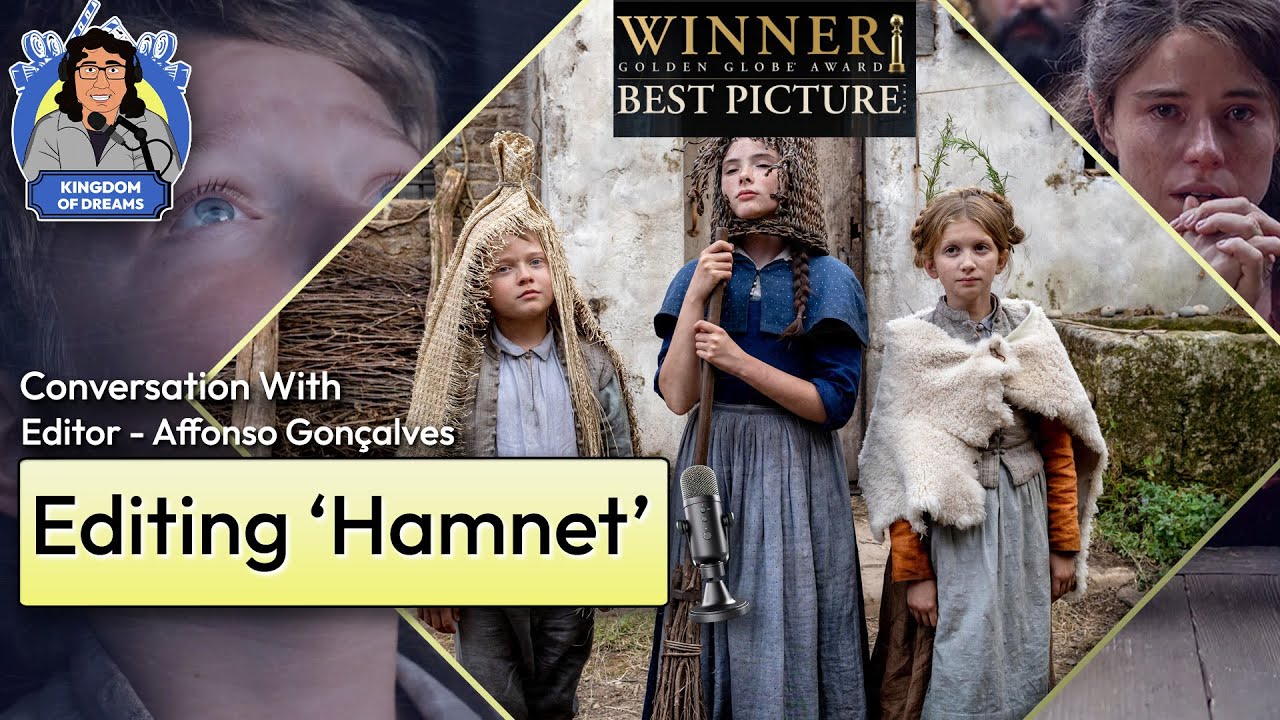
Editor Affonso Gonçalves, Hamnet, Golden Globe Winner
Clips and Shorts from this episode
About this episode
🎙️ On this episode of the Kingdom of Dreams Podcast, I sit down with Affonso Gonçalves, the acclaimed editor behind Hamnet.
Affonso opens up about the deeply emotional experience of editing Hamnet, how the material affected him personally and the responsibility he felt in shaping such an intimate, grief-driven story. He reflects on his creative collaboration with director Chloé Zhao, discussing trust, restraint, and how emotion guides editorial decisions. Affonso also takes us inside his editing workflow, from performance-driven cutting to finding rhythm, silence, and breath in the edit. It’s a powerful and insightful conversation about storytelling, vulnerability, and the invisible art of editing that gives a film its soul.
Affonso Gonçalves is an acclaimed film editor known for his emotionally precise and rhythm-driven approach to storytelling. He has edited a wide range of celebrated independent and studio films, often collaborating closely with directors to shape character, tension, and tone through nuanced editorial choices. Gonçalves is particularly respected for his work on Carol, Hamlet, True Grit, The Lost Daughter, and Dark Waters, bringing a restrained yet powerful sensibility to intimate dramas and complex narratives. His editing style emphasizes performance, subtext, and visual storytelling, making him one of the most sought-after editors in contemporary cinema.
#hamnet #goldenglobes #stevenspielberg #sammendes #amblin #oscarnominations
Full transcript
Automatically generated from the episode audio, so expect the odd misheard word or name. Speakers were labelled automatically. About 5,600 words. Tap a timestamp to play from that moment.
0:00Jawad MirBut was there something that ignited inside you, deep inside you, that you hadn't thought about in a while, from an emotional standpoint, and really brought you in as editor but as also as a human being?
0:13Affonso GonçalvesI mean, yes, because it's such an emotional film and the story is so emotional. The way the film deal with grief, which is such a hard subject. It was emotional. I mean, there were scenes that were emotional to cut. I remember myself…
0:26Jawad MirYeah
0:26Affonso Gonçalves... Like, tears going down my eyes just watching some of the footage and the way... I mean, and plus the actors are so spectacular. You know, Jesse and Paul and Emily and all the kids. So I had to trust, I really had to trust that whatever my emotions were when I'm watching the footage is the one, like, that you hope that it carries through when you're cutting…
0:50Affonso Gonçalves... When you're putting that together. The tricky part about editing is like not only on… when to choose when to cut, but when not to cut at all.
1:06Jawad MirWelcome back everyone to Kingdom of Dreams podcast, the making of stories. I'm your host Jawad Mir. Happy 2026. Today we're gonna kick off with editor Afonso Goncalves, who edited the Golden Globe winner Hamnet, produced by Sam Mendes and Steven Spielberg's, and directed by Chloé Zhao. I had the pleasure of having production designer Fiona and costume designer Malgosia, which you can check out on our podcast. But my conversation with Afonso was incredible. We talked about working with Chloé. We talked about the technicalities of editing, the workflow, and a whole bunch of other stuff. Lovely talking to him. Without further ado, here's my conversation with Afonso for Hamnet. Love to start off with, Afonso, that your involvement with the project, how that came about. Was it in an organic way through, you know, a referral the way it happens in Hollywood, or was it Chloé's approaching you directly? If you can run that by me initially, and we can get going from there.
1:58Affonso GonçalvesYeah. I met Chloé, I mean, I knew of Chloé, years ago, but I met her officially at the Sundance lab when she was at the filmmakers lab, with the writer. So it was a while back, and I was there, and then we met, and we talked a little bit, like we're just talking about more the writer, but, and then we kept in touch. We have a lot of friends in common. And obviously, I've always, like been a big fan of her work and just kind of like peripherally always try to find the right time, the right way to work together. And then she got in touch, and sh… we talked. She sent me the script. We had a long conversation over Zoom. She was already in England. And, it was great. I love the script. It was very positive. She says she... Like, her approach of editing because she edits all her films, and I have, I have worked with directors that do that, like something k… kind of similar to the way that she…
3:03Jawad MirSure
3:03Affonso Gonçalves... She does. And, so it was very easy, and I was super excited about her approach to the script, the how it's gonna be in the filming and ultimately to the edit. And, so it started very much like organically in the sense that we knew each other and we kind of wanted… This was something that we wanted to happen be… from before.
3:30Jawad MirRight. So when you were chatting with her about the script over the Zoom meeting or after or any… at any point in the pre-production stage or during the production or post-production, was there a moment where it sort of stays with you about how she tackles something from an emotional standpoint? Because it's a very emotional film. It's probably one of the most emotional films I've seen in a long time. And how she tackled that, and that impressed you about her even though you had known her for a while. A little moment. There's always something that happens in the post-production room, I find also in scripting stage.
4:05Affonso GonçalvesY… yeah. I mean, I knew her, but I didn't know in… her in that way, like in the, in such a deep creative, internal way. And just by talking about her approach to how she's gonna handle the material, and then we had, o… obviously, we had a long conversation about, the way she wanted to do things in the cutting room. Like how is her approach, how she approached to the footage, and we… It was very similar to the fact that first and foremost it's performance, and the performance is gonna lead us, and we… it's gonna guide us, and it's gonna be there, like what feels true, and it feels like even if we need to change some ideas in the, in the, like, the ultimately what the script is or this and that. If it's, it's something that the feeling and the emotion, is right in the acting and the performances, that's what we should all go for. And so that's when we talk about that, I'd be like, "Okay, th… this is gonna be g… this is gonna be fun, and it's gonna be great because we are kind of the same idea."
5:10Affonso GonçalvesObviously then, once you do it'd be like, are we thinking the same thing in terms of the performance we choose? And immediately, the way, the way we did it, the way it was worked, like she finished shooting, and then she did a pass. She took some time off, and she, and she did it the first pass of the film herself, by herself. And I said, "Do you want me to watch the footage?" And she says, "Don't watch anything yet. When you come in, when you come to..." She was in England. I was in LA. She says, "When you come to London where we're gonna cut, I want you to watch the film for the very first time without seeing anything." So that's what I did. I came to London after she did the first pass. She wasn't there. And I watched the film a few times, took notes, and then we had a long conversation, and then I started. And when I started, basically I started watching the footage. As I'm, I'm cutting scenes and watching footage, cutting scenes, I'm catching up with her. And basically, I would say almost like 100% of the time, whatever I was marking a good performance are basically the performance that she chose. So we were always in the same wavelength in that, in that aspect.
6:12Jawad MirThat's awesome. I wanted to talk to you about, you know… As creative people, especially a director, but also eventually cinematographer, costume production, and editor, the work that we do is in some ways an extension of ourselves. There's always something in that work that resonates with us very deeply, sometimes knowingly and sometimes not knowingly. I've had that experience both times. Knowingly, if I'm involved in the project, if I'm directing something or if I'm co-editing one of my projects, there is something that resonates right away or later down in the, you know, after the 10th cut that connects at a very emotional personal level. In this film, without giving much away even though people have seen, you know, the emotional arc of the film, the element, not necessarily exactly like that, but was there something that ignited inside you, deep inside you, that you hadn't thought about in a while, from an emotional standpoint, and really brought you in as editor but as also as a human being?
7:15Affonso GonçalvesI mean, yes, because it's such an emotional film and the story is so emotional. And it's, it's, the way the film deal with grief, which is such a hard subject, and I think I have to put myself... It was emotional. I mean, there were scenes that were emotional to cut. I remember myself…
7:33Jawad MirYeah
7:33Affonso Gonçalves... Like tears going down my eyes just watching some of the footage and the way, I mean, and plus the actors are so spectacular. You know, Jessie and Paul and Emily and all the kids. So I had to trust, I really had to trust that whatever my emotions were when I'm watching the footage is the one, like, that you hope that it carries through when you cutting…
7:57Affonso Gonçalves... When you putting that together.
7:59Jawad MirSure.
7:59Affonso GonçalvesBecause in editing, so how much you manipulate, but you use them in a way that still maintains that truth of emotion. I mean, and I think is kinda like, the tricky part of editing is like not only on when to choose when to cut, but when not to cut at all.
8:17Jawad MirYeah. 100%.
8:17Affonso GonçalvesBecause all of this, you know, and I always give that example to people. There's a scene, it's so beautiful, after Hamnet is already dead and Paul… and Will comes back home. And then he says to her, she's sitting by herself in the kitchen. He says, "I'm going, I have to leave. I have to go back to London because..." And she says, "Then go." And that's, it's all like a wide shot. And she gets up and he tries to approach and she tries to hit him, and he kind of flinches and grabs her and stuff like that. She only did that once. This wasn't scripted. Whatever was happening there was happening there, and that you can't really fabricate or cut that moment.
8:58Affonso GonçalvesAnd you kind of like, as an editor, you have to be aware of the moments that they're real and you feel, then you with them. And I think that's, you kinda like, in a film like Hamnet, y… you're hyper aware of moments like that like let's, let me, let me see what they're giving me and let me be, you know, just respectful in a way to their, to the work they're doing, the actors, you know? And Chloe, and Chloe by directing them and letting them do those things, you know. So I'm not sure, I'm not sure if I'm answering the question…
9:41Jawad MirYou are
9:41Affonso Gonçalves... But, it was definitely like that I think you naturally look for that. But in this film, p… particularly because it's such a, it's, it's, it's, it, I mean, it's, it's a hard, it's a hard subject, and it's a hard theme. And also I was trying to look for levity when we could just to have some contrast. And both me and Chloe, also Chloe as an editor, which she's a, she's a great editor too, we kept watching footage constantly. We'd sat down, we watched the film once or twice a week, and we constantly like, "We, I wanna explore this. Let's watch the footage for this." And I think it was something that we, I think we also matched so well because we never tired of watching and watching and exploring and finding, "Is this the best? Is, let's go back. Let's... Okay, it is the best. But you really, okay, let's go back." And it w… became part of our process, too.
10:40Jawad MirThat's awesome. I mean, you talked about the wide shots, and over the years I have learned, you know, directing several films but also editing a few of them, is that it's the best time, best thing is not to cut. And two sequences, one that you talked about and the other one which was in the, attic and when everybody kinda goes out of the frame and the camera slowly pans, the amount of tension that builds is absolutely remarkable and how the audience is just so immersed. And because the emotion that's taking place or whatever's happening, people are so involved in that. So I really wanted to appreciate you or Chloe or both of you or the entire team not cutting on that scene, because that is my favorite part in the entire film, how there's nobody in the frame and you're hearing all these sounds and you have no idea what's going on.
11:27Affonso GonçalvesYes.
11:27Jawad MirSo that was amazing.
11:28Affonso GonçalvesYeah, no, I also love those moments, and there are a few of those in the film that you're just like, you just let it be. Because I think the audience is so used to cut. When the cut doesn't happen, it c… it create, you just feels that there's a, I think it creates some unease of, okay, so what's coming and when that is coming.
11:51Jawad MirYeah.
11:51Affonso GonçalvesAnd I think like i… in a film like that is, I mean, is already designed by Chloe and Lukasz, the DP… ... To be that. But I think the moments when we use it, they're, they're powerful like that because it create, that's, that's tension that is just, because you don't know what's in the other side, like at the end of that pan.
12:14Jawad MirYeah. Even if you plan it, right? Sometimes in the post-production, because the pacing of the film, you end up…... Slicing it out because…
12:22Affonso GonçalvesYeah. Yeah
12:22Jawad Mir... You know, it's, it's not working, but it just does. It just does work so remarkably.
12:26Affonso GonçalvesYeah.
12:26Jawad MirAnd going back to the original question, which you more or less answered, but, and if this is personal, please don't, you know, just tell me right off the bat. In terms of grief, we all go through it or we will all go through it to some point.
12:40Jawad MirIs there a moment in your personal life that you connected with or you thought about that could happen in the future and how you would deal with?
12:50Affonso GonçalvesI mean, y… I think, y… yes. I don't know if I was just sort of trying to imagine that for myself. I was just mi… trying, as an editor, I was trying to imagine be her or him. I mean, yeah, like you said, I think we all, well, like, we experience some grief of some sort of some kind. I mean, thankfully I never experienced that kind of grief, but you hopefully you understand what that is and the states there are and how s… like, that, I mean, the level of grief they experience that like I hope I never to have that, but you still understand and you have to respect and be like, "Okay, h… what is it? W… h… how can I really be true to this moment?" And I think it's, it's less about me in my own life. It's me, what if I h… if I'm her, what's the depth of this pain, and how do I get there?
13:52Affonso GonçalvesSo I'm kinda like, and I think that's true for my work. I think the reason why I like, I love what I do so much is it's like it's a, it's a learning, it's, it's sort of this exchanging of m… me trying to give something, but also getting something from…
14:08Affonso Gonçalves... The story and the footage and I think that's…
14:11Jawad Mir100%
14:11Affonso Gonçalves... Kind of like the approach to it, to it.
14:13Jawad Mir100%. And you mentioned this, but I would like to sort of extend this in a bit. You know, whenever any one of us work on a project, a film, a book, or when we travel, right? But let's talk about the film in general. We always, I know for me, I discover a lot about myself than I probably do about the actual film that I'm working on. Was there something that you discovered about yourself while working on this film?
14:41Affonso GonçalvesYeah. I, yes, definitely there was something I discovered about myself. I don't think I can put it in words, though. I know that the person that was, that came in is not the person that came out. I don't know if I explain in words, but it was just, I think being part of it, being part of, like, the world of Hamed… Hamnet, but also being part of working with Chloé in this project, you know? There is, there is sort of like, I think the exchange of creative, the creative process that I went through with her and having, like, working as a co-editor with a director who's, like, a co… co-writer is in the process, and I learn a lot about her process of dealing with the actors and dealing with everybody. Like, with production design. So…
15:28Affonso Gonçalves... It was, it was super interesting because it's so deep, because Chloé just dives in so deep into every aspect, and it was the same with the, with the edit and the same with the music and the sound design and stuff like that. So I think it was just definitely, there was a learning that it's just, it's difficult for me to say, yeah, I learned…
15:47Jawad MirFair enough
15:48Affonso Gonçalves... Like, practical thing that I can do now. But it was a, it was a very kind of like, it's just emotional, thing that I went through in this film, partly because of the story, partly because of what's happening and then a lot because of just the, just by working with, side by side with Chloé.
16:10Jawad MirSure. Fair enough. Well, h… tell me how she is in terms of working, relationship that you have with her as a, as a director editor versus other directors that you have worked on. Not trying to, you know, put down anybody else, but obviously every person that you work with has a different kind of a personality and a relationship that you have. How is she different from other directors?
16:28Affonso GonçalvesI mean, I think, I think, the biggest difference is, like, we w… we would come, we come in, like, beginning of the week. We watch, we watch the cut, and we took notes. We talk about it, and we take, I'll take notes of, like, thing, idea that she has. But I have my own Avid, my own computer, and she has her own computer. So there's sometimes we're watching, she says, "I have an idea, but I think I wanna do it. I wanna try something." And she did it. And I think it's, just not that common. Like, the, often the directors I have, we just work together. This way we could do it, and sometimes she give me something and be like, "Wait. I think l… let me try something here," and I would do it. So i… it was just a great, this great kinda, like, back and forth.
17:10Jawad MirSure.
17:10Affonso GonçalvesMost of the time she would, I would just go to her room and we'd just keep working together. So I would be operating and then we'd just be like, you know, throwing ideas at each other. And there were times it's like, "Oh, I like," she says, I kinda like, "Let me give it a shot here," and then she would do it. So that's, that's in a way, that's different because at a… any moment she'd be like, "I'm, I'm jumping in. Let me, let me just jump in and try some stuff myself." so it was, it was fun. It was, it was a, it was a fun and different way. But basically because there were two editors.
17:44Jawad MirSure. That's awesome.
17:45Affonso GonçalvesYeah
17:46Jawad Mir... I'm just gonna, I'm just gonna kind of travel back in time a little bit and we'll come back to Hamnet. What was the catalyst in your life that gave this, you know, ignited this little flame in you that you want to go into films, specifically editing?
18:04Affonso GonçalvesI always, I mean, I always liked film a lot. I always loved films, but I think the catalyst, I was in col… I'm from Brazil. I went to college in Brazil, and I had, I wasn't really happy in college, but I had one class. It was a film class, and the teacher was clearly, the teacher was a commercial director and I think he was, like, a frustrated commercial director that wanted to be…
18:22Affonso Gonçalves... A film director. And I remember he showed He showed Rumble Fish and he showed Koyaanisqatsi. And I remember those films, I'd be like, "Wait, you can actually m… make those films? Th… this is kinda crazy." And that moment on, I'd be like, "I think this is what I wanna do." And then I found a school in England, and I moved to England. I went to first a film school there. And there it was like a, kind of like a general you learn film, but every aspect of it. And then I had this amazing editing teacher that I'd be like, "This is what I wanna do." And then I kinda like, "This is, this is it." And then I went to LA. I went to AFI and did, like just cutting for two years, and then that was it. I'm still, I'm still at it.
19:11Jawad MirNice.
19:12Affonso GonçalvesYeah.
19:12Jawad MirAny editors that you, I'm assuming Walter Murch is one of them, any editors that you sort of…
19:17Affonso GonçalvesYes
19:17Jawad Mir... Look up to, get inspired by, you know, even at this time in your life, you know, as you work, because we're always learning every single day.
19:26Affonso GonçalvesI mean, there are so many, man. There's so many editors that I watch and be like, "Oh my God, how do you do this?" You know? I mean, I mean, o… of course the obvious, fucking Walter Murch, but then is Dede Allen, and then Thelma Schoonmaker, and Vee Coates. And right now there's this editor called Nelly Quintas. She's a, she's a, she's a French editor, and she cuts for, she used to cut for Claire Denis, and Leos Carax, and Alice et. And her work is just spectacular. I love her work, but I mean, there's just too many. Jay Rabinowitz I love. It's just too many names, but yeah. I, yeah…
20:08Jawad MirNice
20:09Affonso Gonçalves... There's a lot.
20:10Jawad MirNice. I… in terms of Hamnet, you talked about working on Avid. Let's get a little bit technical here now. Were you on the, first of all, were you on the set at all? 'Cause some editors do, depending on, or was it like completely everything was done and you kinda came in the post?
20:28Affonso GonçalvesThat's it. That's the way Chloe wanted.
20:31Jawad MirOkay.
20:31Affonso GonçalvesBecause…
20:32Jawad MirIn t…
20:33Affonso GonçalvesI, like I had to offer her, "Do you want me to watch?" She says, "Don't watch it. Don't watch it. Start s… from zero."
20:41Jawad MirBut in the past you have done that with other films?
20:44Affonso GonçalvesYou mean start from zero? No. In the past, like…
20:47Jawad MirNo, like on being on the set
20:48Affonso Gonçalves... I can't even watch it. Yes. Not on the set, no. I don't really like to be on the set. I'd rather not.
20:53Jawad MirOkay. I have notes.
20:54Affonso GonçalvesBut I will definitely watching as they're shooting, yes, and I'm cutting as it's g… a… as it's going.
21:00Jawad MirWas this way preferable for you, working with Chloe sort of after all the filming was done?
21:08Affonso GonçalvesI mean, think it
21:08Jawad MirBecause I mean, Chloe has a point, in my view, that because you're completely fresh to it, right? Like, you're not, you don't have these preconceived notions from physically being on the set.
21:19Affonso GonçalvesWell, I mean, often happens that I'm, I'm, I'm, if I'm cutting while they're shooting, I can just be the eyes and like for the director, and he doesn't have to worry about things. I mean, partly because Chloe is also, she thinks sometimes as editor, as an editor. And, I think she sensed what we had and we were getting was good. So it was, no, it was, it was, I think you adjust and adapt, and it worked, and it really worked.
21:49Jawad MirAnd when you're working on Avid, I mean, it doesn't matter what software you're working on, but specifically now that we're talking about Avid, there's obviously a collaboration tool that you can utilize, but in terms of the workflow, you know, with e… assistant editors that you have, how do you, how do you guys tackle the footage, like once it gets ingested into the software and then kind of working through it, picking up scenes, the best takes? If you can talk about it from, you know, a pure editor standpoint, the technicality, would that be really cool?
22:18Affonso GonçalvesYeah. I mean, yeah, the pro… the process, they were shooting and then they, we had Tracy, our assistant, was fantastic. She was, she was in London, and she was just basically ingesting and kind of organizing the whole thing because, I mean, and she had to do it also because she knew as soon as, Chloe had, was done, she did it more the way, like, Chloe wanted, which it happened to be like it's a pre… it was very kind of standard the way she did it, but, she did the whole thing and then Chloe took a little time off and started cutting. So Chloe was working with Tracy before I came in, and Rachel, our second, and then I came in, and everything was basically there organized. So we were in this post house, and then we had three rooms, one back to back to back. I was in one. My assistant was, Tracy, was in one, and Chloe was in the other one. And anything that happened, we'd just send, basically we sent it, anything to Tracy was the one that kind of kept everything updated. If Chloe worked on it or I worked on that, she would update, and then we always have things updated.
23:21Affonso GonçalvesThe good thing too, you know, is the fact that we, Johnny Burn, the, our sound designer, which is incredible sound designer, he was giving us stuff from the get, from like… We were, we were, like even from the first cut, there was so much sound design made by him. It wasn't like me trying to put birds and stuff like that. He would provide us, and he was very close to us. So we, every week we had a session with Johnny, which is, which was just incredible. You know, that experience of just sitting down with him and already being specific about the birds and the song and the, and the forest and London, and the, a… and so we w… everything was happening, like, at the same time, which is, which is great and s… also really fun to do it that way.
24:10Jawad MirYeah.
24:10Affonso GonçalvesSame with Max, because Max Richter, Max was als… also known, because Max, if I'm correct, like I think that's what he said, so I hope, I hope I'm not giving wrong information. But he said as soon as he gets the script, he got the script, he was a… already thinking about music. So he, as he was working on the film, he was also on tour. So he would be in his place a certain amount of time, then we knew when Max was there. And then when he was there, we'd send cuts, he would send music. So I was temping with music that ultimately was the music we used in the cut. So that was also super, like, helpful that we don't have to imagine anything. We'd just be like, he sent us something, Chloe would jump on the phone and be like, "This works, this doesn't work. Let's try this." And then he'd work and g… So everything was happening in this sort of very creative, very rich, ideas were constantly being like fed to us.
25:10Jawad MirYou know, music certainly h… plays a huge part in the film. Huge part. And I'm actually trying to get to sp… I'm trying to make an effort to get to speak to him, but that music in the film was remarkable. It was absolutely breathtaking.
25:25Affonso GonçalvesYeah. He's, he's amazing. He was… And he was so, easy to work with. I mean, again, h… he was on, he would be on tour and then he'd come back and immediately, like, he was on, and he was with us and talking to us and having great ideas. Was really, like, so, just enriching to just to have a chance to work with Max, you know, was great.
25:52Jawad MirYeah. You… you're originally from Brazil, correct?
25:55Affonso GonçalvesI am, yeah.
25:56Jawad MirSo have you seen that new film, Secret Agent?
25:59Affonso GonçalvesYeah. It's great.
26:00Jawad MirWhat'd you think of it? Yeah. I…
26:01Affonso GonçalvesI mean, I like it. I think it's really great, yeah.
26:04Jawad MirI had the editors of those,.. I think his name was Eduardo and Matthew who…
26:08Affonso GonçalvesEduardo. Yeah.
26:09Jawad MirYeah. Yeah.
26:09Affonso GonçalvesYeah. They're, they're awesome, yeah.
26:11Jawad MirYeah. I... You know what, the whole thing with that film was… Sorry, I'm kinda going off topic. The whole thing with that film was, it's like, "Okay, what's going on? Nothing is happening," but you just don't wanna shut it down because you know something is gonna happen. And in that wait, almost 45 to 50 minutes of the film has gone by, and you're still hooked. You're still hooked.
26:29Affonso GonçalvesBeauti… I mean, they're amazing. Those guys, th… those editors did such a beautiful job. And the film, it's just fun to watch. Also, like, it's so great as a Brazilian to see that, you know?
26:40Jawad MirThere's so many amazing films this year, Hamnet being one of them. I talked about, One Battle After Another. You know, aside from obviously the film that you have worked on, and, you know, I hope that it wins. I said when the One Battle After Another came out that this film was gonna sweep the Oscars.
26:57Jawad MirLike, that was my prediction. But when I saw Hamnet, I'm like, "Okay, now it's like, you know, like a juggle between the two." aside from the Oscars, which have y… some of your favorites been, films been this year, you know, top three, if that comes to mind?
27:12Affonso GonçalvesI mean, I think, almost like the obvious ones. I mean, I, One Battle After Another, I thought, I thought it was... I really liked that. Sentimental Value, I th… I liked that. It Was Just an Accident, No Other Choice, I liked it. Sirat. Yeah. I mean, I…
27:35Jawad MirSo there's a big list, yeah
27:36Affonso Gonçalves... Could go on, go on and on and on.
27:37Jawad MirYeah, no. I know.
27:38Affonso GonçalvesBut Secret Agent…
27:39Jawad MirI haven't seen Sirat
27:39Affonso Gonçalves... For sure. Yeah.
27:40Jawad MirI, yeah.
27:40Affonso GonçalvesSecret Agent, of course, yes.
27:43Jawad MirWhat's,.. Actually, if you haven't seen, it's nominated for Best Foreign Picture for Golden Globes, The Voice of Henry Hijab. That's a great film.
27:52Affonso GonçalvesOh, yeah.
27:53Jawad MirHave you…
27:53Affonso GonçalvesI have not seen that. I really wanna see that.
27:55Jawad MirOh.
27:55Affonso GonçalvesYeah.
27:55Jawad MirGod, they just have a bag of, you know, t… box of tissue paper beside you. It's, it's a crazy film. It's a crazy film.
28:01Affonso GonçalvesYeah. I wanna see that, yeah.
28:02Jawad MirWhat's, you know, without, unless there's something that you have signed already in terms of NDA, what's next for you, in terms of project or projects that you're working on in terms of post-production?
28:16Affonso GonçalvesWell, right now I'm working with, Ira Sachs, this filmmaker that I've, I've worked before. I'm finishing a film with him now. And then my next film was with, Todd Haynes, also a filmmaker… ... That I've worked with before. So hopefully that is in March. I'm hoping that happens.
28:35Jawad MirWhat are the films called? Do they have names yet or no? Or you can't talk yet?
28:39Affonso GonçalvesThe one, the I… Ira's film is called The Men I Love and
28:44Jawad MirOkay
28:44Affonso Gonçalves... Todd's movie is called Di Notte.
28:46Jawad MirDi Notte.
28:47Affonso GonçalvesYeah.
28:47Jawad MirOkay, great. No, that's, that's exciting to know. And if you were to give a piece of advice to anybody who is trying to get into the industry, whether it's an editor, as a cinematographer, a director, whatever, what would that advice be?
29:03Affonso GonçalvesI'm not great at giving advice, but
29:05Jawad MirOh, I'm sure you know. You have experience behind it.
29:09Affonso GonçalvesI would say, I would say, you know, if you wanna get into the industry, I mean, I would say try to meet people in the industry and, you know, just, yeah, just I think that's, that's the, that's the, that's the somehow the best way. I mean, I went to film school, so it's a little, it's a little different, but I think if you meet, try to meet the people that you like. And, like sometimes people reach out to me, be like, "Hey, can you have coffee and talk to me?" And then, and I try to, if I can, talk to the people and encourage them to do this because I love it, and there was a lot of people that helped me out to open the doors in that way.
29:52Jawad MirAnd that, thank you so much, man. I appreciate it, for your time.
29:56Affonso GonçalvesAbsolutely. Thank you
29:56Jawad Mir... I look forward to having you. Are you in LA?
29:59Affonso GonçalvesI w… Yeah. I mean, I mean, right now I'm in New York working, but I, home is LA, yes.
30:05Jawad MirWell, if you... I'm, I'm going to LA this, in a couple of weeks, but if later on, if I'm there and if I, if I can reach out to you, would love to grab a coffee.
30:13Affonso GonçalvesYeah. Yeah, absolutely. I really appreciate you having me here. Thank you so much.
30:18Jawad MirNo, pleasure. Thank you so much for doing this film.
30:21Affonso GonçalvesYeah.
30:21Jawad MirReally means a lot to me.
30:22Affonso GonçalvesThank you.
30:22Jawad MirThanks so much.
30:23Affonso GonçalvesTake care.
30:24Jawad MirTake care. Bye.
30:24Affonso GonçalvesYou too. Bye.