
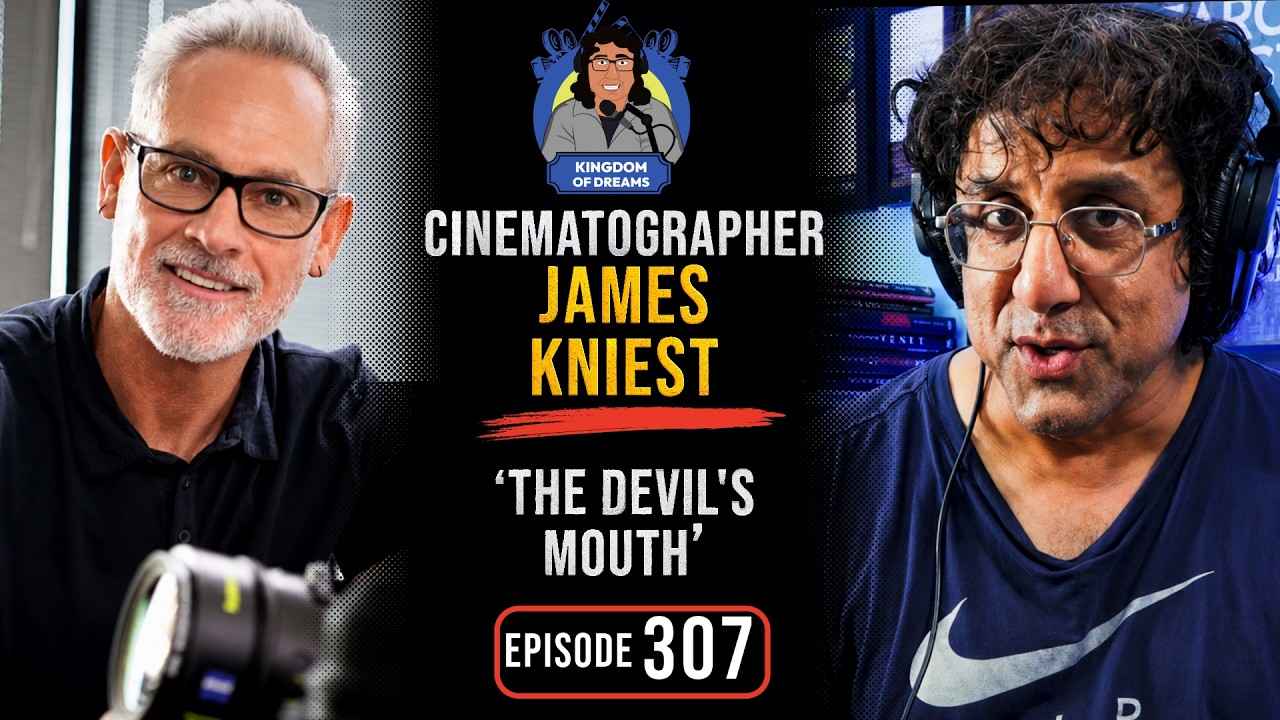
Episode 307 · July 27, 2026 · 43 min
Filming 'The Devil's Mouth', Cinematographer, James Kniest
Clips and Shorts from this episode
About this episode
Amazon Prime, The Devil's Mouth, Amazon Prime, July 29th, https://www.primevideo.com/detail/0STZE8PTP4X3KY6LTBU93B8OE1
🎙️ On this episode of the Kingdom of Dreams Podcast, I sit down with cinematographer James Kniest to discuss his work on the underwater survival thriller The Devil’s Mouth.
James shares what it was like collaborating with director Jeff Wadlow to create the film’s tense and immersive visual style, balancing suspense with the challenges of shooting in and around water. We dive into the realities of filming underwater, working at both real locations and large water stages in Thailand, and the technical and creative decisions that helped bring the film’s dangerous world to life.
It’s a fascinating conversation about cinematography, visual storytelling, problem-solving under demanding conditions, and the craft of creating one of the year’s most ambitious underwater thrillers.
James Kniest is an American cinematographer known for his atmospheric visual style and exceptional command of lighting, particularly within the horror and thriller genres. After studying cinematography and underwater photography at the Brooks Institute of Photography, he spent years working as a gaffer, camera operator, and lighting specialist before becoming a full-time director of photography.
Kniest has built an impressive body of work across both film and television, serving as cinematographer on projects including Annabelle, Hush, The Bye Bye Man, Within, The Haunting of Bly Manor, The Midnight Club, and American Horror Stories. His work is often praised for creating tension through carefully crafted lighting, shadow, and camera movement rather than relying solely on visual effects.
His latest feature, The Devil’s Mouth (2026), directed by Jeff Wadlow, continues his collaboration with suspense-driven storytelling, bringing his signature cinematic style to an underwater survival thriller.
#sharkmovie #devilsmouth #amazonprime #jaws #horrormovie #horror
Full transcript
Automatically generated from the episode audio, so expect the odd misheard word or name. Speakers were labelled automatically. About 8,400 words. Tap a timestamp to play from that moment.
0:00Jawad MirEspecially the characters were just like real people. Like, what would you do if a situation like this arises, and who would handle the pressure in what way? And I really admired that in that, in that film.
0:10James KniestWell, I know Jeff Wadlow, our director, would love to hear that. You know, I th… they, the cast worked really hard with him. You know, the actors were tremendous. They worked their butts off. They did scuba lessons. They did underwater breathing lessons. They... It was really interesting for me to watch them grow with their comfort level and their water abilities, where at the end, there's a scene where gets caught in the, in a passage in the rocks. And, the actors were underwater for 20, 30 minutes at a time, going down and grabbing from the safety divers the hookah and taking a breath, and then going back together in synchronicity and picking the scene right back up where it was. You know, compared to the very first day, I was concerned that maybe not all of them could swim that well.
1:03Jawad MirMoving to Devil's Mouth, I was quite surprised, I won't lie. I wasn't really expecting it to be engaging and entertaining, and there were definitely some moments that, you know, the scare moments, the, where the story was not really expected to go. And, I could just imagine how hard it was shooting that because 90%, if not all of the film, was in water, right? Or surrounding the water. So kudos to you, first of all, on achieving that.
1:32James KniestThank you. It was, it's a lot of fun. I have to admit, you know, as daunting as it can be, I mean, you know, it's, you're, you're in the water all the time and there's challenges. I think we all gravitate as filmmakers to challenges. We're problem solvers. So, you know, inherently knowing that there's gonna be problems all day long is kind of fun, 'cause, you know, you bring together the team and you collectively surmount these problems and it's, it's really fun.
1:57Jawad MirYeah. So which kind of jumps into my first question, right? Which we touch, just touched upon the challenges. First of all, let's talk about where it was shot, right? You know, obviously it's set in the Devil's Mouth. And was, how much was it real location? How much was a set, or a water tank in a studio? If you can run me through that first, without giving anything away, because I don't want the audience obviously to know, but just to kind of give a general idea.
2:26James KniestYeah, we shot in Thailand. We shot a portion of the movie out in real locations, real ocean, real caves, real rivers. And we were trying to, you know, establish the scope of the environment and also the natural beauty of Thailand. And also just how incredibly intricate these cave and river systems are there, to sort of... Oh, I'm so sorry. To sort of…
2:48Jawad MirIt's okay
2:49James Kniest... Set the tone, so that we could move onto stage as we, you know, delved into the cave system itself and dealt with some of the stunts and more difficult, action sequences. But we did shoot in real locations, real caves with real rivers and real water. And it was really fun. I mean, it was, it was almost like a field trip to some degree, where our whole production company moved. We went to sea at one point. We had, I think 30, 35 boats, like a flotilla with equipment and crew and sound and camera support boats, and we had a Technocrane on a barge. We had four cameras all the time, two in the water, one on a crane, and one, from another boat or from the land with a long lens. And then we went to these incredible caves. I mean, Mother Nature is incredible artist. The painterly quality of these stalactites and stalagmites with the, with other, what… whatever sediment is in the, in the earth and how they formed, it's really cool.
3:51James KniestAnd it's exciting and a little unnerving when you're in a dark cave with dark water and it's real and, you know, when you get in the water, you're not 100% sure what's in there, and your imagination kind of goes wild. And, you know, we had a full-time snake wrangler on our set, who actually caught snakes. He was a really interesting…
4:10Jawad MirOh, wow.
4:11James KniestHe was a great guy. He was a, this gentleman, and he would dye his beard and his hair a different color every day, and he would talk about how he can smell snakes from far away and he would find them. And it was really interesting for me to watch the cast, you know, their maturation and with their comfort level and their skill level in the water. You know, the very first day is we're way up in the mountains in the wild on a river. And it was, I think, I saw them enjoy themselves, as did the crew and myself as well, but there was some nervousness to it, and I don't know if that's like first day jitters or the environment. I mean, they're kayaking down this river into this giant cave that's like a maw just waiting for them to arrive, and then it's pitch black when you get in there. So, you know, we really embraced all these natural and beautiful places for the, for the movie, which gave us the platform to move onto stage and shoot some of the, you know, tighter, closer stuff.
5:05Jawad MirThat's awesome. I mean, I can only imagine, you know, especially, again, without giving anything away, the underwater sequences which were quite lengthy at times. Those, w… were those on location or was that on set? Because it looked on location to me.
5:20James KniestWe did both.
5:21Jawad MirOkay.
5:21James KniestWe shot in the ocean, in the real ocean in the water. And then we shot in some caves with river systems in them. And, definitely were in the water. We were underwater a little bit in the caves, but the water quality and the water column didn't have the greatest visibility, so, we would kind of tag and save some of the tighter bits that we needed more clarity to the tank. And then we built these huge tanks in, on stage in Thailand. I think the one tank we built was 180 feet by 80 feet by 6 feet deep on a stage floor, on a regular stage. Beautiful stages there. They weld in iron, basically walls and supports, and we filled it with water. And our production designer, Alec, he built these giant, massive cave structures all around the s… the set and…
6:11Jawad MirWow
6:12James Kniest... Visually stunning. I think engineering-wise they were incredible. There was some lighting challenges because they went all the way to the ceiling, and then we have water and then, and then so he started to design ceiling pieces that could move so we could bring light in depending on what the scene was and where in the tank. And we built a platform with a techno crane that could roll around inside the tank so we could reach different places. So it was really an interesting undertaking with a lot of departments coming together to work together to achieve this.
6:44Jawad MirNice. You know, I felt, even though this was a shark movie, you know, I felt the caves themselves were like a character in the film almost for me, at least as an audience member, serving as another monster in the film. You know, framing that up and you kind of touched upon it very briefly, but if you can get into the more technicalities with the equipment, the type of camera that you're using and just making sure everything is as realistic as possible to give audience that immersive feeling of being physically present at those locations. And I won't lie, there were certain times that did happen with me. It was very immersive. So talk about that from a technical standpoint, please. I would love to know.
7:32James KniestYeah, I think you're right. The cave itself was a character. It was part of the monster that kept them trapped and almost like the gatekeeper, you will, or the jailer that kept them in the cave. And that is part of the storyline is how to get out of this, you know, out of these handcuffs. It was really important, I think, to have continuity between the real caves and the caves we built. And, you know, of course, we tested a lot of different colors and we put stuff on camera. And then, in fact, because the characters, the actors are on these rocks, there was rocks that we made that were rubber coated that looked really real, but they were safe for the actors to play on. And, you know, there were some sharp ones. I think all of us got a little nicks and bruises here and there. One of the things that was interesting is we used largely the same space, but in order for it to feel and match the story points with different caves, we changed different rocks, stalactites, stalagmites.
8:33James KniestWe brought ceilings higher and lower. We opened up ceilings and let some shafts of light come in for different caves to try to, you know, give it some variety, which I think we definitely achieved for sure. You know, it was challenging from a technical standpoint because we were shooting four cameras all the time. You know, we have a cast of up to six in the water at the same time, a lot of coverage. There's some limited time when your actors are in the water. I mean, even when the water is heated, after a while, you still get cold and you still get, you know, it still covers on you. It's very tiring. And so we were shooting four cameras all the time and not any real place to light from. We didn't have a floor to light from. We had ceiling pieces that were difficult. But luckily, some of these stalagmites and stalactites were so large I could hide lights behind them. And then I had an incredible lighting team in Thailand. I mean, the gaffer, this gentleman, Rero is his name. He was, they call him the professor in Thailand. He's super smart. We didn't, they don't really have underwater lighting equipment there. And it wasn't, you know, fiscally viable for us to ship a bunch of stuff from the States or from the UK.
9:38James KniestSo we made our own underwater lights with pool lights. We grouped five, six of them together. We cut out the backs of these giant troughs and mounted them in there. And then we took another trough and cut the bottom out and used it as a snoot. And originally, these pool lights have a green spike in them, you know, and we're always trying to make sure our LEDs and whatever lights we're using are clean. And so in wrapping our head around that, we realized that the real locations, naturally the water has a green tint to it. So actually having a slight green spike in our homemade underwater lights helped us match the water column in the real rivers and water places that we shot. So that was kind of fun. And then we devised plans of floating lights around. We did that also in the real cave systems where we were able to have battery operated lights on like floating pads or little tiny boats that were, you know, like children's toys. But now with LEDs, we're able to control them all remotely and power them with the batteries. And so it was really fun to sort of have this kind of matrix of Easter eggs with lights hidden in strategic places.
10:43James KniestAnd it was really fun. And I think the crew and the Thai people who are just amazing, amazingly lovely, gracious and very hardworking, they enjoyed, I think, that little game of how do we do this? How do we figure this out? And then all the actors would get in the water and it was, you know, it was a little bit like pool day at Caddyshack sort of sometimes, you know.
11:03Jawad MirRight. No, that's really cool. And you were talking about snakes and I was reminded of the most recent Jack Black movie and Paul Rudd, Anaconda, where they try, I don't know if you've seen it.
11:18James KniestYeah. Hilarious.
11:20Jawad MirWhere they go to, you know, film an Anaconda movie and the real Anaconda appears. And was there ever a moment where you guys spotted a shark, obviously not in the caves, but outside in the oceans or any other besides snakes kind of a, you know, dangerous moment?
11:39James KniestNo, not too much. I mean, the snake things weren't too unnerving. It was kind of interesting. You know, it was like mutual Omaha's wild kingdom when he would find one we all wanted to see. And, you know, in the ocean there, I feel it's pretty safe there. I've spent a lot of time in the ocean all across the world. And, you know, I think traditionally they have a lot of jellyfish issues, which is also a story point in the movie.
12:00Jawad MirYeah.
12:02James KniestAnd then, you know, a lot of it's the sun and the water and it's taxing. There's currents we had to deal with. We had to, you know, try to stay in place, keep everybody together. And we had some weather issues with like squalls that would come in. And I mean, you know, that region when it rains, it rain rains. So there was a couple of times there was one instance in our giant flotilla of 30 something boats where we all kind of had to hunker down. We beached a couple of the crafts. We had a barge with a techno crane on it. And it was there was fear that it may capsize. So they ran it ashore with a number of other boats. I love weather, so I kind of enjoyed it, you know? And you could see the squalls outside, and then all of a sudden they would start and come at you, and they would move at, like, 30 miles an hour across the water. So like, "Oh, that looks like rain coming," and before you knew it was on top of us. Everything's, everybody's holding things down. We're grabbing stuff. Things are blowing away. The boats are rocking. But then it would pass, and, you know, so it was, it was really fun in some regards.
13:02Jawad MirYou know, it seemed like that too, and I think, you know, it kind of is, for me, the way movies like I Know You Did Last… What You Did Last Summer and Scream from the '90s, you know, that kind of a audience that it has. But there were a lot of moments in there which were completely unexpected. Like, you know, sometimes you can sort of figure out a pattern of a movie like that, like, you know, where the scare moments are gonna happen or what. At least, if my memory serves me right, because I saw it, like, four or five days ago, three points where I totally believed that was happening, and I'm pretty sure you can pick up one of them. And especially the characters were so, you know... They were not goody good. You know, they were just, like, real people. Like, what would you do if a situation like this arises, and who would handle the pressure in what way? And I really admired that in that, in that film.
13:54James KniestWell, I know Jeff Wadlow, our director, would love to hear that. You know, I, they, the cast worked really hard with him, to kind of re… bring that, authenticity to the situation. And, you know, the actors were tremendous. They worked their butts off. They did scuba lessons. They did underwater breathing lessons. They, swam really well, and it was really interesting for me to watch them grow with their comfort level and their water abilities, where at the end, there's a scene where gets caught in the, in a passage in the rocks. And, the actors were underwater for 20, 30 minutes at a time, going down and grabbing from the safety divers the hookah and taking a breath, and then going back together in synchronicity and picking the scene right back up where it was. You know, compared to the very first day, I was concerned that maybe not all of them could swim that well. But…
14:46Jawad MirYeah. Yeah
14:47James Kniest... They really brought it, and I think that there's no way we could have accomplished this movie on time and on budget like we did without their work ethic and their willingness to push the boundaries a little bit.
14:58Jawad MirI mean, it's not even just the water, right? Especially that scene that you mentioned, which, I mean, I'm glad you mentioned it, where they kinda come up and take a breath and go back. To be in that tight of a space, besides being in the water, it's not everyone's cup of tea, right? Like, not everybody can be in those tight spaces. So that certainly must have been an interesting challenge for them. And you talked about Jeff. You know, I, kudos to him. I would love to talk to him about this too. But when you guys set out to make the film together, obviously, you know, the classic reference point from a shark standpoint is Jaws. I'm not talking about the tone or the visual references. But were there any particular photographs or films that you guys decided to look at or you guys kinda gave back and forth to each other that this is what we should sort of use as a reference point and as an inspiration at least, not obviously imitating it?
15:52James KniestWell, I think, first and foremost, the important part was to start the movie off as like, you know, a beautiful tourist kind of travel destination…
15:59Jawad MirYeah
15:59James Kniest... Travelogue, where we really show the beauty of Thailand. And to set it up for The Descent, no pun intended, into the, into the cave system and the, you know, be trapped in the cave. The movie The Descent was uber disturbing for me. I didn't ever think I was claustrophobic until I watched that movie, again in reference for th… for this project. And it's, it's a bit unnerving. It reminded me of when I first saw, and this is gonna totally date me, Serpent and the Rainbow, where
16:30James Kniest... You know, he's trapped in the coffin and the dirt's pouring through. He's getting buried. And now maybe it's my growing years, but I start to feel clammy and uncomfortable and, you know, because of that. So the next part was to really make sure that these caves started to feel claustrophobic, and that was part of the mandate was all these tunnels. So the production designer created these tunnels to be smaller. We had to figure out how to get underwater cameras in there with operators and safety divers, and lighting. So there was a matrix of, you know, challenges for us to work out, but still convey the sense of, you know, claustrophobia. So that was kind of the thing, big open wide Thailand, beautiful ocean, mountains, rivers, and then just constantly getting all the way down into these tight trapped spaces.
17:18Jawad MirYeah. Have you ever ha… had an MRI done?
17:21James KniestYes. Yeah. Un… fortunately, quite a few. It's a, it's a zen moment for me. I'm just like, "Breathe. Just breathe," you know? And I, you know, I'm, I'm a little bit too big for those things, so it's, it's very cramped. It's no fun. But now they're making ones that aren't so much a tunnel.
17:40Jawad MirYeah, but you can't... I mean, I remember I had it once done to me, this was, like, probably 10 years ago, and I am, I'm, I'm very terrible with tight spaces, right? So they gave this medication, I think it was called lorazepam. Like, it's like a neurotic. It basically really, you know, makes you drowsy, and if that wasn't there, I probably would have, you know, freaked out. And you have to put, like, earphones and headphones on top of that because there are noises coming in. Yeah, it's, it's a, yeah, it's a crazy experience.
18:11James KniestBut it's funny 'cause I remember being a kid, and I loved, like, tunnels, and I loved, like…
18:15Jawad MirYeah
18:15James Kniest... Forts and being, you know, kind of like maybe cocooned 'cause you felt safe. Maybe it was a, maybe it's a age thing. I don't know.
18:23Jawad MirOh, definitely. Definitely. I mean, you become more aware that what can happen if something does happen, right? When you're a kid, you're just sort of like, "Oh, you know, whoopity doo-da. Let's just go. Who cares what happens?"
18:34James KniestRight.
18:34Jawad MirYou don't even think about that, right? Amazing, man. What was the most ch… I mean, you may have answered this, but please, if you can f… kinda dive into it a bit more. What was the most challenging part of the production, aside from being in the water, aside from the lighting and all that? Was there a particular day where things weren't going the way... I mean, that's pretty much every single day on a set, but something that you sort of remember and how, as you said in the beginning, you know, we're problem solvers, how you and your team overcame that?
19:06James KniestWell, one of the biggest constraints was some of these areas that we shot in, shot in the, in the wild, I'll call it, you know, they were so gorgeous and so pretty, and Jeff has had his mi… his headset on shooting these areas, but a lot of them were tidal dependent. So we would have to go through cave passages into, like, these open grottos or to a specific cave, but most of these places were in tidal zones. So we had to get in at a certain tide, shoot all of our material, and get out by a certain tide, or we would be stuck in there overnight. So that was something that was a little bit of a challenge. And how we would approach that, what kind of equipment, how many people, how we got there, everything had to be... A lot of these places had to be brought in by boat. And then we had constraints with how deep the water was, so some of the boats weren't even boats. They were just, you know, floating docks or barges that we would, swim in, that the Thai people would actually swim them in. We had... You know, I had, like, a crane on a eight by eight floating platform and cameras on floating platforms. So navigating these spaces and getting them in there and out in a timely manner, as a, you know, as a, as a production team, as a company, which we had a lot of people, we had a lot of equipment, four camera crews, grips, lighting.
20:17James KniestAnd then lighting those areas too, you know, controlling the sun at the equator in the summertime, and being able to shoot, pick and choose the exact right equipment to get in there so that we could easily get out. That was a lot of the planning and thinking that we had to do. And we started those things right at the beginning, and we hadn't all worked as a team that much yet. So it was a really great team building, part of the movie so that when we moved on to stage, we already had a language and a dialogue and trust, and we all kinda knew what we were trying to achieve. And I think, you know, from... I mean, filmmaking's a team sport, right? Like, I always... I'll never be on a softball team, you know? Tues… Tuesday at 6:30 is never gonna happen in my lifestyle, so I get that from work, you know? And I think it's so much fun when everybody elevates each other, and best idea wins. And I know as a crew member coming up, I started as a PA. I've done almost every job on set, wardrobe, craft service, location scout. I always remember being a half a step away from the camera.
21:19James KniestIt seemed like you could see all the answers, right? But when you're right there in front of stuff, sometimes you don't have the scope to see how the chess pieces could move to simplify something. And, that's why I always en… encourage our crew members to, you know, come with their ideas. And, you know, and a lot of that's timing, like when to speak up and stuff like that. But it's really fun to see how smart and creative all these filmmakers are as a team and, you know, help you solve these problems together.
21:46Jawad Mir100%, and I think, you know, one of the finest examples of collaboration from all the crew members is that Steven Spielberg talked about Raiders of the Lost Ark, you know, the famous scene when, Indy, Harrison Ford, is in the classroom after the opening. And there is these, this girl who's blinking, and it says on her eyelids, you know, "I love you," or something along those lines. And that idea actually came from the first AD. It wasn't in the script. It wasn't, you know, Spielberg heard and he's like, "Okay, let's just do it," right?
22:17James KniestOh.
22:17Jawad MirSo those things... It is such... You know, these little things, because w… we... As directors, as cinematographers, whoever it... Or as actors, you're just so sort of, in a way, not entirely focused on a, like, a tunnel vision in that moment, that you may not see a lot of things. And having, like, an outsider view, which may not work all the times, but it's good to hear because you never know. And that scene is one of the most popular scenes in the, in the film.
22:40James KniestRight? No, it's so true.
22:42Jawad MirYeah.
22:42James KniestIt really is. It's fascinating that way. You know, and again, it's just the timing, like when to say it…
22:49Jawad MirYeah
22:49James Kniest... You know, and how to say it. Those are the happy moments, right? And I think that, like you said, with DPs and directors, that we're so focused nowadays on making the day. Like, time is the singular most precious thing we have, and so it's about designing how are you gonna execute in the time that's given. And so that really weighs on you a lot. Like, the clock is always ticking, and I personally sometimes feel like there's a target on my back, 'cause if we don't make the day, it's the, you know, "Took forever to light the actress," or whatever it is, you know, or, "We had to swing a lens or change a filter." all those things are constantly weighing on you. And sometimes it can, it can, you know, limit your ability to freethink. It's, it's hard to be open-minded and really think sometimes when you h… feel like the... You know, under pressure like that, you know? And I think that's where the team effort works is because, you know, even in a household, both people can't be crazy at the same time, you know? One person can be crazy, but the other person's gotta be, you know…
23:44Jawad MirSane
23:44James Kniest... Good.
23:45Jawad MirYeah. Yeah.
23:45James KniestAnd so you balance each other out through the process ideally.
23:50Jawad MirAmazing. You know, you've worked on s… several horror films over the years, right? Has the horror genre changed today, if you wanna consider Devil's Mouth as a horror film or thriller, as opposed to when you first started working on them? Or is it the same? And if it has, what do you think has changed? You know, mostly based on audience reaction, essentially.
24:15James KniestI don't think it's changed that much. You know, I'm... I was kind of new, or new to the genre, if you will. And I, and I like calling it a genre because there's a lot of different things that fall into that category. And as I've grown in this, in this industry and in that space, I've realized that a lot of movies that were, you know, famous classic movies were actually genre horror movies, you know? I mean, Jaws, Cape Fear. We could go down the list on and on and on. The Birds. Things that we didn't realize were actually, or at least I didn't really label them as horror movies 'cause they were s…
24:48Jawad MirYeah
24:48James Kniest... Mainstream. And, you know, Jaws is a monster movie, like you said earlier. I mean, it's 100% that way. I didn't ever really digest it like that way until I started to learn more from the genre audience, you know, about how, diverse it really is. And one of the things that I've really learned is just how welcoming and supportive the audience is, you know, and they really get behind movies. And they're not very judgmental, you know? They really enjoy the ride. They take it for what it is. They don't take stuff too seriously. They're super supportive. They're hungry for more material all the time. I think…
25:26Jawad MirYeah
25:27James Kniest... That's one thing that maybe has changed, is that, you know, all these tent pole movies have come and gone. You know, chick flicks, if you will. But, they're still making genre films all the time. The audiences eat 'em up, and I think that there's, that's kind of what helps, correct our industry a little bit, and we've kind of already seen it with Obsession and Backroom and, I mean, they're always making Annabelle movies. They're always making, you know, Scream... What came out, Scream VI recently?
25:54Jawad MirVII or VIII. I don't even know.
25:55James KniestRight? You know, and it's just a testament to, I think us as audiences about what we want. We wanna escape. We wanna live our, you know, our biggest fears all, together as an audience and watch it. I was fascinated. I did this movie called Hush with Mike Flanagan. That was a small movie we did, but it had, it had a bit of legs. It got some traction, and I think still has a great fan base. But I was able to sit, with Jason Blumhaus in the testing and watch the audiences react to the film, write notes, Q&A afterwards, and I had never at, to that point, had been part of that process. And it was really fascinating to see, the insights that the audiences had and how much weight studios put on the reaction to the audiences to change something or w… we would often add, you know, two or three shoot days to recraft a scene or add another scene that helped bridge character development or something.
26:48Jawad MirYeah.
26:48James KniestBut that was really fascinating to me to learn that, and largely that the audience is like, you know, 13 to 27-year-old females for that genre. And, I just think it's, it's really fascinating about who watches and what they watch and still I think psychologically why they like this stuff, you know? People like to be scared a little bit, which is interesting.
27:13Jawad MirWell, it's, it's, you know... I always say that I had, a gentleman young yesterday. He has a 9/11 documentary coming out, and… A… audi… like when you're, when you're basically working on a film as a director or the DP, whatever, you're almost like a psychiatrist, right? Because you're trying to get into the depths of a character. Some movies go way more deeper, you know, because that's the requirement of the drama or whatnot. Some don't. But audiences, I think, really like to... Escape is one word, but I think with horror and the genre movies, it's we all like to be scared. We just don't wanna admit it, right?
27:54James KniestAh.
27:55Jawad MirAnd I genuinely feel, because I went to see Obsess… have you seen Obsession?
27:59James KniestI haven't seen it yet, no.
28:00Jawad MirOkay, so I won't reveal it. So there was a scene which I rarely jump out of my seat. I mean, it came out of nowhere, and everybody, even I saw the guys who were, you know, with their girlfriends or fiancées or what.
28:13James Kniesthuh.
28:13Jawad MirThey were screaming, and that unification of an experience when you feel that somebody else is scared as you are…
28:21James KniestRight
28:21Jawad Mir... I will always remember that moment. I thought it was the coolest moment in the film.
28:26James KniestAmazing. Amazing. I think that's what, is coming back to, is the theater experience. You know, we, through COVID and through all this stuff, w… we got away from that collective laugh or that collective jump scare, and I think it's contagious, right? And everybody's energy starts to run, and that's the fun. It's like riding on a rollercoaster with your friends. It's a lot more fun than riding on it by yourself with…
28:48Jawad MirYeah
28:48James Kniest... People screaming and hands in the air kinda thing. And I've, I've seen the box office numbers recently, like that, you know, theater-going is coming back with the next generation…
28:58Jawad MirIt is
28:59James Kniest... Which is amazing. I have a teenager, and, I was worried 'cause there was a lot of, you know, they wouldn't go watch a two-hour movie. They would spend three hours scrolling 30-second TikToks. And…
29:10Jawad MirYeah
29:10James Kniest... Now I think that's changing. My daughter's a big genre fan herself and wants to be a filmmaker as much as I try to…
29:16Jawad MirAmazing. No, you shouldn't discourage her. Let her be.
29:21James KniestI'm teasing. I'm teasing. She has an encyclopedic mind about like, you know, I'll be doing research and watching something, and she'll be like, "Oh, that was shot in, you know, 1999 and directed by so-and-so and starring so-and-so." And I'm just like, "How do you know this stuff?" And…
29:34Jawad MirThat's awesome
29:34James Kniest... Sometimes realizing that the devices actually do bring a lot of information and give them access to stuff, and they're not just playing Candy Crush or, you know, death scrolling. Ch… You know, they're, they're, they're gaining a lot of information and at their fingertips. You know, I used to have to go to the library, get the encyclopedia or even, you know, I got... I was teased the other day about, somebody, "Well, why don't you just ChatGPT it?" I'm like, "I have a thesaurus on my desk. I can look it up." You know, like
30:02Jawad MirYeah. Yeah.
30:03James KniestBut now they have access to everything and, you know, that makes them really well-rounded, and I think a more educated audience.
30:10Jawad MirI agree, and I think, you know, the TikToks, Instagram of the world and everything, like my son, you know, he's a teenager, and he told me the other day, "Oh, I saw a clip from Forrest Gump. Can we watch it?" Like, okay, well, that's one way of learning about the film, right? Because I have been, I have been sort of pushing them to watch the '90s that, you know, I grew up. We saw The Rock…
30:28James Kniesthuh
30:28Jawad Mir... The Rock, The Sixth Sense.
30:30James KniestSure.
30:30Jawad MirYou know, all those popular films. But it's good now, and I think people are craving it. And I was having this conversation yesterday with peop… I was playing volleyball with a group of people, and we were talking about Odyssey 70 millimeter versus, you know, IMAX digital versus the regular. And everybody's like, "Why is there such a big hype?" I'm like, "Look at these next month's… Of the seat preview on your Cineplex or AMC or whatever theater app, they're all gone…
30:59James KniestYeah
30:59Jawad Mir... Except the first two rows. And I believe that IMAX 17 millimeter is going to change the way people watch movies in the next fi… five to 10 years because people say, "Okay, we have a home theater system at home. Why go into movie theater?" Right? So, but IMAX, you can't have that. You can't have that experience, so I think that's gonna make a big shift, and I'm glad that they're pushing that now because it's needed.
31:26James KniestI wholly agree, and I was saying that for a while. I was like, "Well, why would I go to the theaters and spend, you know, a family of five, it's probably 180 bucks to go there and get pop."
31:34Jawad MirOh, yeah. Yeah.
31:34James KniestWhen I can buy, go to Costco and buy an 85-inch TV for, you know, 500 bucks. But you're right. The IMAX experience, you know, trumps the 85-inch TV at home, both sound and picture immersion. And I have seen the box office things, especially here in Los Angeles. I mean, the 7:30 AM sh… showing on a Wednesday is sold out.
31:59Jawad MirReally?
32:00James KniestYeah. It's incredible. It's incredible. And they're playing it all over, too, and I actually, there's a screening for The Devil's Mouth, early next week, and I happen to know where the theater is, and of course, with my nervous knittiness, I didn't get to see a test projection or anything like that. So I went by there yesterday. I just dropped in on him, poor guy. And so he walked me through the different theaters with the different sound setup. They had an 8K screen, which, obviously…
32:25Jawad MirNice
32:26James Kniest... Was with huge Dolby, and then they had some other lesser, screens with lower knit and but he, while they were playing, he was very kind and he walked me through the different theaters. And, I hadn't really done a side-by-side comparison like that, you know, at least not in a long time. And it's not projected anymore, their LED screens. But the I… the I... You know, the 8K bigger, more immersive experience was not… it's not IMAX, but was still heads and shoulders above the other, the other rooms, you know? And so I think you're right that pushing an IMAX experience is gonna definitely, trump the home theater for sure.
33:04Jawad MirAwesome, man. I'm looking forward to films being more successful, so it's good for all of us at the end of the day and the audience. You know, as an audience member, which I hate to... You know, when you watch a film and you sometimes come home and watch the making of or the featurette, especially if something fascinates you, right? They have so many of those right now. Wou… would you be something that you would be interested in as an audience member watching that if a film is finished, after the credits, have maybe like a five to 10 minute, like how do they actually do all this? Kind of the stories that you shared, right? Like, it doesn't matter if a film is like $2 million budget or $200 million budget. There's so much still goes on in the set, so much. A lot of it never makes it to the featurettes because, you know, it will cause all kind of drama and stuff. Would you want to watch something like that after you finish the movie in the movie theater just again, like... I've always wondered that if audience would be up for something like that.
33:56James KniestI think absolutely. I mean, if you look at, you know, the shows that people have been looking at for years, you know, like Chopped and the cooking shows and, you know, the car shows and stuff like that, I think people definitely wanna look under the hood and see how things were done. I also think especially, on maybe lower budget productions to see how they achieved it without access to all the tools they could have.
34:18Jawad MirYes.
34:19James KniestEspecially given our creator, you know, culture now where, a lot of people are making their own stuff. I know, like, you know, like my daughter and her friends, they're, they're making their own films. And so I think it'd be great for them as an audience to see how things are done, especially with some of the DYI kind of a… approaches where, you know, they don't have a 50-foot Technocrane, but, you know, the one kid's pushing his friend down the hallway on a skateboard and it's… you know, like when I tell… I sometimes like to do panels and help kids and talk to them about stuff, and I always profess that it's not how you did something as how it comes across on screen. So it doesn't h… you don't have to have all this amazing technology. You just have the, have to have the problem-solving mindset and understand, you know, the pieces and parts you're making. You just have to make... You know, and I even at work sometimes I say parts is parts 'cause, you know, AC will be frustrated 'cause there's a buzz in the thing. I go, "It's okay. There's great parts in there and parts apart, we're gonna do another take." And, you know, it's about making little puzzle pieces.
35:20James KniestSo you don't necessarily have to have this grand approach. You could have little one-offs with easy solutions, as easy as rolling the camera on a skateboard or putting it on the end of a broomstick as a crane move. You know, there's a lot of different ways, and so I think the audiences would eat that up for sure. In fact, it'd be really cool to have a channel just on, you know, how it was made, and I know there's podcasts and stuff like that. But to have…
35:45Jawad MirYeah
35:45James Kniest... Pictures and footage and stuff like that, I will tell you that things that frustrate me a little bit is I never have time to do that stuff, you know? And so usually after the fact, I'm scrambling, like, "Oh God, I never got a picture of that rig," especially if I wanna replicate it on another project and I said, "Oh, this is how we did it before." I'm like, "I don't have any pictures." 'Cause I don't really have time, and I don't think it's a good look for the DP to be going around taking pictures.
36:05Jawad MirYeah.
36:05James KniestBecause I mean, we do sometimes, but, so it'd be interesting to send BTS crews out on different productions with the mindset of capturing, the technical and physical approaches to it for sure.
36:21Jawad MirYeah. No, 100%. You were talking about your daughter, which I think is so cool because how old is she? Is she the teenager you said?
36:28James Kniest17, yeah.
36:29Jawad MirYeah. It is so cool because to be able to do all those, you know, those DIY things at this age, it really preps you up for something amazing because I think a lot of us nowadays are always looking for like, you know, a crane or this or that. You know, you just kinda make it work. I, you have to. I know that makes a difference, but at the end of the day, I know I've done so much work over the years where I didn't have a Steadicam budget, didn't have a crane budget, didn't have… It was just like a tripod and maybe like a, you know, those little dolly sliders that you have.
37:04James KniestSure.
37:04Jawad MirAnd you just make it work and the audience, if the story is being told very properly… The audience doesn't care, right?
37:12James KniestNo.
37:12Jawad MirAs long as that you're, you're immerse… having them immersively involved, and that's really cool that she's into this, because she's gonna go far if she's learning from the older movies and not relying on majority of the stuff that comes out nowadays that is not so engaging to watch in my humble opinion.
37:29James KniestAh, 100%. 100%. No, and I think it also helps them, start to learn camera language. You know? And what, "Oh, we did this thing and I ran down the street holding it, and it really was shaky and I didn't like that part," or, "I liked it for this part, but not that part." And so, you know, young filmmakers are fortunate now. When I came up, like it was film, so I had to save short ends and then get up enough money to, you know, process it, and then it would sit processed, and then I'd, you know, wash some boats and cars, and then I could get it transferred. And so now, with the iPhone, you know, shooting 4K and even iMovie on your iMac and I mean, the sound's incredible, there's, they have such tools at their disposal to start, you know, exercising these things and learning by doing.
38:15Jawad MirYeah.
38:15James KniestYou really only learn by doing. Especially when you have an idea, you execute it, and there's always, it doesn't always come out like you thought it was going to, but there's beautiful accidents, there's learning experiences. Sometimes it's better, sometimes it's worse, but if you're doing it, you're learning. And they have the tools at their, at their fingertips now.
38:32Jawad Mir100%, especially with the iPhone now. I mean, you can, you know, the Blackmagic app, and even within the Apple, camera, there's a log version. I was at an event just this last weekend, and I wasn't supposed to shoot anything. I was just there as a guest, and I just opened up the log, you know, the, a camera app and just shot stuff and put something together and gave it to the organizers. I don't need anything for it, but I was just, one of those things that I wanted to test out that how it looks, and it was so cool because nobody knew what I was trying to do, right? It's so discreet. It's just a natural
39:08James KniestIt is. For sure. No, and I, and I think especially for those like, you know, cinema verité, man on the street found… you know, kind of footage is great too, 'cause you could go in these locations and shoot little pieces for your story without, you know, you know, big camera and lights and…
39:24Jawad MirYeah
39:24James Kniest... Booms like that. You could steal a lot of stuff and
39:29Jawad MirDid you, did you see the Ben Stiller HBO basketball documentary bit?
39:33James KniestNo, but I saw that it's out, yeah. I mean, I'm…
39:35Jawad MirSo I ha… I haven't seen it. So what he did was he w… he would go to NBA games, and he would sh… get, instead of getting like, you know, footage rights and all that stuff, he shot everything from his iPhone, and that went into the doc. Isn't that, like... No, you don't, I mean, I don't know what the legal aspects of it, but I would imagine there isn't if it, maybe it's small. But you're just there with your iPhone. You know? It's so cool.
39:59James KniestYeah, and that's a whole nother wrinkle is like, you know, what do they call it, eminent domain or something where, you know, it's public.
40:05Jawad MirYeah.
40:05James KniestI'm sure there's issues, but, you know, when you're Ben Stiller too, I think you have…
40:08Jawad MirYeah. Either way
40:10James Kniest... Access. Yeah.
40:11Jawad MirYeah. 100%. 100%. What's next for you, James?
40:15James KniestYou know, I've been, I've been staying, fairly busy with a couple commercials. I had two Super Bowl spots this year, which was a lot of fun.
40:23Jawad MirAwesome
40:24James Kniest... And I'm currently working, Cate Blanchett's company called Dirty Films has a program that's kind of geared towards women in film, and they're, out of like I think 1,200 applicants, they pick eight filmmakers and they shoot a short that's sponsored by Netflix, USC. So I'm, I'm prepping that. I'll be shooting that next week. Jeff Wadlow has another movie that we just started, working on. We had a meeting yesterday that'll, hopefully happen, here in Los Angeles in the fall. There's, there's been a number of projects that have, you know, gotten off the ground and then have landed. It's been really interesting. But I'm hopeful, and I'm fortunate enough that, you know, things do come across my desk. So I think I'll probably do this Jeff, this movie with Jeff again right before the end of the year here, and then, you know, in all honesty, I hope that, The Devil's Mouth is a great success and it brings me more opportunities. I really wanna transition into more action films.
41:25James KniestYou know? Like, I love movies like, I love all the Bourne series. I love Ronan… ... The, you know…
41:31Jawad MirOne of my favorites, Ronan.
41:33James KniestThe John Wick stuff. I like that. I wanna s… transition a little bit more into that kind of, work. So I'm hoping that the shark and some of the action helps me, you know, round out my resume some for that. So we'll see. You know, I'm hopeful. I still got 20 years of this to do, you know, luckily.
41:49Jawad MirCool.
41:51James KniestWe'll see. I mean, I think that's the greatest thing too, is that y… you never stop learning tech… you know, tech's changing, audiences are changing. This whole AI stuff is fascinating. I was, you know, hesitant and reticent at first, but I'm really starting to embrace it because I find it to just be another tool for us to use, and it, I don't really feel like it's gonna replace anybody.
42:13Jawad MirYeah.
42:13James KniestIt's just gonna be a new approach. And I think we need to stay up on it. Like, if you're not up on the te… emerging technology, you're gonna get left behind quickly, so.
42:22Jawad MirThis has been awesome, man. Listen, I truly appreciate your wealth of knowledge that you shared with me in this podcast. You know, 300 plus episodes, I've learned so much. You have no idea.
42:33James KniestThat's awesome.
42:33Jawad MirLike, you know…
42:34James KniestYeah
42:35Jawad Mir... Being on the set and everything is great, but just learning from the best and, you know, all that has been remarkable, so thank you so much for sharing your wealth of knowledge.
42:43James KniestThank you so much. Have a great day.
42:45Jawad MirThank you. You too, sir.
42:46James KniestBye now.
42:46Jawad MirBye. Bye.