
Episode 308 · August 3, 2026 · 50 min
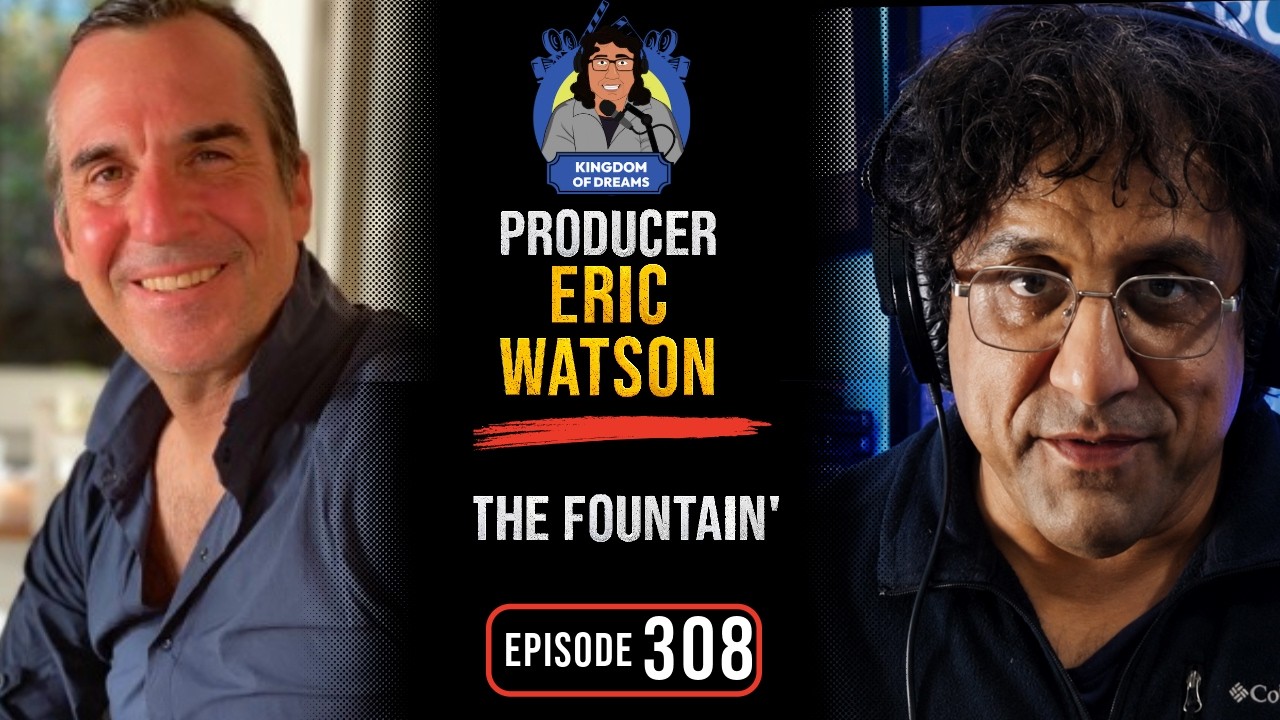
Producer Eric Watson', 'The Fountain'
Clips and Shorts from this episode
About this episode
🎙️ On this episode of the Kingdom of Dreams Podcast, I sit down with producer Eric Watson to discuss the making of Darren Aronofsky’s epic science fiction drama The Fountain.
Eric shares the remarkable journey of bringing the film to the screen, including its early development with Brad Pitt attached to star, the challenges of a shrinking budget, and how the production evolved into the version audiences know today. We also explore the often-overlooked realities of producing, why it can be one of the loneliest jobs in filmmaking, and the constant balancing act between creative ambition and practical limitations.
Beyond The Fountain, we discuss one of Hollywood’s great “what if” stories: how Darren Aronofsky was once offered Batman Begins, a project that ultimately went to Christopher Nolan, while Nolan had originally been in line to direct Troy.
Eric Watson is an American film producer and screenwriter best known for his long creative partnership with director Darren Aronofsky. A graduate of the American Film Institute, where he received the Mary Pickford Scholarship for Excellence in Producing, Watson helped launch Aronofsky’s career by producing Pi, Requiem for a Dream, and The Fountain. He later produced films including Below, Aftermath, Mercury Plains, and The Bygone, building a career focused on ambitious, character-driven independent cinema.
#pi #requiemforadream #thefountain #darrenaronofsky #films #troy #bradpitt #christophernolan #theodyssey
Full transcript
Automatically generated from the episode audio, so expect the odd misheard word or name. Speakers were labelled automatically. About 9,200 words. Tap a timestamp to play from that moment.
0:00Jawad MirAnd I read online, and please, I know I take everything online as grain of salt…
0:04Eric WatsonYeah
0:04Jawad Mir... So if this is wrong, just let me know. Brad Pitt was involved…
0:08Eric WatsonYep
0:08Jawad Mir... At some point, then he left just weeks before.
0:11Eric WatsonNo, we made Requiem for a Dream, and we got a call from Brad's agent saying Brad watched the movie, walked around the block for an hour and then watched it again, and really wants to do something with you guys. And we had just finished the script of The Fountain, so Darren turned to me, and says, "Should we send him, send him The Fountain?" I'm like... We went, actually went to his, house and went over there, and we met him, and we gave him the script, and we talked about it a little bit, and we left. We were on Sunset Boulevard, so we were probably like half an hour from his house, and he, called when we were in the car, and he was just like, "I'm like 40 pages in. I'm crying. I'm in."
0:53Jawad MirHey, Joel.
0:53Eric WatsonHi.
0:54Jawad MirHi, Eric. How are you?
0:55Eric WatsonGood. How are you?
0:57Jawad MirGood, thank you. You've been super busy, which is good.
1:00Eric WatsonYeah. It's my life.
1:02Jawad MirNo, that's awesome. That's awesome.
1:03Eric WatsonI li… I like your old iPod there. I have one.
1:07Jawad MirYes. It still works, actually.
1:09Eric WatsonYeah, mine does too. I can't always keep all the cables together, but I love it.
1:15Jawad MirYeah. Yeah, I still have music on it from the pirate days version.
1:20Eric WatsonYeah. S… something about having just, like, a small amount of songs like that was great.
1:25Jawad MirYeah. Yeah. Yeah.
1:25Eric WatsonAnd I really like the interface too. I miss it.
1:29Jawad MirYeah, 100%. Thank you so much for joining, Eric. I appreciate it, man.
1:33Eric WatsonYeah. Happy to. Happy to.
1:37Jawad MirI, re-watched The Fountain. It's been 20 years, actually, this year.
1:41Eric WatsonOh, right.
1:42Jawad MirAnd, after a long time, and I was just trying to remember how... What did I feel about the film at the time… ... When it came out. But I certainly enjoyed it and understood it a lot more, maybe not entirely. It, you know, it was a very experimental film, experimentational film from the looks of it, but in terms of how the story pans out and the characters and the way the cuts are between scenes, it was just so seamless. I just wanna put that, put that out there before I start my round of questions, unless you have something to say.
2:20Eric WatsonYeah. No, I mean, one thing that we observed, which is not the best for box office, is that it's a movie that really works the second time you see it. You know, and we found that with most people. They'd watch it a second time and go, "Wow, I didn't get it, and then I saw it a second time and it really made sense to me." And, you know, a… again, that doesn't work for box office, numbers, but it definitely, is a quality of the film, for sure.
2:45Jawad MirYeah. No, 100%. So I'm gonna just ask questions and please…
2:50Eric WatsonYeah
2:50Jawad Mir... If you feel like just going on, that's awesome. Don't worry about it. You know, it's a film that doesn't really explain everything to the audience, as you just mentioned. But as a producer, what convinced you that this was a story worth fighting for? You know, besides your relationship with Darren, professional and personal, what was there that made you feel that, "You know what? We gotta make it like this as a producer and make sure Darren gets his vision across to the screen for the audience"?
3:20Eric WatsonA lot of ways I can go because the, it was a, it was a big endeavor to make the film and had a lot of challenges, but I'll just give a little bit of the genesis.
3:30Jawad MirSure
3:30Eric Watson... We were… we had read a book, a short story by Roald Dahl called The Adventures of a Henry Sugar, which is kind of a box within a box story. There's a story within the story in that. ... And it's a great short story. We actually talked to Lucy Dahl for a while about potentially making it into a movie at one point, after The Fountain. But we kinda liked that structure, and so we said, "L… let's do something like that, but let's do a box within a box within a box." And so we kinda mapped... The very first thing we had was like, you know, storyline and then going on to another storyline and another one then back up and then back up in a very kind of linear fashion. And so then we... What are the three storylines and how they intercut was kind of the next question. And we were,.. We went to, the Yucatan in 2000 for the, for the turning of the millennia, and we got inspired to like, "Oh, the Mayan stories are really interesting and let's, you know, let's dig a little deeper here." so we made a decision to set part of it in that world, with the conquistadors and the Mayans and then we, kind of decided to do something way, really in the far future and then present day to kinda anchor the story.
4:56Eric WatsonSo we had those kind of three places that we started and then, and, n… n… you know, then we, then we started working at the theme of, mortality. Darren's parents at the time were dealing… both of them were dealing with, cancer, I believe.
5:16Eric Watson... And, you know, we had already kind of dove into the… I think with Pi we had dove into kind of the big questions of what is, what is the secret of the universe, kind of what is the code of the universe. And with Requiem we kind of dove into the heart of love, you know, and w… and the compulsions that we have in our lives around it. And so mortality was another big one that we were just as young men, curious about exploring and one of the unanswerables, you know, in our lives. You know, I think all religions are built upon the questions that every generation has. And we had those questions and we were just seeking ways to explore them as filmmakers. And… So, you know, we, th… we hit on this kind of hybrid fountain of youth concept with the conquistadors, and obviously there was the myths in Florida at the time around the fountain of youth.
6:17Eric WatsonAnd then, you know, and then, and then there's the whole longevity movement, in the world and ended up making this show, "Limitless," with Chris Hemsworth actually recently that explores longevity. And, so it's all, you know, it's… we know that's kind of a popular theme in the world and people, you know, people think about these things. So we really, grounded it, you know, in a scientist and, our, a college roommate of or friend, roommate of Darren's, Ari Handel, w… was just finishing his, PhD in, neuroscience at NYU. And we basically... He's one of the smartest people that both of us knew, and we kind of took him out of that and got him involved in "The Fountain." He still is working with Darren now. You know, we're like, "W… w-we got to get you to stop operating on monkeys. It's not good for your karma," you know?... And he kinda came on board with "The Fountain," so he… we had an expert in the story building with Ari and, yeah, we just f… we just found with those kind of that structural approach, that there was something,..
7:32Eric WatsonYou know, at the time, and I think still to this day, you know, Darren was constantly looking, or until recently, looking to, push the boundaries of filmmaking, and part of that is with story. And what happened in the process pretty quickly was we realized that it'd be… it just became… made more sense to kind of cut back and forth between the time periods more than the structure I just said, and so the…
7:56Eric Watson... The story evolved pretty quickly into a version of what it is now. And so yeah, I just felt like, you know, we had taken, we'd taken "Pi" and then we had, a one-person subjective story and made a story with "Requiem for a Dream" of four characters sub-subjective. Again, we took that same concept and put it in four characters. And now we were gonna kinda put down some of those visual styles that we really made popular with, the snorricam moving around and the, hip hop montages and the cutting in those two movies and we're going, "Let's put those down and let's, let's go further as filmmakers. Let's push ourselves further." We really felt this was the vehicle to do that with. And at that time, Darren was starting to get a lot of offers to do like "Batman" and all these other big movies, but, this was the movie he wanted to make and, it kinda became a passion piece for us. So we just went for it, and, making a big expensive art movie is not something that Hollywood is built for.
9:00Eric WatsonSo it took a lot of drive to move through all the hurdles that then ensued in the process.
9:08Jawad MirWhen you say "Batman," you mean "Batman Begins"?
9:12Eric WatsonWe… So "Batman" at that point was, like the George Clooney version had just come out.
9:18Jawad MirOh, I see. I see. Okay.
9:20Eric WatsonAnd we were like, "Okay." They asked us to do "Batman." They wanted to reinvent the franchise. They… Lorenzo di Bonaventura at Warner Brothers at the time basically said, "I wanna do with you guys what I did with the Wachowski brothers" at the time. And, you know, give you more money and go bigger and do a bigger vision. So he really saw it in "The Fountain" and we saw in "The Fountain" like that kind of like next step for us.
9:47Eric WatsonConceptually, not in a…
9:49Jawad MirSure
9:49Eric Watson... Ar-arrogant way, but just as artists ourselves. So we had a studio head who believed in us and, you know, he was like, "Want us to make 'Batman?'" We said, "Well, if you're gonna make 'Batman,' you gotta really reinvent it because you've taken it into this place that nobody really wants to see right now." so we brought him Frank Miller, Frank Miller's "Batman."
10:12Eric WatsonAnd we actually had Frank write a script with Warner Brothers simultaneously as we were making "The Fountain." and we just said, "You have to do this really… We have to go really gritty now, you know, more realistic." and what happened with that ultimately was we got to the place where, Lorenzo's boss, Alan Horn, who was running the studio, said, "I can't..." We brought, we brought them an R-rated script and, Alan said, "I can't do an R-rated script of 'Batman' because of the shareholders." They were dealing with AOL at the time. It was complicated for them. And we're like, "Well, make the R-rated version, make your PG version somewhere else too, and then you'll have both." And he's like, "No, the kids are still gonna see the R-rated version and we'll, we'll just get in trouble, so we can't do that." And maybe like, maybe like a year later, Chris Nolan reached out and said, "Hey, they want me to do this. Is that cool?" And we're like, "Yeah, go for it." And he did a great job, with his version of "Batman," which was, not as dark and gritty as ours, but definitely pushed it that direction.
11:13Eric WatsonLike, he had the same…
11:14Jawad MirYeah
11:15Eric Watson... Influence, and he did a great job. I would say the "Joker," was much closer to what we wanted to do with "Batman" back then. And that… ... Was written by our friend Scott Silver, who we had gone to film school with. And he, you know, he's very intimate with the script we were writing at the time. And so when I saw the "Joker," I'm like, "Oh, this is the world that we were gonna go for then," but it was just a different time. You couldn't do it yet.
11:41Jawad MirYeah, "Joker" was a phenomenal film. Even the new, the, "The Batman" by Matt Reeves with Robert Pater. Robert... Was it Pater, Patrick? Robert Patterson? Patterson. Patterson.
11:51Eric WatsonPatterson, yeah.
11:52Jawad MirPatterson. That's, that's great too and, you know, you talked about religion, right? So when I was watching it, I was thinking about religion because Adam and Eve is this story as old as time. It's in Judaism, it's in Christianity, it's in Islam. Was there any sort of…... Consultation from a religious standpoint that you did? I know it, like on a film like Prince of Egypt, for example, right? The story of Moses, where they had…
12:18Eric WatsonYeah
12:18Jawad Mir... Tons of people from all three different major faiths to provide their sort of, you know, point of view or consult. Did you guys do anything like that?
12:28Eric WatsonIn the marketing stage, there was some push to do that with us, but we didn't, didn't… it didn't gra… gain a lot of traction. You know? For us, it wasn't about the, you know, organized religion wasn't as compelling to us as…
12:41Eric Watson... The deeper spiritual concepts that are contained within the world of religion. So, you know, for m… it was the philosophy and the spirituality, that religion deals with that we were, that we were motivated by. Organized religion itself was not something we, you know, really had a strong affinity to.
13:01Jawad MirSure.
13:02Eric WatsonYeah. I'd say with Noah, that happened more of course.
13:06Jawad MirYeah. And I read online, and please, I know I take everything online as grain of salt so…
13:11Eric WatsonYeah
13:12Jawad Mir... If this is wrong, just let me know. That Brad Pitt was involved…
13:17Eric WatsonYep
13:18Jawad Mir... At some point, then he left just weeks before filming. If that's something you're willing to share, and I know there's a lot of sacred stories that people like to sort of hold because the family in the industry…
13:28Eric WatsonYeah
13:28Jawad Mir... I would love to hear that.
13:30Eric WatsonYeah. I mean, I'll give, I'll give the…
13:33Jawad MirOverview?
13:34Eric WatsonThe, yeah, I'll give you the overview, basically. So…... You know, we made Requiem for a Dream, and we got a call from Brad's agent saying, "Brad watched the movie, walked around the block for an hour, then watched it again, and really wants to do something with you guys." And we had just finished the script of The Fountain, so Darren turned to me and says, "Should we send him, send him The Fountain?" I'm like, "Why not?" You know? He wants to do something. It's Brad Pitt. Like, what are we gonna lose? And we sent it… we went, actually went to his, house in, at that time he had a house in Bronson Canyon in Hollywood, and we went over there, and we met him, and we gave him the script, and we talked about it a little bit, and we left, and we were driving. We were staying on the west side of LA, and we were driving back, and we got to, like... We were on Sunset Boulevard, so we were probably like half hour from his house, and he, called when we were in the car, and he's just like, "I'm, like, 40 pages in. I'm crying. I'm in." And just like, Brad Pitt wants to do a movie. You know, what do you, what do you know... Wh… wh… what do you do? You're happy.
14:34Eric WatsonAnd so we began to... You know, and then we went to Warner Brothers, and we said, "Here's the script, and we have Brad Pitt." And they're like, "What are they gonna say?" You know? They're like, "Great. You got Brad Pitt. Let's go." and we already had their… you know, we already were kind of had their,.. You know, we were engaged with them already, so it was a fairly easy thing to set up with them. And right away, the studio had one point of view, Brad had a point of view, and we had a point of view, and we got caught in an extended development, triangle. While simultaneously, we're pushing towards production. We said, "We got Brad. He's got windows. He's got these dates. We gotta make those dates. Let's go." And so we, started to make the movie in Au… in Australia. Warner Brothers was making Matrix two and three in Australia at the time, and a lot of other big movies were being made there because of tax incentives.
15:39Eric WatsonSo they're like, "Can you make this in Australia?" We're like, "Well, it's set in the Mayan world, but if this was gonna get made, let's go." And we went down there. We got an amazing,.. We got Grant Major, the production designer from Lord of the Rings, got on board, and we started building sets in the Gold Coast in Australia and, you know, moving towards making the movie, but we were never quite worked out this development piece with these three points of view and, went through many iterations of the script, many conversations. We're, we're moving towards production. We were spending a lot of money. We basically spent, $20 to $25 million, and we were about 12 weeks from shooting. And, I r… I remember I was in, my one day off was Saturday, and my partner at the time had gotten, moved to Aust… quit her job, moved to Australia, with me. And, w… with the one day that I had off, you know, I w… I… she wanted to go to a petting zoo and look at koalas.
16:42Eric WatsonSo we're looking at koalas, and I get a phone call from Brad's agent saying, "He's gonna… he's out." so I had to tell her right away, "You just quit your job for nothing." but, you know, we basically packed up and flew home and, you know, once they're out, they're out, you know? And, you know, all that, all that money was wasted, essentially. And Warner Brothers did a deal with Brad, got him to do Troy. He basically did Troy for this reason. And, you know, did a deal with us and said, "We still wanna make this movie," and we said, "Great." And they didn't really expect us to come back to them. And a year later, our production executive, Jeff Robinov, had been moved up to the head of the studio a year later. Lorenzo had moved on to, produce movies. And a year later, we basically spent a year wandering around Manhattan, not really doing anything, just trying to figure out what we were doing, and after a year, I'm like, "Darren, you gotta make a movie.
17:46Eric WatsonLike, what are you doing?" And he's like, "I wanna make The Fountain." It's like, "What's it gonna take?" I'm like, "Well, we're gonna have to make it for less," 'cause at that point it was like $70 to nine, $90 million budget, and we have to do it for less.
17:57Jawad MirOh.
17:57Eric WatsonAnd he said, "Well, what's that gonna take?" And I gave him, I gave him, like, my notes of what it would take to reduce the budget. He gave me a draft like a week later, that was everything it needed to be, and more, kinda more focused on the love story. It initially had a lot more battle scenes in it and things like that. This was much more of a love story. Which is what the studio had wanted. And I'm like, "Great," you know? "You… you've done what I've asked." And so, you know, let's... Took it to the studio, got a budget done that was like $30 million and, took it to studio and they're like a little surprised, but they're like, "Okay, well, you… you… you need a movie star." And so we started sending it out, and at that time, Hugh Jackman had a sh… a one-man show in New York. And we went and saw that and were really blown away by this singing and dancing performance that he had in the show. He's incredible performer.
18:57Eric WatsonAnd, we met with him and gave him the script, and he said he wanted to do it almost right away. And so we had Hugh Jackman, went back to studio. We got Hugh Jackman and, you know, we have a much smaller budget, and they're like... You know, we kind of put them in a situation they couldn't say no to because the… Alan Horn, the head of the studio, had promised us that in this deal that we had done with Brad when he left, that he would still make the movie. And we literally had to go sit down with him and say, "You gave us your word, and we got a movie star, we got a budget, we got… we're ready to go." So we mo… made the movie in Montreal. You know…
19:39Jawad MirOh, really?
19:40Eric WatsonYeah. Maybe a year later. We flew a bunch of Mayans up there, who'd never seen flush toilets and things like that, so crazy. Definitely had never seen snow. And…... And we had a wonderful experience making the movie in Montreal, mostly on set, and, with Hugh, with Hugh and, Rachel Weisz. And, yeah, that's, that's basically the Brad story. You know, the overview.
20:08Jawad MirThat's awesome. It's interesting that Christopher Nolan... He… Darren was asked to make Batman initially, but the whole grading thing and then Christopher Nolan called you guys and he made Batman Begins. He was, he was attached to Troy originally. I just found this out when he was doing the whole press tour for, Odyssey.
20:27Eric WatsonYeah.
20:27Jawad MirAnd then he made Batman Begins and how everything is so connected. It's awesome. And, you know, Montreal is one of the, in my view, being a Canadian, the best place to make a film in Canada from a standpoint of appreciation and understanding of art because…
20:45Eric WatsonYeah
20:45Jawad Mir... They're French. You know? They get it more than anybody else in Canada. And, I really admired the fact that the film was very contained in terms of characters. Right? And it was… it really gelled everything together because the type of the way the story was told with so many cuts back and forth, if there was a battle sequence, which you were talking about, maybe the cutting had been different, I think that would have probably deterred the audience from the love story, and I think I'm glad that you guys were able to…
21:16Eric WatsonYeah
21:16Jawad Mir... Pull the budget down significantly and tell the story that you wanted to tell.
21:20Eric WatsonYeah, I mean, ultimately it's a necessity of budget, you know?
21:23Jawad MirBut it worked out in my view as an audience member.
21:24Eric WatsonYeah, no, I agree. I think the love story was the strongest story we had. It's interesting what you were just saying about Troy and Chris. You know, when this whole thing was happening with Brad, the studio said, "Do you guys wanna make Troy?" You know, "Darren, do you wanna make Troy?" And he said, "No, but I'll make The Odyssey." It's what he said to them, and they laughed at him.
21:41Jawad MirReally?
21:42Eric WatsonYeah.
21:43Jawad MirWow. Wow. That is awesome.
21:47Eric WatsonYeah.
21:47Jawad MirThat is so crazy.
21:49Eric WatsonLike, I haven't seen The Odyssey yet, but it's... I can't wait. I'm, I'm gonna go see it in 70 millimeter next week or so.
21:55Jawad MirYeah. We, over here, the… we have two cinemas, and they're sold out for the next month in 70 mil.
22:01Eric WatsonYeah. I haven't, I haven't been able to get a ticket yet, basically, but I will see it.
22:04Jawad MirYeah. Yeah. You know, protecting Darren's vision, you know, that's, as a producer…
22:12Eric WatsonYep
22:12Jawad Mir... Your job, essentially.
22:14Eric WatsonYep.
22:16Jawad MirYeah, you talked about the budgeting cut down and all that. Now the film is in production. You know…
22:20Eric WatsonYeah
22:20Jawad Mir... A lot of stuff is happening, and it's in…
22:22Eric WatsonYeah
22:22Jawad Mir... Post. Executives seen it. How much of a battle that you had to do once there was some sort of a, you know, daily viewing or a cut, rough cut viewing with the executives, if there was anything like that?
22:35Eric WatsonOh, yeah. So when we finally had a cut ready, we were cutting in New York, in Midtown and, Jeff Robinov, the head of the studio, was in New York, and we showed the s… the film to him, in a little screening room at our editing suite. And, yeah, he walked out and he's, you know, he didn't really have any notes because the way… 'cause the complexity of the movie, it's very hard to give notes on. You know? So it was just like, basically it is what it is. Like, I… he's like, "I'm, I'm not sure what to do with it," but it's, you know, it's... It… how do you give notes on that movie, you know? It's, you can't, you can't rechange something. Everything falls apart. So, it was one of those situations where we actually did not have a big, struggle in post with them because it's Darren's vision. Like, you can't, you know... Y… you couldn't really get in there and mess it up as a studio executive on that one. And Jeff wasn't like that either. Jeff was, Jeff was a great exec.
23:35Eric WatsonSo yeah, that's pretty much what happened. There was nothing they could really say. You know, they had some small notes, but they were... I mean, I don't even remember what they were. They were so small. They weren't…
23:43Jawad MirYeah
23:44Eric Watson... They were nothing. We got no post-production struggles. It's clearly a director's vision. There's no, you know... Y… you can't alienate the director when everything hangs on the director that much, so you have to just kinda do what you got with what you got.
23:57Jawad MirYeah. Yeah. And the, you know, visual effects in the film, like the whole future element, right? I… even though that was 20 years ago… ... I mean, they're, they're darn impressive, right? Like, not for a second I felt I was watching anything that was computer generated or anything like that. Talk to me about that process the futuristic sequence of how, what the vision was and how it came close to what Darren wanted or exactly, and were there any challenges in pulling that off? Because keep in mind, it was 20 years ago.
24:30Eric WatsonYeah. You know, we no… we're noticing that CGI dated very quickly. And we decided to do all photo real textures. So there's no CGI in the movie.
24:43Jawad MirYeah.
24:43Eric WatsonThere's, there's a lot of computer…
24:45Jawad MirYeah
24:45Eric Watson... Work in the movie to put, stitch things together and do compositing and things like that, but there's actually no CGI in the movie. And we found this, photographer, Peter Parks, in England, who, did this micro photography with yeast, and it was inc… it's incredible. He's... And Peter, he also does underwater photography. But just one of the most amazing photographers in the world really. And, we called him up and we basically took these yeast imagery that he did, and we just kind of colored it and made it work within, you know, a space is all created from a Petri dish in our movie.
25:24Jawad MirYeah.
25:24Eric WatsonSo yeah, we had to mandate that every texture is photo real because, so it wouldn't date as fast ultimately, and that created this very surreal space world that he's in when he goes into that world.
25:38Jawad MirOh, it's fantastic.
25:39Eric WatsonYou could e… even the texture of the spaceship, you know, we were using like imageries of bubbles to get those text…
25:50Jawad MirYeah
25:50Eric WatsonYeah.
25:52Jawad MirNo, that's, that's awesome. And going back to Christopher Nolan again, it kind of, I mean, y… your film came way before Interstellar did, but that whole sequence in Interstellar where they're going towards a black hole and…
26:02Eric WatsonYeah
26:02Jawad Mir... The whole orang… orangey, yellowish kind of a, you know, space, it reminded me of that as well, which was really cool. And I also felt that Hugh Jackman and Rachel were perfect for the film. Not… nothing to take away from Brad Pitt, right? But his performance was remarkable because he was... Even though Rachel was there too, but he was the main glue through all three different time periods.
26:28Jawad MirIf you can…
26:28Eric WatsonYeah.
26:29Jawad MirGo on.
26:31Eric WatsonNo. No, so you were saying.
26:33Jawad MirI was just gonna ask you i… if there was something that you remember, I know it's been a long time, what was the process of Hugh's performance? I mean, I know he's a versatile and amazing actor, but to be able to play three different characters in, essentially, in three different time periods. If you can give me an example or whatever else you were gonna say, you can add to that, please.
26:54Eric WatsonYou know, when Hugh said yes, there's a... Part of why he was saying yes is that there's a lot for an actor to work on there. And, you know, actors like challenges, so one way to get a big actor is to bring them something that they're gonna, you know... Not all actors, but a lot of actors, good ones, wanna, like, push themselves, and this was clearly an opportunity for him to push himself. And if you're gonna do that, you d… you have to fully trust your director ultimately. You know, it's a, it's a really powerful, intimate relationship between a director and an actor which involves trust. If the actor really trusts the director to make sure that nothing, that what happens in the edit is gonna be good, then they, then they have a lot of space to go. And so Hugh a… Hugh and Darren worked very hard for m… several months, in preparation of that, role. And whether it was doing Tai Chi or, yoga or, you know, all sorts, you know, readings, you know, going to the science labs or, you know, there's a lot of research that was done and then, and then there was a lot of rehearsal that was done with just the two of them, really working out this character and working out the method.
28:02Eric WatsonSo by the time Hugh got to set, you know, the… their, dynamic was in place in a very powerful way and so, n… you know, I think that, he just really trusted Darren, he delivered. You know, Darren likes to do, likes, you know, I think 12 takes-ish average. You know, he likes to get a good amount of options for the edit, for the edit room. We shot on film, so it was different back then.
28:34Jawad MirYeah.
28:35Eric WatsonAnd yeah, he would just really work with them. There wasn't a lot of tension between the two of them. And we definitely had some hard days that were just around the logistics of what we were dealing with, and Hugh worked really hard, but he was fully committed, and, you know, kinda gave it his all and Darren's, you know, very good at knowing what he wants. You know, I... In film school, one of the reasons I started to really work with Darren was he, I saw he was a director that shot to edit. He really understood the edit as he was shooting something. And not a lot of directors actually really can see the edit when they're shooting. And so when he's shooting a scene, he's shooting a take or shooting, you know, having an actor deliver a line, he's thinking about how that's gonna cut together as he's shooting it. And so yeah, I think it was just a strong bond between the two of them and I, and there's a degree that's kind of emerged as one of Darren's calling cards is, that, you know, strong performances that he gets out of actors.
29:37Jawad MirYeah. And I'm, I'm glad you talked about, and, this is nothing against the directors who don't see the edit because they probably haven't been exposed to it as an editor. You know, I totally relate to that because I've done, you know, from behind the camera, tons of editing and, we were just in, Poland and Jordan, I don't know if I'd mentioned this to you last time, scouting for my next feature, and literally, you know, even with a script, like I'm already envisioning how these things are gonna get spliced together if it is, if it's gonna be just like, you know, one long take…
30:10Eric WatsonYeah
30:10Jawad Mir... Or if it is gonna be cut.
30:11Eric WatsonYeah.
30:11Jawad MirAnd it makes a huge difference. It really does.
30:14Eric WatsonYeah.
30:15Jawad MirIt, you know, it's, it's awesome.
30:17Eric WatsonThere's different, you know, there's just different styles and different ways of working and…
30:20Jawad MirYeah
30:20Eric Watson... And directors have different strengths. But that was the, that was the strength that he had. Even before he was really adept at working with actors, he Shot to edit, you know, and then he really, he really developed his, skill of working with actors.
30:34Jawad MirYou… as a producer, right, on, The Fountain, you're the director… you're making sure the director's vision come to life, you know, all the logistics and all that other stuff that goes on behind the scene that's not director's problem, that's your problem.
30:48Jawad MirIf you can think of it, I'm sure there were dozens of days, 'cause every set has ridiculous amount of problems, unexpected things that come up. What was something that stands out to this day that came up during the production, and how you overcame that as a producer, making sure that everything goes smoothly for Darren?
31:07Eric WatsonWe had a great crew, and so, you know, we didn't have a lot of production challenges. It was cold. We shot in the winter in Montreal, so like sometimes we'd shoot on the streets and the cameras would freeze. Like it was really cold.
31:27Jawad MirYeah
31:27Eric Watson... And so, you know…
31:28Jawad MirWelcome to Canada
31:29Eric Watson... There definitely some hard n… hard nights like that, you know. But, you get through them. I don't think we... I mean, if we went over, we went over one day. It was… we were pretty much on schedule. Yeah. I mean, and, but it was a, it wa… it wasn't… I wouldn't say it was an easy shoot, but it was a fairly smooth shoot. I think that there was a lot of,.. We did a lot for the money that we had, and when you do a lot for the money you had, there's a lot of pressure on the key creatives and the relationship with the kinda line producer, can be,..
32:06Jawad MirTroublesome?
32:07Eric WatsonThere could be, there could be friction there.
32:09Jawad MirYeah
32:09Eric Watson... M… because they're, they're trying to get the best for Darren. Darren's pushing them to get the best, and then they're, and there's somebody who's trying to maintain that within a budget, of course. And, m… so we had Ian Smith who, you know, is w… at that time, was certainly one of the top three line producers in the world. Incredible line producer. But he, but he's very strong. And then James Chinlund, our production designer, it was his first big movie. He had done Requiem for a Dream, maybe like one other thing, but this was like a big jump for him. Now he's one of the biggest production designers in the world. But, this was a big jump for him, so there was a lot... We got a, you know, very strong, art director to work under him to work with the budget. So James was really... It was a lot of learning for him in the art department. The art department, you know, was a pretty serious art department endeavor to do three worlds. So there was just a lot of like l… long days, hard work to kind of get through that process. And then, and same with, you know, same with the visual ambition with Maddie Lebatique.
33:13Eric WatsonLike the set we had for the ship was massive and, you know, it… to light it and not have a bunch of lights on the set was, you know, a... It was certainly a certain kinda challenging lighting job, and Darren really was asking that it set get lit, and then he could just work. And that's not easy for DPs all the time. You know, DPs wanna constantly tweak between every shot and…
33:38Jawad MirOh, yeah.
33:40Eric WatsonDarren's like, "When you're done, Maddie, I'm in and you're out," you know? And so, you know, there were definitely like, there was, I'd say, healthy friction, you know, between Darren a… and the, and the department heads, and the department heads and the, and the line producer. And, you know, my job is to make sure none of that leads to something, you know, destructive, but we, but we can stay focused on what matters.
34:07Jawad MirYeah. You mentioned DPs. My colleague for the last twenty years, he's my DP, and anytime we're working on a project and, you know, he would come up with all these wild ideas, and it took me like five, six years to realize like, "Dude, you know, I know you love lighting everything the way you want to, so do I, but you gotta be realistic about things." And you get… we get excited, right? Like as…
34:27Eric WatsonYeah
34:27Jawad Mir... Even as directors and set decorators. But it is such a cool thing to go through that and then come down to the earth and think, "Okay, now we gotta think, you know, properly and rightfully so it fits in the budget." I wanted to talk to you about, you know, as a producer, I think, you know, it's one thing for a director to bring his vision to life on the set. For everybody, it's a really hard job. But for producer, I think at times it could be harder. Not trying to draw any comparisons.
34:58Jawad MirBut you have to be tough on the set. You know, you have to make sure that everything, you're, you're not… you're getting... You're… you have a commanding sort of approach towards everybody. And any film that you worked out throughout your career, has there been a moment where you felt extremely vulnerable, but you did not want to bring that out on the set because it would, of course, affect the entire set?
35:20Eric WatsonYeah. I mean, the producer's job is a lonely one, because everybody comes to you with their problems, but you have nobody to go to.
35:27Jawad MirYeah.
35:28Eric WatsonAnd, so, you know, I think that's… I think what you just described is the nature of the job ultimately. Like I'm, I think, I feel like I'm constantly in that position, you know, of having to, be, compartmentalized with information ultimately because it… 'cause, you know, how information moves can... You need to keep the information moving in the right way, and you need to be careful with it, and you need to make sure that y… you know, you're not sinking the ship with information. And so there were, you know, many moments where in my career... But certainly on The Fountain. I mean, The Fountain was so hard because it was a big art film, and the studio didn't really wanna make a big art film. So it's really my interactions with the studio where I had the most vulnerability, and I was constantly just kinda like having to keep them over there and keep Darren over here, you know, get to the finish line despite this kind of…...
36:29Eric WatsonTension because when you have a, you know, when you have $30 million on the line, it's, it, the, you know, big budgets are not something to seek out.
36:38Jawad MirOh, yeah.
36:38Eric WatsonBecause they create, they create a lot of pressure, and that pressure is, you know, affects the ar… the artistry ultimately. And that's without…
36:47Jawad MirI al… I always wonder, I always wonder i… if... Obviously, you've seen the movie Tropic Thunder.
36:52Eric WatsonYeah.
36:53Jawad MirYou know, where Tr… Tom Cruise's character, right, the studio executive. Is it... I'm pretty sure it comes close because I've seen other mo… shows like The Offer, which was, like, behind the scene…
37:03Eric WatsonYeah
37:03Jawad Mir... Godfather. Does it, is, does it get like that at times? I'm not asking for specific examples, but…
37:07Eric WatsonOh, yeah
37:07Jawad Mir... Just to... Yeah.
37:10Eric WatsonDefinitely. It's, I mean, it's a different world now. But Hollywood in that time was, you know, still had remnants of the Hollywood from before, and, it's a cutthroat world, you know. And the, and the ig… the ex… studio executives are under tremendous pressure.
37:28Jawad MirYeah.
37:28Eric WatsonYou know, the agents have a certain role in that whole,.. I don't know, what wa… what was the,.. There was a, I'm totally blanking. There was a show about the White House written by one of our great American…
37:45Jawad MirOh, The West Wing, Aaron Sorkin.
37:48Eric WatsonYeah. Oh, Aaron, so Aaron Sorkin, Aaron Sor… what was Aaron Sorkin's, the Facebook movie he made?
37:53Jawad MirOh, The Social Network.
37:55Eric WatsonSocial Network.
37:55Jawad MirNow they're making a sequel, a new sequel.
37:57Eric WatsonAnd West Wing, you know, those are really stories about Hollywood, right? If you watch those, if you know Hollywood really well and you watch those shows, you're like, "Wow, he's getting all his characters and inspirations in there, all the dynamics from Hollywood." And I, and I found those shows were actually some of the most accurate depictions of what it's actually like in Hollywood. And I remember watching the S… The West Wing, and I remember watching, the Fa… the Social Network and being like, "Wow, this is, this is…"
38:25Jawad MirInteresting.
38:25Eric Watson"... This is like watching my nightmares in this other way," you know. The thing I was gonna say before when you mentioned Interstellar, you know, Chris, Darren, and pretty much every other filmmaker owes so much to Stanley Kubrick and 2001 when it comes to science fiction. And so one thing we were trying to do with The Fountain was where do we go from 2001? Where do we go from The Matrix? Like, those have been done now, right? And so with sci-fi, like, m… those are pinnacles of what sci-fi can be, and they're, they're rarely exceeded, you know. And so we were just trying to put, go somewhere really beyond 2001 in some way, shape, or form, which is, ambitious. But 2001 was a huge reference and inspiration for us, and even in terms of the lighting and everything. Like, the lighting in 2001 is unbelievable. You know, un… unbelievable ambition in that movie. And yeah, that's, that's, I just wanted to reference that. Ku… Kubrick…
39:20Jawad MirNo, I…
39:20Eric Watson... Saying that
39:21Jawad Mir... I appreciate that, and you're right about, 2001: Space Odyssey. I mean, even as a film, but in terms of lighting, considering it came out, what, almost, what, '68, '69, I think it was.
39:30Eric WatsonYeah.
39:31Jawad MirAnd, a… and it's crazy, right? It's how... I mean, even Interstellar, the, was it the character T-80, the robot, was inspired by HAL, I think. I think that's what it was called.
39:43Eric WatsonYeah. Yeah.
39:43Jawad MirBut yeah, no, it's, it's an amazing piece of film. And the problem with The Fountain is, not that it's a problem. Now, if I recommend that movie to people to watch it, they'd be like, "What the hell are you smoking?" Like, "Why would you tell me to watch this film?"
39:58Eric WatsonYeah. Totally.
39:59Jawad MirRight? Because it's not your typical, your, you know, mainstream type of film. But it is truly an amazing film. And I know you guys didn't really intend it, you know, from a s… although there was spirituality in there, but it wasn't, like, you know, in a very intended way. I still felt it. I still totally felt it, and I thought, yeah, it was, it was just brilliantly executed from production design to visuals to performances and keeping things contained. That's what my favorite part about the film was.
40:31Eric WatsonThank you. It's, again, sometimes by necessity, you know. I think when we last spoke, I talked a little bit about, you know, your challenges and your obstacles are the things that push you to be more creative, and that's why, like, I think lower budgets often make better work. Because when you have the freedom to do whatever you want, you have no limitation, then you have no challenge, you have no obstacle. And so it's, it's always our challenges and obstacles that force us to think harder and deeper and push our creativity.
41:03Jawad MirI couldn't agree with you more. I couldn't agree with you more. And those films have a tendency of profiting as well. I mean, if you're making a movie for $2 to 3 or $5 million, I mean, look at Obsession, right?
41:15Eric WatsonYeah.
41:16Jawad MirLook what it's done, right? So it has a tendency of if it, if it get, if it connects, then it's easier for it to make profit, as opposed to a $250 million film.
41:25Eric WatsonYeah.
41:25Jawad MirYou know, that's tough to, tough to, break even or even profit.
41:29Eric WatsonHuge risk. Yeah. Yeah.
41:30Jawad MirYeah. Amazing. And just lastly, I know you worked on this, AI series…
41:35Eric WatsonYeah
41:36Jawad Mir... Or anything else that you're sort of working on. Would love to hear about that.
41:41Eric WatsonYeah. You know, Darren started a studio, I think last year or the year before, called Primordial Soup. And it's, the first goal of the company is ultimately to, make the first, AI film that really stands alone on its artistic merit, not because AI, but because it's good. And that's a challenge. And so this show, we're doing 30 five-minute episodes about the American Revolution, and for us, a big part of it is it's a sandbox for us to explore the medium, to learn the medium, and document the growth of this medium that's emerging right now, or this new tool, let's say, that's emerging. And it's an animation tool ultimately. You know, we're using real actors. We're using real writers. We're just using, to create our visual animations, we're using th… this new computer tool. Well, this, it's computer-generated animation literally. And we're, we're learning how to use it. It's, it's evolving as we're learning.
42:41Eric WatsonAnd it's just been a really interesting experiment with a lot of challenges, and it's very hard to make something good with this tool right now. But, you know, if you go back to the beginning of any evolution in any visual medium, it's like it starts off rough and rocky. And, you know, I'm, I've been very excited to be, you know, kind of at the tip of the spear of this creation in this new medium, e… despite the amount of kind of like... You get a lot of reactions when you're, when you're working with AI in the world. And so, you know, people have this expectation that it's gonna be the same or as good as or whatever as something that's shot on film, and we're just not there yet, you know? So it's like you gotta, you gotta take a breath, take a step back, and look at it for what it is. But that's been,.. It's been really fun to work on it and to lea… I've learned a lot this year, you know? And this tool's here. It's not going anywhere. Either you learn it or you don't, but it's here.
43:38Jawad MirAnd, you know, you talked about the reaction on AI, and I think over the last three, four years, we have all had our reactions…
43:45Eric WatsonYeah. Yes
43:45Jawad Mir... Right, like to a certain extent.
43:47Eric WatsonYeah.
43:47Jawad MirAnd a lot of people have sort of, you know, come around.
43:52Eric WatsonYeah.
43:52Jawad MirAnd do you think in your view as a producer over the years, all the work that you've done and you continue to do so, do you feel that AI films, for the lack of calling them AI films, will be sort of like a separate genre of films in re… and all the stuff that we do now, whether it's animation or live action, will still exist and they'll use AI as tools? Or do you think it will eventually at some point in time completely eradicate the film industry from a standpoint of real people?
44:27Eric WatsonIt definitely won't eradicate the film industry and real people. It's, it's gonna get integrated into the process more and more and more. And, you know, from a visual st… standpoint, from a, the standpoint of creating, you know, pretty much anything you can think of, it's an amazing tool, you know? From the standpoint of, like, great performances with actors, it's not. You know, it's gonna get better and continue to get better that way and, you know, we're gonna see more and more and more AI-generated content. But ultimately, there's no soul.
45:00Jawad MirYeah.
45:00Eric WatsonAnd you, whether you're reading it, like I always notice AI w… writing when I read it right away. And whether you're reading it or watching it or looking at it, you... There's something that you don't feel. And it's, and it's the same whether you're reading it or watching it. It's the same feeling of not feeling this thing 'cause there's this thing that's not there, and what's not there. You know, for lack of a better term, there's no heart, there's no soul, there's no, there's no life in it. So I think there's gonna be a lot of content created this way, particularly in commercials and things like that, you know…
45:32Jawad MirYeah
45:32Eric Watson... Where you can get a lot done very quickly. There's all sorts of use cases for it. But the alchemy of... You know, it's not like theater went away when film came.
45:43Jawad MirYeah.
45:44Eric WatsonYou know?
45:44Jawad MirV… VCR and…
45:46Eric WatsonYeah
45:46Jawad Mir... Yeah.
45:47Eric WatsonLike, but it's also not like stage theater went away, you know? There's still stage theater, and there's…
45:52Jawad MirTrue
45:53Eric Watson... That you can't replace that, you know? And the same thing of being on set and working with actors and working with a crew, it's like what happens in that human alchemy is not gonna disappear, you know? Well, what percentage of what gets made and how that works, who knows? You know, and that's gonna evolve over time. And so I think it's, it... The wise move is to learn this emerging technology as a new thing in the tool set. Just like, you know, I was alive when w… you know, pie was cut on film and, you know, w… with a negative cut. Reckon it was cut with a negative cut. And, you know, and we watched non-linear avid editing come into play and computer editing come into play, and that's the standard now, but it wasn't. And then digital cameras came some kind of around the same time and freaked everybody out and then, and now m… most people use them, you know? But not all the time. With some people, shoot on film, and some people probably, you know, see still cuts on film. So it's like these are just the evolutions in the medium.
46:57Eric WatsonYou know, color film came at one point, right?
47:00Jawad MirYeah.
47:00Eric WatsonAnd the first color films, people freaked out, you know? Th… this is just the same thing. 10 years from now, 10 years from now, we're not gonna be talking about this.
47:08Jawad MirYou know, it's interesting. I was watching a movie. I can't remember what it was, and there was a scene about... It was a comedy movie, and it was a scene about there was cinemas on the road, like a screen, like a multiplex, and across from the road there was a video theater.
47:25Jawad MirAnd people are watching a movie on a TV screen inside this video theater because it's cheaper. So there was this whole movement in the '80s where there were people in Hollywood and other parts of the world trying to get people to leave the VCR and go to the theater to watch…
47:40Eric WatsonYeah
47:40Jawad Mir... The movie.
47:41Eric WatsonYeah.
47:41Jawad MirAnd we're in that same realm right now, right, with streaming and all that stuff. And it's, it's interesting how history repeats itself. But AI definitely is an amazing tool. I mean, one of the major ones that I use, I don't know if you've heard of it, storyborder.ai.
47:56Jawad MirOh, you gotta check that out. It's insane.
47:59Eric WatsonOh. Okay.
47:59Jawad MirIt's really cool. Like, you know, you can throw in a script…
48:03Eric WatsonYeah
48:03Jawad Mir... And it will storyboard pretty much everything for you. Then you can create like animatics, and you can edit them and all that stuff, which is really helpful.
48:11Eric WatsonThe whole process, it's like you're... I mean, literally right now you could do it. It would be clunky, but you could have it generate a script, get your boards animatic done, get all your animation done, get all your voices done, get all your music done. I could probably have a, show you a movie in a week. You know what I mean?
48:30Jawad MirOh, yeah.
48:30Eric WatsonYou know, or less. The, you know, again, it would be very clunky, but it's, it... That is coming. It's here, but it's coming into a way where anybody at home can have an idea, and then we can watch it a couple days later. No question. And those are the tools that are gonna... Those are the software tools that are really gonna catch on. You know, when the software really catches up to the place where you have an idea and a couple days later you can watch it, you know, that's gonna be fun, and that's 100% coming.
49:00Jawad MirHave you ever seen that movie Beowulf by Robert Zemeckis?
49:04Eric WatsonNo. Never heard of it.
49:06Jawad MirSo it came out around the same time The Fountain came out.
49:09Eric WatsonYeah.
49:10Jawad MirAnd it's motion capture. But if you watch the... It's a great film.
49:13Eric WatsonYeah.
49:13Jawad MirIf you watch the imagery in that film…
49:15Eric WatsonYeah
49:16Jawad Mir... It kinda reminds me of what AI is right now.
49:20Eric WatsonRight. Yeah.
49:20Jawad MirLike how close to its re… reality, but it's not. So…
49:24Eric WatsonYeah
49:24Jawad Mir... You know, it's, it's getting there. But no, this has been awesome, Eric. I truly appreciate your time.
49:30Eric WatsonYeah.
49:31Jawad MirYou know, it's been always lovely talking to you, man. Thank you so much.
49:34Eric WatsonCool. Best of luck with your film, Johan.
49:36Jawad MirNo, thank you. I'm... Are you in, LA, right?
49:39Eric WatsonYeah.
49:40Jawad MirI should be there in the next month or two. If you're free, I would love to grab a bite.
49:44Eric WatsonOkay.
49:44Jawad MirSo.
49:44Eric WatsonIf I'm here, let me know.
49:46Jawad MirIf you're here.
49:46Eric WatsonYeah.
49:47Jawad MirI will, sir. Thank you so much.
49:48Eric WatsonOkay. Thank you, Johan.
49:48Jawad MirTake care. Bye.
49:49Eric WatsonBye.