
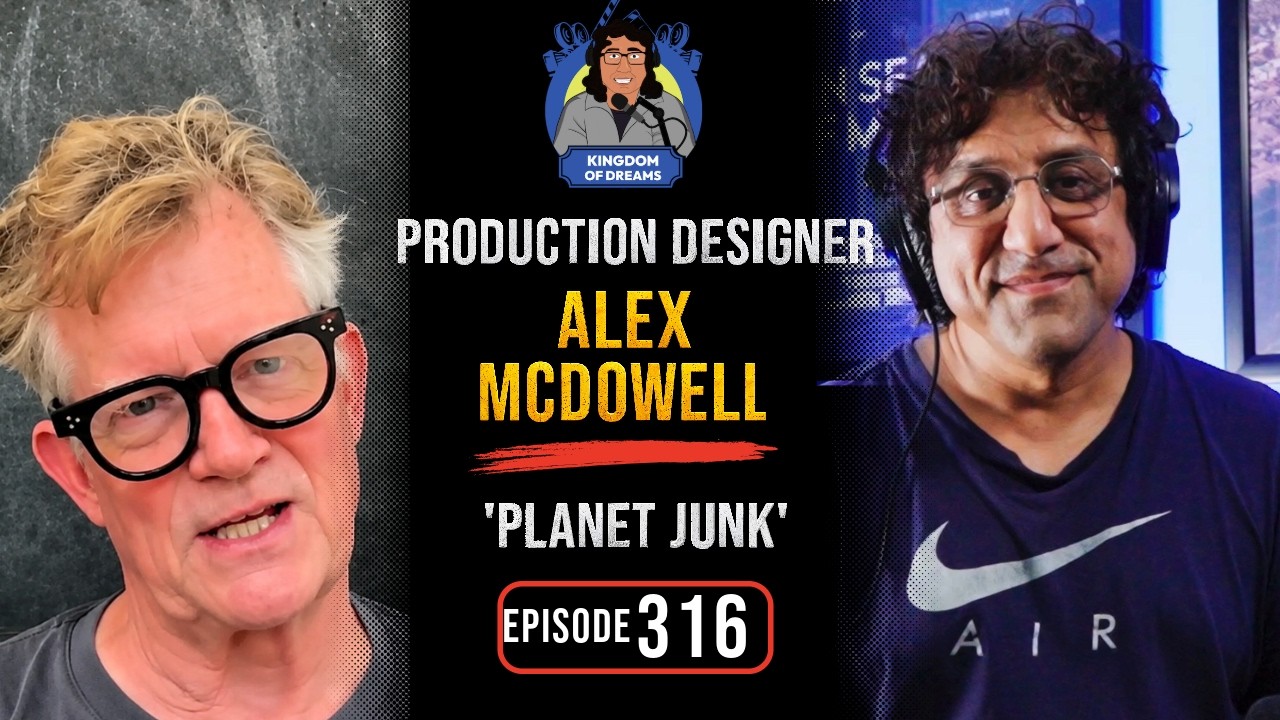
Episode 316 · August 21, 2026 · 51 min
Production Designer, Alex McDowell, Planet Junk
Clips and Shorts from this episode
About this episode
🎙️ On this episode of the Kingdom of Dreams Podcast, I sit down with acclaimed production designer Alex McDowell to discuss his remarkable career in filmmaking and world-building.
Alex takes us behind the creation of films including Minority Report and The Cat in the Hat, exploring how production design helps build entire worlds and shape the audience’s experience of a story. We also discuss his creative approach to world-building and his new venture, Project JUNK.
It’s a fascinating conversation about production design, imagination, world-building, and creating environments that extend far beyond the screen.
Alex McDowell is an acclaimed production designer known for creating immersive cinematic worlds that blend storytelling, design, technology, and world-building. His film credits include Minority Report, Fight Club, Watchmen, Man of Steel, The Terminal, and Charlie and the Chocolate Factory. Beyond filmmaking, McDowell founded the World Building Institute and developed the World Building methodology, an interdisciplinary approach that explores and designs complex fictional and real-world environments. He has also served as a professor at the USC School of Cinematic Arts, where his work has helped expand world-building beyond film into areas including architecture, technology, education, and future-focused design.
#productiondesigner #catinthehat #alexmcdowell #planetjunk #designing #world #project
Full transcript
Automatically generated from the episode audio, so expect the odd misheard word or name. Speakers were labelled automatically. About 6,800 words. Tap a timestamp to play from that moment.
0:00Jawad MirYour background being in films, I mean, you've done so many films, some great stuff. How has that influenced with what you're doing? I mean, I think the answer is quite obvious
0:10Alex McDowellIt's a great question, and I actually don't think it's obvious because I think that film considers the industry to be linear. I think that there is actually great conservatism in the film industry. It's how that sort of process of inception development and marketing works, you know, the through line that the studios drive. On the whole, it's been a pretty strict Victorian industrial system, which is we start here with the, with the script, and then we move into kind of director's, interpretation of the script, and then that moves rapidly into design, and then gradually more and more crafts come on. You're dealing with interesting and stimulating relationships with very different crafts.
1:08Jawad MirI'll let you sort of, since you talked… mentioned it, let's talk about where are you in the project in the grand scheme of things? What are you working on in the integration, and we'll kind of just go from there.
1:21Alex McDowellSo right now, you know, I've been developing for the past twenty years really, a process which has developed from world-building, you know, developed out of production design, was pushed towards world-building, kind of as a natural part of my design process. And became, you know, as I started developing, as I started teaching and started developing new, narrative design or... Sorry, I'll go back. But as I started teaching and s… and developed a new design studio, that idea of world-building transitioned into an idea that world-building was really an under the hood process, that it was a tool, rather than an outcome, which I think has always been true, but it was the focus was on this idea of world-building as a thing. And it really transgen… transitioned into narrative design as the outcome and the process.
2:24Alex McDowellSo world-building at the front end evolving into a process of, you know, inception from the research from all of the information foundational work that you get from world-building into prototyping and into this idea through line of narrative design. And what we discovered was that this was applicable to kind of almost anything. To…
2:53Alex McDowellBut certainly bringing it out of media and bringing it into industry, into the corporate space and into non-profit space and education space, that it was using the capability and the fluidity and the agility of what we have always expected to be the driver in film, to spaces that really didn't know that kind of agility. So anyway, this was fifteen years ago, and it's continued to evolve. In, at USC, it's been a fantastic testing of that. You know, the students, don't allow you to get away with, any bullshit, and you have to, you know, you've, you've gotta, stay focused and relevant. So that's been a really useful, sort of side pressure and also a great way to prototype.
3:58Alex McDowellI've had my lab at USC for a while, and that's been a prototyping space in a very different, m… collaboration with a biological division, you know, really looking differently at what world-building means. And then in the recent times of USC developing this space that we've been called Planet... Been calling Planet Junk, which... Have I spoken to you about Junk?
4:30Jawad MirYou briefly talked about it over the email, so I would love to hear more about it.
4:34Alex McDowellOkay. So briefly, what my class evolved into, my teaching was really a question about how to encapsulate world-building in a constraint space, in a space that had a basic set of rules, and had a driver that would apply or a framework that would apply to multiple different classes and to an, to a evolution of classes. And that we called Planet Junk. And it, and it grew out of a provocation which, allowed enormous amount of, evolution, development, questioning. And the provocation was, what if there was a world three hundred years in the future built from a civilization that failed? Sorry, I'll start it...
5:35Alex McDowellThat's not actually all of it. It… the premise was built on a provocation, which is usually how we start any world build, and the provocation was, what if there was a world three hundred years in the future built from the detritus of a former civilization?
5:56Alex McDowellAnd breaking that down, it set up a few constraints and drivers. One is the civilization has failed. The other is that there is a…... Resource that has evolved out of that failure, the detritus. The other is that you have 300 years to develop from that base of collapse. And that 300 years allows a new world and is demanding a new society and new world to be driven, to be built. So there's quite a few axes of, you know, involved in that question. And what it allowed was us to say you have this many ways to destroy the world, you have this many ways to think about what the evolution from that destruction might be, and you have an enormous amount of possible solutions or ways to build worlds out of that. So that worked.
6:57Alex McDowellYou know, we spent about three years developing that. And gradually, particularly Australia University, in, Buenos Aires in Argentina, got very involved. And one of my former students was leading a department there. And with their collaboration we began to realize that this wor… would work for many schools. So right now we have a consortium, The Junk Consortium. There are about 20 schools engaged on five continents, and they're all working with that same premise. But they do what we have believed in for a long time, which is they apply it to multiple different disciplines. So we have engineers in Mexico and anthropologists in Canada and philosophy and religion in Kenya and game making in, Copenhagen and production design in Amsterdam and, m… toy production in, M… Milan. Two or three schools in Spain. So it's, it's sort of, growing.
8:15Alex McDowellWe've got more and more schools, building on that. And it's just, it's become a very level playing field by using that provocation and applying it to or allowing a very, a large number of different, lenses into that. The most recent, and m… outside academic, development has been with the Fab Network, which is, the, a very large network, that built from MIT Media Lab that, represents 3,000 different rapid fabrication labs across the world. And they've used it to look at the future of the Fab Network, and the ways in which the complications of connecting that many schools, that many laboratories across that many continents, and particularly across that many languages, and cultures, how do you start building common ground?
9:20Alex McDowellAnd it's not different really in a sense from how do you get all of these schools to teach, them to talk to one another. How do we all benefit from that kind of common knowledge? And it's largely built within a constraint of three islands. You know, there's some very specific, rules to it that allow students to rapidly get inside the world and then really focus on what world building means. So that's been a big influence on a lot of the work we've done, and a really good use of the academic space, because it's really a big research project.
10:00Jawad MirThat's amazing. It almost sounds like Minecraft.
10:04Alex McDowellYeah. It could be Minecraft.
10:08Jawad MirNo, exactly.
10:08Alex McDowellIt could be a game itself, yeah.
10:11Jawad MirBut, y… you know, i… y… your background being in films, I mean, you've done so many films, some great stuff. How has that been in… h… how has that influenced with what you're doing? I mean, I think the answer is quite obvious, but if, you know, your process of sort of being in the films and now doing this, how has this helped you if you hadn't done…
10:38Jawad Mir... Films or versus you know, the fact that you have? Just trying to understand…
10:41Alex McDowellYeah
10:42Jawad Mir... That world sort of coming into this.
10:45Alex McDowellIt's a great question, and I actually don't think it's obvious because I think that film considers the industry to be linear. I think that there is actually great conservatism in the film industry. It's, it's how it, how that sort of process of inception development and marketing works, you know, the through… through line that the studios drive. There's no question about the innovation of the creatives inside that. But on the whole, it's been a pretty strict Victorian industrial system, which is we start here with the, with the script and then we move into the kind of director's, interpretation of the script and then that moves rapidly into design. And then, gradually more and more crafts come on.
11:46Alex McDowellYou're dealing with, you know, enormously, interesting and stimulating relationships with very different crafts. So that's, that's a founding... You know, we have this kind of tension in film. One is this very linear process. The other is a very creative agility.
12:07Alex McDowellAnd the creative agility and the creative process has… Had to conform to this linear industrial process with this starts here and, you know, it goes from, the script particularly through to editorial and final. And what we realized as, production moved on and the tools changed, you know, which made a big difference to the idea of agility and the idea of moving information across horizontally from, you know, skill to skill acro… you know, from the sort of, craft to craft in film. They began more and more to share the same information base, which was essentially digital and increasingly, using film and game integrated, using the way in which you amass data and then transmitting data from the front end to the back end, and increasingly sharing the same programs, the same, types of data all the way through.
13:23Alex McDowellAnd so the, a new efficiency kind of evolved, and that allowed more of a flow in both directions. And so we found ourselves with a very fluid system, d… sort of weaving its way through the traditional system. You still started with a script, you know, for all of the reasons, that haven't changed. Production has a very specific structure. But the front end, back end began to speak to each other and virtual production is a perfect expression of that, you know, where you've got to build your digital world space before you shoot, rather than in visual, in visual effects. So you're bringing visual effects and high resolution digital, ideation and image making to the front end. So that in itself is a radical shift in system. So what we've been working with is storytelling is not linear, that storytelling is a space of possibility that from which as you build a world at higher resolution, those possibilities resolve, and that resolution turns into the story.
14:43Alex McDowellAnd what is very effective is when the script evolves in lockstep with the world development, and we've seen that work. It's not always necessary. There's many films where that's not important 'cause the world is pre… de… is determined, you know, a location-based, film, for example, and you have a different approach to that. But what we learned from all of that was this process was completely unique. We take it for granted when we're inside the film space. We took the evolution for granted. We weren't saying, "Oh, now we've learned this, we can apply it to anything." But as I stepped outside the industry in a very out of the necessity when I started teaching, and began to look at the client base or the possibility of doing work in other, in other fields, I realized and we realized that agility and that process didn't exist in these other industries, and that we could...
15:57Alex McDowellBut they translated really well because design is a through line. You know, my ongoing pitch and belief is that design is a sharp knife. You know, design slices through these silos, and that includes moving from industry to industry. You still have a design base in the aeronautical industry or the car industry or the urban design industry. There's lots of negotiation there. You know, we're not starting to design cars, but…
16:30Jawad MirYeah
16:30Alex McDowell... We're, we're bringing storytelling into that. We're saying when an autonomous vehicle as a new way of integrating with society begins to enter the urban design space, how, what's the relationship between autonomy and the urban space through the human lens? And that applies, you know, in many industries. We've, we've looked at that in sports and in, and in cities and in the car industries and sort of broadly into, more, s… of the social space. We've, we've looked at it with, working with indigenous people in Alaska. How do you, how do you, look at the role of storytelling at the base of new questions that are being asked.
17:34Alex McDowellWe've looked at it with projects in Wales and Northern Ireland. Each one very different, but each one is asking the same kind of question, what's the human center of the problems we are presented with, or the, or the, provocations we're presented with?
17:54Jawad MirSo it's interesting, you know... Remind me, when did you stop films? Was it like a decade ago or five years ago or…
18:02Alex McDowell2012. Yeah. We… I stopped in 2012 when I was offered a full-time position at USC, and I'd actually just kinda got to a point after 30 years of filmmaking where it was becoming repetitive. And…
18:20Jawad MirThe desire went away. It's not the same old, same old.
18:23Alex McDowellYeah. Not,.. You know, it's interesting, I did a film last year, and all the desire came streaming back because…... It's, it's got a unique energy. But the desire to teach meant that I couldn't do film. I mean, it's really, it's really specific. You teach a semester within a very specific set of dates. If you, get a call for a film, it's like you need to be in Prague in two weeks, you know? It doesn't…
18:52Jawad MirYeah
18:52Alex McDowell... There's no, it doesn't conform to a academic schedule.
18:57Jawad MirYeah. And sometimes it's just for development, and sometimes projects don't get green-lit, so you're always in this limbo. But it's interesting that your timing of that is fascinating because now, you know, in the last five, six years we had the LED screens, and now, you know, Ben Affleck just sold one of his AI companies I think for, like, 500 million to Netflix, where they build environments around the actor's face. And not…
19:22Jawad Mir... That it's gonna take away anything from the film world, but where do you see that, whether it's in the world of film or whether in what you're doing, is, like, the AI usage of creating environments for any kind of project, and losing that sense of authenticity, but at the same time you're saving ridiculous amount of dollars and, you know, trying…
19:47Alex McDowellStrong
19:47Jawad Mir... To be able to do stuff.
19:49Alex McDowellYeah, I mean, of course it's a central question for all of us. I'm very engaged in the idea that AI is a tool. It's an incredibly powerful but very useful tool. It's a great… ... Kind of, it's a great extension of ourselves, and I think, I really firmly believe that it forces us to come back to human center, because you have to ask the question, then why do I need to do this if AI does it better? But part of the outcome of that question, some of the answers to that question is what does AI not do better? And I think that's the kind of core of the creative practice, which is intuition and collaboration and, surprise and, this idea of bouncing around with very little logic. You know? I mean, we don't develop creatively in a logical way. And there is no predictability to the way we work creatively. We are, you know, sparking by anything, a smell in the air.
21:11Alex McDowellYou know, there's things that are not, relevant to AI, and we're not looking when we're b… developing creatively. We may be influenced, we will always be influenced by something that exists in the world, and AI has access to most of that also. But what we do with it, is so driven by our human eccentricity and unpredictability and, sort of individuality. If you, if you track the way that stories work in relation to our, to our human, connection to the world, you know, I do this slight diversion, but I do a project with most of my students which is called,.. What is it called? The s… it's the street corner. It's go… So this, I do this project with my students called The Street Corner Memory, and what it involves is going back into your past, and I ask them to choose the most important memory in their lives and recount them.
22:26Alex McDowellThey have five minutes to think about it and two minutes to tell the story. And we've done it with l… fairly large groups, 30 or 40 people. And what you realize is their stories are unique. You know? There are, there are enormous levels of detail, the smell, the texture, the, you know, the people in the room, the advice, the pressure, the disobedience, whatever it may be, that, the accident, the, you know, the trauma. It, the... And those things drive us. Well, no one has access to that. You know, when w… after you've heard that, I can say to the room, "No one in the world will ever own that story. You own a story. You've d… written a story, and you've developed a story that is absolutely unique, impossible to access for anybody else." And I think that's the balance, you know?
23:28Alex McDowellThere's nothing... W… we, AI's not gonna go away, and… ... And some of it's going to be destructive, and some of it's, you know, probably gonna destroy the world. But,... It, you know, it's a, it's a separate conversation that I have no part in. But when we deal just with AI as a collaborative tool, it's incredibly useful. It's giving us perspective that would take us a long time to find. And it's allowing ideas to cultivate quickly. Now, I'm not a believer in AI as an outcome driver. You know, I don't think… AI illustration is that interesting. I don't think AI film is going to be interesting. It's, it's missing all of those things. It's missing the accident. It's missing the lack of intent, you know, or the...
24:34Alex McDowellIt's, it's missing, our stupidity, you know? I mean, it's like we work our way through these problems in the most i… inefficient way and, you know, there's, there's... And we get to fantastic solutions, and we bounce against the walls and,.. So it's not gonna solve those problems, however much you can see that it begins to develop intuition or... It's not, it's not in the room. Smell is probably not a factor. I, you know, probably at some point it would be. But, so that's the balance, you know. And I, and I think that we have to learn to use it responsibly. I think that we're spending a lot of time in my company, in the company that I've just joined, Make, spending a great deal of time thinking about the inceptive process. What is... How do you start working with AI within a collaborative creative group and allow it to accelerate your process?
25:41Alex McDowellYou know, there's lots and lots of ways that it allows you to be not only more efficient but more communicative, to be challenged for sure. And you can really reimagine in the way that was, you know, a vision in the... Over the last 20 years. Like we have known that there are different ways of approaching the front end. But now you've got no choice. And it's sort of, as you were saying, the LED screen, when it came in, you had no choice but to accept the need to adapt to that. With, you know, with AI, you've got to think differently. If you don't, you're, you're not gonna survive creatively. You know, you will be, you will be replaced by those people who are adept in the relationship, with A… AI. And illustration, you know, and some of the cre… I mean, actually all of our creative, practices in the visual arts are, and lots of creative arts, are being challenged by, you know, what does it mean to be creative?
26:57Alex McDowellAnd that I think ultimately is the healthy outcome.
27:02Jawad MirYeah. And I, you know, I was talking... I've talked to so many people, and AI comes up every now and then. And, you know, to me, and this is just me, right? It doesn't mean that I'm right. It doesn't mean I'm wrong. I find that people, based on the people that I talk to and on social media and all that, there's this AI fatigue now, right? Especially when you're going through the content on social and all that. And I see quite a bit of people, and that's f… fantastic, that they're making these little trailers using AI, and they're enhancing their skills, which is great because they can implement that in a production on a Netflix project and all that stuff. Just to ki… kind of like what CGI did or green screen did and Star Wars did. But to me, the ele… the idea of telling a whole story from start to finish using AI, it just doesn't click with me. Not because it doesn't look authentic, but because one of the key things that you said, the accidents are not there. 'Cause the majority of the filmmaking and storytelling, the best parts happen by mistake.
28:08Alex McDowellAbsolutely. Absolutely. And I th… You would... Yes, absolutely. Would say we're, we're in complete agreement. And the other thing that's happening very quickly is people have AI fatigue and are going in every way in the other direction. Extremely analog, extremely hands-on. You know, these films and games that are so successful are being done generally with smaller and smaller teams. But they're, you know, there is a joy in building stuff, that I miss. You know, I mean, I'm, I'm in a digital world from day to night, and it's not entirely satisfying. You know, I'm, I miss being on a stage and... But I think the independent resistance is going to get... You know, the work gets stronger because it is, it's not seduced by that.
29:06Alex McDowellBy that. And is... And has to go, "What's the point?" You know? And but, you know, I had a student last semester who came in saying, "I hate AI." You know, just it was very clear. And we use AI a lot in my class because it's a common language. So not everyone has to be a designer to be able to express a vision when you have a, an AI tool. Which is very liberating, right? So everyone's suddenly on an equal playing field. But she was producing the best work of any of the students using AI because she was not seduced by what it's telling her to do. She's saying, "Why the hell can't you do what I want you to do?" and she was forcing it not to be generic and not to just go like, "Oh, I'll make a pretty person," you know? So, you know, I think that's what's gonna build quickly.
30:09Alex McDowellBut it's a little bit like, well, when the digital tablet came out, people started reading more books, analog books or, you know, people turning to quarter-inch cassette tape 'cause they're fed up of Spotify or, you know. Like we have other resources, and we get f…... Driven towards them when we get bored with this, you know, this, very generic, continuum.
30:36Jawad MirYeah. And there's just something about physical objects, right? Like, I still have a DVD collection of 200 DVDs, and now DVDs are becoming way more popular. I just bought 10 used LaserDiscs even though I don't even have a LaserDisc player, right? Just because that idea of holding something.
30:54Alex McDowellYeah.
30:54Jawad MirAnd because it's yours. It's yours, right? You know own… you own it. And it sounds insecure and childish, but it is.
31:02Alex McDowellNo.
31:02Jawad MirRight?
31:02Alex McDowellThat's right. And what's happening in game, I mean, there's some terrible, development in game where my son is a, is a avid gamer and has been for, more than a decade, and he's always owned his games, right? He's bought a game, he's spent 50 bucks, and he's played it for three years, and it's incredibly good value, and he gets to know it intimately. And now he's being told he will never own that thing that he spent 50 bucks on because the game development company is going to remain the owner, and he's renting it kind of thing. And so that kind of greedy trend is not, is not serving anyone. And I think that also pushes back and s… you know, he starts to say, "Well, I'm not gonna play those kind of games. It's not... I've, I've got lots of alternatives and I'm not gonna be exploited." And I think that is happening more and more with social media, you know, people getting sick of... I heard a great interview on the radio, yesterday, that one of the new trends in LA is punk bands are starting to do backyard concerts.
32:14Jawad MirOh, nice.
32:15Alex McDowellAnd they're, you know, 15... I mean, the person who was being interviewed was 14, the singer of this band. And so they played and they were like classic punk, and there's probably, you know, 50 people in the backyard. And she ended the song with, "I don't have To… TikTok." You know, it's… You... Basically you can photograph me all you like, but I'm not gonna be using TikTok to publicize my band. So all of these things are an outcome of being told by, you know, corporations the way in which you should be doing it.
32:55Jawad MirYeah. You talked about, this pro… the project, the Project Junk, and you talk about indigenous community in Alaska. I would love to know a little bit more about that, like how is that sort of being implemented to help community or communities in Alaska? If you, if you can talk a bit about that…
33:16Jawad Mir... I would appreciate it.
33:19Alex McDowellYes. The, so the project we did in Alaska was the result of, my partners had an early relationship with, the Cook Inlet Tribe based in Anchorage. And they made a game, that was very successful, with an indigenous tribe in the North Slope, that was made in the language of the, of that tribe. And the, that relationship with the Cook Inlet Council, leaders continued. So we did a couple of projects, but the project that we finished was called Our Future Ancestors. It was several months, it might have been a year. And the question, the provocation was what's the future of education for indigenous people? And the process was a process that we call Kalaka, which means in a Eastern European, language, bond building, bond raising.
34:32Alex McDowellAnd this idea that when you bring a community together, you're not doing a workshop. You are collectively creating narratives, and the collective bringing together of storytellers into the same space raises a bond that none of those storytellers could individually create. And so that bond becomes a world, becomes a framework. And that project was listening fundamentally, very little in, direct engagement from, you know, a bunch of Western fools coming up to partner, but very much saying, "We have a process and it does work." And we work with the leaders of the communities, and then those leaders go into those communities and they work with it, with this process of story gathering. And then our job is to, is to ingest those stories and turn that into outcome.
35:37Alex McDowellSo we made film, a s… a short documentary, but mostly we built a website that, was owned by the community and allowed them to add more and more stories to it. In the end, we had 500 stories from…
35:55Jawad MirWow
35:55Alex McDowell... Communities all over the state. Communities that paid no attention to the state's boundaries that were, that were, working within boundaries that were defined by language, by different tribal, societies, different communities. Those stories went into this website that we were building, and were accessible on an open website. I can, I can send it to you.
36:26Jawad MirYeah. Sure. What's the website called? Just so that…
36:28Alex McDowellOur Future Ancestors.
36:30Jawad Mir.com?
36:34Alex McDowellYes, I think so.
36:35Jawad MirOkay.
36:36Alex McDowellYeah. I think if you just search Our Future Ancestors…
36:38Jawad MirSure
36:39Alex McDowell... It'll come up. And it's a fairly complex, way to access these fun… 500 stories through different themes, different storytellers, and also through a map, which I think is very interesting. So you can see where the geolocation of every storyteller, where the story is, what the story is represented in terms of which part of Alaska. What we learnt at the end, which I don't th… w… was not anticipated at all, was stories were being told that none of the other communities had heard because they were local stories.
37:18Alex McDowellSo a story for one community may not have had any reason to develop in another community. But as these various stories evolved, there was access to stories that others hadn't heard. And so essentially a network of storytelling had been built that was, under an umbrella of the global, mythological narrative history, the 10,000 years within which those tribes were gathered. And I don't want to, you know, put forth as an expert in any way. This is... You know, but the balance in the broadest sense was the global history, generations and generations of narrative that were shared by many tribes, and then these local stories that directly connected to the visions and the, and the mythologies for the tribes, but were individual narrative stories that were being heard, from storytellers who perhaps had never been heard in a, in a, and very importantly, in a framework environment of trust, because we were not coming in and saying, "This is how you should do it."
38:36Alex McDowellWe were just listening. And, it... And in the end, there was a strong broad narrative of what's the future of education in Alaska for the indigenous people. And you know, that in itself massively influential on what is the future education in the West really. I mean, it was a, it was a government project. And so they were asking the education department, and the Alaskan government was asking that question. So, you know, you hope that's influential, but that was the world building process. And we... That's, that's a different way of considering, you know, like designing a city. Very different. But…
39:25Jawad MirYeah
39:25Alex McDowell... But you know, the through line is storytelling, basically. We can always say every one of our projects engages the human... Sorry, every one of our projects engages the human scale, and human stories within the context, the, of different scales of the street corner, of the community, of the, of the region, of the world. But in all way, in all cases, the human is at the center, and that's the core of world building. You know? The world building is you ask the questions, you listen to the answers, and then you, intuitively you are driven towards solutions, you know? And then you're asked questions about in what medium, or you are suggesting in what medium, and you move towards, a accessible, m… m… complexity into comprehension kind of through line.
40:30Alex McDowellThe idea of, reaching forward and threading back. This isn't about future casting. It's about how do we re… re… adjust our present because we know more about the context by looking at it from the future. That's a big part of world building when we're dealing with that space of bringing people into their own future, which is something a world can do in a way that's different than a future caster, you know, or a, or a future trend maker, futurist. So yeah, that's...
41:10Jawad MirNo, that... And I gotta tell you the name Our Future Ancestors is a very cool name. It's
41:18Alex McDowellIt is. Yeah
41:19Jawad Mir... It didn't really hit me until I went to the web to look. Oh, you know…
41:22Alex McDowellYeah
41:23Jawad Mir... So it's, it's, it's a really awesome, name. To sort of wrap things up, Alex, and I'm not trying to draw comparisons because every stage in our life is very special in that specific moment. Working on films for decades…
41:40Jawad Mir... Versus what you're doing now…
41:42Alex McDowellYeah
41:42Jawad Mir... What's the, what's... Not that if one is more gratifying than the other, because I think they both are, but is there a different level of gratification or different type of gratification what you're doing right now…
41:53Jawad Mir... Versus the films?
41:56Alex McDowellDifferent certainly. You know, one of the advantages of film is you know what your process outcome... You know, you know that in the end someone is sitting and watching it on a screen. So you kind of understand audience, which in itself is probably not true o… of a lot of the work we do, and is very specifically true in film. There's also an accepted practice. You know, one of the things that I think is not understood in film by people outside of film, as a process is that until the camera points at the actor, film is nonlinear. You know, it's a world space. And choices are made within that world at any scale that resolve once you create a piece of film that cannot be undone, you know, that is, that's a specific decision.
42:57Alex McDowellAnd then in whatever way it's put together, it's put together in a linear narrative, whether it's a, you know, a time-based linear, geographically based linear. But either way, it's, you know, it's going to be X length, and you're gonna sit and watch it from the beginning to the end, generally. Christian Marclay is, you know, breaks the, that idea, to a point, although in a way he proves it. But, the, yeah, so I'm very interested in that common space that you are in a spherical space of development at the very beginning of the film. Developing and you're integrating more and more process, more and more information. But the physical, tangible, collaborative aspects of film are so unique, and they're so satisfying.
44:01Alex McDowellWhen you sit in a room with a cinematographer and you have radically different craft knowledge, and you have a point of connection, which is we have a story to tell, and you're learning from each other every second. You know, you're just bouncing stuff back and forth. It's incredibly stimulating. With the costume designer, with the stunt coordinator, but, you know, obviously centrally with the director, you're, you are in a very tangible, emotional…
44:38Jawad MirSpace. Yeah
44:39Alex McDowell... S… space. It… it's, it's, it's fluid and it's electric. You know, it has that. So my, a lot of the work that we do is satisfying because the problems that it throws up are very different. And the outcome is much less defined.
45:05Alex McDowellBut you're missing the idea that at every step of the way you're meeting your collaborators at an equal level of creativity, and that's a given
45:21Jawad MirAbsolutely. That's awesome. And, you know, now that you're working on this project, just to like in a very brief, as much brief as possible, 'cause I don't wanna take too much of your time, where do you see this going, or what's your next set of hope or desire…
45:38Jawad Mir... For it to be where it needs to be?
45:40Alex McDowellWell, it's not a project. It's a, it's a company that's been formed, you know…
45:45Jawad MirRight
45:45Alex McDowell... And actually has been in place for 20 years and, founded and owned by an old friend of mine called Angus Wall, who is a…
45:54Jawad MirYeah
45:54Alex McDowell... Academy Award winning editor. And he has remained revolutionary. You know, he's, he's continued to bounce against what the constraints of film are, and he formed a lot of different units that worked in different ways in the media space than traditional. But what he put together now is this new, collaboration of all of the experts that were each in different silos within his organization. He's built a company called Makemake, and Makemake is where all of these different skills come together, and it's right at the beginning of its development. But what's exciting to me is it's very attuned to a process that I've been thinking about for these couple of decades.
46:59Alex McDowellAnd I think Angus' approach from his perspective is how do you flip the model? And my approach, my perspective is how do you flip the model? And there's a lot of overlap. And he's enabling, me and the idea of narrative design, which is in itself a unique space, very different from architecture or, you know, in the, what other facets of design are, express. That if we bring narrative design into the very foundation of the work we're doing, it says, it tells that story, which is storytelling is at the foundation of everything we do. And then we develop the skills by bringing together an enormously capable team, which he has, you know, 100 people in the organization with very, high level of skill, and are also used to working together in a very intricate way, in the s… same way as film. Not always with film as the outcome, but in that kind of training space, and execution space.
48:14Alex McDowellAnd so we have the opportunity to reinvent what we mean by media production, and I think he and I are in perfect sync about that. Many other participants in this company and in the creative practice that he's developing are also in sync with this. And there's an opportunity to do s… you know, revolutionary stuff.
48:44Jawad MirThat's amazing. And I think, you know, I t… I, having talked to so many people on this podcast and meeting them in person, there's a lot of people now… You know, who've done their fair share, bit of fair share, bit of work in the film, and now they're reinventing the wheel. And I think, you know, we're in that era. History kind of repeats itself in a good way, in a bad way, with what's going on in the world kind of started happening 100 years ago too. And the invent… you know, the beginning of Hollywood, Charlie Chaplin, and, you know, film and color, camera. Now we're going through that whole aspect again, and in about the next 20 years, maybe even earlier, you know, who knows what the world would look like in terms of form of entertainment and storytelling and all that. But it's good for that you're on the right side of the history for that at least, and, you know, to continue telling the stories and getting other people involved, especially the young people.
49:38Alex McDowellIt's always been fun in that place of falling forward, you know? Like, I have no idea what's gonna happen next, and I'm, I've always been stimulated by that, "I've no idea." and the, th… th… that in itself is, you know, the what if and why not is just, you know, those questions drive that, and you don't know the answers, but you'll discover them, you know, as you, as you take those steps.
50:07Jawad MirAnd it's fascinating that you say that. So I've directed several feature documentaries, and now I'm sort of shifting into narrative. And somebody used to ask me, 'cause with feature documentaries, the stories that I would choose to tell are in real time as they're happening, so I'm an audience member. And that feeling of not knowing where it's going…
50:24Jawad Mir... Excites the hell, excited the hell out of me, but scare the crap out of me at the same time.
50:29Alex McDowellYeah.
50:29Jawad MirRight? So it's a very, it's a very cool feeling, and I totally understand that, and good for you. That's awesome. And thank you so much, Alex, for your time and for the work you're doing. I know you're really busy, so I really appreciate you giving me the time that you did, and all the best to you.
50:43Alex McDowellOf course. Thank you. This is really a fun conversation, and as always with you, so thanks.
50:48Jawad MirThanks, Alex.
50:49Alex McDowellTalk to you soon.
50:50Jawad MirHave a great day.
50:51Alex McDowellYou too.
50:51Jawad MirTake care.
50:52Alex McDowellBye.
50:52Jawad MirBye-bye.
50:53Alex McDowellBye.