
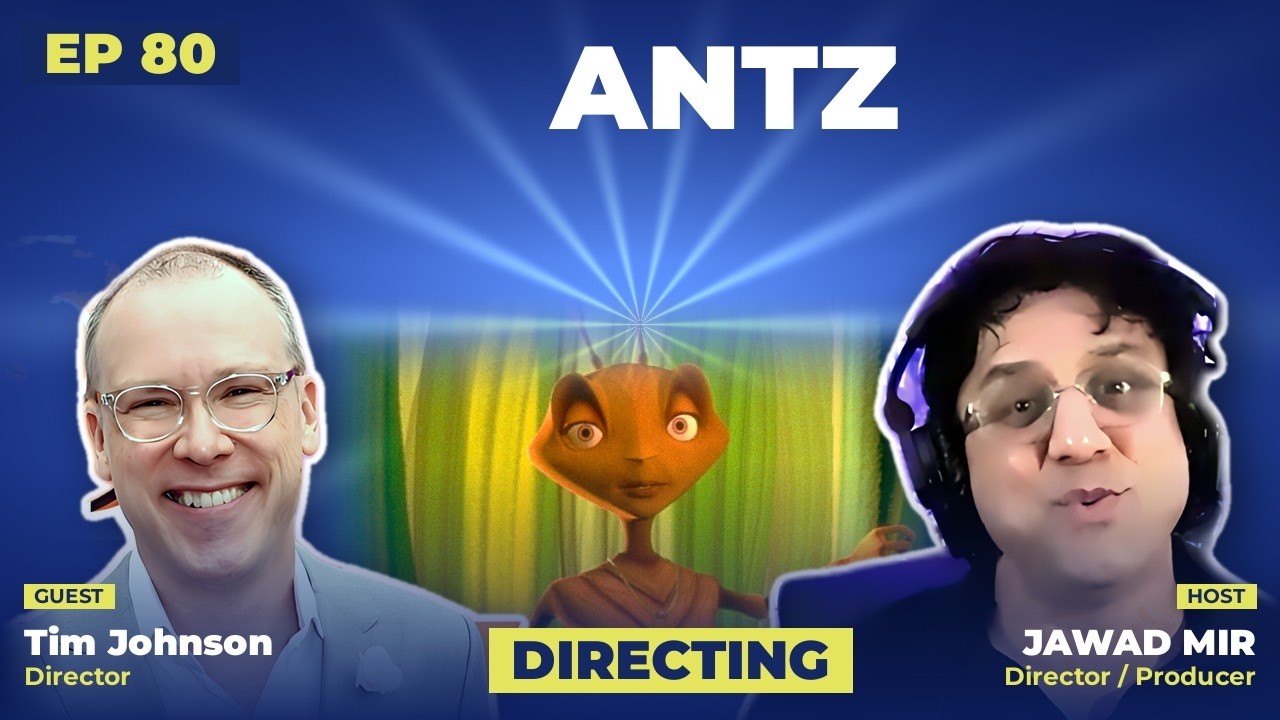
Episode 80 · April 12, 2024 · 1h 0m
'Antz', Director, Tim Johnson
Clips and Shorts from this episode
About this episode
Join Director Tim Johnson as he reflects on the making of ANTZ, a film that defied norms with its distinct tone, witty script, and stellar cast including Woody Allen, Sharon Stone, and Sylvester Stallone. Discover the challenges and triumphs faced in crafting this animated classic and learn how Johnson's journey as an animator led to this milestone in animation history.
Tim Johnson is an American animation director known for films like Antz (1998), Sinbad: Legend of the Seven Seas (2003), Over the Hedge (2006), and Home (2015). A Northwestern University graduate, he began his career in computer animation at Post Effects and later joined Pacific Data Images (PDI), where he co-founded the Character Animation Group. Johnson has played a key role in advancing CGI animation in mainstream film, also serving as executive producer on projects like How to Train Your Dragon.
#timjohnsoninterview #donbluth #animation #highestgrossingdreamworksanimationmovies #animationlookback
Full transcript
Automatically generated from the episode audio, so expect the odd misheard word or name. Speakers were labelled automatically. About 10,700 words. Tap a timestamp to play from that moment.
0:06Jawad MirAnd away we go. Hello, Tim.
0:10Tim JohnsonHi. I'd say good morning, but I think it's afternoon for you by an hour.
0:15Jawad MirYes, it is. It is. That's okay. I mean, I've made that mistake many times. It's all good. Are you in, California?
0:25Tim JohnsonI am. We're in the, we're in the sort of corner of the sprawl that is Los Angeles up in La Cañada, near Pasadena.
0:33Jawad MirOh, okay. Great. Great. How is the weather over there?
0:36Tim JohnsonIt's sort of perfect, if you'll allow me to brag. I don't know where you're at, but I'm sure that we got you beat. It's, you know, 68 and sunny and just typical California…
0:45Jawad MirYeah
0:46Tim Johnson... Fall weather.
0:47Jawad MirWell, I'm in the East Coast in Toronto, and it's, getting colder. That's all I'll say.
0:53Tim JohnsonOne of my favorite cities. You know, I grew up in Chicago, spent half my life there. But in my early days, I was the first alias animator. So I was flying to Toronto from Chicago on pretty much a weekly basis, and it's such a sister city to Chicago. If you grew up in either city, visiting the other is very much a comfortable, fun experience. So I, yeah, I love Toronto. I miss, I miss the Midwest, except not necessarily in February.
1:21Jawad MirI was gonna say Chicago is definitely a sister, but n… not in terms of flight cancellations. Chicago is the worst in that, so. But yeah. I make a point not to travel through Chicago as much as I can. Just, you just never know. Even in summer, like, there's raining and pouring. But good to h… good to have you. I'm so excited to talk to you. Been a fan of, you know, as I, as I, spoke to you on email, of Antz for a long time. Still today…
1:49Tim JohnsonIt's lovely to hear
1:51Jawad Mir... It holds, it still holds today because, I mean, it's, it has so many layers that I remember when I first saw it, the whole idea of, you know, capitalism versus communism probably didn't hit me that well as it has, you know, in the last five, six years. So, very much in-depth film, and obviously the cast, the animation, the dialogue, everything was to the par.
2:15Tim JohnsonIt's probably the, only, animated film to ever, say the line, "It's the workers who control the means of production." So.
2:23Jawad MirYeah. Yeah.
2:24Tim JohnsonStill.
2:25Jawad MirYeah, I mean, that pretty much defines its…
2:26Tim JohnsonIt's a line that's, yeah
2:27Jawad Mir... That pretty much defines its level of depth, that where it's just has so much meaning to it. And but yeah, I mean, good to have you. I'll tell you my little context before we even start about how the relevance of Antz to me. I don't know how much Simon told you.
2:47Tim JohnsonNo, I mean, I really enjoyed exploring your website.
2:53Jawad MirSorry.
2:53Tim JohnsonCongratulations on a body of work and some film that's pretty interesting. I'm gonna be, enjoying to the extent that I can squeeze it in my academy obligations at this time of the year. But I promise you, I'm gonna look forward to seeing a couple of these documentaries you've made.
3:05Jawad MirGreat. Thank you so much. Before that, long before that, around 1997, I started a website out of a course that I was flunking, and I just made it for the hell of it. It was just, like, a basic one-page Steven Spielberg page with a counter on it. And, I had no idea that there was a studio... Well, I shouldn't say I had no idea. 1994, a T… Time Magazine publication came out, which is right there with the cover of, Spielberg, Geffen and Katzenberg. And that was delivered to my home. I didn't know what that was at the time, couldn't really figure out what the hell a studio is. I mean, I was only, like, 16 s… 15, 16 years old. And, then '97 when I started the website, that's when DreamWorks launched its first film, The Peacemaker, literally around the same release, like, when I launched the website, that was the day Peacemaker came out. And then I started following DreamWorks, and then next year, Antz came out, and Prince of Egypt came out.
4:08Jawad MirAnd I remember watching the trailer of Antz and Prince of Egypt, specifically more Prince of Egypt. I was, like, hooked to that f… trailer, like, the artwork that was coming out. And Antz was interesting for me because I did something that I ethically was extremely wrong. I should confess that right now, but I did it out of the g… out of the, you know, I, love for DreamWorks and love for animation and love for promoting the film. At the time, DreamWorks probably didn't have a website. It was, like, early days internet. And Antz came out…
4:41Tim JohnsonGood day, yeah
4:42Jawad Mir... And Antz had a website on pepsi.com. I don't know, they signed some sort of a deal because there was a Pepsi can in the…
4:50Tim JohnsonYep
4:50Jawad Mir... In the film. And I somehow discovered it, and it was no… nobody had talked about it, and there was images and all that stuff. And you know, and I took that, and I posted it on my website, and I sent it to all these news, like, you know, "Here are the images." And I got so much traffic because of that. And then, you know, in hindsight, obviously, being a filmmaker and now a podcast also, it was ethically extremely wrong, but it would, it just ex… excited me to that film so much. And that's how the journey began, like, you know, my journey in, for 10 years, I ran a website on DreamWorks Studio. You know, I even went to PDI DreamWorks at Redwood City film sets and all that fun stuff, and it was a great part of my life. And this is how that pod…
5:32Tim JohnsonAbsolutely
5:33Jawad Mir... This podcast kind of started in me sort of reliving that as a DreamWorks podcast, but now I'm just covering everything and I absolutely love it, and I absolutely enjoy it. So you're, you're part of the reason I'm doing what I'm doing, so I just wanted to…
5:47Tim JohnsonAll right. Let's…
5:47Jawad Mir... Extend that to you
5:48Tim Johnson... That's the most flattering thing any filmmaker can hear from another filmmaker. Absolutely. So, and by the way, I don't know what corporate might have said, but a… anybody who puts the word out about a film I've made gets nothing but my love and congratulations. So I'm not sure, whether the business people would have wanted you to distribute, DreamWorks material, but you probably drove viewers to the film. So as far as I'm concerned, you're a hero, so.
6:11Jawad MirThank you so much. So let's, let's start, Tim, from the very beginning before we get to Antz What's your journey like from the beginning? Like, what instigated you to become an animator, and then sort of that path that you took to getting to, I think you were at PDI first, right? Correct me if I'm wrong.
6:30Tim JohnsonI was, and even before that, you know, I grew up in, Chicago and as al… I've always been a cartoonist. And I sort of learned to draw by tracing Charles Schulz comics and, Johnny Hart comics. And throughout high school and then in college, I did a comic strip, and that was actually my biggest ambition. I still love the art form of the four panel comic strip. To me, it's still, like, the one of the most challenging, tight narrative, you know, comedy mediums ever created, the four panel strip. And somewhere towards, and I was a actually a physics major as I started college, swapped to English literature, which saved my sanity, and allowed me to concentrate on the tools of storytelling. But even as I graduated, I had a couple of short animated films that I did independently at Northwestern, but I wasn't convinced I could make a living at it. So I gave myself, this would've been the summer of '83.
7:32Tim JohnsonI gave myself, like, the summer, three or four months, to see if I could get a job animating, before I sort of shrugged and did what English literature majors do, go copyright or something. But sure enough, I landed a gig in-betweening a Captain Crunch commercial and never looked back. So a few years in Chicago in-betweening and then directing TV commercials, all drawn animation, little bit of stop motion. And then I shared a cab with a businessman who owned a post-production studio who had just bought the first Alias system.
8:06Tim JohnsonAnd at that point, Alias, w… you really had to know a little programming to work it. You had to know C, and I had enough of a science background to have dabbled in programming. I wasn't intimidated by that. So I actually started, my computer animation journey, that would've been about '85 or so, working at Post Effects in Chicago.
8:28Tim JohnsonBy '88, I was sick of being a one-man shop and maybe a little sick of Chicago, and took the chance to, move to California, joined the what was then a very small crew at PDI. I think I was employee 14 or something like that. And the goal there, and the reason they hired me, was I did have character animation chops. I did have some directing, chops, and we really wanted to take a company, PDI, which was known for flying logos. We all called ourselves logo pilots, you know, the swooping around NBC, ABC, Entertainment Tonight text.
9:02Tim Johnson... But we were able, with a concentration on the early days of getting character animation done with a computer, we were able to start doing some character work, you know. So our big, our big land would've been the Pillsbury Doughboy. All that got us at the doorstep of The Simpsons, where we worked on a Halloween of Horror, a Treehouse of Horror, show. And it was clear as you saw how quickly computers' capability with character animation was moving that this was a storytelling medium. It's hard to imagine now where every single animated film is at least in some way touched by a computer, if not entirely, you know, rendered. It's hard to imagine now the responses I got as I was pitching ideas for feature films. I got the same responses actually almost word for word, without them realizing it, that Walt Disney got when he was pitching Snow White as a feature. And people would say to Walt, "Can people really stomach 80, 90 minutes? Won't they just get a headache and their eyes'll bleed?" And I got the same sort of response in those early PDI days as we shopped around to studios with a feature film idea.
10:07Tim Johnson"Gee, could people really watch computer animation for that long without just, you know, it, their eyes melting out of their face?" but it did eventually lead us to pitching to Jeffrey Katzenberg and the DreamWorks fol… folks, which I think was, I think would've been December of '85. And the story we were pitching was at least adjacent to the story of Antz. So Jeffrey sat me and, our, my friends and partners at PDI down and said, "We like your storytelling style. We like your capabilities and technology. We're working on this film called Antz. Take a look and let's see if that's something we could, get in partnership on." And so there's the, there's the winding journey of my road from doodling to, yeah, to directing.
10:57Jawad MirYeah. And I think, when you said December 1985, I think you meant December 1995, correct? For DreamWorks.
11:04Tim JohnsonI did, yes.
11:04Jawad MirYes, yeah.
11:04Tim JohnsonThat would've been…
11:05Jawad MirJust wanna make s…
11:05Tim JohnsonThat would've been '95.
11:07Jawad MirYeah. Yeah.
11:07Tim JohnsonHad the '80s in my mind, yeah.
11:10Jawad MirYeah. Were you also involved in any way, because I remember PDI did some effects, if not most of it, in the, for the first Tron film, no?
11:21Tim JohnsonNo, that would've been Magi. Magi in New York did the first Tron movie.
11:26Jawad MirReally?
11:27Tim JohnsonYeah.
11:28Jawad MirI know…
11:29Tim JohnsonYeah, I know because my wife actually worked for Magi. We met, many years after that. But, no, PDI wasn't involved with Tron. We didn't really get into the film effects business until a few, like, we did a little bit of the work on Terminator and Angels in the Outfield.
11:46Tim Johnson... And that was, that was a sort of interesting friendly rivalry within PDI is there was a film effects division, and then there was this group of animators that I was running with Rex Grignon trying to get a feature, animated feature going. And it, you know, everything was such a Herculean lift back then. Just getting a computer image onto film was a Byzantine technical process, so.
12:12Jawad MirYeah.
12:12Tim JohnsonBut, yeah, PDI has a proud history of, you know, working the first sort of logo animations and then some of the early CG work. But the, but the Tron stuff, you know, th… those early, works from digital productions, Cranston /Cere & Magi, were, they were the ones who sort of, around PDI's time as well, busted down some barriers.
12:35Jawad MirGot it. I may have misread it somewhere, but you know, it's funny you mentioned about the logos, the…
12:41Tim JohnsonYeah
12:41Jawad Mir... Moving around animated logos. Nowadays, you know, you can hire someone on Upwork or Fiverr to do that. Like, you know, the, imagine the technology…
12:50Tim JohnsonYeah
12:50Jawad Mir... Advancement that has sort of come about in not less than 30, 40 years, right? It's just insane.
12:58Tim JohnsonIt, I have to say, of the many reasons I count myself lucky is that sensation was present every day in real time. So sometimes, an event in life, you get to a destination and look back and go, "Wow, now that I look back, I can't believe the pace of change and how much we've done." I have to say part of the many, one of the many joys of working in computer animation is you were aware every day, oh wow, we are on a rocket ship. And everyday capability and public awareness and, a… entertainment industry interest, it just grew, like steadily and with incredible excitement. It, there was always the feeling that tomorrow was gonna be an even bigger day for the capabilities and creativity of computer animation.
13:46Jawad MirYeah. Which is, which is so true because I, you know, ever since I think the seeds were put down by James Cameron in The Abyss, and then Terminator 2, and then Jurassic Park kind of took it to the next level, Toy Story. And then from there on it's just been like skyrocketing. I mean, now, you know, I was, I was talking to my, DP as… couple of days ago, and he and I were talking about the overuse of green screen now, where you don't even know what the hell is real, right?
14:17Tim JohnsonYeah
14:17Jawad Mir... And there was this photo that we both saw separately on social media. Somebody with a, on a sta… it, the, basically there was a before and after. The after photo was, somebody on a, with a bunch of wolves, with a, the rack that's like kind of like going on the ice, and it, there's like this scenic mountain and trees and everything. And then they showed the before. It was on a stage somewhere, like literally on a stage. And that completely ruined, you know, that…... That experience. Like holy, you know? And now I think people are feeling that they wanna go back to that, you know, practical element, which a lot of people are now doing. You know, obviously Spielberg is one of them, Christopher Nolan, Tom Cruise loves practical effects.
15:02Tim JohnsonYeah. Yeah. And the, if, you know, I would say even like the fight choreography of a John Wick, there's a s… there is a sense that, films have gotten a little cold and distant. And anything to really get that visceral sensibility is, it's, it's, it's, it's fun to see both extremes. I mean, to see the choreographed, you know, work it takes for Tom Cruise to leap off a cliff on a motorcycle and…
15:28Jawad MirYeah
15:29Tim Johnson... Pull a rip cord, compared to, you know, really gorgeous, interesting visuals in the newest of Sony's Spider-Man movies. You know, we've got, we live in heady times for both audiences and filmmakers when the range can be that wide.
15:46Jawad MirYeah. I agree wholeheartedly. You know, moving to Antz, Tim, I'm kinda going from different levels of production. One thing, and I don't, you don't need to get into this whole politics of things because I, be… because you know and I know there was a lot of stuff going on, with Antz being, coming out in March 1999, and then it was…
16:07Tim JohnsonYeah
16:07Jawad Mir... Pulled back, you know, October 2nd, 1998. W… how, when did you guys find that out, that you, now you're like almost six, five months before, and how fast and crazy you guys had to move towards to meet the deadline?
16:24Tim JohnsonIt was, I remember, it was, it's funny, my memory on some stuff is so embarrassingly bad, but that was such a shocker that I remember every detail of it. We had, you know, typically on an animated film, even to this day, you wanna put the film up on reels about three times, fully storyboarded, before you start production. Now, that doesn't mean you're not building characters and starting rigging, but in general, you watch the film about three times and you've, by that point it may not be perfect, but there are enough scenes that are really working that you can comfortably go, "Okay, let's start the conveyor belt now and send the first scenes into production." So we did our s… and that was our plan on Antz. It was all laid out on a big whiteboard in a room. Everybody, you know, checked in with constantly. And then we had our second screening, and the Weiss brothers had done a really tight rewrite with myself and Eric Darnell and, all the lead creatives had, you know, kind of all got in a room, pounded out stuff, and Chris and Paul went away and came back.
17:28Tim JohnsonAnd we worked really fast on that second screening and put it up, and it kinda nailed it. Like suddenly the film was there. It wasn't, like a first screening is, where it's like, well, if you, if you clear the weeds and wipe the dust off of the windows, you can see a film here somewhere. The second screening of Antz was like, yeah, we, that's the movie. The tone of it, the comedy. I don't think we'd recorded any of the actors yet. We'd met with Woody Allen, but, you know, so it was all temporary voices. And I remember afterwards, Jeffrey sat us all down and he said, "You're a screening ahead. There, we really should put this into production. And if we're gonna do that and be three to four months ahead, we should look at our release date." And that was very quickly, within a day or two of that screening, we had decided, or the studio really had decided, yeah, there's, there's no reason to spend, you know… You know, m… m… more time than necessary.
18:30Tim JohnsonAnd so not only did we get the film out, and we did come out, you know, a month in advance of Pixar's A Bug's Life, but I, u… ultimately, even though we had to work really hard to get there, I think the film saved money by coming out early. We really did cut time out of the whole production schedule.
18:47Jawad MirAnd how, wha… when was it that Jeffrey sat you guys down and said, "Now we're gonna think about the movie?"
18:53Tim JohnsonWell, this is where, dates are just terrible for me. I would j… I would... It was…
18:56Jawad MirWhat…
18:58Tim JohnsonYou know, we probably had about a year post-production. So let's see. We… if we started in '96, like January of '96 is when we got the sort of, let's make this movie. And of course we came out in October of '98. So I think it would've been late '97, but with a year to g…... No, it would've been mid '97. It would've been like spring of '97 with a y… y… with about 14 months to go…
19:25Tim Johnson... Before that October release date that Jeffrey said, "I think we should come out earlier."
19:32Jawad MirGot it. Antz had, one of the things aside from a very witty script, which I always felt even at the time, like Woody Allen was born to play that, pl… play Z.
19:42Tim JohnsonYeah.
19:42Jawad MirLike th… th… he was just born to play that character. But at the same time, everything else that you guys had, yes, they were A-list, these were A-list celebrities even at that time. You know, I'm just gonna read the names so that I don't forget anybody. Woody Allen, Sharon Stone, Sylvester Stallone, J… Jennifer Lopez, Gene Hackman, Danny Glover, Christopher Walken, Dan Aykroyd. You know, the list goes on and on. And the three characters that I f… actually, I would say four, the four voices that were so spot on in terms of their characters, not that the other weren't, but these were like, you know, sort of main or main ones. Woody Allen, Sharon Stone, but for me the two that were icing on the cake were Gene Hackman and Sylvester Stallone. You know, the tough guy.
20:28Tim JohnsonYeah.
20:28Jawad MirAnd Gene Hackman had just done Crimson Tide I think three, four years ago or something like that. And it was just, it was just perfect.
20:33Tim JohnsonYeah, we were playing into that kind of character, yeah.
20:37Jawad MirYeah. It was like a home run if you ask me in terms of how you guys were able to bring out those characters with those amazing voices.
20:45Tim JohnsonWell, I mean, it's true I think of, every animated film I've worked on, but Antz maybe more than most. You know, once you... Like we actually wrote for Woody Allen before we went to pitch him. So if he had said no, I honestly don't know if we would've made the film.
21:00Tim JohnsonBut we had a lot of dream candidates for General Mandible, and Hackman was the number one. But we honestly didn't think he'd do it. He'd, he'd sort of never done y… y… like family entertainment, stuff like that. He had done some amazing comedy stuff, but this w… this was ahead of some of his comedy stuff even. So when he said yes, we did go back and rewrite some of the work for him. And working with Gene was, I mean, so many of those talents were, like I was learning more than I was directing, right? I was just like a... And we, I told Gene this at the end of the process. I told him that we had a secret nickname for him, which was, he was called Take 2. You know, t… typically an actor's gonna come in, and while we send them lines, they'll read them, but they're not gonna memorize them like they would have to 'cause they know it's gonna be on a microphone stand right in front of them. And what would happen with Gene Hackman is he would do the first read of a line, it'd be a cold read, and he would deliver it and it'd be very impressive.
22:01Tim JohnsonBut then the second time he read a line, now he knew the line and the context, and he would crush it. I mean, it would just be the perfect nuanced, funny, threatening read. And then he'd go on to give you a third and a fourth and a fifth and a sixth, you know, take, in which he would vary it and play with different aspects. But inevitably, his actor's instinct of wha… what was the best read of the line was always that second take. And so you'd listen to all the takes and go, "That's my favorite." And then everyone would shrug and go, "It's Take 2 again." He just really knew that instinctually how to deliver the line.
22:39Jawad MirYeah, he, great actor. Absolutely great actor. And another thing that I remember when I watched Antz, now nowadays it's a very common thing, right? Like back then, I remember even watching like a movie on TV like 8:00 PM, like a movie like Predator or Terminator, you know, they would have a beep on all the F words or…
23:03Tim JohnsonYeah
23:03Jawad Mir... Anything like that. I don't even know if that's still the case. I mean, I haven't had cable in a long time. But at that time, seeing a dark animated film, I mean, Simpsons you can kind of call dark, but still was very different, with the amount of, I wouldn't call it violence, but at the time it was pretty, it was a lot for, you know, for a kid, for a young audience to sort of decipher. Even The Lion King, like the death of Mufasa was, you know…
23:31Tim JohnsonYeah
23:32Jawad Mir... You could argue that it was. But it was just so witty but at the same time dark and contrasting to what Pixar had been doing. Were you guys ever, had this fear that, okay, who the audience is? Like if the kids or families don't go see it, who is going to? Because it wasn't really popular, animation wasn't really popular among adults aside from Simpsons per se or maybe Toy Story.
23:58Tim JohnsonI think, I think Katzenberg was definitely, like he would say again and again, "Are you sure you wanna go with this character design? Are you sure that's the art direction you want for your movie?" it's funny, Jeffrey has a reputation for being sort of, you know, a steel hand and a demanding, you know, producer and studio head. And yet every film I've made with him, he let the filmmakers make the film they wanted to make. Not that he didn't give you strong, smart notes that you were wise to listen to, but I think he was very He was very concerned, but he was also genuinely excited about what he was seeing. And here he is opening up this new animation studio. You know, we're making only the second major feature length computer animated movie to be released. And I think he just settled into like, okay, this is the film Eric and Tim and the studio wanna make, and I'll sell it as unique. I'll sell it as different. We'll, you know... He initially, I think, envisioned a more, you know, brightly colored Jiminy Cricket, character design.
25:02Tim JohnsonBut he went with us with this, you know, semi-realistic sort of, y… y… human meets insect bizarre look and feel to the film, and let us roll with it. And in many ways, less planned and more in hindsight, I do look back and feel like whatever one, whatever politics and business one might make of the competition with Bug's Life, you certainly can't accuse the two films of going for the same tone or look or art direction. And so I think that even audiences looked at the two films, and they didn't register it as like, oh, they're ripping off each other. It was more, wow, those are, those are about as far apart as you could get in the same, you know, medium of computer animation, and story, storytelling as well, just really different. So I think Jeffrey sort of se… he was concerned about the marketing aspects and ultimately celebrated it, and ultimately was very happy 'cause we performed well, and it did set a tone for the studio that led to things like Shrek and other early successes.
26:06Jawad MirYeah. Well, one thing I mean, I always give, obviously you probably do more than I do because you d… you know, worked with him quite a bit, Katzenberg, is that anytime he's worked in a studio, like he was at Paramount, and Paramount excelled in the '80s.
26:21Tim JohnsonYeah.
26:21Jawad MirAnd then Disney Animation excelled in the, you know, late '80s or early '90s. Same thing with DreamWorks. And that you can argue, yeah, you know, he's a great leader, but at the same time, great leadership comes with also believing in people that are working for you or they're working for the studio, and giving them, not necessarily free rein, but believing in them. I mean, that's just the old, you know, r… rule that when you believe in people, they will deliver the best that they can, and I think that's what he was good at.
26:51Tim JohnsonMy, one of my... I don't know if I've ever told this, story before. My f… my favorite most telling Katzenberg story was I was asked to give a pitch, an update on a movie to our board of directors. And our board of directors at DreamWorks was impressive. It was, oh, Howard Schultz, I think his name is, the head of Starbucks. It was Nathan Myhrvold, the former tech officer for Microsoft, and a, and a group of just stellar accomplished people. And so I, so I gave my little pitch, an update on, I think it was Over the Hedge or something like that.
27:23Tim JohnsonAnd then afterwards, I got to be a fly on the wall as Jeffrey kinda casually asked this group of b… billionaires, "What are you up to?" And so Howard Schultz would say, "Well, I just opened 200 more stores." And Mellody Hobson would say, "I just did this." And Nathan Myhrvold said, "I just bought a T-Rex." And, all these amazing accomplished people talked about what was in their life, you know, catching up with Jeffrey. And when it, when they returned the f… question and asked Jeffrey, "Jeffrey, what's up with you?" Jeffrey answered, "Well, Tim's got a new movie in addition to the one he showed you, and Simon Wells is developing this new thing that I'm really excited about, and we just got this, animator that I think is one of the best animators." And at the end of it, I walked away going, he never said I. And yet he was absolutely bragging. Don't get me wrong, Katzenberg's ego is enormous.
28:15Jawad MirOh, yeah.
28:15Tim JohnsonBut I would argue, I would argue Katzenberg's ego was a mature business ego which realized and embraced the entirety of his success was in creating a place where the best wanted to come to work and then did their best work, and that was his pride. And so he was just as, you know, massively ego driven as anybody in Hollywood, but his head was screwed on right in realizing, acknowledging, and celebrating that it was the ability to get great people to do great work that was h… actually his biggest accomplishment.
28:48Jawad MirWonderful story. Thank you for, thank you for sharing that. And I think that business model is something that, you know, I was watching Steve Jobs' old video. He said something similar in the lines of, you know, one of the things that I learned in my life, and I applied to Pixar as well as Apple, before Pixar became part of Disney, of course, is that I always would hire people that were smarter than me and that were better than me. And that philosophy is something that I even to the day, you know, when, whether it's a medium sized crew, whatever, I have to have people who know more than I do. It's important to have ego. It, ego drives you forward for your own self, but at the same time, you gotta manage everybody properly. And k… kudos to Katzenberg. I mean, it showed in the work. I know this, not even knowing this, not even knowing him, is that because, you know, seeing press releases at the time when I used to run the website, watching interviews, the level of excitement this guy used to have, you know, i… in his eyes, and he was a very shy man at the same time.
29:54Jawad MirI went to a test screening of Shrek in March 2000, I think it was, and him and Mike Myers were there. And I was very shy at the time, and I wanted to approach him and everything, and I think he was more, you know, in person probably shyer than I was, but, you know, that's just how he was. But, you know, in front of a camera or in front of, like, a pitch or when he was trying to talk about the film, he's a completely different person. Ama… amazing human being. And one thing I've talked about this with Simon as well, I emailed him. He was the first one that I emailed during COVID when I was thinking about starting a podcast, and I thought it will never see a light of day. He responded to me in less than 10 minutes
30:35Tim JohnsonYeah
30:35Jawad MirAnd, I mean…
30:37Tim JohnsonThere's, there…
30:37Jawad MirHe did, like, a text
30:38Tim Johnson... A commu… yeah, a communication ethic with Jeffrey that is unique, I think.
30:42Jawad MirYeah. He did, like, a... He wrote answers to my questions about Prince of Egypt over three pages. He said, "I can't do audio, but I will just write it for you." And yeah, I mean, amazing person and amazing businessman. I'm gr… I look what he's doing now, he's doing some amazing things.
30:59Tim JohnsonFascinating, isn't it? Well, I mean, as a director and a first-time director of a feature film, I couldn't have asked for a better mentor for exactly that reason you were talking about, which is hire people better than you, let them do their job. And the analogy I always, you know, the, those are the two pieces of advice I give to young directors. The first is you're the conductor of the orchestra. You do not need to know how to play the violin to be a great orchestra conductor. But you need to know what the violinist requires to be the best violinist. And so that idea that you're the orchestra conductor and you're creating an environment for people to do their best work, and you're pointing to a place on the horizon that allows everybody to focus on a goal, but maybe not paving the road on the way there by fussing over their fingerings and bowings and tonalities that are their decisions as an individual artist. But trusting that if you, as a director, paint a target on a horizon line and can compellingly convince people that target's worth fighting for, that's, you know, an incredible accomplishment.
32:05Tim JohnsonThe second advice I always give to directors is learned directly from Jeffrey, which is if you can, never, ever use the word "I" when you talk about your film. 'Cause at the end of the day, the film's gonna come out and it's gonna say, "Directed by," your name. And that is a, that is as powerful a professional badge as any industry will ever off… offer. And so your job is to acknowledge the incredible team with every moment you get, because it, no matter how much you say, "Oh, it was their idea," and, "He really accomplished that," and, "I'm so lucky to have this production designer," at the end of the day, your name, it says Directed by. That's all the bragging you need to do.
32:51Jawad MirSo true. Absolutely. No, thank… thanks for sharing that. And it, at, the angle of looking at it from brag… directed by bragging is certainly something different that I never thought about myself, so certainly good to know.
33:07Tim JohnsonWell, it's such a... It's the best job in the world. I hope you've had that…
33:11Jawad MirI…
33:11Tim Johnson... Sort of sensation…
33:12Jawad MirI have
33:13Tim Johnson... As you've put your films together. It…
33:15Jawad MirI have. I have
33:16Tim Johnson... It's the best, isn't it? I mean, to work with creative people, to see them work hard for a vision that you're, you're cooperating with them on creating and guiding them towards, and it's a, it's a very high pressure position to be in. I, Steve Hickner, who partnered with Simon and
33:35Jawad MirYeah
33:36Tim Johnson... Simon Wells, Brenda Chapman on Prince of Egypt, Steve gave me advice, w… like, in the first weeks of getting the gig to direct Antz. And Steve said, "The thing you have to remember about directing is at the end of the day, your crew's gonna go home, they're gonna sit down with their wife, partner, best friend, mom, dad, and the… that person's gonna say to them, 'How was your day today at work?' And the response to that question will be entirely based on the 30 seconds they spent with you."
34:08Jawad MirWow.
34:09Tim JohnsonAnd that is what it's like to be a director. Because people want the vision, want the guidance, also want the freedom. And when they have that freedom and deliver for a director and they s… and the director goes, "Wow, that was great," they open a good bottle of wine that night. And if a director goes, "Ooh, I think you missed the mark. That really doesn't work," well, you still open a bottle of wine that night, but for a completely different reason. So I always thank Steve Hickner for putting into perspective the sort of, you know, in… awe-inspiring responsibility of being a leader of a creative project.
34:46Jawad MirThat's such a great advice. That is such a great advice. Because at the end of the day, we all crave, in a very indirect way, of what the world thinks of us.
34:56Tim JohnsonYeah.
34:56Jawad MirDo they like us? Do they not like us? And whether we find out or not, that's another story. But at least if you do the best you can to make sure that people are gonna have a good day because of you, I think that in itself is the greatest achievement.
35:10Tim JohnsonWell, and creative people, it doesn't matter how much success you've had. Every time you create something, you're vulnerable. You're putting yourself out there. You're saying, "This matters to me and it affects me emotionally, and I'm offering it to you hoping it affects you emotionally as well." And it's the most joyous thing in the world, which is why directing is such a great job, when somebody goes, "Yes, I feel it in the same way you do and the way you want me to." And it's so debilitating if you get the, "I don't know what you were going for there. That left me cold." And s…
35:40Jawad MirYeah
35:40Tim Johnson... And so treating every creative with that respect that you so crave yourself is a, it's not always easy. It, you do sometimes come across an artist that is a poor fit for a show, or their best efforts never quite meshed with the c… the group. And that's a sleepless night for a director. But I find for the, for the most part, especially with the incredible caliber of the talent that DreamWorks is, was able to pull together for so many decades, a couple of decades there, that y… you would almost always be able to find that shared vision that would lead to that joyous discovery together rather than frustration.
36:20Jawad MirYeah. No, that's, that's absolutely true. And the f… the great thing about directing, I mean, I'm just speaking, from my own experience, and I would s… guess most people are like that. I am a completely different person when I'm on the set… When I'm directing, when I'm working on the film from the beginning, as opposed to in real life. So as would, not in the terms of, you know, for the lack of better word, two phase, but more so I'm in my zone. And…
36:55Tim JohnsonYeah
36:55Jawad Mir... I can, I'm not crazy about heights, right? But I can be given a camera, and I'm okay with the heights. It's just…
37:04Tim JohnsonHuh
37:04Jawad Mir... You're just so much in that zone, in that world, where you're like, "This is for what I'm doing," or, "This is what my team is doing for," or whatever it is. It's just, it's an incredible feeling. It just makes you know, as Jerry Maguire would say, "It ma… it makes me complete." I, you know, that's just how it is. And it's, it's amazing.
37:24Tim JohnsonI love that. Yeah. Yeah, I love that, Jawad. I think that's exactly right. The, you know, I'm a passionate, amateur musician, and the flow that can happen when you're, playing a guitar is also what you can get when you're directing in the sense of, your personality and the weight of your daily to-do list and the bills that are due and the family crises can all take this very, lovely moment to getting in the backseat as you and a creative team are chipping away at the big chunk of marble to find the sculpture inside of it. And that sense of getting to do creative work with a team, and you can feel your own individual ego being satisfied by it, but also realize that it's because the team is aligned with you. You know, we all…
38:24Jawad MirYes
38:24Tim Johnson... And this is, you know, we all want to be understood and heard and appreciated. And if you're in the flow on directing, every day has those opportunities to go, "Wow, I was understood, I was appreciated, and we're creating, something together." It's a, it's a powerful sense, and I actually miss it since COVID kind of shut things down. I departed Dreamworks. I'm developing all these projects. I'm working with some great people. But it's not the same as 300 people all working…
38:53Tim Johnson... On the same canvas together at the same time.
38:56Jawad MirYeah. And, you know, speaking of appreciation, do you remember the first time Antz was screened, whether it was, you know, with a small crew, a small group of folks, including Katzenberg, at DreamWorks, or whether it was, like, a test screening or a ful… fully finished screening? Do you remember what that experience was like watching and re… seeing people reacting?
39:21Tim JohnsonYeah, the very first... I would say every single test screening I've ever had for a film I'm directing, and you usually have m… many for any film, a, as few as three and as many as six, test screenings. And they're, they're professionally run. Somebody with a clipboard, walks up to people at shopping malls and says, "Would you be available to watch a movie at 2:00?" And they tell them very little. They just say, "It's an animated comedy, and it's a work in progress," something real similar. But I do think the first test screening of Antz being the first time, film I was directing, co-directing with Eric Darnell, I was almost physically ill. Like, I was st… I remember shaking. I remember, not really, not being able to pay attention to anything. It all went by as a sort of surreal, scary dreamscape. But I remember every laugh was like ambrosia, and every silence where there should've been a laugh was a dagger.
40:29Tim JohnsonLike, it just…... You feel everything keenly. But it's, it's such an important process for a filmmaker, and of course happens with live action films as well. It happens, you know, for people who make a song demo before producing it. The, you can climb so deep into your own head, especially with a long narrative where you're tracking characters and arcs and themes, that you can convince yourself you're, y… you know, you've dotted every I and crossed every T. But only when you show it to an audience does that cold water slap you in the face, and you're like, "Oh." Even before they don't laugh, I know they're not gonna laugh 'cause I can feel the energy in the room, and I missed the setup that would make that joke work. And even before I get the bad news that they didn't get the joke, I at least now know why, and there's a, there's a path to fixing it. So the experience of sitting in the dark room is the most nauseating one a director or anybody on a crew can do, but it is so fundamentally important. Nobody, no, like, stand-up comic walks out on stage and improvises a whole show that gets filmed for their hour special.
41:35Tim JohnsonThey craft it one joke at a time… ... And make all the subtle changes to timing and cuts, and that's what a filmmaker needs to do too. So yeah, I remember every test screening I've ever done, but that first one on Antz was, like, literally physically overwhelming.
41:53Jawad MirAnd what was it like on the weekend when it was supposed to, October 2nd, I think it was…
41:59Tim JohnsonYou know
41:59Jawad Mir... 1998?
42:02Tim JohnsonIt's, it's, it's such an emotionally tur… it's turmoil. You work towards that moment that an audience pays hard-earned cash, holds a ticket with your film's name printed on it, and then sits in the dark and has expectations. And so when it happens, there is a sense of crossing the finish line, but it's so diffused and so compromised. I remember Katzenberg and I bought tickets to three shows for Antz, matinees throughout the afternoon. We drove, I think even hired, like, a driver. So we were in the back of a really nice S Class Mercedes, racing from theater to theater. And I couldn't do it. I'd walk in, and the people would start laughing at those opening lines of Woody Allen's monologue as we dive underneath the soil of Central Park and meet our ant character on the psychiatric couch. And the prints w… looked, like, muddy and dark, 'cause theaters typically don't project, especially pre-digital, at the full brightness of their bulb, and people are still, like, talking and settling and getting their popcorn sorted and their kids settled.
43:08Tim JohnsonAnd l… like, as a filmmaker, you're like, this is both joyous 'cause people are experiencing it, and yet it's, it's not the pristine, perfect experience you crave for an audience. And so I think with each one, Jeffrey and I stayed five minutes, and I would say to him, "I c… I can't do it. Let's go to the next theater."
43:26Jawad MirThat's, that's, that's so true. I mean, even when I'm looking forward to a film that I have nothing to do with, like, you know, like I'm a huge Spielberg fan, right? Like, and I would go, and I would be like, if somebody… if I hear somebody eating popcorn, I'm like, "Oh, sh… oh." That just ruined my experience of watching the…
43:47Tim JohnsonThe gl… the glow of a cellphone on a face, it's like, "Oh."
43:49Jawad MirOh, God. Which is why I stopped going to movie theaters for a while, but now after COVID, I'm kind of, you know, making an effort again just to go more often. But it's so true. I… You reminded me of my... The first feature documentary I directed, it was about a small fishing village trying to fight, a government, the Canadian government, to get their seawall repaired before the hurricanes destroy the village. And it was, like, a three-and-a-half-year-long production on and off, because I was, like, following the story real time, and it was just literally just me. Like, I pretty much did everything from the beginning to the end because lack of budget. And I remember the first screening. It was so interesting. So I… two stories I'll tell you, from here to here. The first screening I did, it was a packed house of, like, people from 55 and above. Like, you know, small fishing communities all the way came to a church. It was a big screen. There was a projector. I had to do everything in laptop and connect.
44:51Jawad MirAnd I wouldn't even leave that room to see what the audience is thinking and doing…
44:56Tim JohnsonOh
44:56Jawad Mir... Or looking, and I was petrified. And then when the film was about to finish, because I, you know, the credits were gonna come, I kinda went just downstairs in the hallway, and all of a sudden I heard this loud cheer and applause. And I'm like, "Okay." So then I go in, and I go on the stage, and everybody's, like, on their feet, and it was one of the most memorable experiences…
45:20Tim JohnsonSo powerful
45:20Jawad Mir... Of my life. A month later, because of that success, in my eye at least, we decided to show this film, another fishing commun… fishing villages community, and we reached out to one, and we rented a theater. It was, like, 1,600 people capacity.
45:37Tim JohnsonOoh.
45:37Jawad MirAnd we advertised every… everywhere. It was just me and the organizer that showed up, and that was such a detrimental experience. But I had the best of both worlds in a m… matter of month, and that taught me that how you shouldn't have those kind of, you know, letting things get to your head. You just kinda…
45:56Tim JohnsonYeah
45:56Jawad Mir... Have to balance it out and,.. But yeah, I've… it was, it was a very empty feeling. I remember, I'm like, "Oh my God, this is, like, horrible." But that's just the way it is in the film business.
46:07Tim JohnsonWell, and then you run right into the all-consuming other half of any commercial endeavor, of an artistic medium, which is marketing, and how much you are beholden to the ideas and energy and sophistication and spend on telling people about your film. And how no matter h… what tight reins you felt you had as a director, you have to let the baby go to college, and other people are going to do all the work of that next step. Again, I'm very lucky that for the most part, the experience of working at DreamWorks and our various distributors, I always felt was passionate and served the movie well, and the box office responded and... But there's a, there's a, there's an inc… It's like you said, like, as a director, you can have these feelings of absolute joyous egos, you know, feeding, accomplishment, and then utter powerlessness, in the, in the same week.
47:10Tim JohnsonAnd the partnership that it takes with your crew and your fellow creators to make a film, it, like, I think if you're, you're naive if you don't then extend that partnership to how do you take the kid to college? How do you get it out of the house and into the world and get eyes on it? That, nowadays, that is i… even more baffling and terrifying and competitive. I can't imagine actually with the smaller independent budget of a documentary and the challenges any documentary has, I'm s… I'm, I'm sure I would love to hear, actually, like, how much of your energy is in making the film and how much after it's made is your energy... Is it twice as hard to market it and get it out there than to make it because the rewards are so challenging?
48:01Jawad MirYeah. So one thing I learned from my first film, Only 78, which is the one I was just talking about, that it, I, you know, you can, one can argue that was such a, it wasn't a successful film because it didn't really make much money back. Which was fine for me, because I used it as a portfolio. And that gave me the ability to approach investors for the next couple of projects that I directed to get money, right? Now, I knew at the time because of the failure of the first film was that it's gonna be really hard to make the money on, you know, whether it's on, Amazon, whether it's on…
48:43Tim JohnsonRight
48:44Jawad Mir... Tubi, on all those platforms. Like, unless somebody comes out and buys it, which again is competitive, but in, I was realistic about that. So one thing that I figured out and that helped immensely, was that even though there was COVID, I finished both films around, I was directing two films simultaneously, and then they both finished around 2021. One of the things that I figured out, and it was just by trial and error, was because they were about social change, one was about Ameri… US and China, and the Uyghurs in China, and all that foreign policy element, and the other one was more about the migrant issue, both told from a protagonist standpoint. I approached all these different nonprofit organizations, universities, US embassies, European Parliament, and were able to license dozens and dozens of screenings all around the world.
49:38Tim JohnsonWow.
49:38Jawad MirAnd that, and that helped a lot, way more than I think, you know, a streaming platform would have been able to, in terms of their pay per click or pay per view. So that, I mean, yeah, it hasn't... It reached a lot of people, and it still is on the platform, and it's still doing reasonably okay, but if I had not figured that out, I probably would be in the same place, you know, com… as opposed to the first film. So I think that it's a learning thing, and you learn, and you kind of move on, and I, that really helped. It really helped. And it reached a lot of people. A lot. And it changed a lot of people's lives, which was way more important than anything else.
50:19Tim JohnsonYeah. I mean, I, ultimately, even within the m… money-driven world of Hollywood and fixation on box office, as a director, I'm more interested in eyes on the film than dollars in the studio's pocket. I mean
50:33Jawad MirYeah
50:33Tim Johnson... Even though they're intimately connected and mean something. The hardest thing about Sinbad not performing at the box office, my second film, was n… was not that it didn't make money, it was that I thought I'd made something beautiful, and it was just painful to think it wasn't gonna be seen by people who might find it beautiful. You know, it remind... You point out something in the, in the work you did in your subsequent documentaries. Like, I think a lot of directors don't understand that you actu… you have to be entrepreneurial, even within a studio system.
51:10Jawad MirYeah.
51:10Tim JohnsonEspecially for somebody like yourself, crafting independent f… you know, films. But even within a big studio system with all of the support of marketing and the, and the big voices involved, and big money involved, you really as a director are running a company that is both making a product and delivering the product into a marketplace. And the more you're savvy and own, and can take some joy in those challenges, the more successful you'll be as a director.
51:38Jawad MirYeah. It's, it's 100% odd, because I learned, again, I'm not a person that would go around and look for investors. But again, the first film, you know, you learn the hard way, taught me that this is, this is what I have to do. And over the last three or four years, I haven't perfected the art, but I have become way better at it as to gauge the situation, gauge the individual, how to tap into this, how to tap into that. But that's just, entrepreneurial element is absolutely necessary, 100%.
52:10Tim JohnsonWell, and it's funny, like, salesmanship is, for some reason in the world of creativity, considered sort of an ugly word. And I've always, celebrated it in that what a good salesman really is a good storyteller.
52:23Jawad MirYep.
52:23Tim JohnsonAnd the act of making a film isn't working for three years to make a story, it's telling the same story again and again and again every day. And so I think about, like, a film like, Over the Hedge, where I really had to sell the studio on turning this comic strip into a feature film. And so telling that story to Jeffrey, and the marketing people, and the other creatives, and then getting a small story crew and telling that story to the story crew, and trying to get them to bond with and add to that story. And then every time, you know, more crew would come on, I would pitch them the story and sell them on the story to get their enthusiasm. Eventually, that turns into me pitching toy companies and the marketing company. And you end up as a filmmaker telling your story so many times, often as a salesman, a salesman for the energy of your crew, or literally a salesman to get people to give you money to make it. And it's just not to be underestimated, that the power of storytelling is really the salesman's main job, and if you embrace that as a filmmaker, you're, you're gonna enjoy your life a lot better, as well as see an ability to get that enthusiasm from crew, or investors, or advertisers.
53:41Jawad MirYeah. Yeah. No, you couldn't have said that better. And I, going back to two films that you mentioned, which we can probably save for another day, Over the Hedge, but especially Sinbad.
53:52Tim JohnsonYeah.
53:53Jawad MirI love that film.
53:55Tim JohnsonOh, thank you for saying so.
53:57Jawad MirAnd it was such a sad th… thing, because I remember as a kid, I saw this movie called Sinbad and the Seventh Voyage. I don't know if you've ever seen that…
54:05Tim JohnsonYeah
54:05Jawad Mir... With the one-eyed monster and it…
54:08Tim JohnsonRay Harryhausen.
54:10Jawad MirYes. Yes. And it stuck with me forever. And then when this was announced, you know, Brad Pitt, Michelle Pfeiffer, Catherine Zeta-Jones, and then just seeing the animation, even in the trailer, right? Like, it was just so mesmerizing and beautiful. And when I went to see it in the theater, I absolutely enjoyed it. And I don't know what happened where. Maybe it was a transition between 2D versus 3D, or maybe the marketing wasn't there. Maybe the audience was shifting.
54:35Tim JohnsonI think it, yeah. I mean, yeah, we could do another, a whole, conversation about it.
54:39Jawad MirYeah. I'd love to.
54:40Tim JohnsonIn brief, I would say it was kind of the perfect storm. Y… So often you just cannot control a sort of zeitgeist f… feeling and tone, and I feel like we were experiencing in, what was it, 2003, there was a cool factor and a hip factor to films that Sinbad just didn't… Appear to have audiences. So Here When CG Was Ascendant was a drawn film. Here was a very, in many ways, and I don't mean this as a negative, but a very old-fashioned adventure. It really was a tribute to the Ray Harryhausen films. And we thought we were doing sort of an animated version of, say, Indiana Jones, a rollickin', comedically, you know, sexy adventure out there solving a big, you know, fantasy story. But I think audiences went, "Hand-drawn, o… old title, old sort of story paradigm," and we just didn't have that must-be-seen-in-a-movie feeling.
55:40Tim JohnsonYou know, the great thing about, you know, making a feature film is that, they can have multiple lives, and it's been a joy to hear, again, thank you for your kind words on it, and I hear all, you know, all the time the people who have discovered the film long after it came out, and to think that's still possible is really one of the joys of an artist. If you're, if you're able to make something that does have real, beauty to it may never, cross the line of the kind of profits that the big businesses want, but it will find its audience, and you can take great joy continually in people making that discovery.
56:22Jawad MirI think that, you know, to sort of wrap this conversation up, the element that I always think about in film and in life as well is that if you have done your utter best, and you know that you have…
56:37Tim JohnsonYeah
56:37Jawad Mir... After that, if things don't work out the way you want them to, at the time at least, or if they fail, it's still a better feeling than you not doing your best and it tanks, then you have regret with you for the rest of your life. So, you know, the first is always, option is somewhat gratifying in the long run, despite the box office or, you know, showing. So you did your best to create something, and if it wasn't something good, m… a lot of people, even if the box office shows, numbers doesn't show it, because a lot of people didn't come because they thought it was old-fashioned. If they had seen it, I can guarantee a majority of them would have liked it. And I think that just goes to testament to what you created as a director and your team as well, the cast and the animation. I mean, the 2D and 3D mixed, at the time was a groundbreaking thing. I mean, Prince of Egypt kind of introduced that, and I think it was Titan A.E. And Treasure Planet. But, yeah, we can save this conversation for another podcast. I would love to chat with you about more of your work.
57:39Tim JohnsonAbsolutely. And just to reinforce in closing kind of what you were saying there, back to maybe the early part of our conversation, the great thing about hiring people better than you is when you do have one of those days where you're off and you aren't delivering your best, or you're just not in the kind of mood to bring that energy, if you've, you're surrounding yourself with great people, you can coast on their talent and energy, and it'll get you past that low spot and back into that pride and drive. Surrounding yourself with great people is just fundamental to getting, you know, the beauty on the screen. It also just absolutely saves your own sort of artistic soul, especially in the marathon running of an animated film. It's not a sprint. It's a marathon, taking multiple years and having many different sort of challenges as you go. Surrounding yourself with people and letting them know you have their back and finding out they have yours, again, that's one of the greatest sort of experiences of working in animation and directing.
58:48Jawad MirAnd that sounds like family life.
58:50Tim JohnsonIt sure is.
58:51Jawad MirI think, yeah.
58:51Tim JohnsonI mean, it's, it's sort of a, it's sort of a hoary, old, you know, trope to say, your work family, but w… I genuinely believe that when you're doing creative work, you have those aspects of vulnerability and love and support that really do have direct analogies to the emotional whirlwind of family life. It, I don't know if somebody working in a bank or selling stocks, has the same experience, but I guarantee you, if you're, if you're creating with fellow creators, there, those are bonds that are lifelong friendships.
59:29Jawad MirYeah. Well, that, on, you know, on that note, thank you so much, man. Thank you so much. I appreciate your time. It was a pleasure and fun talking to you, not just about Antz, but just life in general. Thank you so much.
59:41Tim JohnsonThanks so much for having me, Jawed. It was really fun to talk.
59:45Jawad MirWe'll talk soon for sure.
59:46Tim JohnsonAll right. Bye for now.
59:48Jawad MirTake care. Bye-bye. I hope you enjoyed this episode. Thank you so much for watching and listening. Don't forget to subscribe, like, share, and comment, and do come back for another episode. Until then, have a great day.