
Episode 266 · October 2, 2025 · 1h 0m
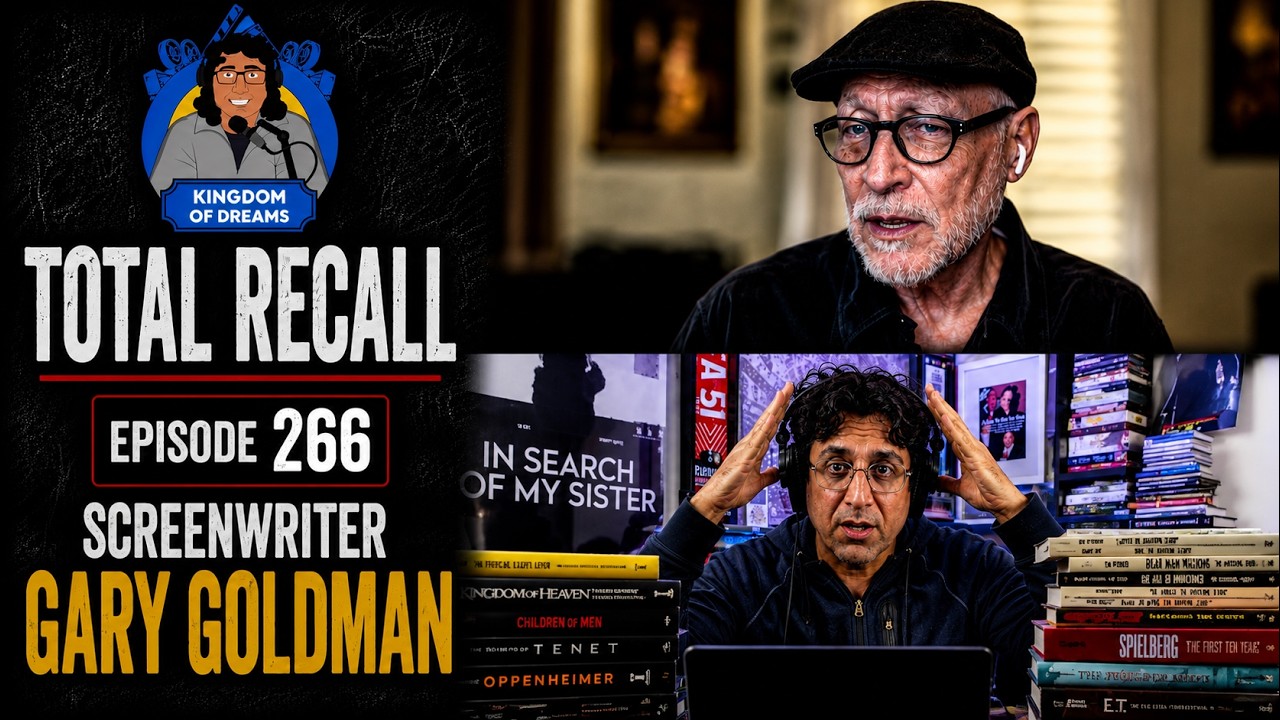
'Total Recall', Screenwriter, Gary Goldman
About this episode
🎙️ On this episode of the Kingdom of Dreams Podcast, we sit down with screenwriter and producer Gary Goldman, best known for co-writing the sci-fi classic Total Recall and serving as Executive Producer on Minority Report. We explore how the futuristic worlds imagined in these films, once pure speculation, are now unfolding in our present day, raising questions about technology, surveillance, and free will. Gary also reflects on the creative and production challenges that Total Recall faced in its second half, offering rare insights into the evolution of a film that became a genre landmark. It’s a conversation about vision, perseverance, and how cinema’s imagined futures often collide with our reality.
Gary Goldman is an American screenwriter and producer known for his work on major studio films, particularly in the action and science fiction genres. He co-wrote the Arnold Schwarzenegger hit Total Recall (1990), adapting Philip K. Dick’s story into a blockbuster that combined sharp political undertones with high-concept thrills. Goldman also worked on Big Trouble in Little China (1986) and Navy SEALs (1990), contributing to their mix of pulp adventure and genre-bending storytelling. Beyond his credited works, he has been involved in numerous high-profile script rewrites and unproduced projects, making him a familiar figure in Hollywood development circles. With a career spanning decades, Goldman has earned a reputation for tackling imaginative, large-scale narratives that balance spectacle with subversive ideas.
#totalrecall #sciencefiction #arnoldschwarzenegger #paulverhoeven #future #ai #robots #sharonstone #cultfilm #remake #colinfarrell
Full transcript
Automatically generated from the episode audio, so expect the odd misheard word or name. Speakers were labelled automatically. About 11,000 words. Tap a timestamp to play from that moment.
0:00Gary GoldmanTotal Recall was a really interesting screenplay. I read it around the 1980 or so. It was always a great screenplay, but it kind of fell apart in the second half. David Cronenberg was the director in the beginning, and, you know, I mean, that's… that was the tone of it. It was gonna be dark. Patrick Swayze was supposed to be in it. Richard Dreyfuss was supposed to play the lead. And then, Arnold had always liked it and brought it to Carolco. They had to pay a kind of a ridiculous price in order to get it.
0:34Jawad MirGood morning, everyone. Welcome back to yet another episode of Kingdom of Dreams podcast, The Making of Stories. I'm your host, Jawad Mir. Today, my guest is screenwriter Gary Goldman, who has been responsible for being involved in some of the most incredible films, especially in the sci-fi genre, particularly being the writer on Total Recall and executive producer on Steven Spielberg's Minority Report. Although we talked about Total Recall and very briefly about Minority Report, the conversation focuses a lot also on the future elements of the film that were predicted way back then that are coming true now, of course, with a lot of in-depth conversation about the film itself. So without further ado, here is my conversation with screenwriter Gary Goldman for Total Recall, starring Arnold Schwarzenegger. Thank you so much, Gary, for joining on Kingdom of Dreams podcast to talk about the film Total Recall. Truly appreciate it. I, you know, obviously went through your credits.
1:35Jawad MirOne of my childhood films that I watched several times was Big Trouble in Little China… ... Which you wrote. Minority Report is one of my favorite films, which you, I think, were EP on.
1:47Gary GoldmanYes
1:47Jawad Mir... And, yeah, so phenomenal work. Thank you so much for joining.
1:52Gary GoldmanMy pleasure. My pleasure.
1:54Jawad MirHow... So, you know, two of the films, among many of the films that you worked on, two of them are M… Philip K. Dick stories, right?
2:02Gary GoldmanRight
2:02Jawad MirThe short stories that he's worked on.
2:03Gary GoldmanWell, actually three.
2:05Jawad MirThree? Which was the other one?
2:06Gary GoldmanNext, N… Next is also from a Philip K. Dick short story.
2:09Jawad MirReally? I did not know that.
2:11Gary GoldmanYeah. It's credited that way, but in a sense, you're correct because I only kept the nearest central idea of the short story.
2:21Jawad MirGot it. Got it. So was there a fascination with his stories that kind of... I mean, they are about future, and it's kind of weird…
2:29Gary GoldmanRight
2:29Jawad Mir... How all of that is sort of unfolding in front of us right now.
2:33Gary GoldmanYeah
2:33Jawad Mir... What, where did that fascination come from? How did you get introduced to his work and decided to sort of take it upon yourself to pursue that?
2:42Gary GoldmanIt happened more or less accidentally. Basically, I'd always loved science fiction as a kid, but I wasn't a particularly, a avid fan of Philip K. Dick. And then, the screenplay for Total Recall came to my attention at a certain point, and it led seven or eight or nine or years later to working on the screenplay, and that led to Minority Report, and that led to, you know, basically suddenly now I had a trend going here. And I pursued it with Next, which came from a short story called "The Golden Man." And then I continued it one more time with a project called Vari… Variable Man from a novella called Variable Man…
3:25Gary Goldman... Which I wrote as a spec screenplay with a collaborator named, a writer named A… Angus Fletcher, which we did not sell. So I had this run of three consecutive Philip K. Dick projects, and then, you know, one more. And at that point, you know, I, sort of the s… the string was broken. But I realized a number of years ago that I had a friend a long time ago who had touted me on Philip K. Dick as being a great, brilliant writer, and that,.. And he ended up making a Philip K. Dick movie himself. He did, his name is John Alan Simon, and he wrote and directed a small film based on... Oh, I can't remember. The, o… one of Dick's later works. And he, and he touted... He almost got made a movie called Flow My Tears, The Policeman Said.
4:21Gary GoldmanAnd at one point, he even had, Tom Cruise attached to it. And I realized that somewhere in my mind, I, you know, his original introduction to me might have planted the seed, and I wanted to acknowledge that today because I've, I haven't mentioned it before. I've always sort of e… explained to myself that my interest in Philip K. Dick, developed on its own without any precedent. But he was there, and he told me about it, and he, you know, he was a, he was a fan before I was.
4:53Jawad MirRight. Oh, thank you for sharing that. I appreciate that. You know, I find it, and please tell me if, this is, like, just a generic observation.
5:02Gary GoldmanYeah.
5:02Jawad MirYou know, in the s… 80s and the 90s and even early 2000s, there were a ridiculous amount of sci-fi films, like, that sort of…
5:10Gary GoldmanYeah
5:10Jawad Mir... Foretold the future, right?
5:12Gary GoldmanRight.
5:12Jawad MirBut if you look in the current climate, there's not that many, other than, like, alien invasions or, you know, things like that. But there's nothing like, you know, Total Recall that kind of tells you the future or minor... It predicts the future…
5:25Gary GoldmanRight
5:25Jawad Mir... Or Minority Report. Am I quick in assessing that? Is that something you have seen too if you think about it?
5:32Gary GoldmanYeah. Well, I'm not sure, I'm not sure I would agree with that. For example, The Matrix.
5:39Jawad MirNo? Well, Matrix came in the 90s, right?
5:41Gary GoldmanWell, that, you know, that's the, that, to me, that's yesterday. But yeah, it m… it may be that since then, most of the ideas have not been really explored. They've been explored on a more microscopic level. For example, Ex Machina. You know, the, you know, th… this is a good sci-fi movie that explores the, you know, the borderline between life, re… human intelligence and artificial intelligence.
6:06Jawad MirYeah.
6:06Gary GoldmanAnd it's excellent. And then I thought, there was a great animated movie called, The Hendersons vs. The Machines.
6:14Jawad MirOh, yes. Yes.
6:15Gary GoldmanWhich is…
6:15Jawad MirYes.
6:16Gary GoldmanI mean, and that, and, I, which sort of dealt with some of the same issues that I was dealing with in my Variable Man adaptation. And I thought, "Yeah. That's right on. That's right on." But, you know, and, but I do feel that, of course, it, we're, we're about... And then since then, science has overtaken science fiction. You know, I mean, what's happening right now with AI is, it's happening in real life. And so I found that when I look around and see what people do with AI, you know, in terms of, you know, sci-fi movies, that it's not very interesting. And that the, you know, I have a lot of ideas for what I think is interesting about the future of AI and humanity. And, I would like to write some stuff about that. But, I do think that these themes we're... I would predict that we're about to have a huge resurgence of interest in science fiction as people now explore the dra… the dramatic and thematic, opportunities of thinking through AI.
7:24Gary GoldmanAnd with the, I mean, with so many, you know, and some of them are bound to be interesting. I don't know that it's very... It's not that easy to get ahead of this curve. You know? I mean, for example, what is science, in terms of science fiction showing you the future before it's about to happen, I feel very much that the thing that's about to happen is ahead of our ability to envision it.
7:48Gary GoldmanAnd so basically they're things like, we're very close to Terminator, right? We're very close to the idea that people can easily imagine automatic robots and the idea that our military decision-making will become so f… need to be so fast that it's computer versus computer. The humans will be left out of the, left out of the loop, and we really will be dependent on the computers. And then I think, you know, William Gibson, even from the very beginning of his career with Neuromancer, imagined very interesting a… perspectives on what this meant with, for example, the, immortalization of a, of a person's intelligence or the immortalization of a group intelligence. These, I think, are more advanced ideas. I've al… always been a little bit surprised that it's taken so long for them to get to the screen, maybe because they seem a little too internal.
8:48Gary GoldmanBut, they are finally getting around to doing Neuromancer as a limited series.
8:53Jawad MirOkay.
8:54Gary GoldmanAnd, a… and so I think that the more interesting, you know, the things that we can't do quite yet, are gonna start coming around again. And, a… a… and then of course, as the scientific advances actually happen, of course we'll, we'll just keep moving. But it's a little bit like how far ahead do your headlights work?
9:15Jawad MirYeah. Yeah.
9:15Gary GoldmanI mean, if you're able to imagine, if you're... I mean, we've already glimpsed The Matrix, and it's pretty hard to go beyond that. I mean, that's a little bit of a hard... You know, ev… everything is inside the computer. So it's, you know, I do think that it's gonna re… you know, re… it will require some real imagination. And I have some ideas on it, because I think it, basically what happens is that it starts to enter the realm of religion. And basically science fiction st… you know, s… the li… we're, we're now, we're now, we're now about to have the technology to recapitulate religion. I mean, the things, for example, I used to feel like, "Well, I can't believe in God, that any, anyone, any being could actually know everything that's going on and what's going on in everybody's life and what they're thinking." And now I realize, "Wow, boy, that was so limited of me." Because we human beings are almost on the verge of putting a little chip in every person's head and then connecting it to a computer and having the computer understand everything, and then giving you the opportunity to become a more, you know, having your identity downloaded in some digital form into the computer and for you to live forever inside of the computer and for the computer to be able to judge you morally and to decide whether you get access to this immortality based on a moral algorithm that it's developed.
10:36Gary GoldmanAnd if not, you know. I mean, or even a Hindu version where you have to keep reliving this game over and over again until finally you get it right. So I think all of, you know, basically that's w… that's, to me... Yeah, you know, I mean, I guess I should keep writing my science fiction. But, this is, this is, th… yes, I think these things are coming. I think we're very close to having the ability for a computer to know, to make a very good simulation of your entire psyche.
11:06Gary GoldmanAnd that you could, you could participate in this. Throughout your lifetime it charts everything you do. Every click stroke, you know, every click. Everything you've read, it reads along with you. All your experiences. It,... And it, you know, I mean, I'm probably not gonna go into this business, but, you know, I mean, I definitely believe that you could have a, you could work on an ongoing simulation of yourself so that your, you know, the simulation, you know, you could, you could say, you know, you can keep testing it and testing it and what would it do in this situation. And the, and the computer keeps testing your simulation against you and what you actually do. And then you, then you critique it and you say, "No. W… w… what it got wrong here was that I was thinking this, and that's what caused me to do that." And little by little, the simulation could become an almost exact predictor of you. And you could meet it, and you could say, "Well, if I were gone, if I were dead, and this thing lived on, I would really feel that I was still there."
12:07Gary GoldmanYou know? I mean, my consciousness might not be there, but as far as everybody else was concerned in terms of, like, having a kind of immortality, this would be very close to it. And I don't think we're far from that at all.
12:19Jawad MirYeah, no, I actually will go one step before that. I mean, not in a direct way, but like our, you know, if you look at our browser history, now you look at ChatGPT, almost everybody uses it. So pretty much there is, wherever it's going to a central data system…
12:38Gary GoldmanYeah
12:38Jawad Mir... Somebody is, or you know, whether it's AI or a group of human beings or whatever, a combination of both, is monitoring that, right? So I think we're already there, but yeah, the chip obviously takes it to the next level. And sometimes, you know, you... What's scary to me is I think one thing that I keep remembering over and over again, I remember in Minority Report there was a scene when, Tom Cruise, John Anderton's character, Tom Cruise, played by Tom, enters in Gap and, you know, there's a retina scan like from…
13:07Gary GoldmanYeah
13:07Jawad Mir... 20 feet away. And I used to wonder, "Oh, boy, I wonder if that's gonna happen in my lifetime." And that's been happening for the last seven, eight years at least.
13:16Gary GoldmanYeah.
13:16Jawad MirNot mainstream, but now it's on… you know, you can do facial recognition in a matter of seconds.
13:21Gary GoldmanYes
13:21Jawad Mir... So it's crazy that how that has unfolded. And a lot of stuff in Total Recall as well, you know, this idea of the dream and it, whether it's real. It's kind of like Matrix. Who knows where we are right now, right? I mean, you can…
13:37Gary GoldmanYeah
13:37Jawad Mir... Argue the religion part of it and everything, but is this a dream? Are dreams our reality? Who knows, right? So it's just this…
13:45Gary GoldmanRight. Well, I do think we're gonna be spending more and more of our time inside of fictional realities. You know? I mean, I do think that people can… will be able to have, you know, s… several different lives going on at the same time. You know? The idea... What were they called? I was, it was... I'm trying to remember. There was a big boom about 20 years ago for creating, you enter, you enter virtual realities, and you can interact within them. And
14:13Jawad MirAh
14:13Gary Goldman... And…
14:14Jawad MirI think, I'm not sure which one you're referring to, but I would imagine the thing that comes close to it is holodeck from Star Trek where you create, like…
14:20Gary GoldmanYeah. Right, yeah
14:21Jawad Mir... Time.
14:21Gary GoldmanBut…
14:22Jawad MirYeah
14:22Gary Goldman... Yeah, so I think that, I think that, really we are gonna be, we are gonna be... Hold on, I have to get rid of a message here that's right in front of you. W… e… everything you can think of is going to happen. I mean…
14:38Jawad MirYeah
14:38Gary Goldman... And people will be having relation… full relationships with artificial personalities.
14:45Jawad MirIt's already happening.
14:46Gary GoldmanAnd…
14:46Jawad MirThat's already happening.
14:47Gary GoldmanYeah. So when you ask the... So just sort of getting back to your original question…
14:53Jawad MirSure
14:53Gary Goldman... About s… s… sci-fi being ahead and v… you know, trying to imagine the future, I mean, the pr… well, you know, sci-fi will be, we have, like our headlights in a vast desert of darkness, and our headlights illuminate just a few feet in front of us. And I think that, you know, this, th… this level of, you know, the science fiction in the movies will continue to illuminate, you know, 150 or 100 yards in front of us reliably as we move forward. And then there'll be the visionaries, you know, who can try to, you know, to see the things that are not within your headlights yet. That's, that's a, that's a little harder. And I think it's, you know, and that's the, that's the part that I worry about the most. I mean, I mean, the thing that concerns me is what does it mean to have to be an individual and to have free will? And, so for example, in Variable Man, which, you know, I was very interested in this, and this is what I was trying to explore, that if you, if you have an AI that's been following your life and knows everything about you, and you walk into a bar and you say, "Gee, I wonder what I should order," and the, and the AI says, "Well, you know, you generally like Guinness, but here the Guinness is a little flat.
16:11Gary GoldmanSo w… you know, based on everything else we know, so we think that the thing that'll make you happiest here is to get a Sierra Nevada Pale Ale," you know? "And don't get the ham… we know you're really tempted to order a hamburger with onions, but don't because, you know..." So, and I'm saying, and if you listen to the AI, you'll be perfectly happy, and if you choose things on your own, you won't be as happy. And so the smartest computer in the world is the one that fixes you up with your mate.
16:44Gary GoldmanAnd if you decide and be r… really stubborn that you wanna choose your own mate, you'll probably be wrong and unhappy. And if you do what your friends are doing and listen to the computer and, you know, and marry the one that it picks out for you have a 99 point percent chance of doing better than you would on your own. And so on and so forth until finally what decisions do you still make? In other words, if you know what's smart and best, the only way to have free will is to willfully do something stupid. Otherwise, you're just gonna do what's normal and ra… rational and likely to work out. And then so w… w… what is free will now? Free will now is not knowing enough. Because if you knew enough, you'd know exactly what to do. We, the only reason we ha… we need free will is because we're living in this little gap between instinct and the actual answer that we don't know.
17:46Gary GoldmanAnd if we, and the closer we come to actually knowing that answer, the smaller and smaller is our range of free will. And I'm, unfortunately, I have a pretty pessimistic view of human nature. I, most of, most people flatter ourselves that we're unique and irreplaceable and, you know, we're inventing everything we do as we go along. But I really feel we're dangerously close, especially with, you know, to people losing the little, you know, little by little by little the capacity, the brain muscle, you know, to make that willful decision not to... You know, it's, it's only, it's only in that sort of quantum space… Of not being sure of what to do, that you actually even have free will. 'Cause if you know what to do, you do it. You're only really exercising free will in that little tiny space between I'm not sure. And so I'm, I'm just, I don't know, maybe I'm being too philosophical here. But knowing too much, having the computer know too much, having it all figured out, every step in that direction changes what it means to be human.
18:53Gary GoldmanSo if you could, if a, if a computer takes your job, well, maybe the government will put you on a, on this, you know, on the, on the stipend that everybody will stay home and play games all day or be creative. But if the computer is able to make the decisions for you, should you stay in this relationship or not? Should you... I mean, what's left of us? And I think that's an int… I mean, that's an interesting question that I think science fiction hasn't dealt with yet. If I were to write something new, I would write about that.
19:22Jawad MirInteresting. That's actually a very good observation, and I agree with you 100%. And I think I'll, again, even with this, I'll go one step backwards. You talked about relationship. You know, yeah, marriages don't work. Things happen. Maybe 30, 40 years ago, there was no such thing as a marriage therapist. Now there is.
19:46Gary GoldmanYeah.
19:46Jawad MirDoes, and a lot of people resort to that. Now, sometimes that may work out, but at the end of the day, it goes back to your argument. If we are not able to have that free will of making mistakes and figuring things out on our own…
20:00Gary GoldmanYes
20:00Jawad Mir... And we're relying on others, whether it's human and the next step is machine, then we're, what's the point? What's the purpose?
20:07Gary GoldmanRight.
20:07Jawad MirAnd that's the same thing we do in our conversations too. Like, "Oh, do you think I should do this? What do you think?" You know, to a friend or somebody. "Do you think I should eat?"
20:14Gary GoldmanYeah.
20:14Jawad MirSo there's that level of uncertainty when, and unless there should be spontaneity.
20:19Gary GoldmanYeah. Yeah. But n… now the problem here is, I think a problem that you find in most science fiction, which is that, I mean, there's, there's literary science fiction and then there's movie science fiction.
20:30Gary GoldmanAnd generally speaking, most of the really interesting stuff is not necessarily, I mean, every now and... I mean, they don't make a science fiction movie unless it's highly visual, and generally that means expensive and spectacular. And so basically, to deal with the interesting ideas, you have to, you know, be able to package it in a very visually spectacular…
20:54Jawad MirOf course.
20:55Gary GoldmanAnd so that's part of the reason why it's hard to write a good, intelligent science fiction movie because they don't really want the ideas. But if you can get, you really have to work very hard to slip them into a sort of a conventional story with a lot of production value. And then there's the sort of, technological prediction part, you know, in Total Recall, and in Minority Report. They did a great job of that in Minority Report. You know. But you know, a lot of that is available from consultants.
21:27Jawad MirYeah. Exactly.
21:28Gary GoldmanYou know. I mean, you know, I mean, you say, "Okay, what's gonna happen next?" And then you visualize it and, you know, and you know, and you say, you know, a world of cars that are driving themselves at 300 miles an hour and you put it on screen and, you know. And now of course. Al… also, there's been a trend, 'cause you're talking about time. The ca… the visual capabilities of visual special effects, it has completely changed. It's revolutionary. I mean, I remember the first, you know, beginning of digital effects, I went to this little convention called SIGGRAPH.
22:02Jawad MirYeah.
22:02Gary GoldmanNow finally, and yeah, and it was about using, remember they had these, it was in commercials. They would take the, you, there was letters A, B, C and turn them inside out, and you could fly in between the letters and it, that was new at the time. And now you can have fake people, fake environments. I mean, pretty soon, I mean, obviously the, we still shoot movies on location because the capabilities of the computer are not great enough and you can tell the difference. And that primo experience of being in the movie theater and being fooled, thinking that it's real, I mean, that's something that we like. But it's get… you know, that's a technological evolution now. Little by little by little, you know, the fake will become more and more real. So, it'll be interesting to see what it is that continues to shock and surprise people in terms of…
22:58Jawad MirYeah
22:58Gary Goldman... You know, what the, what the future holds. 'Cause so much is already now because of the capabilities of the visual effects capabilities. It has pushed that way ahead that you can convincingly imagine things in the future.
23:12Jawad MirI see.
23:12Gary GoldmanBut…
23:13Jawad MirYeah
23:13Gary Goldman... But I don't know. I mean, I imagine the future might become more, I mean, I think that there's a, for example, in Total Recall there's something I'm really proud of. There's a girl in the Recall, the f… the receptionist in the Recall anteroom is on the, she's doing her fingernails.
23:31Gary GoldmanAnd I thought, okay, you know, I mean, like, you know. I mean, the ways in which technology will infiltrate our normal lives is, I still think, kind of interesting. But you know, the obvious thing is, I mean, I've written a number of car chases, you know, saying okay, you know, the cars are, the cars are being driven by the computer and they're going 300 miles an hour, you know. And then you have a person on foot, you know, or another person in another ve… and then someone manages to hack it, and they're trying to, you know, they're going 60 miles an hour or 80 or 100 mile. You know, it's imag… imagine the guy, the driver of the F1 race car is catapulted in the future where everything is going 300 miles an hour. What does he do? I mean, you know, these are like fun movie things that, you know, I think audiences will still respond to.
24:19Jawad MirYeah
24:19Gary Goldman... And but I don't have anything in my pocket right now to, you know, to, that would be visually spectacular. I mean, I have ideas for what the, how the future will really be different and fun and spectacular. I think a lot of it unfortunately is gonna be… A lot of people sitting in a chair immersed in something, and that... So then the real world becomes, you know, we're, we're now living in this world of infinite visual possibilities.
24:50Jawad MirYeah.
24:51Gary GoldmanAnd then not only that, we're gonna be able to change the channel like we do now on TV, and be in, be in any of those. We'll be able to…
25:01Jawad MirInteresting
25:01Gary Goldman... Be in them, and to, you know, and to live them. They're all gonna be, pa… you know, expanded out into the ten zill… you know, in other words, the possibilities that are available, the p… the r… the paths. And it'll be, and it'll become more, and more, and more realistic. And…
25:19Jawad MirYeah
25:19Gary Goldman... I was, I just, a f… a couple of months ago I tried out the Apple, I can't remember the name of it. Is it…
25:25Jawad MirOh, the, VR headset
25:28Gary GoldmanYeah.
25:28Jawad MirYeah.
25:30Gary GoldmanOkay. So…
25:30Jawad MirApp
25:30Gary Goldman... It's fan… it's fantastic. But the most interesting thing about it to me was the emotional, the feeling of what you're experiencing when it's so real and it's all around you. Suddenly you... It evokes real emotions in you in a way that looking at a lower resolution, less immersive image doesn't. I remember a while back Doug Trumbull had this 70 millimeter, process of, like, 60 frames a second.
26:10Jawad MirSure.
26:10Gary GoldmanAnd they had a, and they had a demonstration of it, and it was amazing because it, you know, it basically, it fools your mind, your brain better. And because it fools your brain better, you're more immersed in it, and you're, and it's more of an experience. And it wasn't necessarily more dramatic or more interesting, but I mean, your brain knew. I mean, watching that, you would come out of it, the screen disappeared. It wasn't you were n… you were not aware of a surface anymore. You were t… definitely much more, like, there. You know, they did, they did the usual rollercoaster shit, you know, and your stomach would, "Bleh," you know what I mean? It fools your brain into that. And now, the a… the Apple thing is that way. And basically the most powerful thing that it did was that, you know, you're, you're, you're hanging in a sack on the side of, like, El Capitan in Yosemite.
27:02Jawad MirNice.
27:02Gary GoldmanAnd then there's a, and then there's a pretty girl, and you know, and, like, you know, she comes up and she reaches out to you. And, you know, and the visceral reality of her presence, you know, like making your heart beat a little faster and things like that, was just infinitely more lifelike and powerful than watching it on a screen. So when we have these, when we ha… I mean, as it continues, we'll be able to, when we go into these immersive environments, they're gonna be satisfying, or challenging, or difficult, or whatever. But I mean, they're, it's gonna be more than just a, like, it's gonna, not gonna be that easy to detach.
27:42Jawad MirYeah.
27:42Gary GoldmanYou know what I mean? It's gonna be better, and better, and better, and more and more of our lives are gonna be spent inside of these environments.
27:49Jawad MirI agree. And by the way, the way you ta… talked about the Apple VR headset, you should work, do some spokesman work for Apple.
27:55Gary GoldmanOh, thanks. Well, you know, I... Well, you know, I think it will be particularly... I mean, right now I think it's, it's really useful for things like nostalgia.
28:06Jawad MirYeah.
28:06Gary GoldmanFor you to be able to go into your past and your pictures, and to experience them that way is, already a huge improvement. And the fact that the headset is heavy and a little uncomfortable and all, you know, I mean, there are some problems…
28:21Jawad MirIt's a first iteration
28:21Gary Goldman... There's some problems with it now. But I would say that, I mean, if I were, you know, if I were starting a family, I would get one of those immediately, invest in it, and then I would go, you know, chick and take pictures of my babies growing up. You know?
28:35Jawad MirYeah.
28:35Gary GoldmanAnd then go back and relive them because you c… you know? I think, I think it's... I'm a little surprised that it's not catching on that much for, you know, among that segment because I really, I think it's, that's, that capability is already there.
28:49Jawad MirI think it's more about the price than the product, just because… ... With the economy and everything. But I do…
28:55Gary GoldmanYeah
28:55Jawad Mir... Think that, you know, I recently just a couple of... I think it was last month. W… we were invited to someone's birthday and there was, like, one of those VR games that you…
29:06Gary GoldmanYeah
29:06Jawad Mir... You know, and you put that thing on, the helmet. And the graphics were okay. They were nothing fantastic, but it was basically you're on this ship and, you know, there's aliens, and you're trying to survive, and you're trying to kill as many as possible. That's the whole idea. But I was, I think it was a 30-minute session, and I was so into it. Like, you know…
29:27Gary GoldmanYeah
29:27Jawad Mir... We had, like, a gun, like a toy gun, and I felt like I was, like, running around, jumping, holding the gun like this because I was so into it. And then I saw the video of us outside in the real world moving around.
29:39Gary GoldmanYeah.
29:39Jawad MirWe looked like a bunch of fools you know…
29:41Gary GoldmanYeah
29:41Jawad Mir... Walking around the open environment. But it's, it's interesting your theories, on that. And I think one of the things that you talked about, the visual, importance in a film more than the script. Not to take away anything from Total Recall, it had a great story. But I think the production design, and the special effects, and all that, even for today's time, I just saw it like a few days ago.
30:08Jawad MirIt's quite remarkable, right? And it goes along with the films like Blade Runner and Mi… Minority Report, where everything is not extremely futuristic. There's still elements…
30:21Gary GoldmanYeah
30:21Jawad Mir... Of the present.
30:23Gary GoldmanYeah.
30:23Jawad MirWhat kind of... What, when you got onto Total Recall and you started writing it, and I think you had a couple other writers too, at least according to IMDb. Please correct me if I'm wrong.
30:33Gary GoldmanYeah. Yeah.
30:34Jawad MirAnd how did that all process start, and then getting into production, and how involved were you in production, if at all?
30:44Gary GoldmanOkay. Okay, so the project, the T… Total Recall was a really interesting screenplay. I read it around 19... Oh, I don't know, 1980 or so. And it didn't get made until, I guess, it was released in 1991.
31:00Jawad MirYeah.
31:00Gary GoldmanYeah. So it took a long time. It had been, Ron Shusett was the guiding light of the project, and he was working with Dan O'Bannon. He teamed up with Dan O… Dan O'Bannon on Alien. And they were a team, and they did it. You know, and so they worked together on Total Recall. It was always a great screenplay, but it kind of fell apart in the second half. And then everybody kept trying to make the second half work, and it went through, you know... But it w… everybody, you know, it was... Everybody wanted to make the movie, and it had, David Cronenberg as the director in the beginning. And, you know, I mean, that's, that was the tone of it. It was gonna be dark. A lot like the remake.
31:39Gary GoldmanAnd then they got, I don't know how long David Cronenberg was on. You know, Patrick Swayze was supposed to be in it. Richard Dreyfuss was supposed to play the lead. W… Bruce Beresford went into pre-production with it in Australia.
31:57Gary GoldmanI think with Patrick Swayze. And then Dino De Laurentiis' company went bankrupt.
32:02Jawad MirYep.
32:02Gary GoldmanAnd then, Arnold had always liked it and brought it to Carolco, and Carolco... And maybe he brought it to, Paul. And so suddenly Paul, Arnold, Carolco, who was this big p… independent production company, they snapped it up. And they had to pay a kind of a ridiculous, like, price in order to get it. I mean, it w… it was... In other words, what they were buying was a screenplay. But to get the screenplay, they had to pay for however, all the money that Dino De Laurentiis had spent on it for 10 years. But they did.
32:32Gary GoldmanBecause they wanted the screenplay that badly. And then after that, I was the only writer. But there had been many writers before that. So in terms of the look of the film, I mean, it, Ron wanted it to end on Mars. He wanted that f… that, the whole Mars section. So, and t… but he didn't have a lot of,.. And there was the Johnny Cab, and there was the pulling the thing out of the nose. Th… that was from Ron. And Ron had also, you know, it was already, the Quaddou was there. You know, the alien. A lot of the, smaller things, the environmental window in the, in Arnold's apartment, where he's able to sort of watch the... You know, there's a, there's a nature scene outside, and then the TV. The fingernails, the specifics of recall and the idea, the whole idea that it might really be real and not just a fantasy.
33:31Jawad MirYeah.
33:31Gary GoldmanThat's, that's more or less resolved in the earlier screenplays at about the half point. And we, Paul wanted to keep that going throughout the whole movie… ... You know, as long as possible. And we did. We kept it to the end, where, you know, Melina says, Arnold says, "But what if this is all a dream?" And then she says, "Kiss me quick before I wake up. Before you wake up." And so it's really continued all the way through, and that was, that was important. The idea of the underground reactor was from Ron and Dan O'Bannon. The specific look of it was from some,.. Actually, my wife gets a little bit of a tip here. She... There's a, I think a guy named Hugh Ferriss, who's, a, an artist, and he did some art deco drawings, and that was the specific inspiration for the way the reactor looks, underground.
34:29Gary GoldmanThe idea that Arnold would be hiding inside of a very large woman was my idea. But the idea that her head would split open was Ron Botin's idea. Ron Botin is, you know, Paul's practical special effects guy.
34:49Jawad MirYeah.
34:49Gary GoldmanAnd so he, you know, he's more like a puppeteer, kind of. He builds actual devices, and then you have to shoot them just right. And then, you know, if you shoot... You know, if he makes them pretty well, I mean... I mean, if you see them in real life, they're not at all convincing. But if you do them right and they move right and you cut them right, you know, then it's like, ah, you know, it, they seem real enough, especially for that time.
35:10Jawad MirNice. Yeah, no, the visual effects of that, the head kind of opening up…
35:15Gary GoldmanYeah
35:16Jawad Mir... Like in little blocks, I always thought it was kind of weird how it was done. But at the same time, it was so unique that how it was done that you've never seen anything like that, even since then, right? It just s… stands out.
35:29Gary GoldmanWell, you know, the thing is that there are certain things in a movie which make sense and certain things that don't. But if, but if they, if you, if you buy into them while they're happening really fast…
35:37Jawad MirYeah
35:37Gary Goldman... You totally accept it. And so the idea that, the idea that, you know, that, like, "Is that fat lady Arnold?" I mean, that's a great disguise. How could that be? And then the transition to paying it off was great. That was brilliant and innovative and it was so bizarre, no one could possibly have anticipated it. Right? I mean, there's no way you could have said, "Oh, I know what's going to happen next. The head is going to split open." I mean, right? No…
36:02Jawad MirYeah
36:02Gary Goldman... Absolutely many steps ahead of the audience in terms of, you know... And that's the fun. I mean, part of the fun of filmmaking is to be ahead of the audience. I mean, that's sort of the game we play because, the au… most of the audience has seen a lot of movies. And so, and you're playing... The game you play is you have to satisfy certain ob… you know, expectations and then defy certain expectations. And you know, and the more things have already been done, the harder and harder it is to fool an audience so they don't see, "Oh yeah, this is solution one. This is solution 47. This is..." You know what I mean? These are things... It's very hard to play this game with a sophisticated audience. So, what you want is to surprise them in a way that afterwards they say… I didn't see it coming, but it makes sense. Yeah. Yeah. You know, and that's hard. It really is. It's a hard space to work in.
37:03Gary GoldmanOh, what was the other thing I wanted to say? Oh, the three-breasted woman. That was me. But that's not exactly unimagine... You know, a vision of the future, but it is a... You know, it was a kind of a funny idea. And but also, the... I would say part of the look that you're after is Paul likes one... He has a vision that he used in Robocop that he kept in Total Recall. He didn't want, I mean, he didn't wanna do dazzling things that seemed... He wanted everything to seem normal and real. There were still newspapers. People were still having relationships. Yeah. You know, the s… the, it wasn't sort of taking place in a, in a world where, you know, there are totalitarian leaders and everything is different and it's... No, it's like it's our world just a little bit in the future. Everything should be recognizable, and y… you know, you can figure out how they got from here to there. Yeah. And that nothing that's, that's, that's there is something that you couldn't imagine, you know, another... And that the surprises happen within that space.
38:04Gary GoldmanYou know? Not, "Oh, we're gonna dazzle you. We're gonna show you s… you know, a space port." You know, we... That wasn't it. It wasn't to try and show something i… unimaginably grandiose. Yeah. It was to try and make it, make it believable within a kind of a near future. But, and that was tough for a few reasons. The premise seemed quite far-fetched at the time. It doesn't seem that far-fetched now. So the idea is how futuristic does the world have to look in order for you to believe that you can buy a memory? Yeah. And then… Yeah... The idea that the, that, oh, wait a second. In the fu… you know, the technology is glitchy, and this is a malfunction. You know, that's kind of a fun idea that makes it feel very real. And a little bit of a s… a small innovation from, like, a future where everything works perfectly. And then, you know, and, what was the other thing I wanted to say? Oh, Mars. I mean, it's, you know, it's, it's underground.
39:04Gary GoldmanIt's cl… you know, it's, it's, it's claustrophobic. They've got domes. There's not enough air. It's dirty. It's grimy. But then there's an alien reactor underneath it, which is an unimaginably futuristic technology, which not only is capable of transforming Mars, but it's capable of doing so in the course of a movie sequence while you're watching. Yeah. Right? So that was, that wa… that was the biggest stretch, which is that we're gonna show Mars being terraformed before your very eyes. And that, and that is gonna come in time, that after the, between the time that the domes break and the people don't have air anymore, and the time the planet is terraformed and they can breathe real, natural air from the atmosphere, is gonna happen, you know, in real time. And in a sense we get away. That's quite preposterous. You know, there's absolutely no reason to think that could ever happen. And you, we pull it off with, you know, movie magic and sound effects and things shaking and cutting here and cutting there and trying, you know, just sort of creating our own false, reality.
40:10Gary GoldmanBut in part it i… it's that the movie feels a little bit like a fable. It keeps going deeper and deeper from things that are just very real, you know, people living in small apartments, to the idea that there's alien shit un… underneath and nobody quite knows, and there's a guy with a n… you know, a mutant inside of another person, right? And then they're gonna, like, r… they're gonna r… re-erase, you know, un… un-erase Arnold's memory and put him back to being Hauser, that's possible. And then finally you go there and you see it, and you're there underneath it, and you see the size and the grandiosity of it, and then you finally come up to this place where there's a, an alien handprint. And little by little by little, we kind of relax your, the audience's sense of that this is gonna has to be real, to the idea that this is going to be this is fantastic. This is, you know, this is beyond your imagination. This is something from cosmic interaction. And, you know, and I would say that the movie creaks a little bit at that point in the end.
41:12Gary GoldmanAnd I'm, I've never too fond of the, you know, the bulging eyes shot at the end. But I felt that as a p… as a kind of a poetic ending, combined with the idea that it might just all be a fantasy. I mean, blue sky. I don't know if you remember if… Yeah... Blue skies on Mars is, yeah. So I mean, the idea is at the end you can say, "Oh yeah. Oh my God. This is the story, blue skies on Mars." And you accept it, and the whole thing is gonna a fantasy that's gone haywire, and the movie ends. So, you know. Now… Yeah... The as… i… in terms of my participation, I, this was the best experience, work experience of my life. I worked with Paul. Paul loves his writers. He doesn't have a Hollywood idea, which is sort of like writers are interchangeable and replaceable, and you don't want them around on the set. His writers are, they're with him on the set. We worked really closely. He shot the entire screenplay. I don't think there was one... He didn't, he didn't add anything. He didn't improvise anything. He didn't take out anything. The one, the one change he made, there was one scene we changed, which is the, where the lady has to, the old lady tries to take away the briefcase.
42:21Gary GoldmanThat was the... That's not one of my favorite scenes, but it worked. It sa… it saved us a few million dollars. It cut out, it cut out a big action sequence. So we put that in instead. I get a call one day from, I'm in my office. I had a little office at the, studio, the Churubusco, in Mexico City. They said, "Paul needs you on the set." Rushed to the set, and, they're shooting a scene where, Sharon has just come to Mars, and, the whole Dr. Edgemar scene has happened, and the walls blow in, and she's, she's standing above him… And, you know, and the other bad guys are there. And Paul says, "Well, she's on the ground. I want her to say something like she should handcuff him." "What should she say?" I said, "Cuff him." Okay. And so, and so he said, "Okay, great. Paul, so Sharon, say cuff him." And then they shoot the scene and she says, "Cuff him." And I said, I said, I, there was a journalist on the set and I turned to the, to the journalist.
43:26Gary GoldmanI said, "I'm sure glad they don't pay me by the word."
43:30Jawad MirThat's amazing. That's such a cool story. I mean, Paul's work is phenomenal, right? Like Robocop is, to me, still is one of the most violent movies ever made, but it's such, so humanistic. Like the whole film is him trying to find his identity, right?
43:46Gary GoldmanYeah
43:46Jawad Mir... And I don't know what you thought of the new Total Recall with Colin Farrell and Kate Beck… ... And Kate Beckinsale, which was actually shot in Toronto here, where I am. It looked, you know, if I hadn't seen the original Total Recall, I would've said, yeah, this…
44:01Jawad Mir... Is a great film. Yeah, it was very kind of like present times and everything, but there was just this film noir type of feel of the original one that the new one didn't carry it. I don't know if you had any thoughts. I think you were kind of involved in it, or were you…
44:15Gary GoldmanNo
44:16Jawad MirNo?
44:16Gary GoldmanNo, I wasn't involved.
44:18Jawad MirOkay
44:18Gary Goldman... They, be… because I don't have separated rights.
44:21Jawad MirOh, I see.
44:21Gary GoldmanI mean…
44:22Jawad MirI see
44:22Gary Goldman... You know, I mean, I came on with the last writer and so I don't have, I don't share in the story credit. But on the other hand, Ron Shusett was. Did have separated rights, but he wasn't involved either. So n… n… you know, basically they just went off and did it on their own.
44:37Gary GoldmanAnd I think, I think, well, that their basic idea was to do more, something more like the original version of Total Recall. I mean, the ver… the original Ron Shusett, Dan O'Bannon version. But also to take out all the silliness, to make it, that it was a good enough story, that the ideas are interesting enough. We can make this without getting corny. We don't have to go to Mars. We don't, you know, we can, we can make it about what it…
45:05Jawad MirYeah. Yeah
45:05Gary Goldman... We can make it about what it's really about. I mean, by the way, Paul and I considered taking Mars out and, you know, and Ron Shusett, it was in his contract that you couldn't take Mars out. Really. I mean, because Ron…
45:18Jawad MirYeah
45:18Gary Goldman... Ron was, had made the, had made the deal for, Total Recall right after Alien, and Alien was such a hit that he had a lot of clout.
45:26Jawad MirYeah.
45:26Gary GoldmanAnd so he was, you know, he got the presentation credit. He got the idea that they... He, you know, you can't... The studios are notoriously protective of having the right to do whatever they want. If you buy a novel, you know, you don't, y… you give it up. You don't, generally speaking, it's very rare for a studio to give any kind of control over the script to anyone to, you know, but themselves. Even directors, you know, who want the final cut, they, and control, they, only a few get it. It's, they're very protective. Ron was very shrewd. He boiled down like six or seven points that he considered to be essential to the story, and if they changed any of those six or seven points, then the project would revert to him.
46:12Gary GoldmanAnd one of those points was that it had to end up on Mars. So we really couldn't, you know, we couldn't do it, even though Paul really liked that very much and I didn't like it very much. We had to struggle really hard to sort of make it work.
46:29Jawad MirYeah.
46:29Gary GoldmanAnd in fact, I'll tell you, I'll get back to your... Well, no, first I'll answer your sto… your question about the sequel. So I think that was their goal, and I would say that, you know, I was sympathetic to this goal because I, you know, it would be, I do think that there's room for a serious version of Total Recall. And it's not entirely clear why, I mean, and I didn't think the movie was terrible. I don't think it was as bad as the reviews said. Of course, I was flat…
46:55Jawad MirYou're talking about the new one, right?
46:56Gary GoldmanYeah, the newer one. Yeah.
46:58Jawad MirYeah.
46:58Gary GoldmanYou know what I mean? I wasn't as hard on it as the reviewers were, although I was happy to see that it got bad reviews because it, you know, it made my, you know, the original look better by comparison. But I wasn't that bad. We were invited to the, to the premiere and I went up. You know, I, you know, went to the director and I, you know, I told him that I liked his movie. And, but I do think that strangely enough, all in all, this certain thing that b… came together with Paul and Arnold, and the script and the form it was in, tailored for Paul and Arnold, had such vivacity that's really what was missing, was this incredible vivacity that imbued... I mean, it's, it's got enough in it. I felt this way when I saw Robocop. It has enough in it for three movies. And so I was intimidated by that when I saw it in the theater, and then I was inspired and challenged to try and do something, you know, to try and make our Total Recall as packed a… as Robocop.
47:58Gary GoldmanAnd the pace is relentless. I think there's just something about it. It's a very, it's very special, and Arnold is charming, I think. And I think that strangely enough, although Colin Farrell is a, there's no question he's a really great actor and as a pure dramatic actor, he's a better actor than Arnold Schwarzenegger. But Arnold's performance is more endearing, and I would even say that to a certain extent you feel it more. And I don't, you know, in other words, I don't know why that is. I mean, but I really feel like you f… you, I felt the predicament of Quaid w… as Arnold was going through it more than I did with Colin Farrell going through it. And, you know, and that's, the audience, that's what the audience wants, meaning that you're gonna live through this. And so I do think that it was, I think probably, you know, maybe a bit in retrospect people will not be as hard on that movie. I think they were…
48:50Jawad MirYeah
48:50Gary Goldman... A little, a little too hard.
48:52Jawad MirYeah, no, I wasn't hard on it. I just thought it was, it was not as good as the original. And I think to a… to kind of talk about what you're saying, that… Arnold was a bit more endearing, and I think that is because, you know, Colin Farrell, despite being a great actor, I mean, he's got a charming personality, charming looks and everything. Arnold may not be other than his bodybuilding, you know, physique, but I think that what plays against it is this, there's this big guy trying, going through all this problem, and even though you think he will overcome them, he's facing obstacles after obstacle. And then Arnold Schwarzenegger, the way he has his talking, you know, "I'll be back," like I'm the denominator
49:28Gary GoldmanYeah
49:29Jawad Mir... You know, right, his accent. I think that played in his favor, too. But I, again, I think it's a g… as film is a collaboration effort, right? So there's a production design…
49:40Gary GoldmanYeah
49:40Jawad Mir... There's writing, there's everything in there that just clicked. I mean, the m… the way, I think the sets, to me, like they… ... Made the film. Nothing against anybody else. Like, you know, it was just one of those things that takes you into that place…
49:55Gary GoldmanRight
49:55Jawad Mir... Of physical locations, and…
49:57Gary GoldmanRight
49:58Jawad Mir... A lot of time and effort went into making them.
50:00Gary GoldmanYeah. Oh, so let me talk about that. The production designer was Bill Sandell, and just a c… few weeks ago, there was, the production design union…
50:10Jawad MirConference
50:10Gary Goldman... Guild.
50:10Jawad MirOkay. Yeah.
50:11Gary GoldmanThey ar… they arranged, they have a series of movies and they project them at the Egyptian Theater on Hollywood Boulevard. You know, gr… the great old movie palaces. And they did, they showed a 70 millimeter print of Total Recall, and Bill Sandell was there t… to speak about it. And, Bill, he did, so there are two things there. One is, are the, you know, the sets, and then the other thing are the locations. There were a lot of really great, brutalist, concrete…
50:45Jawad MirYes
50:45Gary Goldman... Ar… architecture in the, in, around Mexico City that we used. There was the War Academy. There were some of the subway stations. And so we were lucky that, you know, there was a look there that we, that, you know, that we could just shoot in. And then make the other sets match. So Earth was Mexico City. There were these, you know, pieced together parts of Mexico City. Mars was, you know, made to match, but of course most of it is underground and industrial and rock.
51:17Jawad MirSure.
51:17Gary GoldmanAnd I think he did a good, a good job of that. I'll give you an interesting, I'll tell you the best anecdote, from that, from his commentary. So we had the Mexico City subway station for a couple of nights, you know, a certain area where we could shoot in, and they were brutalist concrete and very modern looking. The problem was that the r… the subway cars were brightly colored orange and blue and everything like that. So what he had to do for these scenes, when they went to the railroad station, 'cause they wanted, you know, there was a palette of, you know, a futuristic palette they were working with, gray, silver, bi…, you know. And so he had to paint all the Mexico City, the, these Mexico City subway trains silver, and then when we were done they had to paint them black, yellow and green and red.
52:07Jawad MirOh, wow. Yeah, no, that look certainly was there, like the consistency of that silver, bluish, grayish elements in the walls in the subway and everything, and that's... And obviously the little town, I wouldn't call it a town, like little streets that they had created that goes into the restaurant.
52:27Gary GoldmanYeah.
52:27Jawad MirYou know?
52:28Gary GoldmanYeah.
52:28Jawad MirThat was, yeah, that was really well done. Yeah, no, again, it's, it's a collaborative effort, and Total Recall, I mean, it's, it's a great film, and this guy, I can't believe it's been 35 years.
52:42Gary GoldmanYeah.
52:42Jawad MirYou know? That long. But, amazing. Like I love sci-fi, I love futuristic sci-fi, but Total Recall is definitely up there for me among Minority Report and Blade Runner. And I, and even though I'm a huge Spielberg fan, I love Minority Report, to me Blade Runner and Total Recall give Minority Report a little bit of a edge, not because they were better films, but in the circumstances of technology that was available at the time…
53:13Gary GoldmanYeah
53:13Jawad Mir... As opposed to Minority Report, they did, went above and beyond in making the worlds look as real as possible.
53:21Gary GoldmanYeah. Well, I love Minority Report. I think it's a really good movie.
53:25Jawad MirSo do I.
53:25Gary GoldmanAnd I was, no, you know, no, and I say that in part because, you know, I didn't, I did a lot of writing on the movie. Ron Suskind and I wrote the first four or five drafts of Minority Report, and we didn't end up getting writing credit. We got our executive producer credit, but the writing credit we didn't get, even though a lot of what we wrote, you know, and the i… the main li… the ideas that we contributed didn't, you know, m… did make it into the movie. And in part it has to do with, you know, I mean, I would say that according to one way of looking at the apportionment, you know, in one way you could say it was just and in another way there were a lot of,.. The Writers Guild has rules, and because Ron and I were also producers on the movie, there were rules that, I mean, we could have actually contributed 80, something like 85% of the movie, the writing, and still not gotten credit under the spec… the specific way, rules they were using, because there was Ron and me, and there was a... The short story, Minority Report, was originally brought to my attention by a writer named Robert Goethals, who was I think an unproduced writer, although he might have had a couple of, TV episodes, and he was the boyfriend of one of my wife's friends.
54:33Gary GoldmanAnd he said, "Do you know about Minority Report?" And, you know, and I, so I kept him involved, and he worked, he worked on the first draft with us together. But then, various things happened and, you know.
54:44Jawad MirYeah.
54:45Gary GoldmanAnd we ended up doing some drafts, just Ron and me, when we got to, 20th Century Fox. It started off at Carolco. We moved it to 20th Century Fox. And so because of that, and because we were producers, we didn't get credit, but I do think that Minority Report is great and I think that it… Conceptually speaking, it pulls back from its idea. And maybe that's one of the reasons why... I mean, it's, for example, it's really great and they found a lot of, a very emotional reason for Anderton, that his son was kidnapped.
55:23Gary GoldmanAnd, I mean, and that's really great. That's Scott Frank and Spielberg working together, and those are great solutions. But, you know, Blade Runner says that, you know, Rutger Hauer is a real complete human being. You know, it doesn't, it doesn't... At the end, it doesn't say he's less than a human being.
55:39Jawad MirYeah.
55:39Gary GoldmanAnd so it's okay, since he's a full human being. That's a really radical idea. In Total Recall, the whole idea that Arnold chooses to, he says, "I don't wanna go back to being the asshole that I was. I feel like a completely real person, and my moral sense says that I wanna remain a good person, not go, not be a bad person and sort of sell out into being Hauser again." And that's a very radical notion. Also, the idea that the whole thing could have been a dream is a very radical notion. It's not just a technological trick.
56:08Jawad MirYeah.
56:09Gary GoldmanIn Minority Report, the short story, Anderton commits the crime knowing that he's gonna be punished for it, but that he has to do it anyway. In other words, there is no... He doesn't use free will to escape his fate.
56:24Gary GoldmanHe finds out why, given who he was and what his values are, what he needs to do. He has to kill this guy, even though he's gonna be punished for it. And so the idea is that, the idea is that the, it doesn't let you know that the Precogs are wrong, it says, "The Precogs are right." Now, and but he's gonna do it anyway, even though he knows he's gonna be punished, because it's, because it, the future of his society depends on it, at least according to his own values. And Spielberg turned this into a kind of a more or less a very familiar story, which is that, you know, you have free will and you can change. You know, that no prophecy is fixed, and you can change the future.
57:03Jawad MirYeah.
57:03Gary GoldmanWhich I felt like is, he pulls that off brilliantly.
57:08Jawad MirYeah.
57:08Gary GoldmanBut it's not a radical... It's not a d… it's not a challenging idea.
57:12Jawad MirYeah.
57:12Gary GoldmanAnd I would, and I would say that, if he had actually stuck with that, I mean, everything else about Minority Report was so good. I mean, you can't really say it's flawed. It's not flawed. It's just that it has, it, there's a certain level that it could have reached. Which was, you know, to really, you know, to, which is to seize the mind-expanding potential of science fiction, rather than to repeat the idea that we have free will. And although we're showing you…
57:38Jawad MirYeah
57:38Gary Goldman... All this futuristic stuff, honestly, it doesn't count. No. You know, I mean, it takes the sci… It really, it could have taken the sci-fi story really seriously.
57:48Jawad MirYeah. No, it's, I mean, again, Spielberg's approach to films is a lot different. That's just his style. You know, he connects with the audience at a different level. I know quite a lot of people who say that the last good film they saw from Spielberg was Minority Report.
58:03Gary GoldmanOh.
58:03Jawad MirWhich I beg to differ, but I see why. Because his career changed a lot after that. It g… became more, you know, political films and historical films…
58:14Gary GoldmanYeah
58:14Jawad Mir... And all that. And that's fine, but Minority Report still is a great film. And yeah, and it, and it, just to me, it was just, I was looking at it from a technological standpoint, the, what's available. And Total Recall, I think will hold the test of times, and I think it still does. The fact that there was a screening on 70 millimeter, you know, a couple of weeks ago…
58:39Gary GoldmanYeah
58:39Jawad Mir... After 35 years. So it's a great film. Thank you for writing it. And
58:46Gary GoldmanThank you
58:46Jawad Mir... And maybe I would love to talk to you about, like, Big Trouble in Little China one day, because that has a lot of childhood memories. I mean, when it came out, '84, '85?
58:56Gary GoldmanYeah.
58:56Jawad MirSomething like... I probably saw it in '86, '87.
58:59Gary GoldmanYeah. Yeah. Yeah.
59:00Jawad MirYeah. So when I was 10, nine, 10 years old. So yeah, thank you so much for all the work.
59:05Gary GoldmanThank you so much for inviting me. It's been a real…
59:07Jawad MirI appreciate it
59:08Gary Goldman... Pleasure. A lot of fun.
59:09Jawad MirAnything else you wanna add?
59:12Gary GoldmanNo, I think that,.. Oh yeah, I'll add a nice idea. I'm gonna give you a quote from Big Trouble in Little China. The, my favorite line in the screenplay that didn't make it into the movie.
59:24Jawad MirOkay.
59:25Gary GoldmanAnd, Jack Burton says to, Egg, "How did I get caught up in a Chinese person's fate? You know, I mean, how did that happen?" And Egg says, "One big fate, everybody."
59:41Jawad MirOh, God, that should've been in the film.
59:44Gary GoldmanSo that's such a great... I thought, you know, "Okay, you know, this is a great thought for the world. I wanna g… I wanna get this out into the world, even if I can't get it into a movie." "One big fate, everybody."
59:53Jawad MirWell said. Well, that's a really nice line. Thank you for sharing that. I appreciate it.
59:57Gary GoldmanThank you.
59:58Jawad MirThank you so much, Gary. I would love to have you again maybe in the next couple of months or so to talk about Big Trouble in Little China, or anything else that you wanna talk about. It was a pleasure talking…
1:00:07Gary GoldmanSure
1:00:07Jawad Mir... Not just about the film, but just the whole, you know, the science and the eventualities and the fiction part of it, so lovely.
1:00:14Gary GoldmanThank you.