
Episode 279 · December 14, 2025 · 40 min
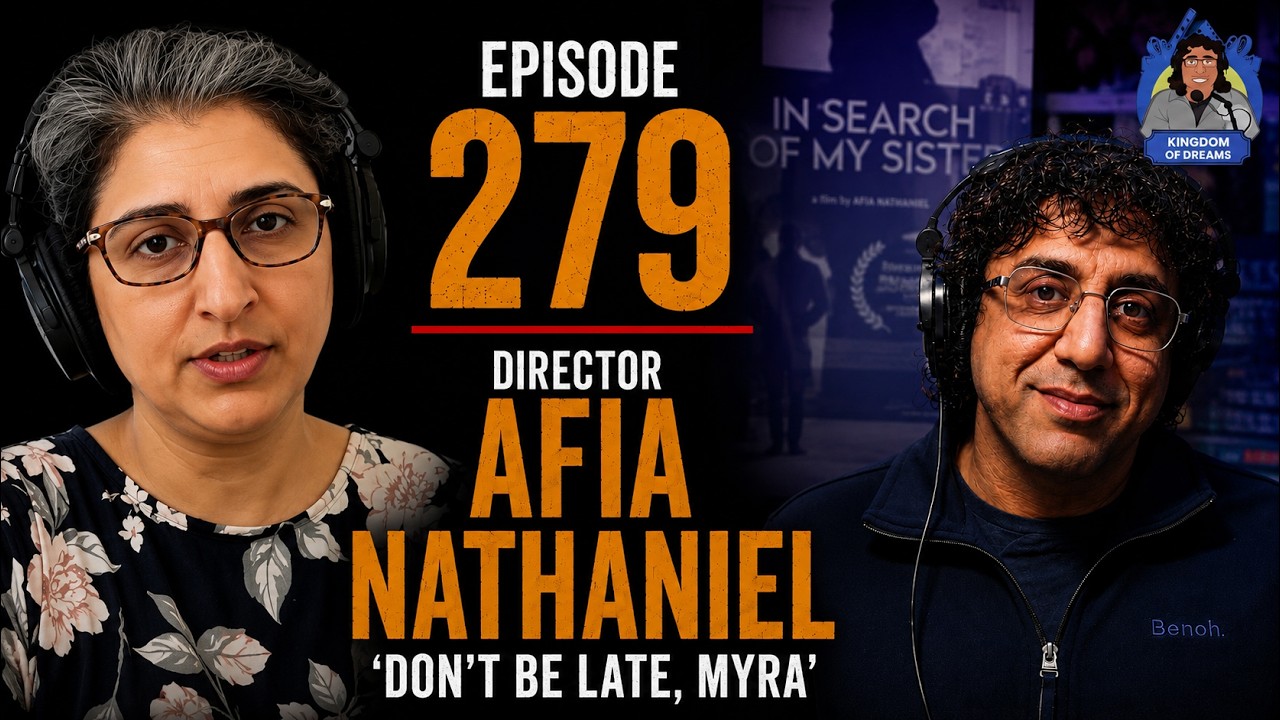
'Don't be Late, Myra', Director, Afia Nathaniel
Clips and Shorts from this episode
About this episode
🎙️ On this episode of the Kingdom of Dreams Podcast, we sit down with acclaimed Pakistani filmmaker and director Afia Nathaniel, who takes us inside the making of her powerful short film inspired by a real rape incident in Pakistan. Afia shares how that harrowing event deeply affected her and became the emotional trigger that compelled her to tell this story. She speaks candidly about confronting trauma through cinema, the responsibility of portraying such a sensitive subject with honesty and care, and how the process transformed her both creatively and personally.
Afia Nathaniel is a Pakistani filmmaker and director known for her socially conscious storytelling that centers on women’s lives and marginalized voices. She gained international recognition with her debut feature Dukhtar, which premiered at the Toronto International Film Festival and went on to screen at festivals worldwide. Her work often explores themes of identity, resilience, and human rights, combining intimate character-driven narratives with a strong sense of place and cultural authenticity.
#assualt #pakistan #family #pakistani #film
Full transcript
Automatically generated from the episode audio, so expect the odd misheard word or name. Speakers were labelled automatically. About 6,800 words. Tap a timestamp to play from that moment.
0:00Afia NathanielPakistan was roiled by a series of very high-profile sexual assault cases in the country, and one of them was the story of this mother who was on the motorway with her young children in a car. She was traveling at night. The petrol in her car, you know, finished, and her car stalled. As she was inside her car, a few strangers who were going by in their car, they stopped and they, you know, reversed, got this mother out, and gang-raped her in front of her children. And the conversation in the country was, "What was she doing so late at night?" It really triggered me, and for me, this film, Don't Be Late, Myra, really came pouring out in that, in that fit of anger, of rage, really. It was like lava flowing out of me.
0:56Jawad MirWelcome back, everyone, to another episode of Kingdom of Dreams podcast, The Making of Stories. I'm your host, Jawad Mir. Today, my guest is Afia, who's the director of Don't Be Late, Myra, a short film. I saw this film by complete accident in LA. I was there for several meetings, and I happened to find out that one of my colleague, she has a film, Where the Light Enters, that I had seen previously, that is gonna be shown again, and I decided to go see it again, and it was a double feature of that plus Don't Be Late, Myra. And I was absolutely blown away by Don't Be Late, Myra, to a point where I almost wanted to walk out of the movie theater at the end. But it was an extremely important and powerful film about sexual assaults of young girls in Pakistan, my hometown. It was a pleasure speaking to her, so without further ado, here's my conversation with Afia for Don't Be Late, Myra. Well, thank you so much, Afia, for joining.
1:51Afia NathanielThank you. Thank you.
1:52Jawad MirAnd to talk about Don't Be Late, Myra, which I had the pleasure of seeing, was it last month when we saw it?
1:58Afia NathanielYeah, in LA. Yeah, you came to…
2:01Jawad MirYeah. Yeah. And, I didn't know anything about your film. We had never met. As you know, Hemo, I was there for, you know, the film that she had worked on, Where the Light Enters, and I was completely taken by your film to a point where, as I mentioned to you, that for the good reason, I wanted to walk out of the theater because it was an extremely powerful, and meaningful film. So thank you for that, first of all.
2:30Afia NathanielThank you. Thank you for having me and for all your thoughts. I appreciate it.
2:37Jawad MirSo tell me, how did this start? You know, how did this idea come to your mind? Obviously, it's an issue, that is very common around the world, especially in the subcontinent, but nevertheless, to be able to tell the story the way you did in such bravery and authenticity, where did this originate from?
2:56Afia NathanielYou know, the seeds of this story have been lying dormant for quite a while, you know, for Don't Be Late, Myra, and it's based on lived experiences of myself and many of my friends from Lahore, in Pakistan, and, you know, I was, I was only nine when I was assaulted in the streets of Lahore. So at that point in time, I didn't know how to express what had happened to me or even talk about it to my elders, and there was so much shame surrounding, you know, the idea of your own body and, the idea that perhaps in some way you were responsible or guilty for inviting this incursion on your life and dignity. And so I just buried this story and those of my friends for many years. This is until a few years back when Pakistan was roiled by a series of, very high-profile sexual assault cases in the country, and one of them was the story of, this mother who was on the motorway with her young children in a car, and, she was traveling at night, and, the gas, the petrol in her car, you know, finished, and her car stalled.
4:17Afia NathanielAnd as she was inside her car, you know, as she was sitting there, a few strangers who were going by, in their car, they stopped and they, you know, reversed, you know, got this mother out, and gang-raped her in front of her children. And the conversation in the country was, "What was she doing so late at night?" And you know, that incident really triggered me. This idea of blaming and shaming the victim, and putting this on her shoulders, it really triggered me. And for me, this film, Don't Be Late, Myra, really came pouring out in that, in that fit of anger, of rage, really. It was like lava flowing out of me. And I just wrote it as a script, and I knew I was gonna make it. So, I called up one of my, you know, very best friends and pr… producers from Lahore, Noman. I call him Nomi Bhai.
5:18Afia NathanielAnd when he heard the story of Myra, he was like, "Afia Ji, just pack your bags, come to Lahore, and I will take care of this production. We need to make this film. We need to tell the story because this is not just one girl's story, you know? And it's not just about girls. It's about the safety of children in the country." And so, we really wanted to bring this story to as many audiences as possible, and I'm very grateful to my cast and crew for helping me tell this important story.
5:51Jawad MirAnd it's just one of those things that you don't know how you convey… ... To people.
5:57Afia NathanielYeah.
5:57Jawad MirBut your f… your f… your film does it in such a I don't wanna use the word tasteful, but in such a proper way where you feel the emotions of the character and the fear, and the story just diverts in a, you know, completely different direction. And, from a technical standpoint, it was just a masterful storytelling as well.
6:20Afia NathanielThank you. Thank you. Yeah. I really did want the audience to experience, the point of view of a, of a survivor, what it means. You know, this is not, this is not a, this is not a male director telling the story of somebody he thought, you know, he's gonna tell. This is a story of a survivor telling the story of a survivor. And so for me, it came from a place of wanting to respect that cinematically, but also to not tap dance around the issue of sexual assault. It's real. It's real, and I want the survivors to be heard and to be seen at the end of the film. And for the audience to remember, this story long after they have left, you know, that screening room.
7:15Jawad MirYeah. What has been the reaction? I mean, I was there for a screening, but you have been doing so many screenings for the, you know, the Oscar shortlist. What is one or two reactions or questions that have sort of stood out for you, from the audience standpoint that may have generated another set of emotions for you? 'Cause it's almost like reliving that whole thing over and over again, right?
7:40Afia NathanielYou know, it's, it's interesting that, as, you know, I said earlier, the film came from a place of anger. But really, the telling of this tale and traveling with this film to several festival through several audiences and screenings, my biggest takeaway has been that this journey has been one of healing. I did not expect that. I thought, you know, when I first started the festival route, I was very, I was very, I don't know, fearful of what it might mean for me to break the silence. This is such a personal story, not just of myself, but of many f… many of my friends, you know? And so, I was very fearful and anxious of what that meant to so many of us. You know, did I do it right? Is it okay for me to talk about it? You know, even after all these years, I'm an adult woman, there is still this trepidation, this fear that comes with it.
8:41Afia NathanielAnd the beauty of this journey has been that audiences have been so receptive and supportive. And I've had survivors come to me at the end of screenings telling me this is a story of somebody that they knew. This is the story of their own life. And after watching this film, this, they really feel seen and heard. And that was something that was completely unexpected for me. You know, to find this sisterhood across language, across culture, across geography. This is not a story of one girl in Pakistan, you know? As we know today, as statistics stand, like, one in every five girls before she turns, you know, before she turns 18, she would have experienced some form of sexual violence in her life. That's a huge number, right? And so, having this film and this theme resonate across, language and culture and geography has been very eye-opening.
9:51Afia NathanielAnd in conversations with many other people and many other survivors, this has been a journey of healing for me. So I'm very grateful for that opportunity. And it was completely unexpected, but it's real, and I just wanna acknowledge that I've shared this with, in this space with so many folks, that, I feel like the catharsis has been, has been real, and I welcome that.
10:19Jawad MirRight. No, that makes sense. I'll talk about the film a little bit now. You know, you talked about you approached your producer friend, Nomi, and that's where the sort of journey began. In terms of the script that you had…
10:35Jawad Mir... Versus the way the film came out visually, would, were you satisfied in terms of... You know, because sometimes when you're making a film, when you're writing it, you assume a lot of things may go through depending on the budget, and then there could be discrepancies or a shortage of budget, and you can't do this and you can't do that. What was the challenge, if at all, in doing so, from a, you know, the translation of the script into…
11:01Jawad Mir... The visual medium?
11:03Afia NathanielI mean, there's always a challenge, right? What you have on the page and then what you wanna shoot, and then what it becomes eventually in the edit. And I'm actually 2,000% satisfied with how that journey evolved. It is an evolution. It an is, it is a journey, and you have to embrace it with that openness. So I'm very open, you know, but I also, it's a very intimate process. I'm the writer, director, producer, and editor of "Don't Be Late, Myra." And having written what I had written, you know, the biggest thing for me in terms of translating the page to the screen is, how do I service the journey of my protagonist who's gonna be silent for most of this journey? But there's something buried inside her, that's living inside her, that wants to come out, you know? What is this inner voice, and how do I capture that for the screen? And that's the fun part for me as a director to translate. So I'm from Lahore. I grew up, you know, where I grew up, and I know the city very intimately.
12:07Afia NathanielSo in the writing of the script, I knew there were certain places and spaces that I was gonna really go back. Like, there's this, you know, this beautiful bridge in the c… in the city, in Lahore. There are these, this big market, the Anarkali Bazaar, where they have these narrow lanes and, you know, the shopkeepers are gonna shout at you and entice you to come and check out their wares. And so there were all these different spaces that I knew I was gonna film in. And so… How do I capture that for the screen? For me, one of the biggest things was using the city, the location, as a character in the frame, right? So creating the sense of the city as a living organism that lives and breathes around this lonely figure of a girl traveling all by herself alone on the streets, not really knowing the way back home. And so, you know, creating that sense of dynamic energy around Myra, that would gonna...
13:10Afia NathanielThat was gonna contrast with the, this very silent, static figure of her, you know, navigating the streets. So that contrast, I think, really plays well in the film. That was one of the things that I'm really happy it ca… it came out well. The other thing that I really wanted to embrace was the saturated palette. You know, I love color. I am from a culture that embraces color for everything, right? I'm wearing black today, which would not be the case if I were back in Lahore. You know, so for me, embracing color and encoding the nuance of color and playing with it in the film, the deep reds, the bright yellows, the haunting blues and the greens. You know, the, that contrast with that palette was gonna, like, really stand out. So what begins with this beautiful palette, you know, it feels like a, like a dream, like almost, you know, the reality feels almost hyperreal because of the color…
14:16Afia Nathaniel... The saturation. And so I wanted to draw you in, into this dream world and for it to become a nightmare. So the colors really have a payoff. The palette has a payoff in the film, too. And so bookending the opening and the ending, that was always there on the page, and I translated that, into some haunting imagery in the film with the balloons and this theme of, the predator and the prey, you know. There was one thing in the script... There's one thing in the film that was not in the script, and I can, I can talk about that, you know. I was trying to figure out how to convey this idea of the predator and the prey and for it to stay nuanced, in a metaphorical way. And so when I was scouting the streets of Lahore, I would always look up, you know, at the sky. I love doing that, like the sky. And I would see the cheels, you know, the hawks circling sc… the sky. And I thought, "Wouldn't it be nice to use this in the shot?"
15:20Afia NathanielBut how do you get the cheels to cooperate with you? You know, that was gonna be the logistical challenge. But I wove this visual metaphor in my film of the, of the cheels circling and I think the payoff is great with that as one of the ending shots, and it works really beautifully across the film, and says far more than anything I could have said, you know. And so to me, that is the payoff, when you can watch... And the audiences, you know, the audiences really pick up on these nuances, the subtext. And, they always ask me about this ending, and I... And they've, they've felt the ending in some ways, and they always wanna confirm that this is what it actually meant.
16:11Jawad MirYeah.
16:11Afia NathanielSo that's, that's, you know, that's the gratifying part of having conveyed that cinematically, for audiences and for them to experience this in a very visceral, haunting way, you know.
16:26Jawad MirYeah. No, we talked about the color palette, too, when we were in LA, and that's, the saturation is what I loved, you know, from a creative standpoint. And also how her journey from her h… from school to home, and how light plays a big part in her emotions and where she ends up towards the end, right? And it was very clear the intention was there. And I think one of my biggest, like, when I think, when I think about your film, I think about the last shot, that one that you talked about, the balloons…
17:01Jawad Mir... And, when she's walking on the bridge, I think, and there is a window pane that you shoot through. That spoke volumes. I mean, you can interpret that in so many ways, but just visually, that was a breathtaking shot, you know. And I really resonated with that.
17:19Afia NathanielThank you. Yeah. And that shot, I was, you know, I was scouting the bridge, and we were waiting for the light to change. So in that, in that part of the journey, you know, she starts her journey, like, late afternoon, and it goes into evening. So I'm playing with light as it's changing across the landscape, across the city. And on this beautiful, gorgeous bridge, I was, I was walking up and down because I was trying to kill time. We were waiting for the light to sort of, the sun to set a little bit more before it had the right look for the frame. And I was walking by, and I saw these buildings right next door to the, to the bridge, and all these windows had the reflection on them. So you could see the reflection of the traffic of the bridge. And I thought, "Wouldn't it be great, if Myra could walk down in the reflection and just capture that still," you know, that idea of stillness playing with the kinetic energy. So the frame…
18:17Afia Nathaniel... Was gonna be still, you know, trained on this window that is capturing the energy of the city as it's, as it's just zooming past Myra. And she's, she's walking as this lonely figure. And so I said to my DP, like, "Bring the camera here. Let's get this moment. I know we're waiting for the light." They were set up for the other shot. But I said, "Never mind, never mind. We have half an hour. Let's get this other moment," you know? And so we ran, and we, you know, repositioned the camera, and I, and I asked Inaya, who's our lead actress, that's this wonderful 10-year-old actress. And I said, "Inaya, just walk down, you know, with this backpack of yours, and just keep walking as long as you can." And so as we were filming this, something really surprising happened, and I don't know if you, if you saw that in the film or not in the moment, but as she is walking and you see her reflection cross, there's a rickshaw walla going by who turns to look out at her, you know, as if he wanted to call out to her.
19:19Afia NathanielAnd I was like, how strange is that? Because I have this other scene in the film just before this bridge scene where a rickshaw walla actually stops to ask her if she needs a ride. And it's not with the best of intentions he's gonna ask her, right? So, it was a complete accident, and when I saw it in the edit, I said, "This is the take we're gonna do," because it follows right after that encounter. And how funny is that we actually got this in the can, you know? The... We couldn't have choreographed this. It was just pure happenstance. We were in the right place at the right time with capturing, bottling this right moment. So it felt, you know, like an omen that, okay, we're, we're, we got what we needed. This is it. This is it, you know?
20:07Jawad MirYeah.
20:07Afia NathanielSo yeah, it's one of those lived, you know, moments on the set that you know in the edit you mi… you're like, "Oh my God, this is gonna be there in the edit," you know?
20:17Jawad MirYeah. It's always those spontaneous moments. I mean, those…
20:20Afia NathanielYeah
20:20Jawad Mir... Planned moments…
20:21Afia NathanielYeah
20:21Jawad Mir... You know, they're great.
20:22Afia NathanielYeah.
20:22Jawad MirBut those spontaneous moments when you're like, "Oh my God, let's do this," right?
20:25Afia NathanielYeah.
20:26Jawad MirAnd that…
20:26Afia NathanielThat's the fun, yeah
20:27Jawad Mir... That ex…
20:27Afia NathanielYeah
20:27Jawad Mir... That's the best part. And look what you got out of it.
20:30Afia NathanielAnd you know, I have to say, like, this is, this is the kind of collaboration I really encourage on my set. Like, there's a, you know, there's a whole thing of a vision, right? The vision is there. But also, this opening up, so allowing the DP, the production designer, you know, all the, all the key, heads of department, even my spot boy, you know. I'm, I'm very open to how people are experiencing a location as we're filming, because sometimes you may get an idea from a conversation with somebody on the crew who may not be the head of your department, and you're like, "Oh my God, that was so interesting. Let me think about this," you know? So I really encourage, an openness with my actors, with my crew, and keep it going because at the end of the day, the sum of the parts is gonna be greater, you know…
21:26Afia Nathaniel... When it becomes the whole. And that's what I'm looking for, and kind of feeding off, this energy on the set, and creating that invitation of openness that I feel has such a huge payoff for me, as a director. And I, and I love, I love that energy, you know, tapping into that energy.
21:49Jawad MirYeah. No, that's beautiful. And the collaborative effort is, I mean…
21:54Afia NathanielYeah
21:54Jawad Mir... The whole collaboratives, collaborative part is essentially what works. I mean, I've heard so many stories…
21:59Afia NathanielYeah
21:59Jawad Mir... From directors like Steven Spielberg, from Francis Ford Coppola, like all that stuff.
22:03Afia NathanielYeah.
22:04Jawad MirAnd it makes a huge difference because they're always looking at things differently. I mean, one of the most stories that I really enjoy, I don't know if you ever watched Seinfeld
22:13Afia NathanielI love Seinfeld. Yeah.
22:15Jawad MirSo there's a story which, Bryan C… Bryan Cranston, the one who was in Breaking Bad, and he was, the dentist in Seinfeld.
22:22Afia NathanielYeah.
22:22Jawad MirHe said that there was a story on the set. There was this guy who was just fixing something, like a, you can call him carpenter, and he said, you know, "What if you do this… ... At this moment?" And everybody started laughing.
22:37Afia Nathanielhuh.
22:37Jawad MirAnd, they threw that in the episode. I don't remember what the exact scene was…
22:42Afia NathanielYeah
22:42Jawad Mir... But, you know, that whole collaboration effort.
22:45Afia NathanielIt's great, right? So I think, I think bottling that and recognizing that, it's a huge part of collaboration.
22:55Jawad MirYeah.
22:55Afia NathanielAnd especially with actors, like I don't go with a very predetermined set of things to do. I have a fair idea. They ha… you know, and I wanna leave it open, because things arise in the spontaneous, in the improv versions of lived reality that you can say, "I can, I can work with that." Like, build on that, you know? Or change just that a little bit, and you have it, you know? So the door is always open to finding the something new. I think as directors, that's, that's always the exciting part. Like, it's not the predetermined stuff. That's gonna happen. That's, that's the part, that's part of the prep. You're living with it, right? The exciting part is discovering something new. What can that be? And I think every day, of being on the set and being open to that energy of bottling, that discovery of something new, that to me is, like, such the f… you know, the, I miss that part of being on the set.
23:57Afia NathanielSo, I'm dying to get back on the set, as you can tell.
24:02Jawad MirYeah.
24:02Afia NathanielAnd work with that energy, because that's what I love doing.
24:06Jawad MirYeah. Yeah, makes sense. I completely agree with you.
24:09Afia NathanielYeah.
24:09Jawad MirYou know, when you were writing and/or when you were directing on the set, what... Let's talk about directing. So on the set, you w… what, the girl's name was Anaya, the actress?
24:18Afia NathanielInaya, huh.
24:19Jawad MirInaya. So those scenes where the guys on the motorbike, the guy on the cart, the guy, in the rickshaw, and then few other things that I'm not gonna talk about… Was there moments, I'm assuming there were, where it made you extremely uncomfortable and emotional as well as Anaya? Did you guys…
24:40Jawad Mir... Share that on the set that when anything like that popped up?
24:44Afia NathanielI think a lot of the conversations I had with Anaya were before, while I was… ... Casting. And, you know, finding the right actress to play this was super important. The script was written for a 15-year-old, when I first started working on the, on the story. And as I started casting, I really wanted to open the door to a younger actress too, just to see what kind of talent I was getting. But also I found that what I was looking for was a completely natural and lived experience, from the actress herself. So when, by the time it came to Anaya, you know, she was the very last audition I saw in a, in a span of two months, and she was the youn… one of the youngest ones. She was only 10 at that time. And when I saw her, she was so completely natural. So I did a call back with her, you know. I brought her parents back. I had a call back with my, with Anaya. And what I found out in that conversation was that she's one of three girls.
25:53Afia NathanielShe's the youngest girl, and she's from a middle-class background, and she knows what it is to walk down the street with no male chaperone, you know, with her. And so also, you know, in terms of conversation, it was really important, you know, this idea of sexual assault. So, you know, her parents knew the story. They had the script. They had discussed this with their daughter. Her mom's a psychologist. And so there were, you know, a series of these conversations of talking about this character and making sure that, you know, there's a comfort. There's a space…
26:31Afia Nathaniel... Where we can talk about the things that we have to talk about. Because growing up in Lahore means you're constantly exposed to this fear of sexual assault, you know. Whether it's a public space or whether it's your private home, it's, it's a conversation that is happening widely in society. And so nowadays, I think our children are far more and better informed about sexual assault and the problems that exist and how do we, how do we talk about it, you know, in schools, in different spaces, in social media. So with Anaya, you know, it was very easy for me to have this conversation knowing that we have built a space where trust can exist, where vulnerability can also exist. And my job is to protect my actor, my young actress, from a lot of things too, right? So I'm not gonna overload her with a lot of things, with a lot of heaviness.
27:35Afia NathanielSo I have to keep it simple for her, and I have to tap into her own lived experience. So, you know, when she's walking down the streets, she knows exactly what it is to do that. So I don't have to tell her…
27:46Afia Nathaniel... You know, "This is what you're thinking of," or, "This is what you're feeling." She already knows that. So all I have to do is to be technically ready for me to bottle her lived experience and how she moves and behaves and looks. It's all real. I did not have to direct her. You know, there was only one moment I think, where I gave her a prompt. It's one of the most difficult scenes in the film, and I'm not gonna give it away what it is.
28:15Jawad MirI know what you're talking about, yeah.
28:16Afia NathanielRight?
28:17Jawad MirYeah.
28:17Afia NathanielSo I gave her a very simple prompt to think about, and it had nothing to do with the, with the scene itself. But I knew this moment would help her come to the point of an emotional truth. You know, that's what we're looking for. Like, how do we convey an emotional truth with respect to an actor? So I tapped into, something in terms of her memory bank, in terms of evoking a certain kind of emotion. And when I called action, she was ready. Emotionally she was ready. And I made sure that my camera and my sound was technically ready to get this one take. It was gonna be a one take, and it had to be the first take, you know? So I didn't want her to go through the same emotional journey again for another take. So I wanted to be ready to bottle this. So, you know, that was…
29:10Jawad MirRight
29:10Afia Nathaniel... My job as a director, to keep it very simple and to protect her and to make sure that I can arrive at this emotional truth through a different path, of how to tap into that. So, you know, I, that's my job as a director. So we do what we have to do to get the performance, but also to make sure that we protect our actors from, especially a child actor, you know?
29:42Jawad MirYeah.
29:42Afia NathanielAnd I'm the mom on the set too, so I have a daughter. So I worked with Anaya, you know, as sh… as if she were my own daughter. And the parents trusted me with that. So that's the, that's the joy and beauty of being a female director in Pakistan is that, the parents of the child actor will give you the trust because they know…
30:04Afia Nathaniel... You will do right by it, you know.
30:07Jawad MirYeah.
30:07Afia NathanielYou will not be exploiting their child. And it's not a toxic male director on set, you know. So they really trust you as a female director to do it right with empathy and with nuance.
30:21Jawad MirMakes sense. You know, one of the things you talked about, in the, in the conversation, and it kind of just brought up this thing that I come across with a lot of people and that I don't know about Pakistan…
30:34Afia NathanielYeah
30:34Jawad Mir... But especially in diaspora I, you know, when you make films like these or when you write books like this, there's always this thing that why are we portraying the country… ... Or the people in a negative way, right?
30:47Jawad MirI don't know if you've experienced that. I have come across a lot of people in the diaspora, whether it's in States, in Canada, why must we be critic… like, yeah, okay, we under… I understand that, you know, there's Western media that may sort of take that in a different way and all that. I get that.
31:04Jawad MirBut at the same time, the only way to resolve a problem, the first step is recognizing that there is a problem. And do you feel that something, have you experienced and that's something that needs to change, whether it's back home or here…
31:21Afia NathanielYeah
31:21Jawad Mir... That at least recognizing and don't say that why are you portraying the image of our country in a negative light?
31:27Afia NathanielI mean, there is always that, you know. I, all my films so far have dealt with patriarchy in some way, and the push and pull forces that exist, you know, especially when it comes to the stories of women. And so for me, I do not back down on telling the stories that I want to do just because I will be criticized for it by some portion of society. That's always gonna be the case.
31:55Jawad MirYeah. Yeah.
31:56Afia NathanielAnd right, so you go in with a thicker skin. This is something I have learned is to not take it personally, right?
32:04Jawad MirYeah, 100%.
32:04Afia NathanielPeople are gonna criticize, and they will have an opinion, and they're entitled to their opinion, and so you do what you have to do, in the best possible way. But I will say this, you know, Pakistan is constantly surprising me. There are people who will criticize you, but there are people who will also support you. You know, there is that part of society that we don't really hear from in the Western media and that is, you know, the part of society that does want these stories to be seen because they do create the conversations that are hard but necessary. And I feel like a lot of our TV dramas are doing that, right? In Pakistan, if you look at what are people watching and how are they watching it, they're watching a lot of television stuff because that's where all the hard-hitting social justice stuff is happening, especially when it comes to, women's rights or the perspective of women, right?
33:06Afia NathanielYou're seeing a lot of that. And so people are very open. Like, it's very normal to have conversation, about a TV drama that may trigger you in one way or another. There's a lot of polarized conversations happening like, "Did you see that? That was horrid. How dare they?" Or they were like, "Oh my God, they did that? How brave of them." Right? So this polarity between opinion, that is, that to me is, it's telling me, you know, democracy is thriving in some way, and those are necessary conversations because you can't have just one point of view in society. So I will do the job that I have to do as a storyteller, which is holding this mirror to my society in the best possible way. I love my country, and there are some things about it that I do wanna change, and this to me is the way I will have those conversations, right? And if somebody feels so strongly about a viewpoint, why don't you go and make that film, you know? If you think this is negative…
34:08Jawad Mir100%
34:08Afia Nathaniel... You know, go forth. There's a camera. This phone is here. Tell your story. Nobody's stopping you. So tell your point of view. That's what I say to all the emerging storytellers, you know. I'm like, "Do not be afraid of your voice and what you wanna say."
34:27Jawad MirYeah.
34:27Afia NathanielSo if you can, if you can find what that is and not be afraid, embrace that because there is no other way for me at least to, you know, what is the kind of story I wanna tell? I'm not gonna lie to you. I'm not gonna make shit up. I'm just gonna do the thing that I have ex… you know, that I feel strongly about, and that's gonna live on the screen. That is my journey, and that may be very different from somebody else's journey, right? So embrace your own journey and see what it means to you because at the end of the day, your, the artist that you are is defined by the person that you are…
35:02Afia Nathaniel... And vice versa. It feeds into you. It's a cyclical process, right?
35:06Jawad MirYeah.
35:06Afia NathanielYour art comes back to you and helps you grow, and you help your art grow. So this cyclical process, if you can find what this is for you, as an independent artist, this to me is the best possible way to look at your journey and not worry about what people are gonna say. They will say what they have to say.
35:25Jawad MirYou know, it's, it's, it's absolutely so true, and it's important to stick to your guns because at the end of the day, whatever you have sort of envisioned… ... You have envisioned because of a certain story or an idea that came up to you and what the point that you're trying to get across or inform the audience and whatnot. And at the end of the day, there's also, you also have to look at the entertainment factor, the drama factor…
35:47Jawad Mir... Because you can't just make a flat film, right? Like, it has to be three-dimensional, multi-dimensional. So I know, like, I'll, I'll, the, one of the films that I directed, the protagonist, after it was cut, she told me, and we've talked about this pu… publicly. It's in our book, too.
36:02Afia NathanielYeah.
36:02Jawad MirShe said that, "I wanted to bo… boycott your film." I'm like, "Okay, go ahead." 'Cause she wasn't happy with certain things.
36:08Afia NathanielYeah.
36:08Jawad MirAnd, you know, and then she was like, "Okay, fine." And now the film is doing amazing. Like, it's because…
36:13Afia NathanielYeah. Yeah
36:13Jawad Mir... Of the things that she wanted me not to put in…
36:16Afia NathanielYeah. Yeah
36:16Jawad Mir... Is the reason that the film is doing really well.
36:19Afia NathanielYeah. Yeah.
36:19Jawad MirSo that's very important.
36:21Afia NathanielIt is. It is important. And, you know, and again, it's a process, right? There is no one way to do it and to have it received in the world. So I think the scary part for us as filmmakers is what will people think of this? And I have learned to not worry about that. You know, at first I used to worry about that, but now I'm like…
36:45Jawad MirYeah You get used to it.
36:47Afia NathanielYou get used to it. The film will have its own two legs and walk. You know, that's what you do as filmmakers. You've, you have birthed a child, you have raised it well, and now it's gonna, like, walk out the door…
37:00Jawad MirGo out there and…
37:00Afia Nathaniel... And have its own life, and there's nothing else you can do about it. So let it…
37:04Jawad Mir100%.
37:05Afia NathanielYeah.
37:06Jawad MirNo, that's accurate. That's accurate. So now the film is shortlisted for Golden, well, at least, not shortlisted. Well, it is shortlisted for Oscars, but I think that…
37:15Afia NathanielNo, it's not shortlisted
37:16Jawad Mir... It's not. Okay.
37:16Afia NathanielNo. It's, it's
37:17Jawad MirOkay. Sorry.
37:18Afia NathanielSo right now the film is one of 207 films, that are qualified…
37:26Jawad MirOkay
37:26Afia Nathaniel... To be in the, you know, the Best Live Action Short category, and the results will be out coming Tuesday next week.
37:35Jawad MirDecember 16th, yeah.
37:37Afia NathanielYes, so…
37:37Jawad MirYeah. So, it, that's what I, that's what I meant by…
37:39Afia NathanielYeah
37:39Jawad Mir... Shortlisted, but it is in that category of 207 films, I mean, which is…
37:42Afia NathanielYes
37:42Jawad Mir... An achievement by itself.
37:43Afia NathanielYes. So thank you. Thank you. Yeah. We're, we are one of t… 207 right now.
37:49Jawad MirYeah. Well…
37:50Afia NathanielYeah
37:50Jawad Mir... I hope, I truly think, and I'm not just saying this, that, and I haven't seen other films, so I can't… ... Say much, but from what I have seen, you know, with Don't Be Late, With Myra, it's beautifully done film, very authentically, with a strong message, with a powerful storytelling and everything and all of the above. So I hope it gets the recognition it deserves more than it already has, because it does need to be seen by almost everybody. It's, it's, it's not just a story of that part of the world. I think that happens everywhere, but obviously it's a little bit different in certain parts because of the laws and all that, but it still happens nevertheless.
38:31Afia NathanielYeah. Yeah. No, absolutely. Thank you for this very thoughtful conversation, and if anyone is listening, you can actually watch Don't Be Late, Myra on 16 Days 16 Films website. It's playing, as part of the gender-based violence campaign, for, you know, for around the world globally, and it's on day number five. It's, it's, it's, you know, there's one film has been released for every 16 days of activism. So Myra is playing as part of day number five activism. So if you go to their website, you can watch the film right now.
39:08Jawad MirSo today is the day number five?
39:10Afia NathanielWell, no, it's already passed, but it's online till 24th…
39:13Jawad MirOkay
39:13Afia Nathaniel... Of December, so…
39:14Jawad MirOkay. Okay
39:14Afia Nathaniel... Between now, today's what? The 12th? 12th of December. Yeah.
39:20Jawad MirYeah, it is. It is.
39:21Afia NathanielYeah.
39:21Jawad MirSo you have 12 more days.
39:23Afia NathanielSo you have, you have 12 more days to watch. If this goes out, by that time you can still catch it on their website. Yeah.
39:30Jawad MirAmazing. And this is, worldwide access? It's not just…
39:33Afia NathanielThis is worldwide access. Yeah.
39:35Jawad MirAmazing.
39:35Afia NathanielAnyone can watch it.
39:36Jawad MirWell, that's…
39:37Afia NathanielYeah.
39:37Jawad MirThat's awesome. I'll re-watch it again, just to…
39:40Afia NathanielThank you. Thank you, Joa…
39:41Jawad MirYeah.