
Episode 280 · December 16, 2025 · 50 min
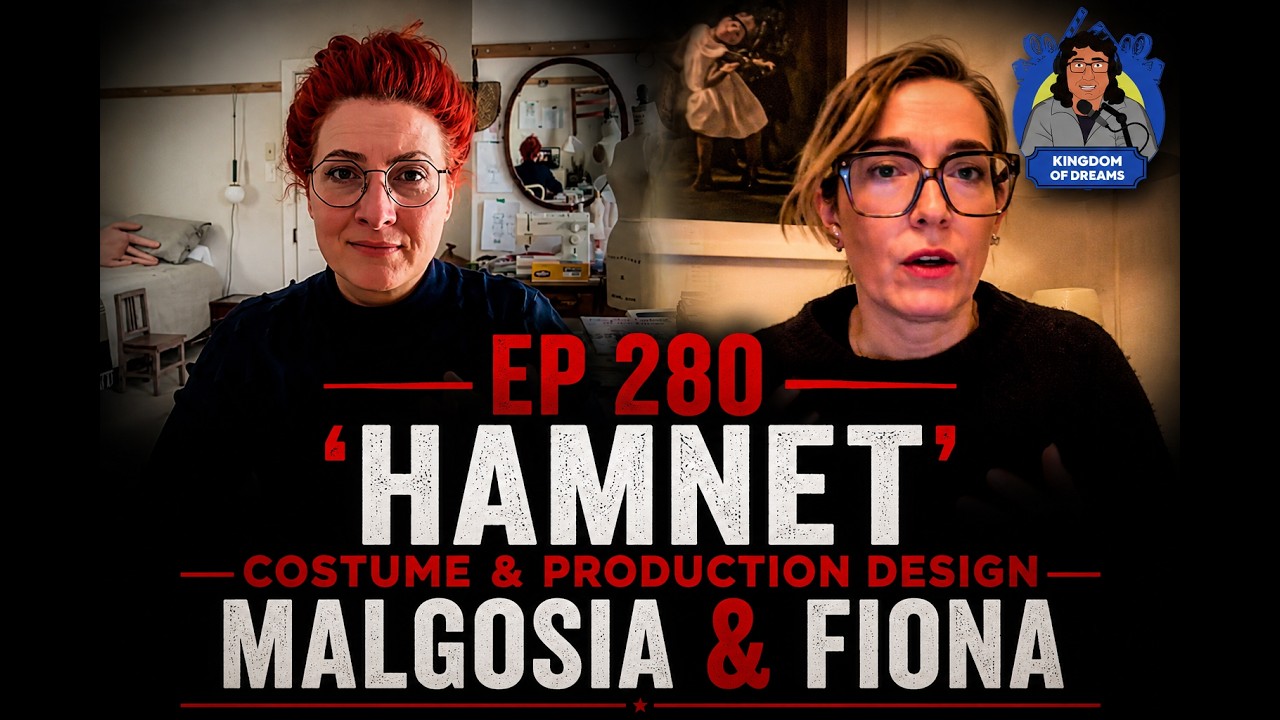
Hamnet | Costume & Production Design, Malgosia Turzanska & Fiona Crombie
Clips and Shorts from this episode
About this episode
🎙️ On this episode of the Kingdom of Dreams Podcast, I sit down with acclaimed production designer Fiona Crombie and costume designer Malgosia Turzanska for an intimate conversation about the art of collaboration and visual storytelling.
Together, they take us inside the creation of Hamnet, revealing how sets and costumes became a perfect marriage; breathing together, evolving together, and carrying the emotional weight of the story. They speak passionately about building a world that feels lived-in, fragile, and poetic, where fabric, texture, light, and space work in quiet harmony.
Fiona Crombie is an award-winning production designer known for her richly detailed and visually striking work on films like The Favourite, Cruella, and Macbeth. Her background in theatre and film allows her to create immersive, story-driven environments that enhance narrative and character.
Malgosia Turzanska is a celebrated costume designer whose credits include The Green Knight, Hell or High Water, and Luca Guadagnino’s We Are Who We Are. Known for her deep research and character-driven wardrobe choices, she brings emotional texture and authenticity to every frame.
#hamnet #stevenspielberg #sammendes #amblin #amblinentertainment #shakespeare
Full transcript
Automatically generated from the episode audio, so expect the odd misheard word or name. Speakers were labelled automatically; this episode has several guests (Fiona Crombie, Malgosia Turzanska), shown as Guest 1, Guest 2 and so on. About 9,000 words. Tap a timestamp to play from that moment.
0:00Jawad MirIt's a very emotional film. Seeing that progression from the book to the script to the screen, were there any set of new emotions or reactions that you guys got?
0:08Guest 1There is one line in the book which kills me every time I think about it, that is not in the movie, and then I realize that the movie does it without the words. After Hamnet's death, Judith, and she says, "When you're a wife and your husband dies, you're a widow. When you're a child and your mother dies, you're an orphan. But what am I?" And it just, like, ugh.
0:32Guest 2I think it's always interesting, like, what material attracts you when in your life. Like, would in 10 years time would I have made the same film? Many things in this film that are deeply personal. My drive with the design was to illustrate the life of a family and to show, to have, to bring an audience close to that.
0:59Jawad MirWelcome back, everyone, to another episode of Kingdom of Dreams podcast, The Making of Stories. I'm your host, Jawad Mir. Today my guests are production designer Fiona Crombie and Malgosia Turzinska, who is a costume designer on Hamnet. Hamnet is based on a fiction book, and the film is directed by Chloé Zhao and produced by Sam Mendes and Steven Spielberg. Despite being a family drama, I still was convinced to watch this in the movie theaters, and boy, what a great decision that was. The film is full of emotions, full of poetic imagery. It has beautiful cinematography, set designs, costumes, and everything else around, especially the performances are groundbreaking. So without further ado, so without further ado, here's my conversation with Fiona and Malgosia for Hamnet. Well, thank you so much, guys, for joining. I appreciate it. I had the pleasure of watching Hamnet last night. I went to see it, and I really liked it. It was a very well-crafted film.
1:59Jawad MirThe performances and especially, you know, the colors and the costumes and the designs and the sets and everything, which was there, not very much so in your face, but they all had a purpose, and I really, I really enjoyed, not necessarily enjoyed, but, you know, you know what I mean. Like, it was a really well-done film from every set of angles. So thank you so much for being part of an important film.
2:24Guest 1Thank you.
2:26Jawad MirSo let's get started on how you guys got onto the project. You know, we know it's based on a book, and I've seen some behind-the-scenes stuff on Spielberg and talking about it and how he got Chloé involved and everything, but how did you guys, get involved on this, amazing project?
2:45Guest 1I'm gonna jump in 'cause I was, I was there first.
2:49Jawad MirOkay.
2:51Guest 1I went to school with Chloé, actually. We were in the same, the same school, but different programs. And I didn't really know her at school, but we kind of crossed paths. And I almost designed her first movie, and then it never came to be. So when I heard about this one, I reached out to a common friend of ours, Molly Asher, and begged her to throw my name into the hat, and then did a look book and, forwarded it to Chloé, and she responded to it. And that was, that was the start for me.
3:26Jawad MirFantastic.
3:26Guest 2Yeah. Well, and I was the last one, I think, the last HOD. So I think when I came on board, there was Malgosia, and there was, and Lukas. And for me, it was a very, you know, it was the classic. It came through my agent. I read it. I had a meet… I did a look book as well, and I did a meeting, and that's just, it was pretty much by the book, you know? Yeah.
3:50Jawad MirAmazing. And…
3:51Guest 1But the interesting thing is that when we started, Chloé shared our respective look books, those, like, very initial, raw, emotional responses to the, to the material. She shared them with all of us, so we could see, like, how each of us was responding to it, and we had a very, it was very obvious straight away that we had a very similar way of looking at it and kind of we're on the same playing field, which was really beautiful to see.
4:18Guest 2Yeah. Yeah, absolutely. We shared, we had the same, some of the same images in our... Completely independently, having never met each other, we had put in several of the same images that had absolutely nothing to do with anything.
4:30Jawad MirOh, wow.
4:30Guest 2Like random.
4:32Guest 1Yeah.
4:32Guest 2There was a bl… a bloodshot eyeball. We should look at them and work out what the other ones were, 'cause there were a few.
4:37Guest 1Yeah, we could…
4:37Guest 2And so I think obviously Chloé, I don't even know if she noticed that necessarily, but she could just see that we were arri… we were starting at the same place. We had the same sort of sensibility and approach to the material
4:52Guest 1Yeah
4:52Guest 2... Just based on these initial impulses, yeah.
4:55Guest 1Yeah, and it was very much, like, from here rather than, like…
4:58Guest 2Yeah
4:58Guest 1... A cerebral take on it.
5:00Guest 2Yeah.
5:00Guest 1So that was…
5:01Guest 2Yeah
5:01Guest 1... It felt great to start. Like, it was like, "Oh yeah, just we're ready to start this collaboration."
5:06Guest 2Yeah. Yeah.
5:06Jawad MirThat's awesome. You know, one of the things that I noticed, and it could be just one of those things that you look into things, the color palettes for me, the three that stood out the most in costume and set designing, well, one of them not really a set design, it's more of like a natural thing, like obviously the trees, the green…
5:25Jawad Mir... And, you know, the branches, the brown, the house is brown, and her outfit being reddish orange. And that, if that is the right color, I'm pretty bad with colors, so I apologize if I'm getting it wrong. That, those three things really spoke to me in a, in a visual way of where the story is and was, like, from the beginning to end. Was there any intention behind that contrast between especially her outfit, as well as the set, the homes that th… they were living in, at the time?
6:00Guest 2Yeah, I mean, I think the thing is that with this film there's n… I would say there's nothing that isn't intentional, you know, that didn't come from a lot of thought and conversation and in the case... I think the thing about the film is it's actually really concise. You know…
6:18Guest 2... We don't... And so in terms of the palette, again, it's like it's concise. There's not a lot of colors.
6:23Guest 1Yeah.
6:23Guest 2There's... And we have a lot of repetition of color, and then when it disappears, you notice it. So there's these things that are very, I'm gonna say spare, but it's actually because I think there's almost, like, this quality of, like, finding the essential in the way that the film, in every level, like I'm talking, I think the coverage, the way that the film is shot or the cinematography, I think the way that the costume design, it's like, it's almost like a distillation actually.
6:54Guest 2And so I think, so it was very... W… we, you know, obviously w… Malgosia and I spent a lot of time talking, and our teams spent a lot of time talking, and we shared samples, and we were very aware of, we did camera tests, so we were very aware of what will be the impact of this color in this environment? What w… and you know, for me, it was a lot about dark and light, so I had light walls, dark beams. How is that going to play with the family and, you know, with all the different characters? So it was, I think it, there was a real kind of process of calibration throughout the whole thing. Yeah.
7:30Guest 1A… and also, you know, you did mention the woods, and I just wanna emphasize that the woods, obviously the woods were there as the woods, but the woods were dressed, you know?
7:40Guest 2Oh, yeah.
7:41Guest 1Yes. This was not as it was found. It was, very much a designed,... Designed stage. And so, you know, it was very much absolutely what Fiona said, but also the, that, you know, whenever we see those characters, it's who's standing out from the background and who's blending in.
8:00Guest 1And when we see Agnes, you know, she is, in a kind of beautiful way, both a product of the woods, but also so vibrant that when Paul sees her, she is just the most vibrant thing in that world. And also when she comes to his house, when we see her sitting there, when she comes to announce that she's pregnant, she is, you know, th… this house has never seen that vibrancy. So she immediately changes the surroundings and the people inside as well with it. Yeah. You know, you talked about her being pregnant. A… as a guy, for me to see, and this, I have two kids, nevertheless, you know, I'm just s… saying it was, it was bizarre in the beginning, like, but I knew what the purpose was, where the story was gonna go. Like, I've never seen in a film three different births, you know? And but then the, you actually show the, emotion of her character going through all that because she's putting all this energy into the birth, as natural as it is, because later on it's gonna play into that, of her connection with her kids.
9:13Guest 1And I, and I thought that was, in the beginning, I, frankly speaking, you know, I wasn't too keen on witnessing that in the movie theater, but later on I completely, valued how that was sort of put out, put out in, on the screen.
9:29Guest 2Yeah, and I think it goes into the inten… intentionality of it, that it is, I think what is on screen is crucial. Like, every little bit that is there. And, you know, we did shoot other things that ended up not being there. Like, not a lot, but there was, you know, some of the stuff in the globe was cut down to just kind of what you, Fiona, what you, the word distilled
9:54Guest 1Yeah
9:54Guest 2... That you, I think exactly that it is, it lets…... I think it, like, lets the moments kind of ring in a, in a…
10:05Guest 1Yeah
10:05Guest 2... Specific and meaningful way because there's no... Like, it's all there for a reason, and it, like, kind of helps us, helps guide us through it, I think.
10:14Guest 1Right. Right. I wanna talk about a scene, from both the costume and the set point of view. It's a very straightforward, simple scene. It's a long shot, where, the baby's sleeping in the background. He's getting frustrated. She comes up to him. The baby wakes up. She goes back. The camera doesn't cut. She comes back again, tries to calm him down. That whole scene, I completely understood why it was, because it was showing his frustration, but that amount of lighting, obviously that's more of a cinematography thing, but still being able to see the set, the space in the background where she was, and the costumes, how did you guys sort of collaborate on that? If you can talk about that for a bit, please.
11:01Guest 2Well, from my point of view, we s… that was a set build, and I worked closely with Lukas. I mean, we did with all of the set builds, but particularly with that house. And the downstairs part of it. We did work together sitting there at a computer looking at camera angles and working out where, you know, basically, like, where do we need to have a wild wall or a camera port or, like, really we designed in the shots and the angles. So I knew that we would be framing from that window. And then I guess it's just, it was like you, we laid out the A frame just the way that we thought it should be, and then it just kind of was, like, right. But I mean, I, from memory, in all honesty, it is lit by one candle. Like, I don't think there's any…
11:49Guest 1Yeah
11:49Guest 2... Augmentative lighting at all…
11:50Guest 1I don't think so either
11:50Guest 2... Which is sort of great.
11:52Guest 1Yeah.
11:52Guest 2And I, actually, we, I watched this in the, when we were cutting, and I remember them kind of playing with the frames. Like, you know, they can move it like, you know, and expand and play with it a little bit. And it was about kind of… How much you include that candle or don't include the candle, you know, because he then knocks it over at one point, you know? And, which from memory was perform… that was a accident. Like, that was never a thing. Like, it just happened in the moment. But I do... My memory is that was just the one candle, yeah. But it's... You know, the thing is, in a way, it's like a stage. It's like a proscenium…
12:26Jawad MirIt…
12:26Guest 2... Like, we're, we're watching. And so many times in the film, I mean, it's kind of interesting 'cause in many ways I see the camera, and I've never discussed this with Lukasz or Chloe, so I'm just saying what I think. The camera, like to me, sometimes is the point of view of death looking, you know, that's sometimes what it is, and then sometimes you're an audience to a proscenium. So it's kind of an interesting... And sometimes you're right up in everyone's face as well, so it's like there's, it goes from this kind of sort of, I guess, presentational... Not presentational, that's the wrong word, but... And to extreme intimacy. So observed to intimacy in a kind of interesting way.
13:04Jawad MirRight.
13:04Guest 2Yeah.
13:05Guest 1And costume-wise for that was, you know, kind of the situation dictated the types of clothing. She is in a nightgown. We rarely see her in not, you know, s… kind of stripped of color, and here she is more vulnerable in the, in the white. And he, the scene where we see them previously together is when he comes home when Susanna, the first time we see Susanna being, you know, already a… after being born, and he's clearly already there's something festering in him. And so that's the time that he, for the first time he has that shell of a, of a doublet, this like thick leather doublet with the little slashes. So there's already this, like, frustration is building, and here is just, he's, you know, without that, without the layer of the leather, but kind of continuing the same, the same thought costume-wise. He's just, like, without that one layer. So it's, you know, I like that, like, she's dressed, he's... I mean, sorry, she's undressed, he's, he's still in his, you know, in his day clothes, clearly, you know, hasn't come to bed.
14:10Guest 1And she's lighter. He's in his darker, in his darker look. So there's, you know, there's the double contrast of, like, the situations they're in and then emphasizing that with the, with the color.
14:23Jawad MirYeah. I liked how you mentioned, Fiona, that the, it felt like a stage play, and I think it did throughout the entire film. It was a very intimate film, you know? It doesn't really go into any kind of extra characters or even a lot of the scenes probably were not in the script, you know, where you sta… where you don't have to establish that he has been gone for this long, or this has happened, or there's no text coming up on the screen, which I really appreciated. And my favorite shot in the film among the one that I mentioned, I'm a huge fan of camera panning while the action…
15:01Jawad Mir... Is going on. And you know…
15:02Guest 1Yeah
15:02Jawad Mir... The scene where the climax sort of hits and I think it was the attic where they were in, the kids, and the camera just kind of pans right without cutting and then they go away from the frame, come, moves back. I, that just builds so much tension and so much suspense even though this has nothing to do, you know, it's not that type of a film, but the moment was. I really enjoyed, and I'm just kinda mentioning that even though we don't have a cinematographer on here…... But I just thought that wa… that was really cool.
15:29Guest 2No, but I think that's, that's the thing is, like, for us where, or f… you know, like, from a design point of view, we're sort of building environments to allow for that, you know, so that they can come in on the day and s… find these ways of articulating and find these ways of presenting the story. One of... A similar one that I absolutely love is when he, Will comes to say he wants to be hand fasted to Agnes, and the camera, he's roaming around, and she's still in the middle and, you know, and the camera is, like, from, you know, it stays with her, but he's moving in and out of frame. And I don't know, there's real confidence to that I just... I don't know, there's something about it that fe… feels very, exciting to watch because the whole thing is you don't, you know, like, I don't know, you're sort of kinda captive to what is happening and, like…
16:19Jawad MirYeah
16:19Guest 2... What you're seeing, which is great.
16:21Jawad MirBecause you're so, you're so, involved with the characters once they, i… in the, in that moment, once he or she walks out of the frame, you want to know what they're thinking… ... What their expression is like, and when they come back in you have that sigh of relief.
16:35Guest 2Yeah.
16:35Jawad MirAnd I think it's, it's all, like, a ps… psychological thing, like, a subconscious thing.
16:39Guest 2Yeah. And I think it all plays into this thing of, like, this is a period film, but this is... It has a, I don't know, a distinct personality I think, you know? Like, a quality that comes from…
16:51Jawad MirYeah
16:51Guest 2... Chloe and from just the sort of the team and the performances and a kind of an energy that, is its own entity really. It was, it was this period of discovery. Like, we didn't... What was on the page to what we've made I think was a process of, through the pre-production, a collective discovery to find the language of the film, and the script did ch… shift, and we did make discoveries that wound up in the film. And so yeah, and the cinematography is definitely part of that. Yeah.
17:23Jawad MirYeah.
17:25Guest 1I remember what happened, you know, af… during prep when we were, we were discussing things and you guys were scouting, and then when we had the first camera test or the camera test with the, with the actors already with, you know, part, parts of the set and everything together, and Lukasz came to my office afterwards and just, like, couldn't shut up. He was so excited suddenly. Like, he saw, you know, the things that we were seeing…
17:52Guest 2Yeah
17:52Guest 1... Kind of, like, day to day. He suddenly saw it, like, through the lens, and it was, oh, he just was so happy. It was so... I will treasure that 'cause he just like... I was like, "Okay," like we needed to move on and go and he's like…... He's just like, "And this and that," you know? It was amazing.
18:10Jawad MirThat's awesome. You mentioned, that there were some changes I… in the script from the... Sorry, not in the script or I think you said that there were, the script was the way it was, and then while you guys were filming things got changed. Do you know what those were in respect to the costume and in respect to the set?
18:28Guest 1Well, there was al… it would happen organically throughout till the very end of the movie. You know, it was, like, constant… ... Chloe was,.. And I think all of us through her, but she was the engine of it. She was so connected to the story that the script was not more important than the story, you know? The script was, like…
18:48Guest 1... Just kind of a vessel for it, but the story was the liquid inside it, and it kept, like, changing. And so she kept,.. We would get these voice memos i… in the morning. She would send them to Fiona, Nicole our hair and makeup designer, and me, and she would just be like, "I was... So I was thinking," and then there was this, like, whole new branch of thought coming out of…
19:15Guest 2But there would be, like, a pause. Like, there'd be this, "I was thinking," and you'd be thinking, "What? What? Like, what's coming?" And then there'd be some, "She needs a bowl of eggs." Like, from my point of view.
19:26Guest 1Yeah.
19:26Guest 2You know, be, "She needs a bowl of eggs," and you'd be like, "Okay, I can do that. I can do a bowl of eggs."
19:29Guest 1Yeah.
19:30Guest 2You know? Yeah.
19:31Guest 1But it was really amazing because it... You know, the first time it happened I remember that I was, like, telling my team about it, that it was a... I don't remember what the first one was. But it was, you know, it was some sort of a change. It was not super significant, but it was something. And so I'd be, you know, I was, talking to the team and they were like, "Oh, what is this gonna be?" You know, "Is this, like, how it's gonna be every day?" And then very quickly we all realized that she was always right. She just, like, she was so instinctually connected to it that it was... She was constantly learning what was the most important thing, you know, and what was more important than an or… and a new thought that suddenly was explaining things that, you know, we would take multiple things to explain, and suddenly she was doing it in one thing. And it, yeah, it was always, it was always right, and it was always, you know, you had to, like, rally and make things happen. Like, the kids dressing up as witches, for example, which honestly it's one of my favorite scenes and I cannot imagine the movie without it…
20:36Guest 1... Because it adds, it's both levity and shows the family dynamic and…
20:42Jawad MirRight
20:42Guest 1... And it's creativity and just everything. And it was, it was, like, a last-minute addition, and it's so fantastic.
20:50Jawad MirAmazing. You know, it's based on a book, so you guys obviously had read a book, and then the script, and then you had seen the movie. It's a very emotional film, right?
21:02Guest 1Yeah.
21:03Jawad MirSeeing that progression from the book to the script to the screen, was w… were... I'm assuming the emotions were always there, but were there any set of new emotions or reactions that you guys got from... And aside from seeing your work, you know, as proud as you should be, just from this level of, like, the storytelling and the film itself as an audience member.
21:26Guest 1There is one line in the book which kills me every time I think about it that is not in the movie. And at first I missed it, and then I realized that the movie does it without the words, kind of has it, and it was, after Hamnet's death, Judith is talking to, I think, Will. I don't, I don't remember if it's Will or Agnes, and she says, "When a chil… when a…"
21:56Guest 2Oh, yeah. This…
21:57Guest 1Yeah. "When you're a wife and your husband dies, you're a widow. When you're a child and your mother dies, you're an orphan. But what am I?" And it's just like, ugh. You know? The twin-less twin. Like, what is that? And I think that search for your identity as a bereaved person... Bereaved person, is that the w… right way, word? I don't know if that's... I guess.
22:26Guest 2Yeah.
22:27Guest 1The search of an identity in loss is what this movie is, and I think that's the one sentence that is, like, you know, like, we've, like, dug into those feelings and came up with an, a visual explanation of this. To me that's what it feels like. And I'm deeply connected to it emotionally. I, you know, I've seen it now a number of times and it works every single time. I still get the journey, you know? And, like, ultimately it is about the power, the healing power of art, you know? It is, it is about, like, what we all do as filmmakers and as audience members who are, like, receptive to this pain and, like, reconstruction. Oh, sorry. I'm rambling a little.
23:18Guest 2No.
23:18Jawad MirNo. You're f… you're fine.
23:19Guest 2No, I think that's right. Yeah. No, but I feel exactly the same way, and I feel like it would... I think it's always interesting, like, what material attracts you when in your life. Like, would in 10 years' time would I have made the same film? Would I have wanted to articulate the same things that I felt at that time? Would Chloe? Would any of us? But this found us all at a time. And, you know, and then there's many things in this film that are deeply personal. My drive with the design was to illustrate the life of a family and to show, to have, to bring an audience close to that family and to put, to give it a real, you know, immersive and, like, I don't know, a real sense of connection for the audience. Because I think that it's about, you know, love and I... You know, there are all these things, but it's also about grief and it's about loss. And I think weirdly through working on the film, we were also all, a lot of us were working through things that were happening in our lives, and so… It was, yeah, it's really deeply personal.
24:28Guest 2I… when I put my look book together, I used to not be able to get through it without crying. Like, this was before I'd even started. Like, there was something about this film that was, like, so powerful even just on the page. And so now to see it in the cinema and, you know, it's, yeah, it h… it held it the whole way. Yeah.
24:50Jawad MirIt did, and, you know, the whole thing about, and Steven Spielberg has been talking about this too, that it needs to be watched in the theater. And, you know, and not just because he, you know, you wanna promote the idea of theater, which is great, but at the same time, you know, I, after a long time, and I do go to theaters a lot, but after a long time, I saw a proper drama film…
25:12Jawad Mir... That didn't, you know, I saw one battle after a… another, which was very action-oriented, but this was, like, very, you know, like, low-key, small film, if you wanna call it… ... Kind of like the Miramax days.
25:24Guest 2In…
25:24Jawad MirIntimate, right? And it just, it... And I w… when I went to see it with my wife last night, the theater was packed. And you would not, I mean, you heard, like, after certain scenes, like the nose sniffing, you know…
25:37Jawad Mir... The tears wiping off, and it really is a theater movie, not because you should go see in theater and, you know, make it, the film money, but just it's an experience of being involved with these characters. It is amazing. It's absolutely amazing.
25:50Guest 2But I, and I think it's about the collective, you know, sharing of an experience…
25:55Jawad MirYeah
25:55Guest 2... You know? And that's the thing I remember. I mean, it's so funny, like, you know, like Malgosia was saying, you watch the film and you sort of, even now, even having made the film, I see things that I remember doing on the day, I remember talking about, and then I think, "Oh, now it has, it's more powerful for this," or, you know, I've, I've just recognized this. But on the first time I saw it actually with an audience, I realized, oh, it's a mirror. Like, here we have an audience watching the play and I, and then I am the camera and I am behind that, and I'm watching an audience. Like, you sort of, it, the mirroring was incredible and, incredibly powerful. Yeah.
26:35Jawad MirYou know, you guys talked about, and you don't have to answer this, I don't like to get into personal stuff, but since you mentioned there are certain things in life that comes back to you when you see something like this, we all have lost someone, right?
26:49Jawad MirIn one way or another. Is that something you guys, if there's a moment that you wanna share, you're comfortable with, that kind of brought back that part of your life where you may have lost someone, whoever that may be?
27:03Guest 1I think it just helped proce… like, helped to teach me personally that there's no right way of grieving, you know? That there's no, that everyone, it's, it's a personal journey for everyone, and it's, you know, it's, there's, I'm gonna go totally sideways, but there was a, an incredible, installation, or perfor… performance called, the... God damn it. Ar… called Architecture of Loss, Something of Loss, by Terence Simon. And it was showing different cultures who have the criers as a, as a job, a person whose job it is to go to a funeral and cry, and she collected people from all over the world who were doing these jobs. They still are a thing right now. And it was stunning to see, A, how different it is, but also how primal and how human, but also all the different ways of processing grief, you know?
28:13Guest 1And suddenly being here, on, you know, doing this movie and, like, seeing two characters that I personally identify with both. I am, I feel like, you know, that is, th… they are this, these archetypal, that they're a yin and a yang and, you know, we all have, we all have, especially as artists, I think, we have those two pieces in us, and there's just no, I'm, I just, like, stop judging myself for, you know, whatever I thought I should be, you know? Or, like, whatever someone might think I should be doing to, in order to go through grief, which I think is really beautiful and helpful, and it's like, if you know, if you never cry and just write a beautiful play, so be it, you know?
28:59Jawad MirYeah. Makes sense.
29:01Guest 1Occupation of Loss…
29:02Jawad MirFiona?
29:02Guest 1Sorry. Occupation of Loss is the… ... The performance. It's unbelievable.
29:08Jawad MirThank you for sharing that. Fiona?
29:11Guest 2Oh, I think for me it was really about, oh, just ack… acknowledging that you have to, you know, let things go, let people go, and that I have the ability creatively to articulate these things through my work, you know? And make sense of it through my work, exactly like Will was doing. I mean, it's exactly the same and yeah. That's all.
29:41Jawad MirRight. No, makes sense.
29:42Guest 2I could stay with that.
29:43Jawad MirNo, it's all good. Working with Chloe, we touched upon that a little bit, if you can give me an example, you know, of just how she is as a director. And she co-wrote the film too, and I think the author co-wrote the film too, if I'm not mistaken…
30:01Jawad Mir... Right?
30:02Guest 1Yeah.
30:02Jawad MirAnd, how she is to work with as a director com… not necessarily comparison to what you have done with other directors, but how is she unique in terms of who she is as a director and a storyteller?
30:18Guest 1I think she is just unique. She is just absolutely singular. That's, that's the most incredible thing. She was so…... Living in it and so like visceral and fearless and open. I remember like her screaming when a shot would like go right, just like, you know? But also pushing us all, you know? But in a, not in a, not in a pushy way. It just like, because she was willing to go there, whatever the there was, you know, she was willing to go into the unknown and like dig deeper. I think we were all, we were all doing that. It w… it was just absolutely singular.
30:59Guest 2Yeah. And I think she, what I really enjoyed was being invited to be a real participant, you know? Like, all of our... I think about it as, you know, an invitation to operate. Like, we were, we had to have our eyes open. We were all finding things. We were all finding, you know, whether it was an image or an idea, all of it was, it was a really collective experience. And then she would take it and articulate it, and it would suddenly arrive in the script or like in a, in a sort of a, an amendment or something. And it felt like a r… a really, I don't know, like a kind of a sense of a community. I'm not, I'm not making any sense.
31:43Jawad MirYeah. No, you're fine.
31:44Guest 2But I guess…
31:44Jawad MirYou're fine
31:45Guest 2... I think that was quite unique. It was really genuinely about discovery from the beginning to the end, and I think finding, just going deeper and deeper. And so this is the thing I think about when I think about the way that the film is. It's like, it's, it's very precise in many ways and, but because it's... I don't know. We just went deeper and deeper and deeper with ideas and found the absolute core, and the core articulation again and again and again. And I think that's a really interesting thing that I, when I look at the film, I think it's, it's kind of obviously hugely emotionally complex and has enormous depth. But actually, it's arti… articulation. I think about the, like, the Globe Theater stage. It's just a forest cloth. It's so simple in its articulation. It's not even, I mean, it's graphic as well, and with a simple black door, and that went through permutations. We tried different things, but then you arrive at this essential image, and I think that to me is what happens the whole way through the film.
32:52Guest 2We brought it back to the essential, and I think that's part of the reason why it's resonating because it's got a clarity that allows for the complexity of emotion. But visually, it has a kind of, I don't know, like it's a frame really to allow for the... It's like the humanity of the characters and, you know, the…
33:13Jawad MirYeah.
33:13Guest 2Yeah.
33:14Jawad MirI mean, I have so many things to say, but I'll just talk about a couple of things, and they're all over the place, so forgive me.
33:19Guest 2Okay.
33:19Jawad MirYou know, the way the film sort of ends, I'm not gonna talk about it, but the last scene, you know, when you, when she's watching this event, this thing unfold, and I'm in my head saying, "Okay, I hope I see what I want to see," right? Like the last frame, basically. And then when you see that, I'm literally like so happy, right? And then you... And even though there's so much emotions going on, like I'm looking at it from a standpoint of cinematic, you know?
33:48Jawad MirAnd also the emotion. And then when that walk happens, I was just, you know, delighted to see, okay, now I've found my peace as an audience member.
33:58Guest 2Yeah.
33:58Jawad MirAnd I, and I thought that was masterfully done. And you know, you talked about, one thing you talked about, you guys talked about that would you guys be doing this film 10 years ago or 10 years from now, right?
34:08Jawad MirA lot of us remember as audience member films not because they were fantastic, which could be partially the reason, a lot of us remember really terrible films, too, and they, we associate ourselves with it because we are in certain moment in our life that somehow connects to that…
34:24Jawad Mir... However the film is. What would that be moment that you guys think that you may have been at the stage when you guys started working on this film that resonated with you? Is it, is it something like not necessarily you may have lost someone, but you know, let's face it, our parents are getting old, you know? Is it that? Is it something else that may have connected you guys?
34:47Guest 1I don't think it was that personally for me…
34:49Jawad MirNo?
34:49Guest 1... Even though obviously things did happen, but it wa… it... I was attracted to it because it was Chloé and it was this material, and it was very obvious straight away that we were going to go into the unknown, that I,... What I'm like most excited about when I start working on movies is when I have no idea what it's gonna be, that there is... I… if I know what we're doing, then why do it, you know? Like, if you already know where you're gonna end up.
35:17Jawad MirRight.
35:18Guest 1Here, it was very obvious that it was going to be a journey and, you know, she straight away said, "This is not like a faithful museum recreation of the story," which is, you know, the story is fiction. So it was just a lot of question marks and unknown, and that was the most, the most exciting thing. And through that, you know, discovering the grief and everything al… along the way, that's why it mattered because it was a genuine discovery. So I think that's why, that's why I was like, excited…
35:58Jawad MirRight
35:58Guest 1... Excited for it and like, just, it pulled me in straight away.
36:03Jawad MirBe… before I go to Fiona, when you say you didn't know the unknown, obviously, you know, you had read the script and everything. I'm just trying to understand, what do you mean by the unknown? Was it more so like how it would c… come out on the screen, or I'm just…
36:15Guest 1No
36:15Jawad Mir... If you could…
36:16Guest 1It, I didn't know what the, what the co… For me personally, I didn't know what the costumes would be. I didn't know…
36:21Jawad MirOh, it's in that sense, okay.
36:23Guest 1Yeah, that I, like I ha… It was a challenge. It was a, I had to work through it to... You know, and there were obviously I had, there were… the emotional response and the initial ideas, obviously they were there, but I didn't know what the outcome was gonna be. And then for example, the ghost, costume, you know, the very final…
36:47Guest 1... Will's costume, it was for the longest time I had no idea what it was going to be, and it was terrifying to not like put a guy in a sheet, you know, like make a dud suddenly. Like make this beautiful movie and then end on this like meh. And I feel like it was, it was like that with every costume, that it was like you could go into this obvious place, but you could also dig and figure out and like strip away and figure out what is it, like what actually is it.
37:17Jawad MirSure.
37:17Guest 1And I feel like when those things are not clear at the very beginning or like not clear is the wrong word, when they're not obvious at the beginning, it's when I'm the most happy.
37:30Jawad MirExcited the most.
37:30Guest 1Yeah.
37:30Jawad MirYeah. Yeah.
37:31Guest 1Because I have to like…
37:33Jawad MirMake sense. Make sense
37:34Guest 1... Into the darkness of it, you know, and dig. Yeah.
37:40Jawad MirAwesome. Thank you, Shaina. Fiona?
37:43Guest 2I think, I mean, obviously, you know, it goes without saying that I was excited at, by the idea of working with Chloe, but I remember feeling, like I think I said... My dog's just arrived, by the way, so we can look forward to that. So, I remember just having such a strong feeling that I... I don't know, it was something about the family. Like, you know, I mean, I don't know. I guess, you know, I am a parent and, but I don't think it's exclusive to parents. It's about love. And I felt a, I really wanted to articulate that family and give them a place.
38:20Guest 1Yeah.
38:21Guest 2And I felt, a, an immediate sense of connection with ar… the architecture and the environment, and how I could work with those to tell, to tell that story. So, yeah. That was the, a very big impulse for me. So it was a, it was something that I was... I don't know. It was, I just had a real…
38:42Jawad MirEmotional
38:43Guest 2... A very strong emotional... Yeah, I did. And it wasn't, you know, like it actually wasn't to do with grief at that point. It was almost like, it was almost like a love letter to family, it… to me. And I, and that was my, where I was coming from at the time. Because I remember Paul coming into my office and saying to me, "But where's the love story?"
39:02Guest 2And he meant between Agnes and Will, and I was like, "Oh yeah, but it's the kids." And I was like, "Oh, that's saying something about me," you know? And like, we're missing a beat here. And, yeah.
39:15Jawad MirYeah. No, that makes sense. And, you know, working on any film you come across different challenges, whether it's, you know, cinematography, set design, or production design or costume or do you have... Whatever that is, w… if there's a story that you guys can remember, each of you, where you got you and your team faced a challenge in executing something, and whether it was on the set or in the prep, and how did you guys overcome it? I mean, that's pretty much the story of every set all the time, but…
39:49Guest 2Yeah, exactly.
39:50Jawad Mir... A… anything, a… anything significant that you can remember?
39:56Guest 1Well, the, for me the ghost costume was one 'cause it was…
39:59Jawad MirRight
39:59Guest 1... You know, it was so, it was the last one. And so we had to figure out how to, you know, how to make clay stick to linen and not immediately fall apart. So we were doing different concoctions and I was testing it on myself. I was like we had test capes and I was walking around them, you know, walking down the stairs and around the parking lot at L Street, and trying to see what would stay, what would, you know, how much of it would, just leave a trail behind me. Also making the players' costumes was, I loved it so much. I… it was the most fun 'cause it was at the, again, at the very end. We were done with the other costumes and we started building these and it was kind of like a doing a school play in the end, at the end of the year. There was like a meta Hamlet happening, because we were, you know, bumping against time there and, you know, while we're shooting and establishing other things still.
41:01Guest 1And they were made of raw linen, and then I was painting them with latex paint, and I was terrified that if I, if it doesn't work, if it doesn't look good, then we have nothing 'cause I like, then we're screwed, you know? Like what, h… we can't go back. We can't, we don't have time to remake them. So it was, that was, that was like a, it was thrilling. And I'm, I'm very happy that it did work, but that was, that was just like the, at the very end the like h… you know, h… final huzzah. But honestly my team was so fantastic and everyone was there for the right reasons. Everyone read the script, like connected with the story deeply and, you know, we were just, on the same page constantly. So of course there were moments that like, you know, this fabric is no longer available, the, m… you know, something. The first bodice that Jesse wears is made of barkcloth, so it is literally a tree fiber.
42:02Guest 1And so it w… she was moving and, you know, she's very visceral and raw and like physical, and so it would start, like the fibers would start coming apart, so we had to, you know, every day just fix it a little bit to make sure that it stayed. But I don't think there was like a challenge that was like a... Or at least maybe that's me being like a i… in general a positive, positively loo… a p… person with a positive lookout. Maybe I don't remember the like, the moments of despair, and maybe that's how I go on…... Make movies, you know? That I forget the really bad ones. But I don't think there were like, you know, I think it was just like challenges that are overcome-able.
42:49Jawad MirGot it. Fiona?
42:53Guest 2Oh, well, for us, the biggest challenge was that we decided to build the house, the Henley Street house, very late. Like, so I think we ended up with nine weeks to build the house on the backlot at Elstree, but at the same time, we were building the globe, and we were obviously building the attic and London… the London attic. And so that, and while we were building that, we were shooting on the border of Wales and England, so we've got sets that have to be watched there, and then a four-hour drive. So it became this incredibly complicated process of trying to keep a handle on the most important set of the film, like the heart of the film. It's not the most important set, but the heart, which is this family house, whilst actually being in Wales. Like you know, so trying to work out how does it... So then for me personally, it was just like back and forth and back and forth, and there were lots of Sundays, and we had... It was like I would go to the backlot and it was like an ant farm.
43:53Guest 2There were just people crawling. Like everywhere you turn, there were just people everywhere just working around the clock, building all of these sets at the same time. And I, you know, I just needed to make it feel like it was like centuries old and deeply important and had a h… a history and a life and a story and yet it was a bunch of plywood and like, you know. But we did have one weekend, which I only got told this recently, where the whole plastering team from Jurassic World came to the studio and worked on the Hamnet house for a favor.
44:31Jawad MirOh, really?
44:33Guest 2Yeah. And that's how it happened because, you know, we're plastering and, you know, it's all fake beams mixed in with real beams, but you have to do all this work to tie it all together, and it was incredibly detailed work. And so anyway, we were, we had another film, helped us out. Community, you know.
44:54Jawad MirYeah, that's really cool.
44:55Guest 1But al… yeah, I… the feeling, and I brought my mom over there, w… on one of the weekends. Like, when you were in the house in the garden, it just, it was the house. That's what it was. It was real. It was there for, has been there, had been there for ages, and it felt absolutely real. It smelled real.
45:16Guest 1And then you step outside and there's a Tesco, you know?
45:19Guest 2Yeah.
45:20Guest 1It was just like, "What is, what is happening?" My mom just like…... Could not believe. You know, it was un… like it was just so beautiful.
45:30Guest 2Yeah.
45:31Jawad MirThat is so cool. No, it certainly, you know, the, this, the production design and the costumes really do bring you into that world. And y… you mentioned London, I kind of, I remember ta… when I watched that shot, I was like, I wanna talk about it very briefly, just comment on it, and I remember now. When he's sitting on the sh… by the shore or the beach and there's like, you know, the view of, there's a tower of some sort in the far…
45:55Jawad Mir... And there's a, there's a wharf. And but where he is, there's all these wooden logs. I just, I don't know what the purpose of them was, but whatever, or they were just there. I just thought that attention to detail in that shot just somehow resonated with me. I have no idea why, and I remember telling myself that I have to make a comment about that was really well done if it, even if it was just there out of no, out of nowhere.
46:25Guest 2Well, it was very deliberately there because you can only…
46:29Jawad MirI'm sure
46:29Guest 2... See that. No, but also, like the logistics, that's the real Thames. And so you can shoot that like once a year or something. It's like our moon, at our tide, at our time on a certain day. Like it is, I mean, even s… we, none of us like exactly knew what... I mean, we knew what would be there, but we, you know, it was never that low, you know, when we were scouting. We were always scouting and there was water, you know? Or you'd get a little glimpse of it because you're w… literally waiting for a moon for that shot. And, yeah, it was, it was, very planned. Like that was actually, the whole schedule was based on that shot and that moon.
47:11Jawad MirOh, really? Oh, wow.
47:11Guest 2Yeah. Yeah.
47:12Jawad MirYeah. That's awesome. Yeah, it's awesome. What's, what's cook… well, what's cooking up next for you guys? Is there some project that you're working on that you're able to talk about, or is it all NDAs?
47:25Guest 1I…
47:25Guest 2I'm, I'm NDA'd
47:26Guest 1... Paul has answered. I, nothing, so.
47:30Guest 2So. Yeah. I know. I'm, I'm heavily NDA'd, and I only found out how heavily NDA'd I am the other day when someone told me that a lawyer should have looked at it, and I was like, "Okay, I won't talk about anything."
47:43Guest 1No.
47:44Guest 2Yeah.
47:45Jawad MirYou know, I find…
47:45Guest 2Yeah
47:46Jawad Mir... That, I find that's the most difficult part of people in the film world, our job, is that when you can't talk about something that you're working on for so long until it's officially announced, I know you get used to it after a while, but if there's something that you're really excited about, obviously you wanna share it with somebody, right? And, but it is, it is what it is.
48:05Guest 2But yeah. Yeah. But I have a lot of people in my life who cannot keep a secret, so it is actually quite safe. Like it's bizarre how often my husband tells people. He'll be like, "Well, you know, it's blah," and I'm just like, "What are you doing?" So I've learnt not to... No.
48:20Jawad MirI don't even, I don't even, I'm the, in the same way. I don't even think if it has anything to do with the fact that people can't keep secret. People just have a way of talking, right? And they can just…
48:28Guest 2Yeah
48:28Jawad Mir... Bring it up. So I just like, okay…
48:29Guest 2Yeah
48:30Jawad Mir... If it stays with me, it stays with me…... And that's it. There's no way out of it.
48:35Guest 2Yeah. But then the irony is how often I think there's a massive secret and then somebody says, "Who?" And you think, "Oh, well, what was the worry?" Like, you know, what does it matter anyway? Yeah.
48:45Jawad MirAwesome. Well, I will say one thing, guys. When I went to see, One Battle After Another, after a long time, I loved a film in a movie theater…
48:54Guest 2Yeah
48:54Jawad Mir... That wasn't like, you know, dinosaurs or, you know…... Action-packed. And I said to everybody that said, "This film is sweeping the Oscars. It's like gonna do everything." But after watching Hamnet, I think there's gonna be a very tight call. I think…
49:09Jawad Mir... One or the other is gonna win at least a major category, and obviously others, you know, costume and production design. But it's, it's a marvelous film, truly deserving of many, you know, awards and allocates, accolades and everything, and marvelous work on both of you guys.
49:26Guest 1Thank you.
49:27Guest 2Thank you very much. Thank you.
49:29Guest 1And thank you for watching it in the theater. That's…
49:31Guest 2Yes
49:31Guest 1... I do think it comes, you know, like it da… does add to the, to the experience very much. Yeah.
49:38Guest 2Yeah.
49:38Jawad MirIt does. And unfortunately, we live in a time now where time is limited, so you have to really find time to watch something really great. And when you do it… ... You're like, "Okay, good."
49:48Guest 1Yeah.
49:48Jawad Mir"I made the best use of my time."
49:50Guest 1Good question.
49:50Guest 2Yeah. Yeah, it's true.
49:51Jawad MirSo th… thank you so much, ladies. I appreciate your time.
49:54Guest 1Thank you for having us.
49:55Guest 2Thank you.
49:55Guest 1Sunday.
49:56Jawad MirTake care.
49:56Guest 2Bye.
49:56Jawad MirBye-bye.