
Episode 322 · September 4, 2026 · 43 min
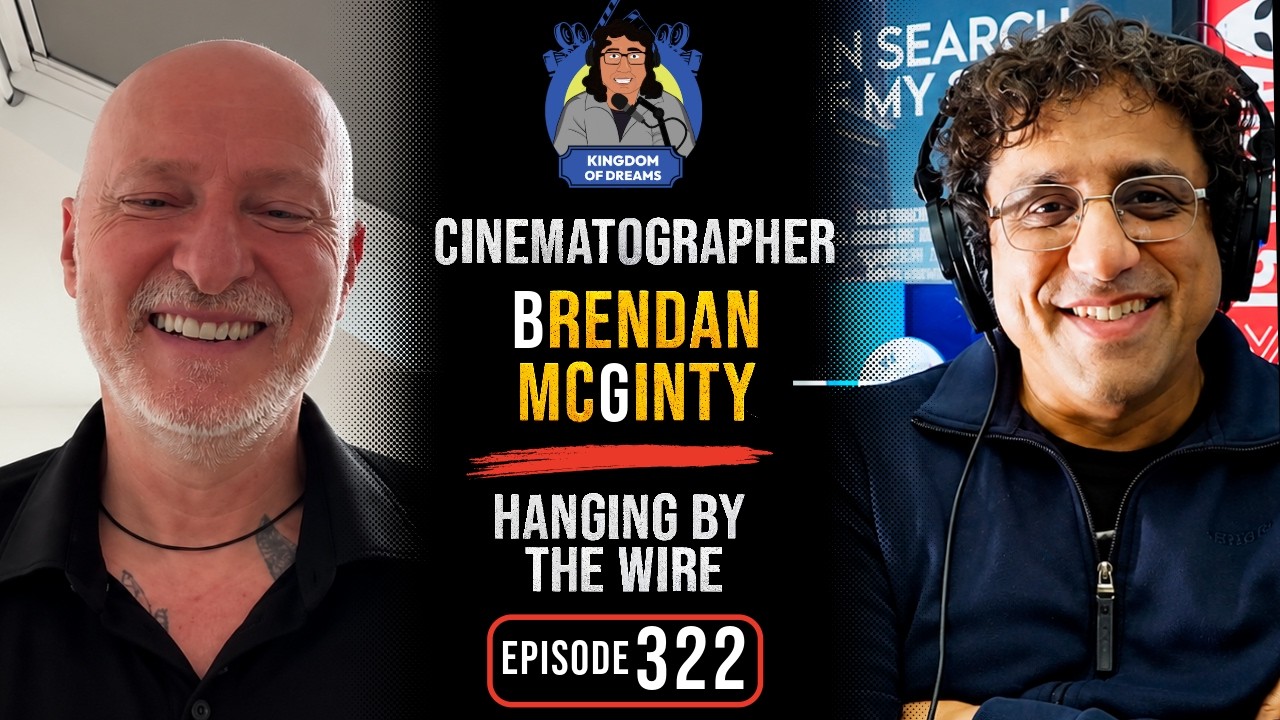
Filming 'Hanging by the Wire', Cinematographer, Brendan McGinty
Clips and Shorts from this episode
About this episode
🎙️ On this episode of the Kingdom of Dreams Podcast, I sit down with cinematographer Brendan McGinty to discuss his work on the gripping documentary Hanging by a Wire.
Brendan takes us behind the camera to explore how the film captures both the emotional human moments and the edge-of-your-seat suspense surrounding this extraordinary real-life incident in Pakistan. We discuss the visual approach, filming under intense circumstances, and finding the balance between tension and humanity.
It’s a fascinating conversation about cinematography, suspense, emotion, and why, at its heart, Hanging by a Wire is simply a film about human beings caught in an extraordinary situation.
McGinty is a cinematographer and director of photography known for his work across film, television, commercials, and documentary projects. His cinematography is characterized by a strong visual sensibility, naturalistic lighting, and an emphasis on using composition and camera movement to support character and story.
Throughout his career, McGinty has collaborated with directors and creative teams on a range of productions, bringing a thoughtful, story-driven approach to the camera department and balancing technical precision with cinematic imagery.
#hangingbythewire #pakistan #documentary #cinematographer #sundance
Full transcript
Automatically generated from the episode audio, so expect the odd misheard word or name. Speakers were labelled automatically. About 7,500 words. Tap a timestamp to play from that moment.
0:00Jawad MirI think you mentioned Ali, which I was gonna bring up. The whole sequence of when he's introduced, from that point on until he's sitting with his father…
0:07Brendan McGintyYeah
0:07Jawad Mir... At the end when he's welcomed. You're, like, kind of enjoying it because he's just so…
0:12Brendan McGintyYeah
0:12Jawad Mir... Confident about what he wants to do.
0:14Brendan McGintyYeah.
0:14Jawad MirAnd then it shows his struggle and his arm and, you know… ... Crying in front of his father.
0:20Brendan McGintyBe… I mean, there's beautiful scenes in there. There's a scene with one of the fathers who's, you know, his son's in the cable car, and he chokes up during his interview, and he says, "Our children are these most precious jewels," or something.
0:33Jawad MirYeah.
0:33Brendan McGintyIt's g… it's very powerful. I'm thinking back to how many elements of the film were actually purely documentary. So when we went up to Battagram, a big crowd assembled from that village and nearby villages. The next thing we knew, we had a crowd which was pretty much like the crowd that ended up on that day.
0:51Jawad MirWow.
0:51Brendan McGintySo Mo, you know, with his documentary instincts, he's like, "Right. Let's, let's let this be the crowd."
1:06Jawad MirTell me your journey on this film. How did you come on board, and h… your time being spent in Pakistan, in that northern part of Pakistan…
1:15Brendan McGintyYes
1:15Jawad Mir... And the experience of that?
1:17Brendan McGintySo, the incident happened in '23, and then I began conversations with Mo and the producer Bilal in '24. There was still, you know, funding, trying to get things in place, lots of logistics and planning. We were gonna go in '24, I think towards the end of '24, and it never happened, and it, we ended up going for our first shoot, which was, the start of '25…
1:47Brendan McGinty... Which essentially our first shoot was a lot of, traditional documentary approach, I guess. These big interview set pieces and, you know, sort of B-roll of the characters' lives and landscape stuff and sort of scene-setting. And then, the very talented Will Graebner cracked on with the edit with a mixture of the archive and these original things. And we then ba… which was a beautiful way to work. We then went back in, late '25 and it was essentially, a drama shoot, which for the rest of it, which I can come back to. I think there's, I think there's a lot more in there that I shot than you even realize. Certainly reading the reviews, a lot of people imagine it's all of the action is archive, and it really isn't. And I'm slightly proud of the fact that it goes unobserved 'cause we were very careful to find the right tonality. Anyway, we can come back to that.
2:48Brendan McGintyBut, I loved shooting in Pakistan. Weirdly, I lived in Pakistan briefly as a kid in Karachi. My parents were photographers who traveled, and they ended up there. And I have very vivid memories of that and kite flying competitions and all these things, you know, and the food. S… but this is the first time in my adult professional life I've been back to Pakistan. I… I've made lots of films in India, and I thought perhaps it would be quite similar, and I found it not at all, very different, and I loved it. I absolutely loved it. We filmed a lot in Islamabad, then we filmed a lot in Lahore, and then we went up to the mountainous regions where the incident happened in Battagram, which is exquisite. I mean, exquisite. It's so beautiful up there. So yeah…
3:36Brendan McGinty... It was,... I got a real sense of, you know, a couple of the key points of Pakistan and, I loved it. I may, there's talk of another project, a feature film, narrative feature film in, Karachi. So I look forward to going back 'cause I loved the crews I worked with, hospitality of everyone, the landscape. Yeah, I loved it. Very positive experience.
4:00Jawad MirThat's amazing. I do think the cinema in Pakistan is evolving…
4:06Brendan McGintyYeah
4:06Jawad Mir... Q… quite rapidly in the last six months to a year in terms of production value, in terms of stories that are being told. I just saw… ... The trailer of this, film called IJ, which is based on a very famous author's novel series growing up. So…
4:26Jawad MirThey kind of, like, Westernized it, and it looks... Check out the trailer. You'll, you'll appreciate the cinematography. I mean…
4:31Brendan McGintyI do
4:31Jawad Mir... In terms of visual and production style, it's, it's really well done. And
4:37Brendan McGintyYeah
4:37Jawad Mir... Yeah, no, s… even with Hanging by a Wire, I mean… ... You know, what's so great about it is everything about it is very traditional Pakistan. But the production value and the storytelling is top-notch. Like, you know, the fact that Universal came on board even…
4:55Jawad Mir... Before the film was finished and…
4:58Brendan McGintyYeah.
4:58Jawad MirYeah, it's, it's just, it's just remarkable. I was really surprised. And you talked about, you know, some of the things in terms of cinematography. I was talking to Mo about this too, that you're right. Like, so there are some parts which seem, like, archival…
5:15Jawad Mir... But there's a… ... Fine line between figuring out which one is which. So he did…
5:20Brendan McGintyYeah
5:20Jawad Mir... Mention that briefly, but I would love for you to tell us as a cinematographer the parts that…
5:24Brendan McGintyYeah
5:25Jawad Mir... You were talking about.
5:27Brendan McGintyOkay. Yes. So Mo, a huge decision for, like, Mo, wonderful working with Mo and, you know, very much Mo and Bilal were very much a team. So these were always shared conversations. But what I loved was their bravery early on, their sort of cinematic bravery that Mo said he's obviously made, you know, built a career and lots of, won lots of awards on films that are showing What he described as a quite sort of traditional Pakistan documentary narrative, you know, quite often some quite sad stories, some, you know, some trauma, and he didn't wanna make that kind of film. With Hanging by a Wire, he felt it was his opportunity to make something that, in his own words, he wanted it to be a Hollywood thriller, you know? And I loved that. You know, this is in our first meeting, this is what he said. And I thought that gave us all permission and bravery to take it to another place. So, but within that, he's also very pure in his documentary thinking in that we never wanted to deviate away from the truth, you know, the reality of what happened.
6:37Brendan McGintySo the phrase that he often used, which I thought we got to, was this sort of Brechtian approach where we sort of reveal our hand. So we went in with a very heightened cinematic style, but he never wanted to, never wanted to be lying to his audience, so there's, there's constantly stuff in there like,... So the big scene that I'm d… gonna describe to you, at the end of the film, we pl… we show our hand. At the end of the film, the young boys are sat for their final interviews, sitting in front of the cable car and the studio behind them. So to the audience, we're saying, "That's a cable car and a studio," you know? "It's not hanging off of a wire." So obviously the whole film was built around this staggering archive, which the local guy got a drone up, and the shots on the drone are all real, and they're incredible, and we never... You would be crazy to think you could ever do better than this life-and-death situation, this unbelievable, you know, jaw-dropping footage.
7:39Brendan McGintyBut then of course the minute it goes dark, you know, the rescue all happens in the dark, and the minute it goes dark, there's no footage. There's no footage at all. There's a few people's phones, but almost nothing. So essentially the whole rescue is shot. But where Mo's stroke of genius, which to be honest I questioned at first, but he was so spot on, it's 100% a tribute to him, is he said, "Let's use the real characters. Let's use Saib Khan to be playing Saib Khan. Let's use Ali Swati to play Ali Swati. Let's use all the boys who are now considerably older," and no one notices that we're intercutting to much older boys, you know? Somehow slight, cinematic sleight of hand and Will's amazing editing. But yeah, we had a zip line facility, very safe, which is, I forget where it was, near Islamabad, which we did our zip line work...
8:42Brendan McGintySorry, we did our wire work on a zip line, a family-friendly zip line facility, very safe conditions, and there we leaned into... You know, I looked at, well, what was, what was there? I didn't wanna light it in a big, glossy Hollywood way. What would the lights have been? And of course the village had a searchlight that they were using, looking down the, down the wire with a searchlight. There were some phones, you know. Ali Swati had his phone out the whole time, and they had one tiny little LED sort of hanging off someone's belt. So just with those sort of tools, building something, leaning heavily into shadows, I actually shot that section on vintage lenses because I knew they would flare tremendously, and this would help that kind of seeing and not seeing. In a way, I guess you're going into the language of a horror film to get back to Mo's, you know, Hollywood blockbuster thriller vibe that he wanted. You're slightly going into horror film territory, tons of darkness, these big flares, seeing but not seeing.
9:47Brendan McGintyI shot... That stuff, was actually all shot on a 50-foot crane, you know, with a remote head on the end with doing all the wire work. And the, and the flares are doing a lot of the acting in those scenes as well, you know? There's tremendous drama of these flares coming down the lens. And then when we... The reverses, if you like, when we're in the cable car, they had built, which I still can't believe, it was so beautiful to see, they'd built the, a replica of the cable car in steel. It was not like some flimsy thing that you might see, you know, in Pinewood Studios over here where they'd build it out of wood or something. This is a metal cable car exactly like that one, perfectly observed from all the pictures, that we put in a studio. And it was important to us that in these reconstructive moments, I'm not sure the word reconstruction is right, but I'll use it, is that we... Everyone was safe and comfortable and all these things. We didn't want to sort of traumatize people with any degree of, you know...
10:49Brendan McGintySo we shot that in a studio, and the cable car could move a little bit, albeit manually with people actually sort of levering it. We could get a bit of movement and sway. And the c… the wire that we see in those scenes is actually rope, sprayed silver I imagine, but the… there's rope. And all of the scenes of the boys in the cable car in the dark are, you know, they... That's me handheld shooting in and around them. But what was so wonderful was being with the boys and having them re-remember things and check each other and say, "Well, you were sitting there." And then, you know, one of them was in floods of tears the whole night. The other one was consoling. And they re-remembered. And at the end of all of it, with, definitely with Ali Swati, who was very emotional about the whole thing, is that they were so gracious. Everyone felt it had been this, you know, to use the ancient Greek phrase, catharsis, you know? It was tremendously cathartic for all of them to relive this experience in a safe way, but also to be given a voice, to be sha… sharing in the authorship of this moment.
12:00Brendan McGintySo I felt incredibly pla… Yeah, that's, that's never happened to me in a documentary where y… you know, the protagonists were that involved in the retelling of their story. So… You know, weirdly we've ended up with this film that is both very heightened in its, you know, cinema… cinematic photography, but also incredibly truthful. Now, these are normally sort of polar opposites, but somehow, you know, through the sort of magic of Mo and Bilal and the whole team, and Will, and hopefully my own contribution is we managed to weave these normally very disparate styles. You know, they are woven together in the film, to the point where I've just finished reading, one of the bigger reviews of the film, The Guardian, you know, The Guardian's opinion on the film, and it's a wonderful review and I'm just very happy that it's sort of, you know, there's an awareness of our film. But of course, the, Guardian journalist thinks it's all an edit and nothing was shot, which is wonderful to hear. I'm like, "Wow, okay." You know, we shot, I'd say three-quarters of everything is shot by us.
13:04Brendan McGintyThere's, there's not nearly as much phone footage in there as one imagines.
13:09Jawad MirAnd one of the best things in the film was... So I, this is, like, a personal preference, right? Like, it doesn't make it… ... Better or worse. I'm not a fan of recreation from… ... The standpoint of, having, you know, like docudrama? Like, you know, you have…
13:26Brendan McGintyYeah
13:27Jawad Mir... Spies, like, crime drama and all that.
13:29Brendan McGintyYeah.
13:29Jawad MirThat's not for me, right? And what I loved about this one was the ni… the rescue sequence. It was so brilliantly edited and shot… ... To your credit and to the editor's credit, with the flares you were talking about, use of vintage lenses. And it was so…
13:46Jawad Mir... Rapid, especially showing the cable and the movement of the cable, and the people, and their just… ... You can't really make out for faces. And even if you try hard, you can't because you're so involved…
13:57Jawad Mir... In the intense action of the sequence.
14:00Brendan McGintyYeah.
14:00Jawad MirAnd I think that's where The Guardian and other publication
14:04Brendan McGintyAnd it's great. I love it. I'm not... The... It's definitely not a criticism. But it's, yeah, I feel, I really feel very proud of this film, and I would say maybe…
14:15Jawad MirYou should be
14:16Brendan McGinty... Yeah, I think, I think Mo and Bilal are, everyone, you know, everyone involved, you know, the UK production company who did a lot of the sort of producing on the ground, I think I... You know, I've been proud of lots of things I've made, but this felt... I mean, I guess they reached out to me knowing that I worked both in documentaries and in drama.
14:42Brendan McGintySo they reached out to me because, again, to come back to what you said, docudrama, it's this sort of, this sort of dirty word. Like, what is this? Like, we… are we in the world of the truth and the document, or are we, you know, are we, are we making feature films here? So it was,... And I, you know, it was, it was great that they came to me because I do actually inhabit both worlds. I, you know, I've just finished shooting a traditional feature film in London, and I shoot commercials and music videos and stuff, but I've also been running round deserts and jungles with, you know, real situations and real people. I've, I've done sort of both those things. So, it felt, it felt like it coalesced two worlds that I've inhabited photographically for a long time. And, but tonally, getting it right is very rare. Very rare. And I think one of the definite magical elements was Mo's decision that all of the characters would play themselves.
15:42Brendan McGintyI think this... It was at that point that it just, it all just slotted in. We were like, "Okay, now I've got it." Like, I get how this is gonna work now, because if you're on a journey, a photographic journey with the actual characters who went through these actual things, and you can sort of check with them, they're not acting at any point, and you don't get into this territory that you just alluded to on a sort of true crime drama where you've got out-of-focus people and, you know, and maybe some slightly bad acting. I, you know, I don't know. I don't want to criticize. I've, I've done some good sort of docudrama work as well. But you're not in the world... You fall between two things, because you've got... You're not making drama with... You know, you haven't got someone who's, who's... You know, you haven't got, like, Robert De Niro there pouring his heart out to you. E… there's not time for it because the stories, that you're telling, this is in traditional docudrama, are sort of illustrative. They're little vignettes that are kind of just papering over the dialogue of the people.
16:48Brendan McGintyWhereas in this film, in Hanging by a Wire, you know, we had this gap. The, this footage did not exist from a lot of the rescue. So we needed to shoot it and we needed to... A… and being on board with the people who, to be honest, everyone involved wanted nothing more than their f… story to be made into a film. That's what they wanted. It wasn't like they, we'd, they did, we'd forced their hand or they were doing it for money or something. They all were all doing it because they had this life and death experience, and in the case of the rescuers, they'd done something very selfless and incredibly heroic, you know, for both of them. But the fact that people had noticed and come along and said, "We want this, we want the world to see this," meant a lot to them. It meant a huge amount to them. So, anyway, yeah, we seem to have found a fusing of these two worlds that don't normally work well together, but I think we really hit a sweet spot.
17:46Jawad MirI agree, and I think aside from Mo's decision to make it with real people who were involved in the, i… in the incident…
17:55Brendan McGintyYeah
17:55Jawad Mir... What was also important was people's involvement genuinely and openly.
18:02Brendan McGintyYeah.
18:02Jawad MirBut to me, the most powerful thing was... So it, you know, it has, it has an interview with, the military personnel…
18:10Brendan McGintyYeah
18:11Jawad Mir... The police pers… personnel and…
18:13Brendan McGintyJournalists
18:14Jawad Mir... Journalists and all that. And that, and I was watching the film because I've seen Mo's past work and… Most of his stuff has been social and political
18:25Brendan McGintyYes. Yeah
18:25Jawad MirAnd I was waiting for it to go in that direction…
18:29Brendan McGintyYeah
18:29Jawad Mir... And it, and it didn't, and I think that…
18:31Brendan McGintyYeah
18:31Jawad Mir... Is a huge factor because it just played on the surface…
18:35Brendan McGintyYeah
18:36Jawad Mir... Because there's a situation and everybody's trying to help, and they will just… ... Kind of say that, "Well, they came late, but then they're trying." You know, so it just played…
18:45Brendan McGintyYeah
18:45Jawad Mir... It's not that it was neutral or balanced or un… you know, n… not truthful
18:49Brendan McGintyIt's very human. It's very…
18:52Jawad MirYeah, exactly. That's the key word
18:53Brendan McGinty... And actually, I watched it with my family, and it is a, it's a very celebratory human story where a whole community, the, you know, the families pull together, the communities pull together, the nation pulls together in quite unusual ways, people who don't normally communicate with each other, and they make it happen. And yeah, they fail. You know, even the guy who eventually does most of the rescue, he nearly fumbles it twice, you know, like, but he's trying. It's not like no one's got a solution for how you do this. But to come back to what you're saying, what I also found interesting is you were waiting for it to go political, you know, because of Mo's usual work, is the politics is there, but it's in a very gentle, human way.
19:37Jawad MirYes.
19:37Brendan McGintyYou know?
19:37Jawad MirYes
19:37Brendan McGintySo a lot of people will talk, for example, that particular reason, region, you know, fairly, I guess, almost tribal up there by towards Afghanistan where people speak Pashto.
19:48Jawad MirYeah.
19:48Brendan McGintyYou know, like, you know, women occupy a very different place to sort of women in the Western world. So but Mo doesn't make a big statement about that, and yet the two central characters of his narrative, the two central who drive everything, who basically got the rescue done, is the woman journalist and the woman chief of police. So but Mo doesn't... It's not a big flag-waving exercise. It's just there.
20:21Jawad MirYou know, it's interesting you mention that. So I… obviously…
20:24Brendan McGintyYeah
20:24Jawad Mir... It's very noticeable the two protagonists are women.
20:26Brendan McGintyYeah. Yeah.
20:27Jawad MirBut until you just mentioned this right now, it didn't…
20:29Brendan McGintyNo, I noticed
20:30Jawad Mir... Hit me.
20:30Brendan McGintyYeah.
20:30Jawad MirThere's no, there's no women from the community, and I understand why.
20:34Brendan McGintyYeah. Yeah.
20:35Jawad MirRight? But if those two protagonists weren't there…
20:39Brendan McGintyYeah. Yeah
20:39Jawad Mir... Then that would be very noticeable.
20:41Brendan McGintySo even there, I'm sure this is a very, you know, Mo's very aware of the political…
20:47Jawad MirYeah
20:47Brendan McGinty... Subtext of this. And there's other things going on. I mean, you, there's, there's class, you know, economic divide. Of course, you've got Saib Khan, the guy who goes out first on his own, you know, and he's, he's not, he… he's got no wealth or power or voice in his society. He does pretty basic mechanical work for a living. He's scraping by, but he sees a way of getting the boys out, and he goes in. And then there's a real sense in that he gets pushed aside because he's not someone who's meant to have a solution, have a voice, you know? And then we end up with Ali Swati, who's, you know, his family's a bit more connected, and he's got links to the military and that, and he comes along and he does exactly what Saib Khan was gonna do but in a, you know, maybe a more elegant way. But even there's a subtle soft narrative that there, that there's class, as there is in every society, that there's, there's class divisions and people's voices not getting heard and getting pushed aside because they're of a different economic, you know…
21:47Jawad MirYeah
21:47Brendan McGinty... So even there I thought, but with all of it, I love the subtlety, the actual subtlety and even comedy. There's moments where the two of them, who are now best friends, you know, their little altercation at the cable car, that really happened, and they're swearing at each other and stuff. And even when we see Ali Swati, you know, when we first introduced to his character and his, you know, his gym and, you know, you… there's a smile. There's a smile on the filmmaker's part. We're not laughing at anyone ever 'cause he's ultimately an incredible hero. But, you know, there is a smile as to, like, you know, he's very aware of his image, his body, how he looks. You know, there's just something there. So with all of it, you know, Mo's not sort of beating up his audience with big political analogies and that. It's just gentle, and it, the humanity of it all shines through, and I thought that's extraordinary. It's very unusual. You know, a lot, a lot more documentaries are very judgemental in tones, and they make very black-and-white decisions between, you know, you know, they… there's a lot more overt political agenda or if not political, even just judgemental morality of good and bad, you know, in your average true crime doc or more social documentary.
23:08Brendan McGintyBut, you know, Mo, he highlights these things, but it's all gentle…
23:14Jawad MirYes
23:14Brendan McGinty... And he lets something else take precedent.
23:18Jawad MirI agree, and I think you mentioned Ali, which I was gonna bring up, is… ... The whole sequence of when he's introduced and from that point on until he's sitting with his father…
23:29Brendan McGintyYeah
23:29Jawad Mir... At the end when he's welcomed. I thought his arc… ... Was probably the best arc in the film for me. That doesn't mean that's…
23:36Brendan McGintyYeah
23:36Jawad Mir... The best arc, you know?
23:37Brendan McGintyYeah, no.
23:38Jawad MirBecause…
23:38Brendan McGintyRight
23:38Jawad Mir... And he had this humorous element to it, like he was full of himself and…
23:42Brendan McGintyYes
23:43Jawad Mir... You know, and in a good way. Like, you're like, you're not like, "Oh my God, this guy is so arrogant," but you're, like, kinda enjoying it because he's just so…
23:49Brendan McGintyYeah
23:49Jawad Mir... Confident about what he wants to do.
23:51Brendan McGintyOh, yeah.
23:51Jawad MirAnd then it shows his struggle and his arm and, you know… ... Crying in front of his father and ... Which is a journey, which is a story as old as time, right? Like getting a nod from your dad. And…
24:04Brendan McGintyWell, even his dad gives that very dismissive comment where he said, "It's a good thing he's so good-looking 'cause he's, he was never gonna amount to much." You know, it's like, "Come on, Dad. Have a, have something better to say." And then at the end, acknowledging that his son's a hero… You know?
24:22Jawad MirBut, you know, the counter to that is, I would say, is that if he had not said that about his son, maybe the son wouldn't have taken that challenge on to do what he ended up doing, right?
24:31Brendan McGintyPerhaps.
24:31Jawad MirSo sometimes you get…
24:32Brendan McGintyYeah
24:32Jawad Mir... You get pushed in a very negative way, and then it makes…
24:35Brendan McGintyYeah
24:36Jawad Mir... You do things that you don't even think you're capable of.
24:39Brendan McGintyYeah. And there's b… I mean, there's beautiful scenes in there. Every time I see it, you know, I'm a father myself, I have two kids, I... There's a scene with one of the fathers, I forget his name, who's, you know, his son's in the cable car, and he chokes up during his interview, and he says, "Our ch…"
25:00Jawad MirIt's in the trailer, too, yeah.
25:01Brendan McGintyAnd he says, "Our children are these most precious jewels," or something, "this gift." And, it's very powerful. It… there's no contrivance there. It was, you know, it... We were all in the room as we filmed it. I'm sure I was in tears myself. He was, you know. And this is, you can tell, this is not a man given to emotion in his day-to-day life, you know? He's quite reserved. He's, you know. Yeah. So a… and actually, even I'm thinking back to how many elements of the film were actually purely documentary. So when we went up to Batagram, we, because it was quite exotic for this tiny little village for us to all turn up with cameras and drones and, you know, gimbals and all these things, a big crowd assembled from that village and nearby villages. And next thing we knew, we had a crowd which was pretty much like the crowd that ended up on that day.
25:59Jawad MirWhoa.
25:59Brendan McGintyYeah. So Mo, you know, with his documentary instincts, he's like, "Right, let's, let's let this be the crowd," you know? And we took some of our central characters, moved through the crowd. So w… when you see Saib Khan move through the crowd and get stopped by the police, you know, we just with the people. But it was, none of it was done at their expense. They all got…
26:20Brendan McGinty... "Okay, we just wanna get this moment when he came in and did this," and they're, "Cool. Yeah, he was there. They were there." And then we would do it. And then I remember at the end of that sequence, crowd dispersed and we were, we were pretty much done for the day, and that father, that very emotional father, he just appeared out of the crowd. And I'm not sure that the plan was even to talk to him. There were a lot of voices in the film already, and he, this guy just appeared, and someone introduced him and said, "This is, you know, this father of one of the boys."
26:51Brendan McGintyAnd we're like, "Cool." And then we were busy shooting this sort of wheel house where the cable had snapped off from. We were in there doing shots of the frayed cable and, you know, all these elements. And then Mo, again, his instincts, you know, documentary instincts, he was like, "Let's just get the father in. Let's just have him wander around and look at these things." And we were just filming this father looking, and next thing, he just started talking about it in this very beautiful, poetic, lyric… lyrical way. And again, I think he was in tears at that moment as well. You know, I think he says something about, "There was a bang and I thought, I thought I'd lost my son," or something. And it was only off the back of that we were like, "Right, we need to interview this guy." You know, his story and his way of telling his story is incredible. We need him. So it was only after this very accidental meeting of a guy, completely accidentally, watching him tell his story, the decision was then made. You know, in modern documentaries, there's so much scripting of things and, you know, they're like, before you go out on the shoot, they're like, "We're gonna speak to this one and that one and that one on Tuesday," you know?
28:00Brendan McGintyThis was not like that. You know, we were out there making a true documentary, 'cause there's the father of one of the boys, not on anyone's radar. We start speaking to him. He's incredible. And then we do an interview with him, and he's one of the, you know, he's a big voice in the film.
28:16Jawad MirYeah. And I appreciated the word that you used, true documentary. Again, nothing against the likes of Netflix or Paramount… ... Or Amazon documentaries. I get it, like, there's budgets behind it and you have to be sort of prep…
28:29Jawad Mir... But I am, I am a very big fan of just keeping it simple, keeping it authentic… ... Not having any kind of agenda, not wondering, oh, would this fil… will it fit this checkbox? Will it fit this checkbox? Just being authentic. And that's, again, going back to that whole thing. That's why this film works at so many levels. I wanna talk to you about the technical stuff.
28:50Jawad MirSo the interviews that you guys did with the policewoman, the journalist… ... Even with the, after the rescues with, you know, TV screens in the back and all that fun stuff.
29:02Brendan McGintyYeah.
29:02Jawad MirTalk to me about that. What was the call on that? Was that something that was always planned between you and Mo of having…
29:10Brendan McGintyYeah
29:10Jawad Mir... Instead of your traditional, you know, talking head, giving it…
29:13Brendan McGintyYeah
29:13Jawad Mir... Its three-dimension?
29:15Brendan McGintyYeah. We tried, we tried lots of different things. We tested. I showed them some previous work that I'd done to f… try and find tonally the right thing. We ended up, on all of our interviews, we ran three cameras, where we would do... We would work back from a big wide, which was always the character in their environment. So, you know, it could either be loads of TV screens or it could be, you know, a interior of a really interesting house, you know? But, like, a big wide that told you something about the person's world, you know? We didn't just want these floating heads. We wanted to understand the world they were from. And then, of course, you needed the intensity of someone, you know, in a traditional close-up. So that was maybe the A camera shot, if you like, would be, would be, you know, traditional sort of head and shoulders where, you know, we're sort of focusing on the character. But then I would always throw in, and it's a shot that I like, would be, a profile shot, on a tighter lens, quite often… Not overly traditional framing, sometimes short-siding people rather than giving them lots of looking space.
30:32Brendan McGintyAnd the idea of that third shot was always why I find it interesting, because it almost offers a counter-narrative. So, you know, here I am talking and telling you my story of the making the film, but if there was another angle from the side which was less traditional, then you might get a sense of that well, maybe Brendan doesn't have the whole picture here. Maybe Brendan had only a glimpse at what the whole picture was, you know? So, we used those shots to give you a sense like they've all got fragments of how it happened. And there's something about the side angle that is… at least lets you know, like, I'm in control of this angle straight on at me. I'm, I'm the sort of hero in my own story. But if you go to the side with a longer lens, I would often shoot it from opposite the key so there's a lot more shadow in it. There's a sense in those shots which is slightly unsettling, that one suited a very unsettling subject matter where it's life and death, and there's all sorts of extraordinary things going on.
31:38Brendan McGintyBut also that maybe I don't fully get the whole picture of this. I'm not, you know, in charge of my own story here. There's something else going on. So we pretty much went with those three cameras on everything, and then I'd have to always sing the praises of Will Graber and the editor, very accomplished editor. And he choosing the… you know, working together with Mo and Bilal and choosing the beats and setting up that rhythm of which shot we saw when, you know, that you're, you're in… it's almost like music at that point. You're choosing which chord…
32:15Jawad MirYeah
32:16Brendan McGinty... To use in that moment. And I have to say, an extraordinary thing to talk about the editing for a, for a moment is we shot the national, quite traditional documentary section first. We knew we were coming back, and we shot bits of drama in that, little bits and pieces of drama. A lot of the daytime drama we shot then. We knew we were coming back for an extended drama shoot, but we wanted to find our feet in the edit first. And then we stood down for a good few months, four, five months, while Will edited. And I tell you, the most productive thing that we did was me, Mo, Bilal, and Will got together in Soho where the film was being edited in London, and Will showed us his edit of… he'd gone through… 'cause there were, you know, people had seen the incident from different angles. There were different versions of how it happened, you know, people, the chaos of a big incident like that.
33:16Brendan McGintyBut Will had sifted it through it all. He's a very meticulous, fastidious editor. He'd gone through it all, and he really stripped it down to what actually happened and what the beats were. And that was incredible. And off the back of that meeting, there was actually a couple of days where we did it, maybe even three days. We almost put together, I wouldn't call them storyboards, but, you know, approximating that, where we were like, "Right, well, these are the beats that we know happened, but we have no pictures for." And it'd be a real tragedy just to have a voice tell you that, but no…
33:50Jawad MirYeah
33:50Brendan McGinty... Imagery.
33:50Jawad MirVisuals.
33:51Brendan McGintySo we then, when we went back, off the back of this editing knowledge, we were able to go, "Right, this is what we need. We need these things. Like, how are we gonna achieve this?" So yeah.
34:03Jawad MirYeah. No, that's, that's, that's remarkable, man. And I… you talked about the worlds. Was there ever a conversation or an attempt to film in their homes, or was that something that wasn't even attempted, or was it sort of off the charts?
34:17Brendan McGintyI think up in Batagram that would have been difficult. I think, I think I'm not, I'm not sure people would have been that comfortable with it. But we shot in places there was a I think there's also logistical issues, you know, moving a lot of people around.
34:37Jawad MirYeah.
34:37Brendan McGintyYou know, quite often it's easier to bring people to you know?
34:40Jawad MirStudio, yes.
34:41Brendan McGintySo we had it's not all studio, but we had a wonderful location just outside
34:47Jawad MirOkay
34:47Brendan McGinty... Islamabad, which is an old family home, beautiful with different rooms, and it's, it's, it's done in a very beautiful, slightly tribal way. There's lots of rugs. There's you know, you don't feel it's not like a boutique hotel or something. It's, it's real spaces, but there's lots of them. And we were able to do some of the interior filming in this place, just because it would be impossible to go up to this guy's village in, you know… Very difficult to get to Batagram. You know, part of the reason people are using cable cars up there is you can't drive. There's no roads.
35:20Jawad MirThat's true.
35:20Brendan McGintyYou can't get from A to B. So to get a whole film crew, you know, three cameras, sound, all these things, to get us up to some remote village somewhere, it just, you know, it gets very expensive, time-consuming, complicated. So we could be more efficient with our time and our money to bring people to us.
35:38Jawad MirSure.
35:39Brendan McGintyYeah.
35:39Jawad MirMakes sense. Absolutely. What was one thing that you learned about yourself while either being in Pakistan or working with, on this film or connecting with these characters, these real people?
35:54Brendan McGintyWow. You know, it a lot of the work that I do is for, in the, in the documentary space, is for like very big streamers. I've shot big films for Netflix. I've shot big films for Disney, for, you know, for all of the big names in the streaming world. And they, you know, so I'm very proud of some of the work I've done. It's very wonderful. But it is, as you alluded to earlier, it's very you're very aware of the process. You're very aware of this kind of… Almost pre-scripting a style guide. We're gonna do this. You know what you're doing in advance, you know, which I think would surprise a lot of people that it's a documentary, but that you know in advance what you're gonna shoot. And things that there's like a house style that you're revisiting and, you know... This was very freeing, very freeing, because they had secured their money independently.
36:55Brendan McGintyYou know, Universal only came on board sort of halfway through…
36:57Jawad MirAt the end, yeah
36:58Brendan McGinty... It, gave them a very free hand. So we had no one there telling us how to make the film. And I guess for me, it was a moment in my career where I got to pull together more than ever before my… these two loves of my photographic life, which is the real world and real people and real light coming over a mountain in Batagram, and what that looks like, you know, which I love about documentaries, and going and just the textures of buildings. You could never art direct things in that way, and just seeing the real world. And then the other world, which is the world of the, you know, i… i… of, I guess, of dramatic cinematography where you c… basically creating from zero. You know, you could be in the studio and there's nothing there, and you build a set and you paint it the right colors and you use certain lenses to heighten this and that. And I'm not diminishing that world, it's extraordinary, and some of the world's greatest cinematographers have only ever inhabited that world.
38:00Brendan McGintyBut for me, it was, I guess, interesting and educational for me to acknowledge that I have these two pulls, and to be allowed to fuse and bring them together and play with them, while making, I think, what is a very important and human film.
38:24Jawad MirAmazing. That's awesome. I know Mo was telling me that it's, it's released in the US last week… ... And it's kinda go through a different engagement throughout the rest of the world. Is it out in UK already as well?
38:36Brendan McGintyIt's out in the UK, yeah.
38:38Jawad MirOkay.
38:39Brendan McGintyI'm gonna be doing,.. They've done lots of Q&As you might expect, but I'm doing one, next, this Thursday at BAFTA. They… there's a screening at BAFTA, and, yeah, afterwards. And Will's gonna be there as well, the editor, and me, and a couple of the producers, yeah.
39:00Jawad MirAmazing. I'm gonna... I know somebody, who's a BAFTA member. She was with, Ridley quite a bit.
39:08Brendan McGintyOkay
39:08Jawad Mir... She's an art director. I'm gonna tell… I'm, I'm really good friends with her now over the years, being on the…
39:13Brendan McGintyRight
39:13Jawad Mir... Podcast. I'll let her know to check it out because it's an amazing film, and she goes to all this kinda stuff, so I'll let her know.
39:19Brendan McGintyTo be honest, I love hearing from people exactly that it's an amazing film. I've, I've, I've shared it with a few, you know, with my family, and seeing my family really respond to it like, "Wow," you know, like edge of the seat, you know, almost wanting to stop me in the middle of it like, "What's going on?" but just to hear from, I think, everyone. I haven't had any negative co… comments from anyone. E… everyone's saying they felt, like, enriched by it in a way, 'cause it puts you through it. You know, it definitely puts you through it. You… Some of those shots, you think, "Oh, my goodness. That cable's gonna go." And it was gonna go, you know? And then at the end, you know... Well, I don't wanna spoil it for anyone who may still…
40:05Jawad MirYeah
40:05Brendan McGinty... Wanna watch it. But there's, I think, tremendous catharsis. You know, like, that phrase gets thrown around, but I think there is something cathartic about this film.
40:15Jawad MirAnd one thing that we didn't talk about, I didn't even talk about this to Mo, which I think is one of the most important part of the film, is the sound of that cable car.
40:26Brendan McGintyYeah.
40:27Jawad MirThe way, the way you hear creaking… ... And, you know, the movement, that is so freaking... I mean, sound i… is always very important, right? Like I've always said…
40:36Brendan McGintyYeah
40:36Jawad Mir... Sound makes the film. Nothing against anything else, but…
40:39Brendan McGintyYeah
40:39Jawad Mir... In that moment, every time you see that and you hear the creaking sound, the sound design was phenomenal. It was really well done.
40:46Brendan McGintyBeautiful. Beautiful. And interestingly, we spoke about that even though, in our initial Zoom sessions, we did a lot of it by Zoom. In our initial sessions of me, Mo, and Bilal, 'cause it was just the three of us chatting for ages, there was lots of chat about sound. Like, I was saying the metallic sounds have to be... You know, you've got this wire which is like, I don't know, like a guitar string or something that you can get that resonant sound of. And this metal structure creaking and groaning and hanging, and the wind howling down the valley. So yeah, even though, you know, my responsibilities were photographic, we were all very tuned into where this was gonna go in terms of sound, yeah.
41:32Jawad MirWell, that's a collaborative effort, right? The film medium, so which is awesome, and it shows in your film. Again, Brendan, man, amazing film. I truly loved it. It was so funny, you reached out to me as I just finished talking to Mo. And I'm like, you know, "Okay, this is like, let's, let's do this. Let's get a perspective from a DP stand." Because with Mo, it is, going around and press. He had, like, very limited time, so we didn't really get to chat…
41:57Jawad Mir... More than, I think, 20 minutes or so. But
41:59Brendan McGintyYeah, they…
42:00Jawad MirBut…
42:00Brendan McGinty... Both of them very busy, yeah. Yeah.
42:02Jawad MirYeah, but amazing to have you. Lovely film. Looking forward to your next film, which is coming next year?
42:09Brendan McGintyIt's a feature film, yeah. It'll be out beginning of next year. It's... Yeah. I'll, I'll look…
42:15Jawad MirAnd then obviously the shoot in Pakistan. That would be awesome, too.
42:18Brendan McGintyYeah, I'm, I'm hoping to find myself in Karachi. I can't tell you too much about that, but that's very exciting.
42:23Jawad MirYeah, that's fine. Awesome, man. Thank you so much for your time, buddy.
42:26Brendan McGintyThank you. You're welcome.