
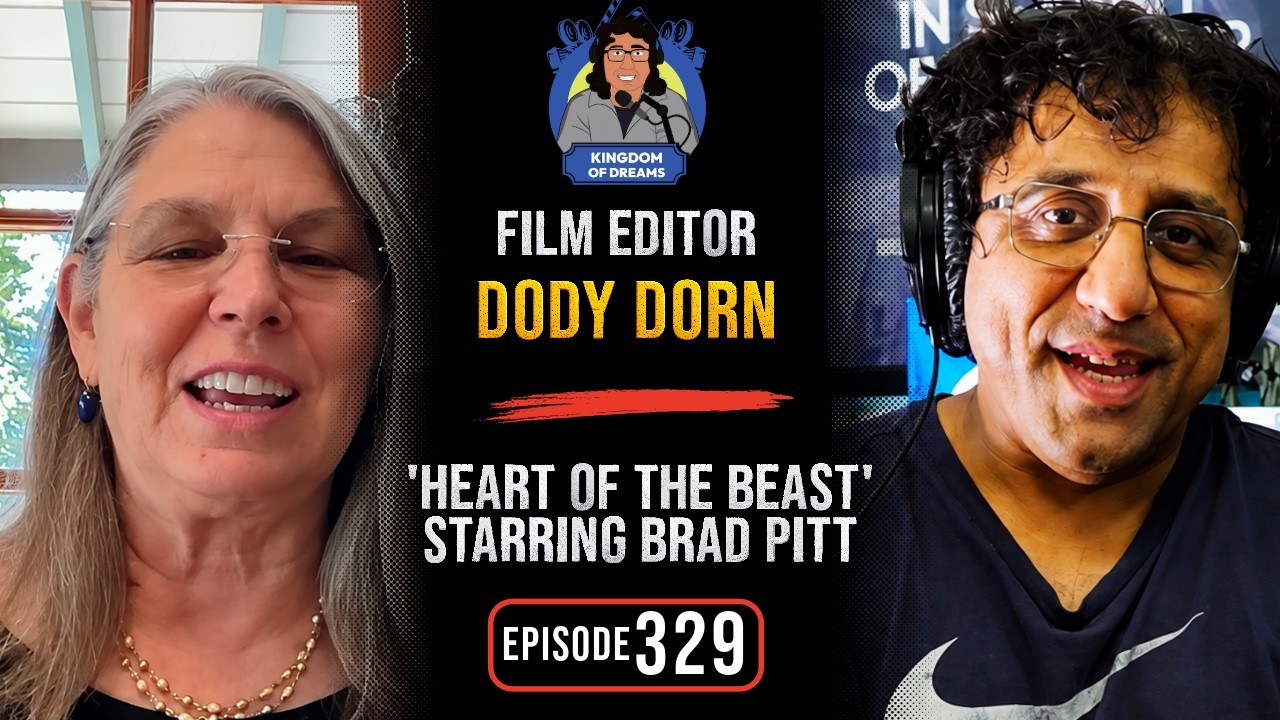
Episode 329 · October 2, 2026 · 27 min
Editor Dody Dorn, 'Heart of the Beast', Starring Brad Pitt
Clips and Shorts from this episode
About this episode
🎙️ On this episode of the Kingdom of Dreams Podcast, I sit down with acclaimed editor Dody Dorn to discuss her work on Heart of the Beast, starring Brad Pitt.
Dody takes us inside the editing room, from the importance of music in shaping the film to the emotional process of cutting a scene that deeply affected both her and the director.
We also talk about an unexpected puppy showing up at her door while she was editing the film, the creative decisions that shape a performance and story in post production, and so much more.
Dody Dorn is an acclaimed American film editor known for her work on major films including Memento, Insomnia, Kingdom of Heaven, Fury, Zack Snyder’s Justice League, and Rebel Moon. She earned an Academy Award nomination for editing Christopher Nolan’s Memento. Known for her strong sense of rhythm, character, and nonlinear storytelling, Dorn has collaborated with filmmakers including Nolan, Ridley Scott, David Ayer, and Zack Snyder.
#HeartOfTheBeast #BradPitt #Dogs #GermanShepherd #BehindTheScenes
Full transcript
Automatically generated from the episode audio, so expect the odd misheard word or name. Speakers were labelled automatically. About 4,400 words. Tap a timestamp to play from that moment.
0:00Dody DornWhen we were cutting the end where he and Odin are on the top of the i… hill, when he's sitting down, and then the scene with the aurora borealis, when we were cutting them, David and I both were sitting in the editing room crying, trying not to show each other that we were crying.
0:20Jawad MirDo you own a dog or a pet?
0:22Dody DornYes, I do. Very strangely, during the edit, a German shepherd puppy about eight or nine months old literally pushed up against our fence.
0:33Jawad MirAnd it's, the music is very subtle in the film until, at least…
0:37Dody DornWe were working with sketches by Jared from very early on. I'd say he scored the film three different times
0:45Jawad Mir... And even the conversation that, the two characters are having in the earlier part of the film, it just really sucks you in.
0:53Dody DornYes, I mean, the whole opening until the heart attack is really all about the relationship with the dog, and then the J.K. Simmons character brings in an opportunity to really drive home how happy James is to just be with the dog. So this is Oscar. He's a…
1:12Jawad MirHey, Oscar
1:13Dody Dorn... He's a border terrier, and he's a, he's very important, player in our lives.
1:28Jawad MirSo I went to see Heart of the Beast yesterday, and, I don't own an animal or a pet or anything, but I did used to have a German shepherd when I was a kid.
1:39Dody DornOh, wow.
1:39Jawad MirTotally loved it. Totally loved the film. It was a very needed film in today's time of films, the type of films that are coming out, and, you know, very kinda, like, laid back, simple, but difficult to execute, so it was a phenomenal film. I just spoke to, like, 10 people since yesterday recommending them because it's a really great film.
2:02Dody DornSo why do you say that it's needed now?
2:07Jawad MirI think we live in the time where the pacing of films with, sometimes depending on what the story is, there's a lot of characters, there are a lot of settings, there are a lot of, you know, fast cuts, like boom. Like, you know, story's always shifting very fast. It's very, because of the type of story it is, it's very kinda like, you know, in the, in the disconnected world, you know, in the woods in Alaska, and I feel that people need that because everything in life is so super fast, and I think by nature we're designed to be in that kind of zone most of the time, if not all the time. That's my perception.
2:47Dody DornWe're to be more slowed down, more in nature, yet we're in, living in an artificial world. Yeah, I could…
2:55Jawad MirYeah
2:55Dody Dorn... I can see that. Yeah, I can see that. Yes, everything, and this is, I had a friend who watched an early cut, and he said, "The film is and this happens." And I thought, "Yeah, that's right. It is, it is really, we are with James and Odin in a really deep way." And you feel, I, at least I do, I feel everything that happens to both of them.
3:29Jawad MirYeah, and what's so great about it, without me diving too much into the film, it's the amount of characters it has, which makes it very easy for the audience to connect to, but it's a very difficult thing from what you do as an editor to be able to contain that story, you know, within those two characters who are pretty much there for the 90% of the film. It's, it's them.
3:53Dody DornNine…
3:53Jawad MirAnd that's, as easy as it seem, it's not…
3:55Dody Dorn... Five. Yeah
3:56Jawad Mir... When you…
3:58Dody DornSorry, go ahead.
3:59Jawad Mir95, right? So… Yeah, so I'm just saying it's, it's, it's, it's easy for the audience to digest, but it's difficult to execute as an editor, which brings me to the first question. I mean, it is, like, as you said, this happens, and that happens, and it's not like, you know, kinda like Usual Suspects or Godfather type of film. It's a very simple premise. But that's what makes it more difficult. What were some of the challenges when you... You know, what was your first reaction, let's say, when you read the script, and, you know, what was going through your mind that how would you execute it once the production was done, or at least when it was done?
4:38Dody DornWell, I read the script, and as often happens when you're reading a script, not often, let me put it differently, it doesn't often happen where I completely lost myself in the script and I was unable to think of it as from a technical craft or creative point of view. I just got completely engrossed in the story, and I cried when I was reading the script, which doesn't happen that often. It's, it was so, beautifully rendered on the page that I just got very excited about it. And I didn't, I didn't think too much about how I would deal with the material because I've worked with David's material before. This is my fourth film with him, and I know what h… I know that he's gonna deliver and that there's going, there are going to be a lot of choices, and I also knew that Brad was going to deliver big time. This was a fantastic, opportunity for Brad to show his breadth.
5:43Dody DornIt's, it's so different than a lot of his other roles. So that in and of itself I just knew was very exciting. It was exciting to dig in.
5:56Jawad MirAmazing. And when you start getting the dailies, you know, whether it was all sort of at the end or whether it was coming in as production was going on… How did you... Like, what was your workflow like in terms of, like, as again, go… I can't re-stress the fact that it's such a simple story, but that makes it more hard to execute, at least from my point of view as an editor. What was the workflow like i… in dealing with the technicalities of the story and the editing and all that?
6:27Dody DornWell, really, as in all films, you have to get the film all together into one, into one thing that you then look at and say what is necessary and what is not, what is additive, what is not. And we had, always wanted the film to have kind of a brisk pace, so we were looking right away for scenes that we were gonna take out, and we did take out a few. And we were also looking at making sure that we felt James was a real character in that he really knew how to do all of the things that he did, which he did know, by the way, by the end of the film. And I'm sure you've seen some of his interviews where he said he read the script similar as I did, had this reaction, and didn't think about, "Oh, I'm going to do all of that."
7:27Dody DornAnd there were advisors and people there to make sure he knew, you know, how to do it all. But we were really intent upon showing that he could build a fire, that he could carry the dog. I mean, carrying that do… the dog, I mean, it's a heavy dog.
7:45Jawad MirYeah.
7:45Dody DornThat he could carry the backpack, that he could do, tie a, tie a l… a bandage around the dog's leg when his own arm was wounded. All of those things, were, you know, he had to, he had to do it.
8:04Jawad MirYeah.
8:04Dody DornAnd so that was a big focus to make sure that came across.
8:10Jawad MirAnd I think that came across very well, especially because of the backstory of the characters, right? Which comes throughout the film very... It doesn't really go into flashbacks in very depth. I'd say the longest flashback probably towards the end, maybe like a minute and a half long tops. And if that context wasn't there, the amount of stuff that they go through together, right? That becomes more believable, and the preparation that he had. Like, he had a tool and solution for almost anything and everything. Now, if that context wasn't there, who he was in the past, people are like, "Okay, how is that even possible? Like, who prepares like that," right? So that's... I really dug that a lot, and the context that it gave to the audience.
8:55Dody DornOh, that's great. Yeah, we call it process. We wanna make sure that people understand his process. And we would watch a scene, and it would... David and I have shorthand. It, "Need more process." But so... And because any of these kind of scenes, you can jump cut them. You could skip. You could just skip this from this to say, "Oh, okay." But there were times when we just wanted to show, oh, it's hard to make a tent. It's hard to even throw a tarp over some sticks that you put up when you're, you're injured. And so we were resisting the urge to do that kind of jump cutting to speed things along. We did it, of course, but there were other times where we really wanted to show it and feel it.
9:51Jawad MirYeah. And I really appreciate it. Until the film really kicks off, you know, which is in the trailer, the plane crashes and it's all about survival, everything leading up to that was just very calm in a sense that even the shorter editing, that, you know, you let the audience absorbs the scene, the shots in. Like, you know, when the plane is flying through the mountains, and even the conversation that, the two characters are having in the earlier part of the film. It just really sucks you in, and I think the pacing of that, I'm sure it was intentional to keep that intensity rather calm. Was that... Is there something that you can sort of talk about in that, towards that?
10:37Dody DornYes. I mean, the whole opening until the heart attack is really all about the relationship with the dog and s… and seeing that they're buddies. They're not,.. They really have a deep, meaningful relationship. So, that was what it was all about, and then the J.K. Simmons character brings in an opportunity to really drive home how happy James is to just be with the dog. He really... It's not like, "Oh, great. A stranger that I can talk to all night." It's sort of there's a reluctance to him even allowing him into the, their sphere. And there were some bits and parts of that scene that were more jovial and where it got more, kind of friendly, and we leaned away from that. It, the friendliest is him hand me, handing him a beer. And, then the stories went on, and there was more where James was more, kind of relaxed and talkative.
11:46Dody DornBut we leaned more into him becoming introspective based on the kind of stories that J.K. Simmons was telling about his own experience in mining. And so we lean… leaned more on that to keep James in a place where he's, wants to be alone and is somewhat guarded and his relationship is with the dog.
12:12Jawad MirAnd speaking of J.K. Simmons, I… it took me a while to figure out it was him until he actually sat down and that distinctive voice of his kinda kicked in. That's when I realized it was J.K. Simmons then, because he was so... It w… he was not himself, like normally as you would, right? Like, he had a beard…
12:29Jawad Mir... The outfit that he had. And, I wanna sort of jump off the film for a second. Do you own a dog or a pet?
12:37Dody DornYes, I do. I do.
12:39Jawad MirOkay.
12:39Dody DornAnd very strangely, during the edit, a German Shepherd showed up, right outside our fence, and it was a German Shepherd puppy about eight or nine months old, literally pushed up against our fence. And we took her in, and we kept her for about, eight months or so. And then now she's rehomed with a pack of other German Shepherds. But that really kind of freaked me out…
13:09Jawad MirWow
13:10Dody Dorn... That this German Shepherd just showed up, and she was so beautiful, but a little bit more than we could handle. I do... Where's my dog, Oscar? Do you mind if I go get him?
13:23Jawad MirYeah, go. Please go for it. That'd be awesome.
13:26Dody DornSee, that's a perfect example. You can do a jump cut from me saying, "Do you mind?"
13:31Jawad MirI was thinking the same thing. I was thinking the same thing.
13:35Dody DornYeah, if I go get my dog…
13:36Jawad MirHey, Oscar
13:36Dody Dorn... And then…
13:40Jawad MirThat's awesome
13:41Dody Dorn... You can jump to Oscar being sitting here in my lap. So this is Oscar. He's a…
13:47Jawad MirHey, Oscar
13:47Dody Dorn... He's a Border Terrier, and he's a, he's very important, player in our lives. So…
13:55Jawad MirThat's awesome. He's a…
13:56Dody DornCome on
13:56Jawad Mir... Looks like a lovely dog.
13:58Dody DornHe is.
13:58Jawad MirHey, buddy. I think he's, he's occupied with something. But thank you for bringing him on.
14:02Dody DornYeah, that's okay.
14:03Jawad MirThat's awesome. But…
14:04Dody DornYeah
14:04Jawad Mir... You mentioned a German Shepherd showing up. How much a… were you into the editing process that time? Do you remember?
14:13Dody DornYeah. I mean, we were in the middle of the director's cut, just a few weeks into the director's cut. So I was, I was kind of freaky… freaked out by that. Yeah. No, maybe…
14:25Jawad MirDo you think that had an impact... Sorry, go on, please.
14:29Dody DornNo, I'm just thinking, yeah, it was in September, so yeah, that was probably closer to the end of the director's cut.
14:36Jawad MirGot it. Do you think that had any impact on the rest of the director's cut and the further cuts that you made…
14:44Dody DornNo
14:44Jawad Mir... Having that dog?
14:45Dody DornNo. It just made me think… It felt very, it felt... I, and actually, I thought we would keep the dog forever because it was so interesting to have it happen like that. And we did all the things you have to do, checked if there was tags or a chip or any of that, and there wasn't. But Oscar, as you saw, is a little, like a smaller dog and he's more manageable for us. Cleo is, Cleo was the German Shepherd, and she's now with, like I said, a pack of four German Shepherds, so and very happy.
15:22Jawad MirThat's, that's, that's so awesome. That is such a cool thing to hear. One other aspect, I mean, there's so many things I can talk about, but music, I think, played a huge role in this film, by Jared Michael, and I actually downloaded the soundtrack as soon as I got home, and I've been listening…
15:39Dody DornFantastic
15:39Jawad Mir... To it since yesterday. So I'm a, I'm a huge score lover, like I always… ... Have been, so I really, it... And I've never heard of Jared's work before. And I thought it was really to the core of the film, like, you know, it had traditional elements. It didn't go overboard. It didn't go under anything. It was just perfect. Working as an edit… working as an editor with music, what is that like, whether it's on this project or another project? How did you bring that in? Because music... And I just wanna say one more thing. So the movie's an hour and 40 minutes long. I was just looking at the soundtrack, which I know is not in the film like that. It's an hour and 32 minutes long. So obviously…
16:21Jawad Mir... They released some of the stuff that wasn't in the film. And it's… ... The music is very subtle in the film until, at least after the heart attack. I don't remember hearing much music. So talk to me about the process of that.
16:34Dody DornWell, we were working with sketches by Jared from very early on, and…
16:41Jawad MirYeah
16:41Dody Dorn... There were some different directions that we went. We went for a while sort of more emotional, like, family emotional style. Then we went... I'm saying he did. I'd say he scored the film three ti… three different times, is the way I would describe it.
17:01Jawad MirWow.
17:01Dody DornAnd that is just a testament to what a great team player he is. And so there were times when we would also kind of go in more in an adventure movie style. And then we, what we really did finally is dial back into sort of a more psychological drama in terms of James and his life and his relationship with the dog, and then also honoring the indigenous, vocals and sounds of the Alaska and, you know, indigenous peoples. So that we, he had used samples for voices, but in… eventually he got actual Ind… an indigenous group to do the singing, and it really, it just blossomed. It was really beautiful. And we definitely, in the final mix, toned down certain areas to let the sound effects and the atmospheres and nature take over and, not be bombastic or leading, rather letting the audience feel everything themselves.
18:07Dody DornAnd that's just a process. I mean, at some point, I watched the whole film after the director's cut without any music And I'm like, "David, you should watch the film with no music. It's very, it's very interesting." And he did, and he loved it. And then we showed it to one of our execs, like the first reel and a half, and the, this exec loved it. And David said, "Did you notice there was no music?" And he said, "No, I didn't notice." So I mean, you can you can go all the way to no music, a lot of music, or just right. It's Goldilocks.
18:50Jawad MirYeah. I learned this, 10 years ago, that if you wanna know your film works as a story, as a, you know, piece of art, not even just the music, turn the audio track off and play it. And if it tells you... You know, if the beats are there, you... If it's convincing the audience, that means you've done the job more or less right with editing. So it's a similar thing with what you were just saying in terms of music. That's awesome.
19:15Dody DornRight.
19:15Jawad MirThat's really cool. And
19:17Dody DornIt was really fun, and it doesn't... It's not any, casting any aspersion on Jared's work, because it's so beautiful.
19:24Jawad MirYeah.
19:24Dody DornBut I agree that it tells you... It's, it... At some point in every film, the director and the editor look at each other and say, "We have a movie."
19:40Jawad MirYes.
19:40Dody DornAnd we knew this very early on. It is... It's been... So everything that we were doing was fine-tuning. It was all fine-tuning, because we had a movie. We had a movie that was just really solid, very emotional, and just literally brought people to tears. So we n… when you can do that, then everything else just becomes a refinement.
20:08Jawad MirYeah. No, I agree. And you talked about sound, right? Which I think is such an integral part of any film. And again, the overpowering music is great in certain situations, but I always find, especially in a film like this, if you don't have the ambient sounds, you know, even playing under the top of the music just a little bit, it really disconnects the audience if the sound is not there. But if it's there, it really pulls them in. I'm a huge fan of sound. Like, if I am doing anything, you know, whether it's a feature film, I need to have damn sound in there even if the music's playing, because it really pulls people into the environment.
20:45Dody DornI think these are just choices that have to be made. And yes, environment in this particular case is really important.
20:52Jawad MirYeah.
20:52Dody DornBut also dynamics. Having things, places where music is big, and places where ambience is big, and places where everything is very quiet. And I think that this is the same with storytelling. You need to have, you need to have dynamics. You can't, not to quote over and over again Spinal Tap, but you can't have everything at 11. It's
21:17Jawad MirYeah
21:17Dody Dorn... It's necessary to have these quiet beats. And also like you were saying about the opening, it's necessary to have this peaceful opening before the heart attack. And I think that makes it a little bit more shocking, because it's, it's not a horror film where you need to be worried at every moment that the monster's gonna jump out of the closet. It is still a psychological drama and a love story. I mean, those are the two aspects that all come together. It's a love s… it is love story.
21:52Jawad MirIt is a love story. Now that you mention it is. It is a love story. You talked, w… let's say, while as we're sort of unwinding down in time, I just wanna ask you a couple of questions. So, and I know it's not as simple as I'm putting it, but you know, any time you work on a project, anybody in any department, you know, there's parts that are challenging, there are parts that are fun to do, or there could be a combination of both, and there are parts that really hit you home emotionally, right? Were there anything, any of those three or all of those three p… present together or separately in a scene that you worked on?
22:29Dody DornOh, wow. Say them again.
22:32Jawad MirSo…
22:33Dody DornIt's hard
22:33Jawad Mir... Something that, something that was challenging… ... Something that was fun to do, and something that emotionally, had an emotional, impact on you.
22:43Dody DornOkay.
22:45Jawad MirLet's, let's answer them one by one.
22:47Dody DornIt's like a per… it's a personality test.
22:50Jawad MirYes, it is. That's what I do.
22:51Dody DornYeah. Yes, it was ch… it was challenging, it was fun, and it was emotional. But the, I wanna go to the emotional first, because…
22:58Jawad MirSure
22:59Dody Dorn... When we were cutting the end where he and Odin are on the top of the, hill, when he's sitting down and they're trying, he's saying, "Find the road," and then, and then the scene with the, with the aurora borealis, tho… those two, when we were cutting them, David and I both were sitting in the editing room crying and trying not to show each other that we were crying. Because we had…
23:33Jawad MirOh, that's awesome
23:34Dody Dorn... To do. So, and the way I have my room set up, I have my table and some monitors behind a sofa so that the director's sitting in front of me. And, I've been doing this for the last, I don't know, six or seven years. And in some ways, some editors do the same, and they say, others say they don't wanna do that 'cause they feel separated from the director. But what I like about it is that when I'm ready to watch something, I come back around from my desk and I sit on the sofa with the director, and I don't have any distracting keyboards or something…
24:11Dody Dorn... That tries to make me, you know, press the stop button. "Oh, I wanted to fix that." So at this moment though, I was still working, so, but, I would stop and play little sections, and we were just pouring tears. It was a little, not really embarrassing, but just sort of a fun... I've never had that quite happen. So, yes, and in terms of fun, there was, there were a lot of fun little montages of the dog playing with James and looking for all the places where the dog's personality comes out the most. Challenging, I would say, we did struggle about whether or not to have the little, flash forward at the beginning and if so, how much. So that was something that we decided in post and we just kept going back and forth on that.
25:18Dody DornThe letter at the end was also really fun to edit. That was just... And mo… 90% of it is Brad's original performance from production for the letter which I think is, you know, really fantastic 'cause it has a very immediate quality to it.
25:45Jawad MirYeah, no, that's, that's awesome. You talk about flash forward, so I'll tell you I loved that so much.
25:52Dody DornOh.
25:52Jawad MirThere are four shots, I even counted, right? The big wide shot. Then from behind the truck, then I think it was her coming out, and then the dog, and that was it.
26:01Dody DornYeah.
26:01Jawad MirLike, it was literally, like, less than a minute.
26:03Dody DornRight.
26:03Jawad MirAnd I think that... And I remember when I was sitting there, so there were little kids watching the movie too, and you could j… I could tell that the audience had forgotten the beginning part.
26:15Dody DornOh.
26:15Jawad MirLike, you know, when you're so enrolled into the film, you don't remember the beginning, like, if there's a flash forward. Sometimes you do, but I think people were so hooked onto the characters, and I heard a kid crying behind at the end of the movie.
26:27Dody DornOh.
26:28Jawad MirBut no, it was, it was... And, the northern lights, I wonder if that was planned or if that just happened because obviously, you know, like, were they waiting for the northern lights to show up? Because I thought that was a really cool moment.
26:40Dody DornThat was all planned.
26:42Jawad MirYeah.
26:42Dody DornYou have to, you have to... It's, some of it's from the writing and some of it's from David. It was definitely planned.
26:51Jawad MirYeah.
26:52Dody DornYes. So…
26:52Jawad MirI loved it. No, that's awesome. I really appreciate the film. I really do. I've been looking forward to watching it. And also, you know, you know, be able to, you know, just ad… admire your work in it. As always, huge fan of your work.
27:08Dody DornThank you.
27:09Jawad MirAnd, yeah, that's it. And, appreciate your time.
27:13Dody DornOkay, great. Thank you. I'm happy to be here.